Abhijit Muhurat: The Noon Window That Borrows Its Name from a Star the Calendar Dropped
Abhijit Muhurat is the eighth fifteenth of daylight, centred on true local noon; two published examples re-checked, three policies on the Wednesday rule, and the nakshatra that left the calendar but left its name on midday.
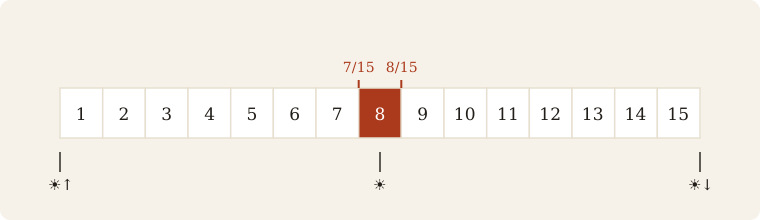
Open any panchang, paper or digital, and somewhere in the day's list of timings you will find a short window around noon marked Abhijit. It is printed for every city, every day, and it is described in the warmest words the tradition owns: victorious, unconquered, self-certified, the destroyer of blemishes. Here is the strange part. The window is named after a nakshatra, and that nakshatra is not in the calendar anymore. The standard panchang counts twenty-seven nakshatras, and Abhijit is not one of them. The star was dropped from the scheme centuries ago; the name stayed behind and still rules every noon. This piece follows both threads: how the midday window is computed and used, with two published examples re-checked by us, and what happened to the twenty-eighth nakshatra whose name it carries.
Everything below comes from five sources fetched on 31 October 2026, and they are named at every step. Where a classical book is mentioned through one of them, that is an indirect citation and is marked as such. Where we re-did someone's arithmetic, that is flagged as our own check, not the source's claim.
Fifteen slices of daylight
Muhurta is first of all a unit of time. A full day and night of twenty-four hours holds thirty muhurtas of forty-eight minutes each, and the daylight half, sunrise to sunset, holds fifteen. Bela's explainer lays out this scaffold, and panchangtime's methodology page gives the construction rule for Abhijit within it: divide the daylight into fifteen equal parts, find the midpoint between sunrise and sunset, which is local solar noon, the moment the Sun crosses the meridian of your place, and centre the eighth of the fifteen parts on it. Abhijit therefore runs from seven-fifteenths of the daylight after sunrise to eight-fifteenths. Jyotish Zone states the same rule in the same fractions, so the construction itself is not in dispute across the sources we read.
Two consequences follow, and both matter in practice. First, the window is anchored to true local noon, not to twelve o'clock on the clock. Clock noon is a convention of your time zone's reference meridian; solar noon is where the Sun actually stands over your longitude. In cities sitting west of their meridian, Abhijit falls visibly after twelve. Second, the window breathes with the seasons. Each muhurta is one-fifteenth of the daylight, so long summer days stretch it past forty-eight minutes and short winter days compress it below. On a day of exactly twelve hours, jyotishzone's example, Abhijit runs 11:36 to 12:24, twenty-four minutes on either side of noon.
Two published examples, re-checked
Panchangtime publishes a worked example: Chennai, Monday 12 October 2026, sunrise 5:58 am, sunset 5:52 pm. They state the daylight as 11 hours 53 minutes, giving a muhurta of about forty-seven and a half minutes, a solar noon of 11:55 am, and an Abhijit window of 11:32 am to 12:19 pm. We re-did the subtraction: 5:58 am to 5:52 pm is 11 hours 54 minutes, not 53. The page's own window is consistent with its stated noon, half a muhurta on either side, so the slip is in the daylight total by one minute, a rounding slip that changes nothing practical but is worth noting as a reminder that even careful methodology pages are written by humans. This re-check is our computation, not the source's.
Bela publishes another: Delhi, 15 August 2026, sunrise 5:51 am, sunset 6:59 pm. That is 13 hours 8 minutes of daylight, so each muhurta runs about 52.5 minutes. The midpoint of the day falls at 12:25 pm, and half a muhurta, about 26 minutes, on either side gives 11:59 am to 12:51 pm. Bela prints 11:59 am to 12:52 pm, about 53 minutes, which matches within a minute of rounding. The same page notes that in December the Delhi window shortens toward 47 minutes and slides earlier, which is exactly what the fifteenth-of-daylight rule predicts. Again, the arithmetic here is ours, and it agrees with the source.
The lesson inside these examples is more useful than the numbers. Two windows printed for the same label can differ by half an hour across cities, and the same city's window drifts through the year, because the unit is a fraction of daylight rather than a clock time. Jyotish Zone remarks that Delhi and Mumbai differ by around half an hour for exactly this reason. Any table that prints one national Abhijit time is an approximation for one chosen location.
Svayam-siddha: the window that certifies itself
The tradition's word for Abhijit is svayam-siddha, self-certified. Jyotish Zone explains the term plainly: the window is held auspicious for ordinary work without any further vetting against the day's tithi, nakshatra or yoga. Bela reports the strongest classical statement of this, from Muhurta Chintamani, the standard muhurta digest by Daivajna Ramacharya, which praises the midday muhurta as capable of destroying doshas by the thousand and needing no further examination. That attribution comes through Bela's page; we did not fetch Muhurta Chintamani itself, so treat it as an indirect citation. Panchangtime, which names Muhurta Chintamani and Kamalakara Bhatta's Nirnaya Sindhu as the texts behind its own rules, gives the milder modern phrasing: the window dissolves many of the day's blemishes and is a generally safe time to begin tasks when a fuller election is not possible.
What does self-certification actually buy you? The sources converge on a list: urgent beginnings that cannot wait for a clean date, quick decisions, signings and short ceremonies, first payments, opening a shop, starting a journey, filing papers. Bela adds two specific roles: the festival puja window, since the Abhijit span is the safe midday anchor for worship on festival days, and the booster role, where an elected muhurta that overlaps Abhijit is preferred and labelled the day's best. Panchangtime describes the same booster logic in its daily verdict feature. None of the three treats the window as a toy; the claim is simply that the day's own strength stands at its peak when the Sun stands at its peak.
What the window does not do
Every source we read draws the same boundary, and it is worth drawing firmly. Abhijit is a general-purpose window, not a master key. For marriage, griha pravesh and the other major samskaras, all three agree that a full election is still required, one that weighs tithi, nakshatra, lagna and the personal factor. Jyotish Zone puts it memorably: use Abhijit for the errands around the event, not the event itself.
Bela names two more limits with precision. First, the prohibited periods stand above any hour of day: the classics do not schedule marriages inside Chaturmas or Kharmas at noon and call it settled. Second, Abhijit does not personalise. Tara Bala, the day's count from your own birth star, is a separate layer that no clock window can fix. A midday that is fine for the city may still be a poor day for you in the personal reckoning, and the window does not overrule that.
Then there is the direction caveat. Both panchangtime and jyotishzone record the classical exception that Abhijit, though favourable for setting out in all other directions, is traditionally not chosen for journeys to the south. Neither source we read explains the reasoning behind the south exclusion, so we record it as the tradition states it, without inventing a justification.
The Wednesday problem
Here the sources openly split, and the split is instructive. A rule in the later digests excepts Wednesdays: on Budhavara, the midday Abhijit is held to lose its force. Jyotish Zone reports that the texts state the exclusion without elaborating much, which is a candid admission that the rule's reasoning is not on record in the material they consulted. The three sites then adopt three different policies, and comparing them is a small education in how living tradition gets printed.
Panchangtime hides the window on Wednesdays entirely, on the ground that the slot is that day's Dur Muhurtam, a separate daily marker. Jyotish Zone computes and displays the Wednesday window but strikes it through and flags it as not observed, so that a family whose tradition does use Wednesday's Abhijit still has correct times, and nobody picks it by mistake. Bela shows the window on every day and marks the day's own quality separately, keeping both readings possible, and adds that cautious practitioners also skip days with Vyatipata or Vaidhriti yoga. Three responsible publications, three policies, one unclear rule. We record the disagreement without resolving it; if this matters to you, the honest answer is to ask which convention your family or panchang follows.
The star the name kept
Now the second thread, the one that makes this window unlike any other in the panchang. Abhijit was a nakshatra before it was a muhurta. The older catalogues counted twenty-eight nakshatras, and kaalpanchang's explainer describes how the twenty-eighth was fitted in: a small, uneven segment carved from its neighbours, sitting between Uttara Ashadha and Shravana. Wikipedia's article on the nakshatra gives the precise span used in that scheme, from 6 degrees 40 minutes to 10 degrees 53 minutes 20 seconds of sidereal Capricorn, covering the last quarter of Uttara Ashadha through the first quarter of Shravana, which is why Abhijit is called an intercalary nakshatra rather than a regular one with four padas of its own. And it identifies the star itself: Abhijit is the Sanskrit name of Vega, Alpha Lyrae, the brightest star in the northern constellation of Lyra.
The name means the victorious one, and the tradition honoured it accordingly. Wikipedia records, citing the Bhagavata Purana, Canto 11, Chapter 16, verse 27, that Krishna, speaking to Uddhava, says that among the nakshatras he is Abhijit. That is an indirect citation through Wikipedia; we did not fetch the Purana text. The same article passes on the well-known telling in which the Moon god Chandra has twenty-seven wives, the twenty-seven nakshatra goddesses, one for each day of the sidereal lunar month, with Abhijit counted as their brother, the one masculine nakshatra. We report that as Wikipedia's narration of the myth, not as a text we verified.
Why does the calendar count twenty-seven now? Kaalpanchang's answer is arithmetic and observation together. Twenty-seven equal arcs of 13 degrees 20 minutes tile the zodiac exactly, four padas apiece, 108 padas in all, nine to a sign, and the Moon, circling the zodiac in about 27.3 days, spends roughly a day in each. Equal division makes the daily nakshatra, the padas and the Vimshottari dasha all computable with clean fractions, so the equal scheme standardised on 27. The twenty-eighth was not denounced or disproved; it was folded into its neighbours when the scheme settled. And kaalpanchang is careful about the surviving roles: the 28-fold count still appears in some ritual calendars, certain muhurta rules, older astronomical texts, and traditions outside India that count 28 lunar stations. Both counts are genuinely part of the tradition, two conventions with different roles, and neither is wrong.
The name, meanwhile, never left. Kaalpanchang notes that Abhijit the nakshatra and Abhijit Muhurta are related but distinct: the muhurta is a daily noon window that takes its name from the auspicious nakshatra. The star lost its seat in the calendar; its name kept the brightest hour of the day. Bela tells the same story in one line: the victorious star lent its name to the victorious hour.
Using the window well
Practical guidance from the sources, in one place. Read the window for your own city and date, because it is built from your sunrise and sunset; a table printed for another place, or for a whole country, is an approximation. Use it for the everyday beginnings it is certified for, and treat it as the classical rescue when a work cannot wait for the next clean date. Let it strengthen a proper muhurta that overlaps it. Do not ask it to carry a marriage or a major samskara by itself, do not expect it to override Chaturmas or Kharmas, and remember the two classical footnotes: no setting out due south, and, in several traditions, no Wednesday. On those two, the sources we consulted do not give reasons, and we have not supplied any.
There is something quietly fitting about the whole arrangement. The panchang's most trusted window is not a rare alignment you must hunt for; it arrives every single day, anchored to nothing more exotic than the Sun standing over your own meridian. The tradition took the name of its most honoured star, the one it had set aside from the count, and pinned it to the one moment nobody can miss. You do not need to find Abhijit. It finds you, at noon, every day.
Questions on this article
Is Abhijit Muhurat at the same time every day?
No. It is centred on the midpoint of your sunrise and sunset, extending one-thirtieth of the daylight on either side. So the clock time shifts with city and season: longer and later in summer, shorter and earlier in winter. Read it for your city, for that day.
Can a wedding be held in Abhijit Muhurat?
Not on its strength alone. All three sources we read say marriage and other major samskaras require a full election, weighing tithi, nakshatra, lagna and your personal Tara Bala, and prohibited periods like Chaturmas stand above any hour of day. Abhijit is the rescue for works that cannot wait for a clean date, and the puja window on festival days.
Why do some panchangs not show Abhijit on Wednesdays?
A rule in the later digests excepts Wednesdays, and the texts state it without elaborating the reason. Traditions apply it with different strictness: one site hides the window on Wednesday, another shows it struck through, a third shows it and marks the day’s quality separately. We recorded the disagreement unresolved; asking which convention your family or panchang follows is the right path.
Is Abhijit a nakshatra or a muhurat?
Both, but different things. Abhijit was the intercalary nakshatra of the older count of 28, the star Vega, a small segment between Uttara Ashadha and Shravana; when the equal-division scheme settled on 27 it was folded into its neighbours. Abhijit Muhurat is the daily noon window, which borrows its name from that auspicious nakshatra. The star left the count; the name stayed at noon.


