Astrology articles and guides
Understand Saturn, Mars, nakshatras, panchang and the 2027 transits in plain words. Every article states how it was calculated.
Guides worth reading

What is Mangal Dosh? Clear things to know before marriage
Mangal Dosh is not the same in every chart. Understand the houses, Mars’s sign and the traditional exceptions.
1 min readRead article
What is a nakshatra? A simple guide to the 27 birth stars and padas
Understand the 27 lunar mansions and their four padas without complicated astrology words.
2 min readRead article
Solar eclipses in 2027: dates, where they are visible and what India will see
There are two solar eclipses in 2027, but neither is visible from India. Know the dates, visibility and safe viewing method.
1 min readRead article
Lunar eclipses in 2027: three dates and what India will actually see
2027 has three lunar eclipses, all penumbral and subtle. Here is what India will see, in plain words.
1 min readRead article
How to read a panchang: tithi, nakshatra, yoga and karana explained simply
A panchang has five parts. Learn how to read tithi and nakshatra, and what Rahu Kaal actually means.
2 min readRead article
Hindu festivals 2027: dates for Diwali, Holi, Navratri and the major fasts
2027 dates for Diwali, Holi, Raksha Bandhan, Janmashtami, Ganesh Chaturthi, Karwa Chauth and other major festivals, month by month.
1 min readRead article
Ekadashi 2027: dates and names of all 24 Ekadashi fasts
Every Ekadashi from January to December with date, weekday and paksha, plus the general parana rule and an explanation of two-day Ekadashis.
3 min readRead article
27 nakshatra names list: ruler, deity and symbol of each
From Ashwini to Revati, all 27 nakshatras in one table, each with a full guide.
2 min readRead article
Zodiac signs dates: the full list of 12 signs with dates, rulers and elements
From Aries to Pisces, each sign’s dates and its full page - in one table.
1 min readRead article
Vastu for home: directions, rooms and easy corrections
Direction, room and correction - vastu in plain words, without fear.
2 min readRead article
The Sun in Vedic astrology: karaka of soul, father and confidence
The Sun is the karaka of soul, father, authority and self-confidence. Learn the traditional signs of a strong or weak Sun in a kundli and the simple remedies.
10 min readRead article
The Moon in Vedic astrology: karaka of mind, mother and emotions
The Moon signifies the mind, the mother and emotions. Learn the traditional signs of a strong or weak Moon, why the Moon sign matters, and simple remedies.
10 min readRead article
Mars in Vedic astrology: karaka of courage, energy and land
Mars signifies courage, energy, siblings and land. Learn the signs of a strong or weak Mars, its dasha, and the truth behind the myths of mangal dosh.
10 min readRead article
Mercury in Vedic astrology: karaka of intellect, speech and trade
Mercury signifies intellect, speech, education and trade. Learn the signs of a strong or weak Mercury, the budhaditya yoga, and simple remedies.
9 min readRead article
Jupiter in Vedic astrology: karaka of wisdom, fortune and expansion
Jupiter signifies wisdom, children, fortune and growth. Learn the traditional signs of a strong or weak Jupiter, the Jupiter mahadasha, and simple remedies.
10 min readRead article
Venus in Vedic astrology: karaka of love, art and comfort
Venus signifies love, marriage, art and comfort. Learn the traditional signs of a strong or weak Venus, the Venus mahadasha, and simple remedies.
9 min readRead article
Saturn in Vedic astrology: karma and sade sati
Saturn signifies work, discipline and delay. Learn the real arithmetic of sade sati, the traditional signs of a strong or weak Saturn, the Saturn mahadasha, and simple remedies.
10 min readRead article
Rahu in Vedic astrology: ambition and illusion
Rahu is the shadow planet of ambition, foreign lands and the unconventional. Learn its real astronomy, the Rahu mahadasha, the truth about Kaal Sarp yoga, and simple remedies.
9 min readRead article
Ketu in Vedic astrology: moksha and detachment
Ketu is the shadow planet of moksha, detachment and intuition. Learn what Ketu is said to take and to give, the Ketu mahadasha, and simple remedies.
9 min readRead article
Lagna in Vedic astrology: the first house
The lagna is the sign rising on the eastern horizon at birth and the first house of the chart. Learn how it is fixed and how the tradition reads it.
12 min readRead article
The second house: wealth, family, speech
The second house is not just money: it holds wealth, family, speech and food. Learn how the tradition reads it.
10 min readRead article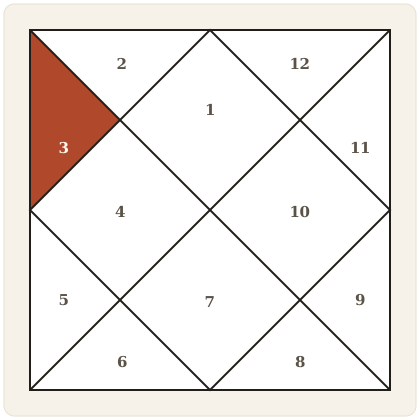
The third house: siblings, courage, skill
A guide to the third house as a traditional symbol of initiative, younger siblings, communication and practice.
10 min readRead article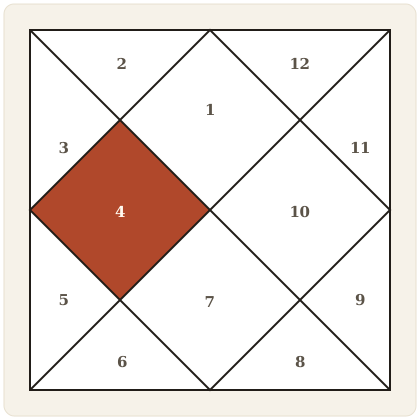
The fourth house: mother, home, happiness
A guide to the fourth house as the traditional symbol of mother, home, property and inner footing.
10 min readRead article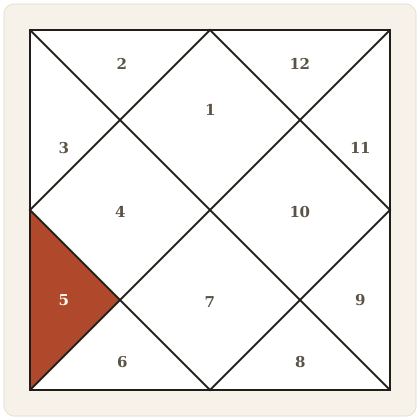
The fifth house: children, intelligence, creativity
A guide to the fifth house as the traditional symbol of children, intelligence, creativity and past merit.
10 min readRead article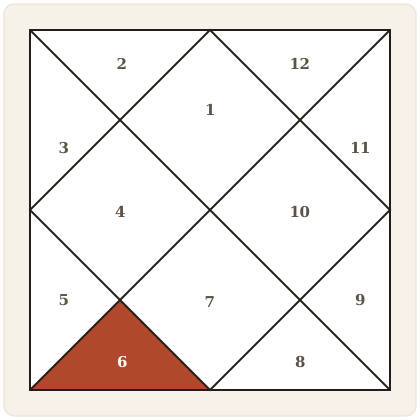
The sixth house: health, debt, conflict
A guide to the sixth house as the traditional symbol of daily obstacles, service and the capacity to cope.
10 min readRead article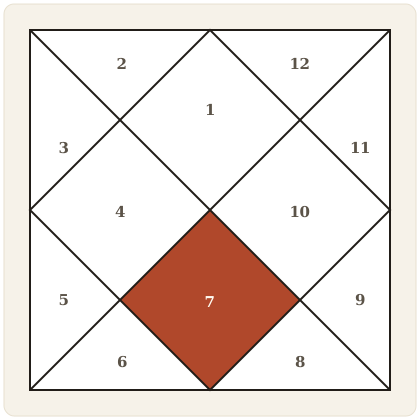
The seventh house: marriage, partnership
A guide to the seventh house as the traditional symbol of marriage, partnership and every one-on-one bond.
10 min readRead article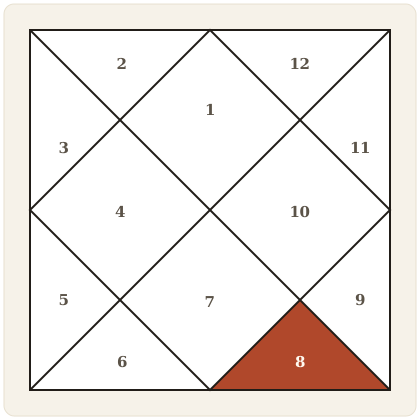
The eighth house: transformation, depth
The eighth house without fear: deep change, legacy and hidden knowledge.
10 min readRead article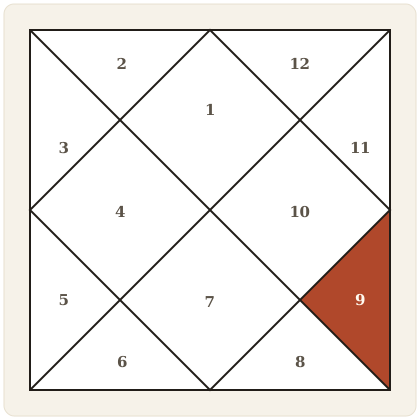
The ninth house: dharma, guru, fortune
A guide to the ninth house as the traditional symbol of direction, guidance and right action.
10 min readRead article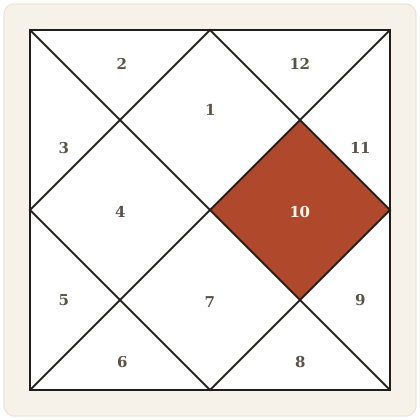
The tenth house: action, career, status
A guide to the tenth house as the traditional symbol of action, field of work and public standing.
9 min readRead article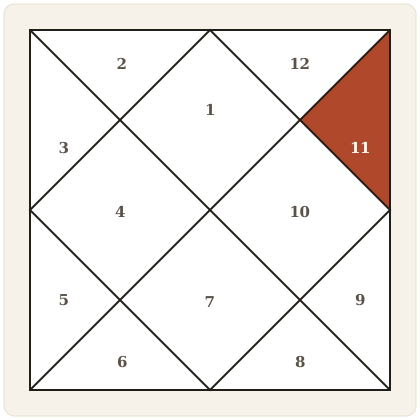
The eleventh house: gains, income, fulfillment
A guide to the eleventh house as the traditional symbol of income, fruit and the social network.
9 min readRead article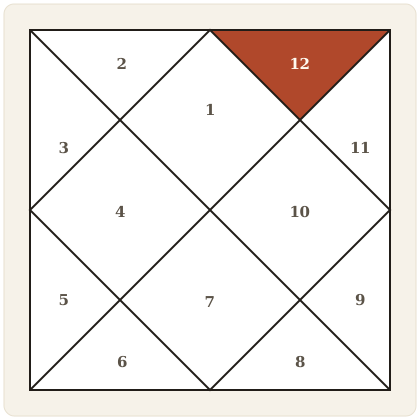
The twelfth house: expenditure, foreign lands, liberation
A guide to the twelfth house as the traditional symbol of spending, dissolution and liberation.
10 min readRead article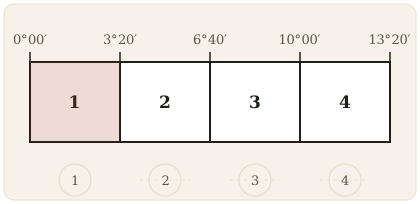
Nakshatra padas explained: the arithmetic of the 108 quarters
The full arithmetic of the pada system: the quarter of a nakshatra, its link to the navamsa, and how to read the pada in your own chart.
10 min readRead article
Nakshatra lords and the Vimshottari dasha: the 120-year clock
Which nakshatra belongs to which lord, how the dasha balance is derived, and what the traditional method of dasha reading is.
10 min readRead article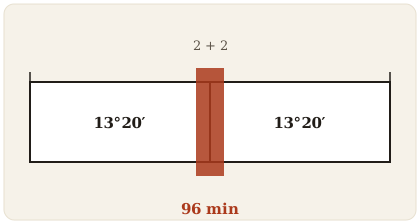
Gandmool nakshatra: the facts about the six nakshatras
Six nakshatras, three junctions, the textual list versus the panchang list, and how to understand gandmool through arithmetic instead of fear.
10 min readRead article
Gandanta explained: the full arithmetic of the three junctions
Where a gandanta begins and ends, how its length is counted, and how to check any moment for it yourself.
10 min readRead article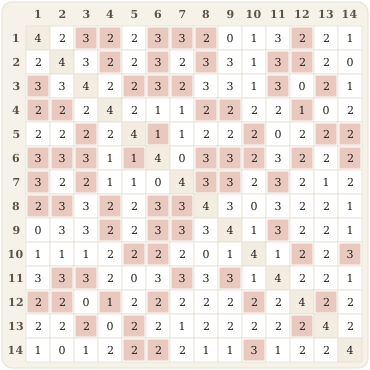
Nakshatra yoni compatibility: the full arithmetic of the 14 yonis and the scoring table
Which nakshatra has which yoni, how the points are distributed, and why a yoni score must be read together with its table.
10 min readRead article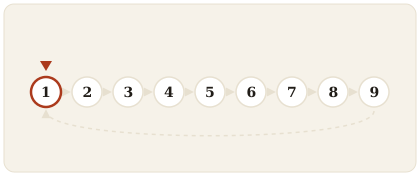
Tara bala and the navtara chakra: the full arithmetic of the nine taras
How a tara is counted, what the three-rounds rule is, and how to work out the tara of any moment yourself.
10 min readRead article
Baby Names by Nakshatra: The Avakahada Chakra and the Complete 108-Syllable Table
The first syllable of a name from the birth nakshatra's pada: the tradition, the arithmetic, the full table, the causes of variants, and a balanced view.
10 min readRead article
Nakshatra Trees and Symbols: 27 Marks, 27 Trees, the Full Table
From the horse's head to the fish, from kuchla to mahua: the nakshatras' symbols and trees, two traditions together.
10 min readRead article
Kaal Sarp Dosh: Definition, 12 Types, and the Balanced Truth
All seven planets on one side: the complete story of a modern concept, without fear.
11 min readRead article
Pitra Dosh: Chart Indicators, the Pitru Paksha Method, and the Balanced Truth
Not a curse but a karmic-debt concept: indicators, cancellations, and the simple system of remembrance.
10 min readRead article
Guru Chandal Yoga: The Dramatic Name, Both Sides, and the Deciding Factors
The Jupiter-Rahu conjunction: a yoga that gives as much unusual thinking as unease; both sides, without fear.
10 min readRead article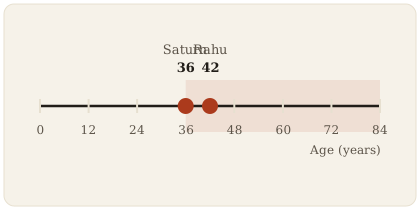
Shrapit Dosh: The Name That Says "Cursed", the Saturn-Rahu Conjunction, and the Maturity Clock
The heaviest-named dosha: the complete story of a modern label, in which the "curse" turns out to be a hard but learnable lesson.
9 min readRead article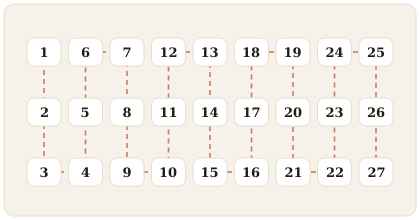
Nadi Dosh: How 8 Points Go to Zero, and Which Rules Give Them Back
The heaviest koota in kundli matching: a good total of 28 with "Nadi 0/8" underneath — when this zero matters and when it does not.
9 min readRead article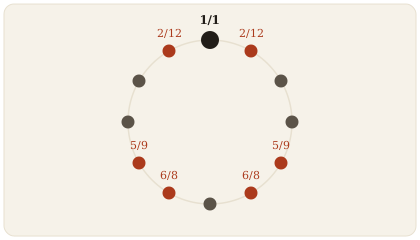
Bhakoot Dosh: The Arithmetic of 6-8, 2-12, 5-9, and the Rules That Erase It
The second-heaviest koota in matching: fearsome on paper, often waived in the tradition; the full arithmetic and cancellation rules, with sources.
9 min readRead article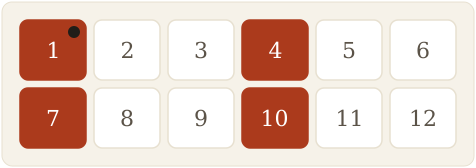
Gaja Kesari Yoga: Jupiter in a Kendra from the Moon, and the Arithmetic of a Common Yoga
The most celebrated benefic yoga in astrology, and the arithmetic that shows how common it is under the raw rule; the rule, the conditions and the balanced reading.
11 min readRead article
Dhana Yoga: The Rule of the Wealth Houses, and When Calculators Measured the Base Rate Themselves
Two independent calculator builders measured the base rate instead of repeating "rare blessing"; the rule, the textual warrant and the real test of strength.
9 min readRead article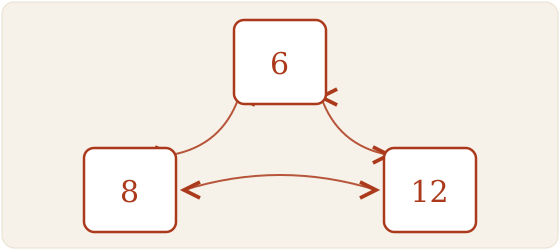
Viparita Raja Yoga: When the Difficult Houses Cancel Each Other
When the lords of the three hardest houses sit in each other's houses, the tradition reads a yoga of reversal; the rule, the textual warrant, and one computation most software skips.
10 min readRead article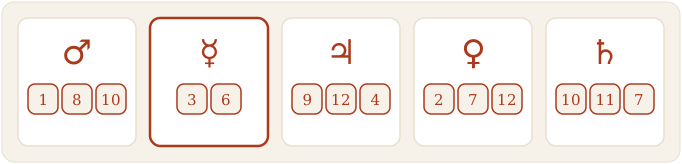
Panch Mahapurusha Yoga: Five Planets, One Rule, and a Measured Test of the "Rare" Claim
Two engine builders measured the yoga called "rare": at least one appears in every third chart of their own samples. The rule, the measurements, the Mercury anomaly and what it means.
10 min readRead article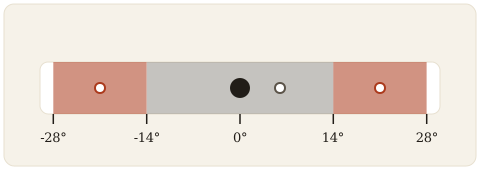
Budhaditya Yoga: The Sun-Mercury Conjunction, and the Difference Hidden in a Few Degrees
One of the most common yogas of all: the quality hides in the very degree gap that most reports never measure; the rule, the arithmetic and the graded reading.
9 min readRead article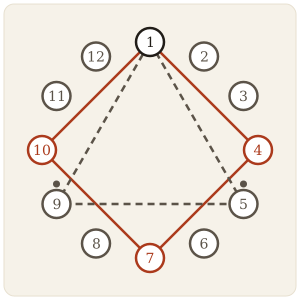
Types of Raj Yoga: The Kendra-Trikona Grammar and Its Seven Forms
Saying "there is a Raj Yoga" is easy; the tradition's actual rule system, in which half the ascendants have their own yogakaraka planet and the cancellation conditions are explicit, with sources.
10 min readRead article
Vimshottari Dasha: The 120-Year Calendar Built from the Moon's Nakshatra, and Its Arithmetic
A 120-year timetable starting from the birth Moon's nakshatra: the rule, arithmetic you can check yourself, and the sensitivity that binds dasha dates to the birth time.
9 min readRead article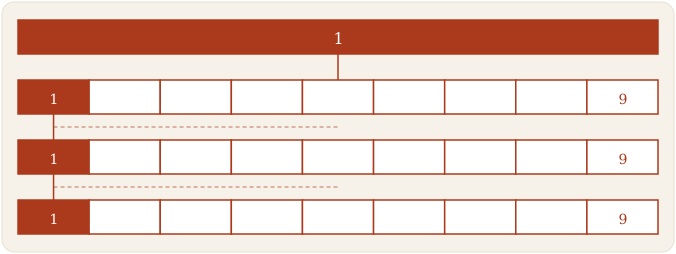
Antardasha, Pratyantardasha and Below: Five Levels of One Proportion, and the Limit of the Input
The mahadasha chapter opens into nine sub-chapters; three more levels lie below, plus an honest computation: where the system's fineness outruns the fineness of the birth time.
10 min readRead article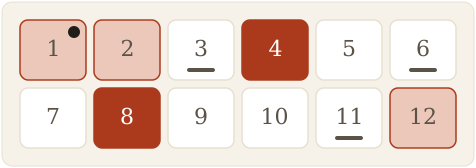
Jupiter Transit 2027: Exalted Jupiter Returns Retrograde, and the Year's Four Parts
In 2027 Jupiter changes signs three times, returning to its exaltation sign Cancer in retrograde motion; the dates are checked against three sources, and the year counts as four periods, not three.
10 min readRead article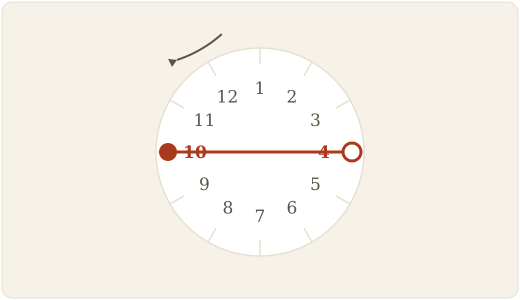
Rahu-Ketu Transit 2027: The Year with No Ingress, and the Full Chapter of the Capricorn-Cancer Axis
A Rahu-Ketu year in which nothing changes: one axis for all twelve months. A four-source date audit, the eclipse calendar, and the restraint that keeps an eighteen-month window as context, not prediction.
10 min readRead article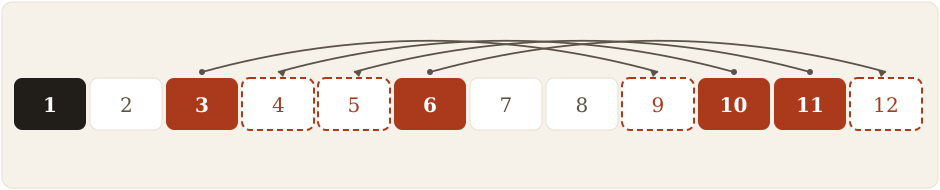
How a Transit Is Read: Counting from the Moon Sign, the Favourable-House Table, and the Complete Vedha Audit
The two-question machine of transit reading: is the house favourable, and is it pierced. The table, the exemptions, the reversed layer, and the one place where two sources disagree.
10 min readRead article
Sade Sati Remedies: An Audit of Three Layers, the Purana Text, Living Practice, and Modern Claims
Behind every remedy list are three layers: the Purana text, living practice, and claims in scripture's name. This article separates all three, with sources and limits.
11 min readRead article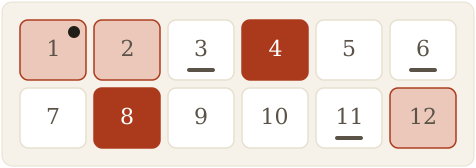
Kantaka Shani and Dhaiya: Two Thorn-Names Audited, One Older Rule, and a Thirty-Year Map
When Saturn enters the 4th or the 8th from the Moon sign, the tradition calls it a dhaiya; the names are a later layer, the rule is older, and see by arithmetic where these states fall in the thirty-year cycle.
10 min readRead article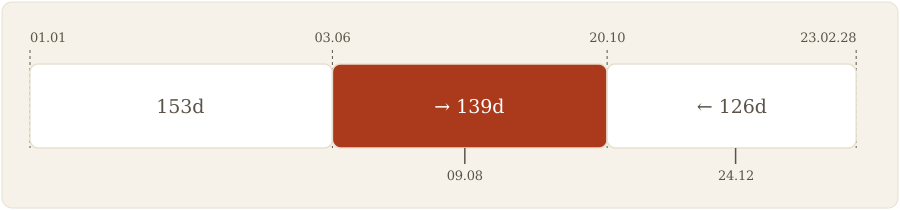
Saturn Transit 2027: The Aries Dip, a 139-Day Preview, and the Returning Pisces
Saturn usually stays years in one sign; 2027 has two changes: a 139-day Aries preview, then a return to Pisces, and the settled arrival in February 2028.
10 min readRead article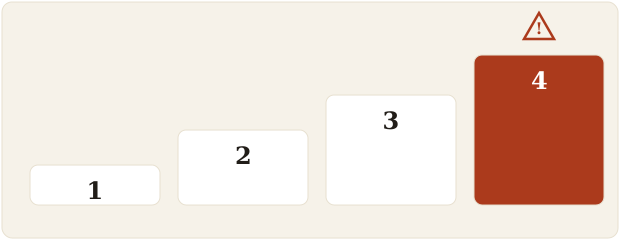
Planetary Remedies: The Four Classical Kinds, the Layers of Their Sources, and the Right Ladder of Adoption
The map of the remedy system: four kinds, three literary layers, one separate system (Lal Kitab), and a ladder that starts free and ends expensive; the market runs it backwards.
10 min readRead article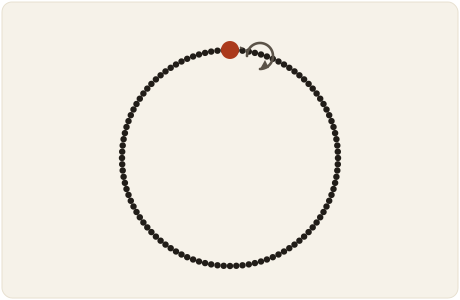
Mantra Japa as a Counting Science: Purascharana Arithmetic, Mala Mechanics, Time and Place Rules, and the Sources’ Spread
One mantra, one mala, one fixed time: japa method read through its counting science, with the text’s fruit-language and the modern rules marked separately.
12 min readRead article
Planetary Donations Audited: The Classical BPHS List, the Modern Colour Tables, and the Gap Between the Layers
A cow with her calf, a conch, a bullock and a horse in the classical list; jaggery, sesame and lentils in the modern tables: the two layers of planetary donation, the gap between them, and the rules they share.
10 min readRead article
Weekday Fasting Audited: The Machine from Sankalpa to Udyapana, the Seven-Day Table, and the Safety Condition That Comes First
A vrat is a machine of six parts: sankalpa, the day’s discipline, puja, katha, paran, udyapana. The commonest mistake is the nirjala-phalahar one, and the first condition is that a fast is compulsory for no one.
10 min readRead article
Rudraksha: The Object Examined, the Tradition of the Faces, the Planet-Mapping Dispute, and How to Read the Market
One object, two sources, one collision: the mukhi-to-planet table one page calls tradition, the other calls a recent sales taxonomy; and both agree on one thing: the real risk is not in the bead but in the claims attached to it.
10 min readRead article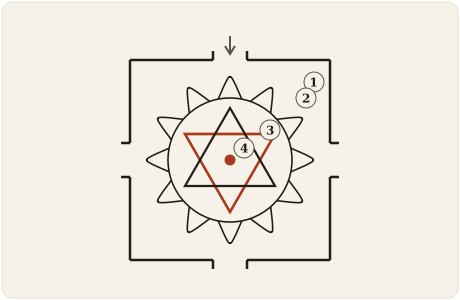
Yantra: The Word, the Grammar of the Figure, Its Three Uses, the Antiquity Claims, and the Market Layer
A diagram that is a deity's seat: a four-layer grammar, the "empty diagram without mantra" principle, a three-level audit of the antiquity claims, and a sales page where the answer to "it did not work" is the next product.
10 min readRead article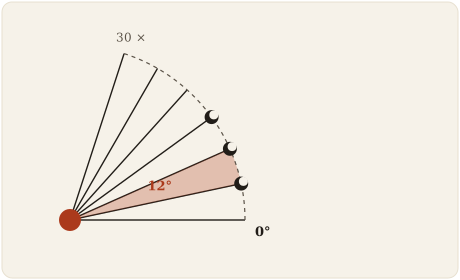
What a Tithi Is: The 12-Degree Angle, the Sunrise Rule, Kshaya and Vriddhi, and Why Two Panchangs Disagree
A tithi is an angle, not a day count: the twelfth part of the Moon's journey away from the Sun; the sunrise rule, the kshaya and vriddhi anomalies, immunity from the ayanamsha quarrel, and the real reasons two panchangs disagree.
10 min readRead article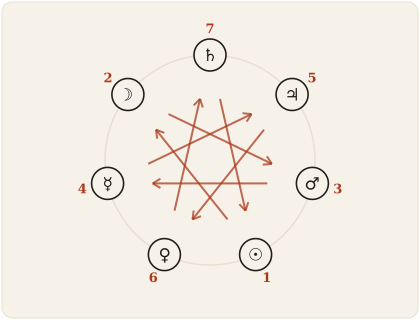
Vara: The Week the Sky Did Not Make, the Reason for Seven, the Machine of the Sequence, and the Layers of the Names
The panchang's only human-made limb: the reason for seven, the planetary-hours machine behind the Sun-Moon-Mars order, the changing god layers, the Indian vasara names, and one open question even our sources will not settle.
10 min readRead article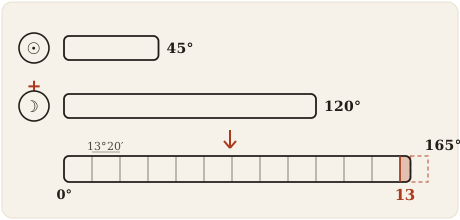
Yoga: The Sun-Moon Sum, the Panchang's Latest-Arriving Limb
Where the tithi subtracts, the yoga adds: the arithmetic of this 27-part counting unit, its late arrival in the almanac, the twenty-seven names, the truth about the auspicious column, and a separate twenty-eight-yoga world.
11 min readRead article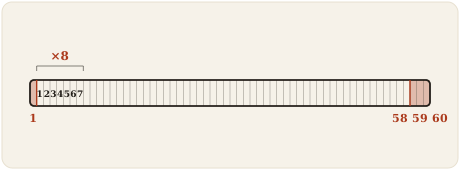
Karana: Half a Tithi, Sixty Halves and Eleven Names
The tithi's half, the karana: sixty halves, eleven names, four at Amavasya's door and seven turning eight rounds; the computation, the Bhadra tradition, the animal names and roots near 500 BCE.
11 min readRead article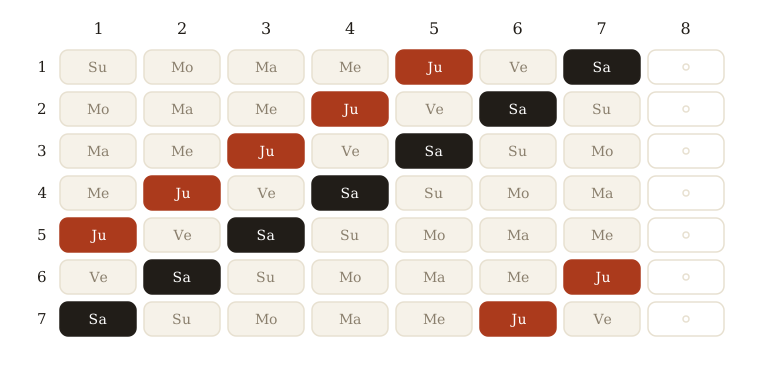
Yamaganda and Gulika: The Deal of Seven Lords onto Eight Chairs, Where Rahu Gets No Chair at All
Yamaganda and Gulika are not tables to memorise: deal seven lords onto eight chairs and Jupiter’s chair is Yamaganda, Saturn’s is Gulika; four sources, one recorded variant, and Gulika’s second life inside the chart.
12 min readRead article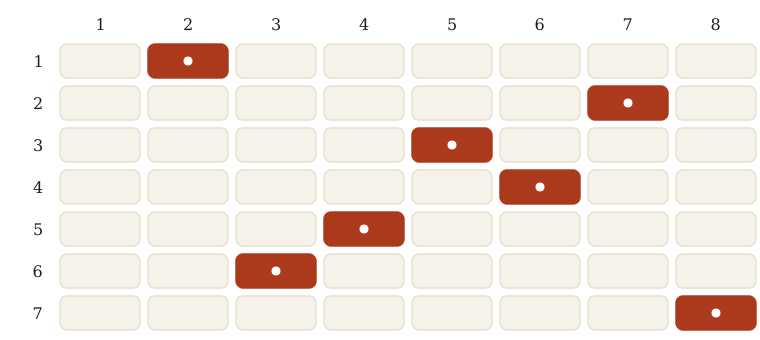
Rahu Kaal: The Window That Moves with the Sun, the Rule of Eight Parts, and the Clock-Time Misunderstanding
Rahu kaal is not a clock time but a moving eighth of the day: the sunrise-sunset weekday rule, a three-source check, our own worked example, and the real scope of the avoidance.
10 min readRead article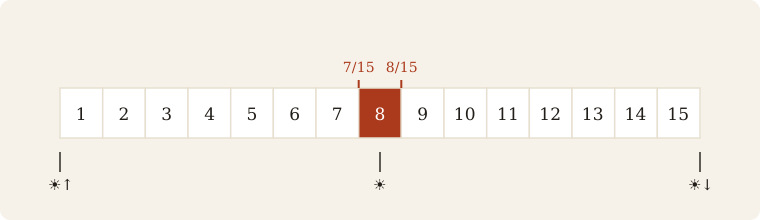
Abhijit Muhurat: The Noon Window That Borrows Its Name from a Star the Calendar Dropped
Abhijit Muhurat is the eighth fifteenth of daylight, centred on true local noon; two published examples re-checked, three policies on the Wednesday rule, and the nakshatra that left the calendar but left its name on midday.
10 min readRead article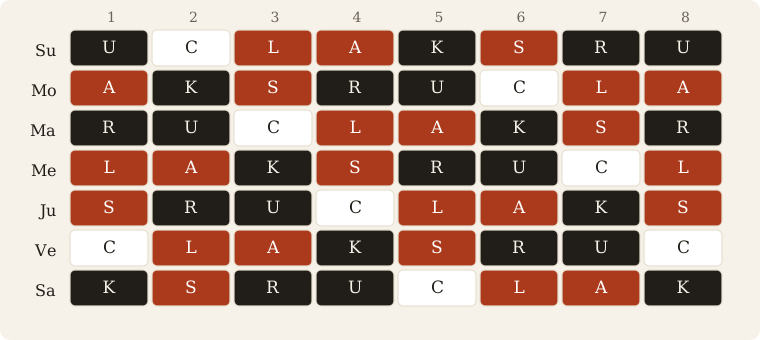
Choghadiya: The Four-Ghadi Timetable Whose Classical Pedigree Two Sources Still Dispute
Choghadiya cuts day and night into eight named parts each; the construction rule, the night’s separate door, two sources openly split over its classical pedigree, and the checks any reader can run on any printed table.
10 min readRead article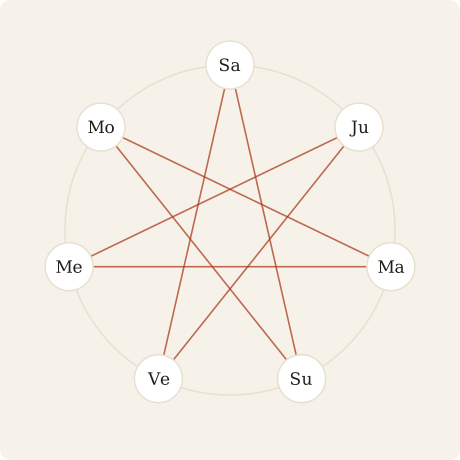
Hora: The Planetary Hour That Built the Order of the Weekdays
The hora cuts day and night into twelve planet-ruled parts each; the jump of three yields the week’s order, the seven-pointed star draws it, and two thousand years of documentation follow, every step with its source.
9 min readRead article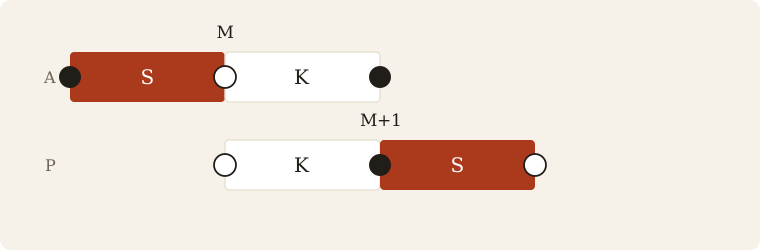
Amanta vs Purnimanta: One Fortnight, Two Month Names
Every day of a waning fortnight carries two correct month names: the amanta panchang ends its month at the new moon, the purnimanta at the full, and that single difference gives every dark-fortnight festival two names.
10 min readRead article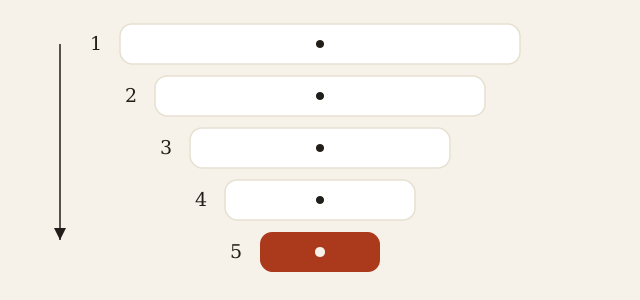
How a Shubh Muhurat Is Chosen: The Funnel from Year to Hour
A muhurat is not picked but filtered: from the season vetoes to the two-hour lagna sieve, the ordered stack of five sieves that narrows 365 days to a window a few hours wide.
10 min readRead article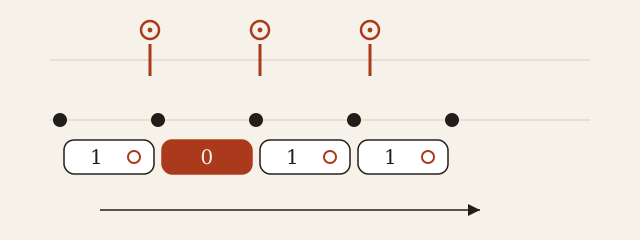
Adhik Maas: The Thirteenth Month the Sun and Moon Decide Together
A lunar month in which the Sun does not change sign becomes the adhik maas: the correction gear for the eleven-day yearly shortfall, which stretched Jyeshtha to sixty days in 2026 and will erase a month in 2124.
10 min readRead article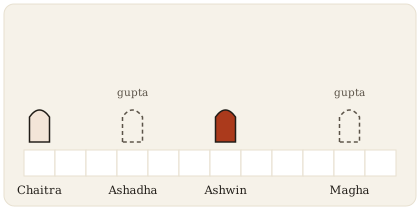
Navratri: The Year Has Four Doors, and Nine Nights Stand Behind Each One
Navratri comes not once but four times a year; the nine-goddess list changes with region and sampradaya, the sources collide on day colours, and every region keeps its own rite. The four doors, the nine nights, the regional rites and the 2027 dates, with sources.
11 min readRead article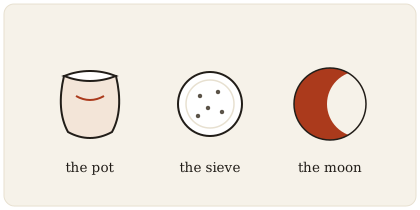
Karva Chauth: A Pot, a Sieve, and the Wait for the Moon
Karva Chauth reads through three things: the clay karwa, the sieve and the moon. Origins, sargi, the feris, the tales, today’s debate, an honest note on the fast, and the 2027 date, with sources.
10 min readRead article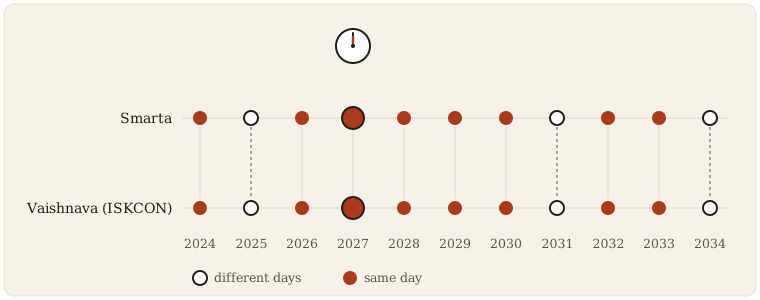
Janmashtami: Two Calendars, One Midnight
Janmashtami appears on two dates in many years because the Smarta and Vaishnava sampradayas pick the day by different rules; 2027 is a single shared day for both, Wednesday 25 August. The rules, the birth legend, the midnight puja, the parana, the regional rites and an honest note on the fast, with sources.
10 min readRead article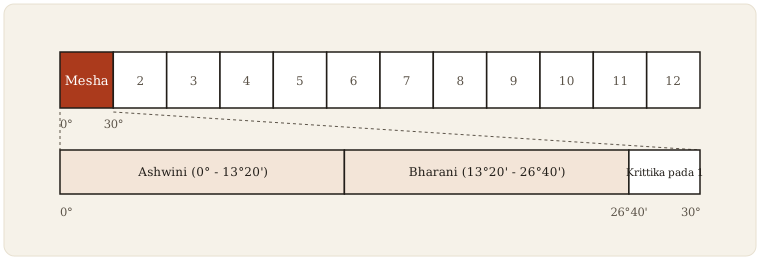
Aries (Mesha): The First Spark of the Zodiac
Mesha is where the zodiac begins: the fire of Mars, a cardinal character, and the energy that steps before it thinks. From the classical verse to the modern sign profile, the courage to start and the challenge to sustain, with sources, and with an honest-limits note.
10 min readRead article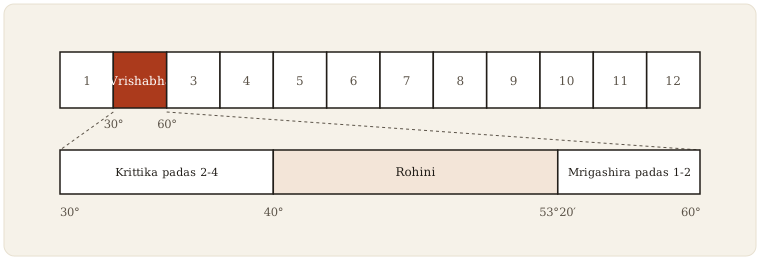
Taurus (Vrishabha): The Steady Ground of the Zodiac
Vrishabha is the ground that holds the spark of Mesha: Venus’s fixed earth, patience that refuses to be rushed, and the Moon’s garden. From the classical verse to the modern sign profile, the art of sustaining and the refusal to move, with sources, and with an honest-limits note.
10 min readRead article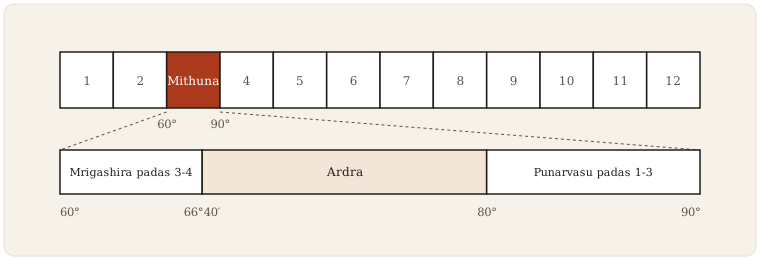
Gemini (Mithuna): The Two Voices of the Zodiac
Mithuna is the bridge between speaker and listener: Mercury’s mutable air, two perspectives held at once, and the challenge of depth. From the classical verse to the modern sign profile, the art of connecting and the cost of scattering, with sources, and with an honest-limits note.
10 min readRead article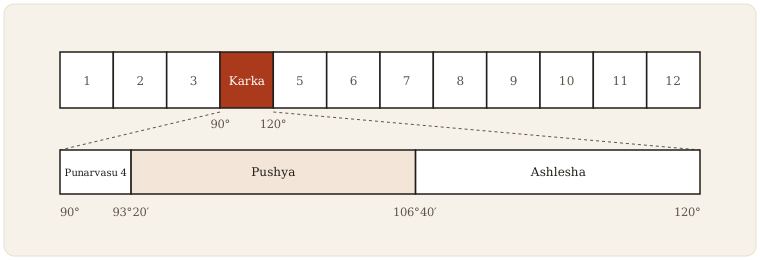
Cancer (Karka): The Shelter of the Zodiac
Karka is the shell that keeps feeling safe: the Moon’s own sign, cardinal water, and a fortune that waxes and wanes like its ruler. From the classical verse to the modern sign profile, the art of sheltering and the refusal to be pushed, with sources, and with an honest-limits note.
10 min readRead article
Leo (Simha): The Throne of the Zodiac
Simha is the fixed fire that does not flare and die but holds: the Sun’s own sign, and a radiance the world cannot stop, though it bows before its own root. From the classical verse to the modern sign profile, the art of sovereignty and the challenge of praise-hunger, with sources, and with an honest-limits note.
10 min readRead article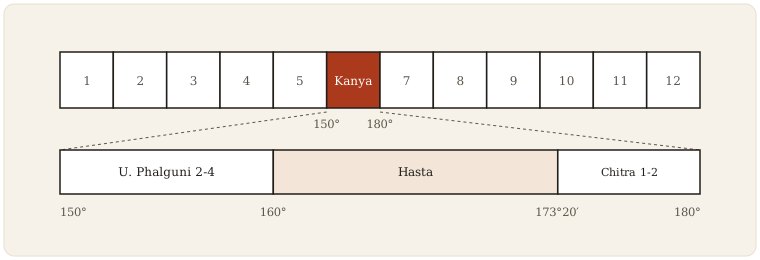
Virgo (Kanya): The Craft of the Zodiac
Kanya is the tilled earth, worked and reworked toward a better yield: Mercury’s own sign, where the same planet is exalted too, and a devotion that would rather mend your roof than say the word. From the classical verse to the modern sign profile, the art of discrimination and the challenge of perfectionism, with sources, and with an honest-limits note.
10 min readRead article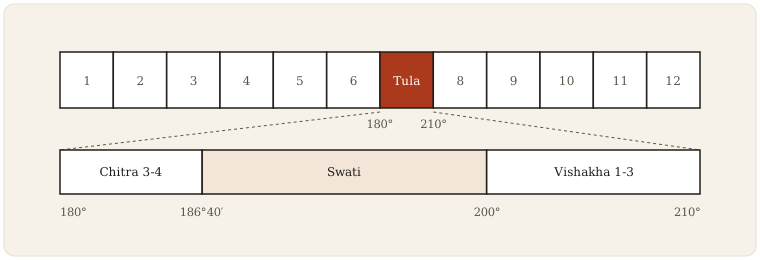
Libra (Tula): The Scales of the Zodiac
Tula is the cardinal air that starts by asking: Venus’s sign, where the judge rises exalted and the king steps down. From the classical verse to the modern sign profile, the art of harmony and the challenge of indecision, with sources, and with an honest-limits note.
10 min readRead article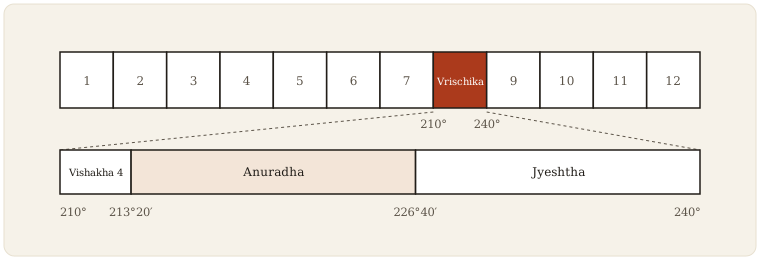
Scorpio (Vrischika): The Depths of the Zodiac
Vrischika is the fixed water that moves beneath a still surface: Mars’s sign where the war goes inward, and the depth from which both healing and destruction come. From the classical verse to the modern sign profile, a life between the scorpion and the eagle, with sources, and with an honest-limits note.
10 min readRead article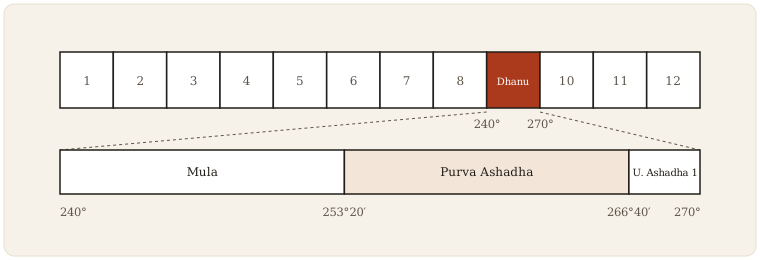
Sagittarius (Dhanu): The Aim of the Zodiac
Dhanu is the mutable fire that travels: Jupiter’s sign, whose arrow aims at the stars and which cannot be pushed, only persuaded. From the classical verse to the modern sign profile, the art of freedom and the challenge of staying put, with sources, and with an honest-limits note.
10 min readRead article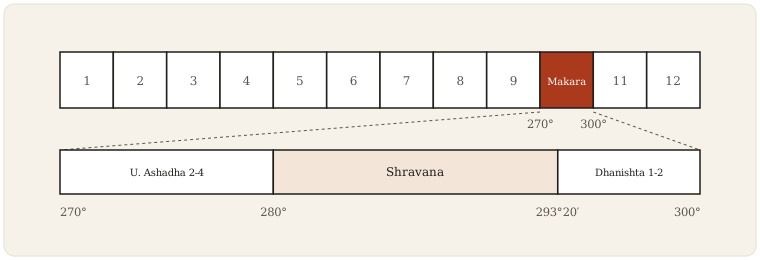
Capricorn (Makara): The Climb of the Zodiac
Makara is the cardinal earth that climbs: Saturn’s own sign, the sea-goat at home in water and on rock, where Mars is raised and Jupiter must earn his keep. From the classical verse to the modern sign profile, the art of the long game and the challenge of control, with sources, and with an honest-limits note.
10 min readRead article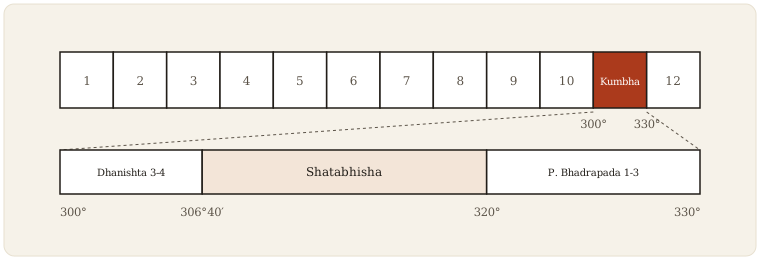
Aquarius (Kumbha): The Water-Bearer of the Zodiac
Kumbha is the fixed air that pours for everyone: Saturn’s second sign, which does not build structures but reimagines them, and whose exaltation table stands empty. From the classical verse to the modern sign profile, the art of far sight and the challenge of closeness, with sources, and with an honest-limits note.
10 min readRead article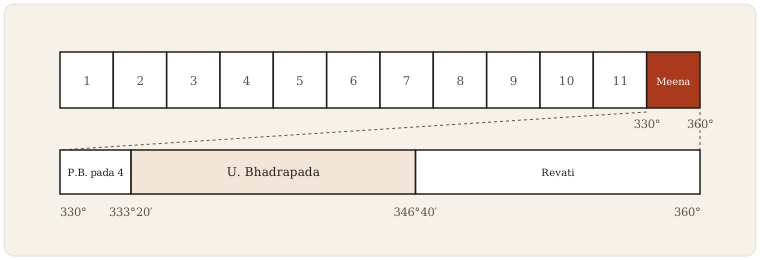
Pisces (Meena): The Two Fish of the Zodiac
Meena is the mutable water where the wheel completes itself: Jupiter’s second sign, where love becomes divine and analysis dissolves, and whose two fish swim opposite ways on one cord. From the classical verse to the modern sign profile, the art of compassion and the challenge of boundaries, with sources, and with an honest-limits note.
10 min readRead article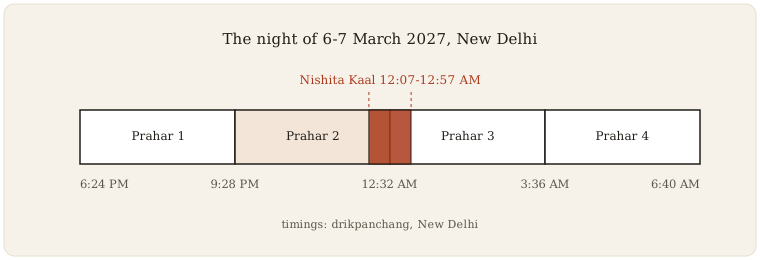
Maha Shivaratri 2027: Date, Timings, Vrat Vidhi and Legends
The Great Night of Shiva: the Krishna Chaturdashi fast, vigil and four-prahar worship, the exact 2027 Delhi timings, four Puranic legends and the tale of the hunter who worshipped without knowing, with sources, and with an honest-limits note.
11 min readRead article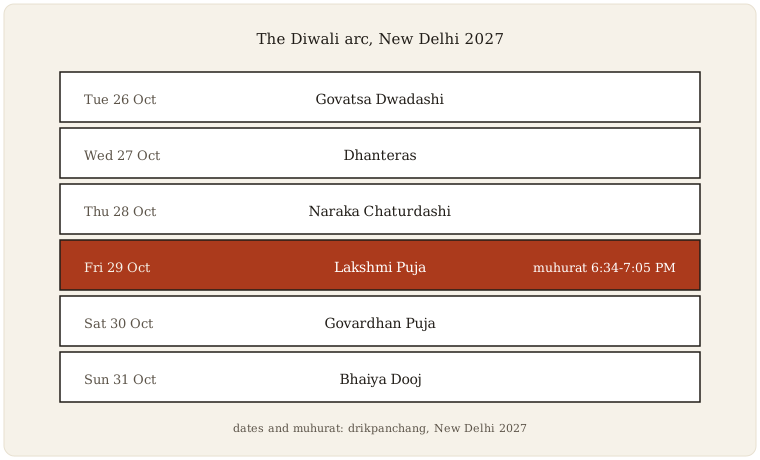
Diwali 2027: Date, Lakshmi Puja Vidhi, Muhurat and the Full Five-Day Sequence
The festival of lights: the exact 2027 Delhi timings, the full six-day sequence, the Lakshmi Puja vidhi and muhurat, the stories behind all five days, with sources, both readings kept standing where sources conflict, and an honest-limits note.
11 min readRead article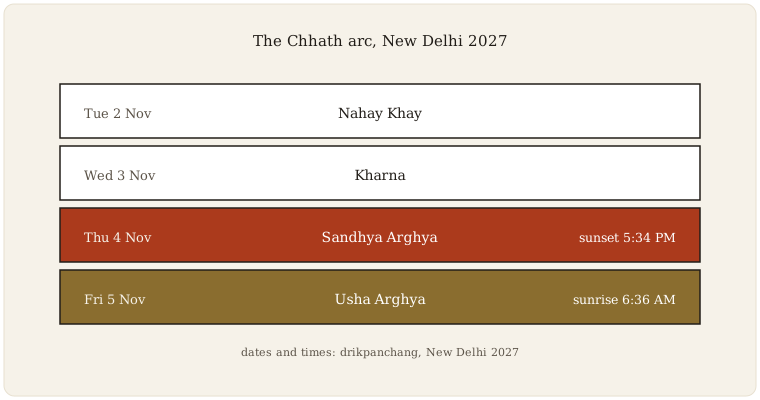
Chhath Puja 2027: Date, Timings, Vidhi and the Full Four-Day Story
The great sun festival: the exact 2027 Delhi timings, the full four-day vidhi, both arghyas to the setting and rising sun, the legends with sources, and an honest-limits note on the thirty-six-hour fast without water.
11 min readRead article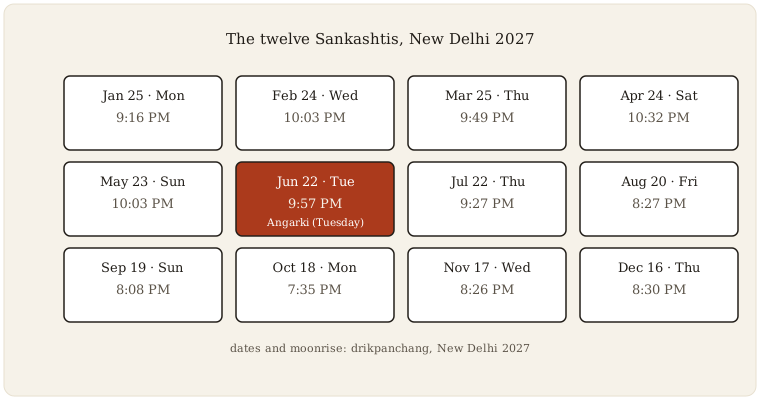
Sankashti Chaturthi: Vidhi, 2027 Dates, Moonrise Timings and Angarki
The monthly Ganesha vrata: the exact 2027 Delhi computation, the sunrise-to-moonrise fast and its vidhi, the Angarki Tuesday, the thirteen names and stories, with sources, and an honest-limits note.
10 min readRead article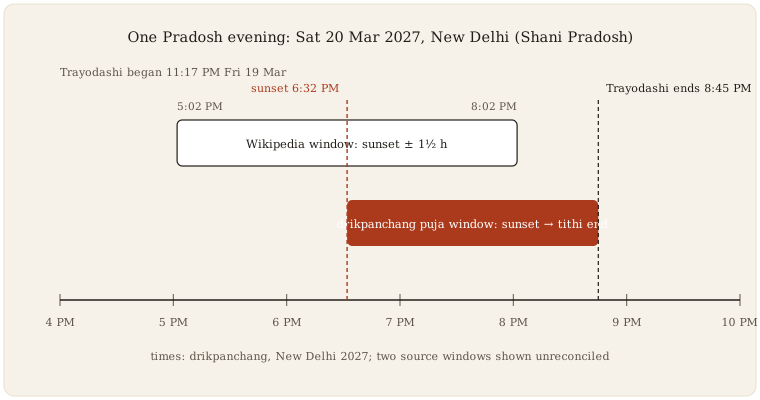
Pradosh Vrat: Vidhi, 2027 Dates, Puja Timings and Shani Pradosh
Shiva's fortnightly twilight: the exact 2027 Delhi computation, the sunset window and its vidhi, Soma, Bhauma and Shani Pradosh, both legends with sources, and an honest-limits note.
11 min readRead article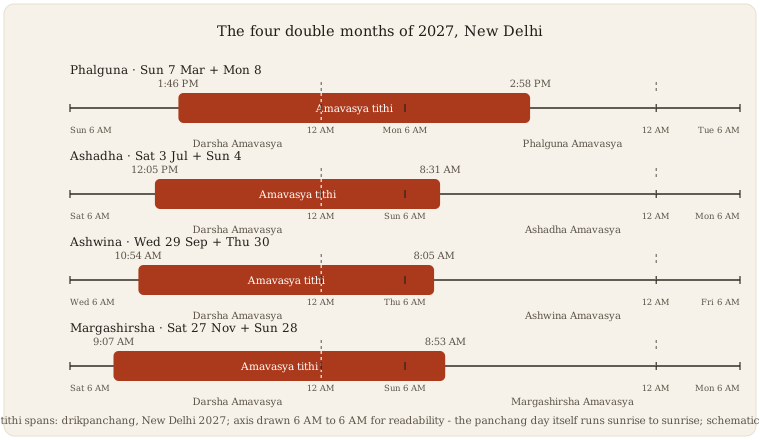
Amavasya: Significance, 2027 Dates, Somvati and Shani Amavasya
The new moon, the calendar's full stop: the exact 2027 Delhi computation, from ancestor rites to Diwali night, the Somvati and Shani named days, the four double months, with sources, and an honest-limits note.
11 min readRead article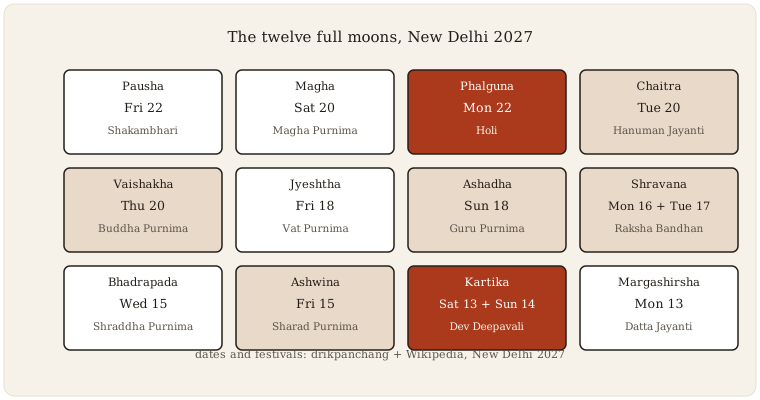
Purnima: Significance, 2027 Dates, Fasting Rule and Festivals
The full moon, the festival year's summit: the exact 2027 Delhi computation, the Madhyahna fasting rule, every month's festival from Holi to Kartika, with sources, and an honest-limits note.
11 min readRead article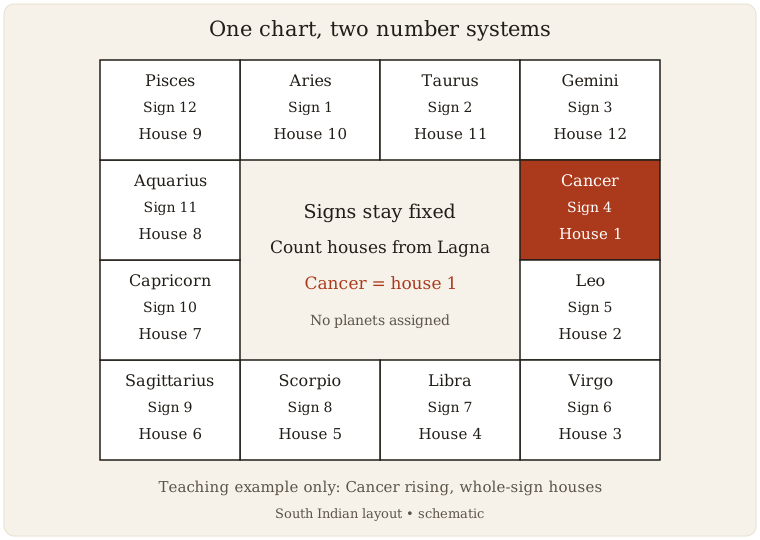
How to Read a Kundli: Signs, Houses and a Worked Example
Read the diagram without confusing a sign number with a house number. A step-by-step cultural guide, with declared assumptions and limits.
11 min readRead article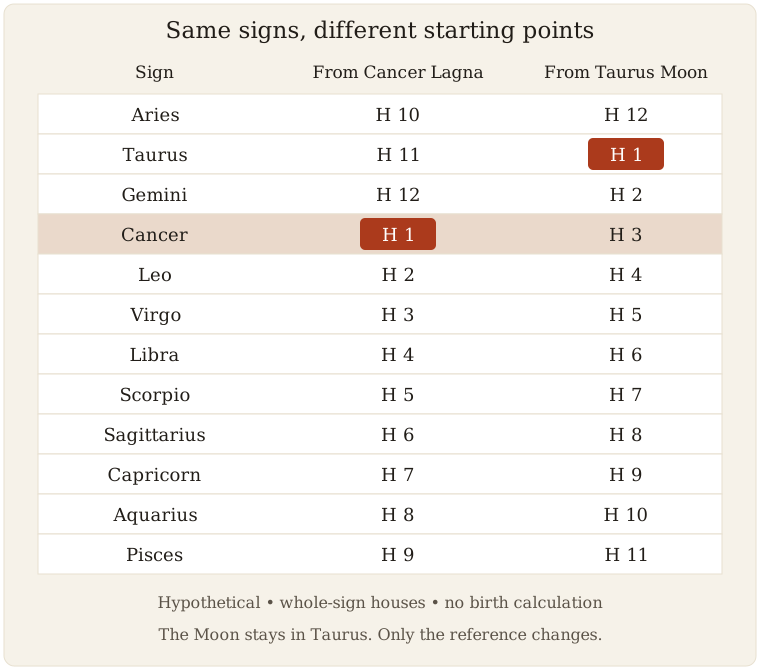
Lagna vs Rashi: Rising Sign and Moon Sign
The horizon and the Moon answer different questions. Learn the terms, reference shifts and limits without inventing a birth chart.
10 min readRead article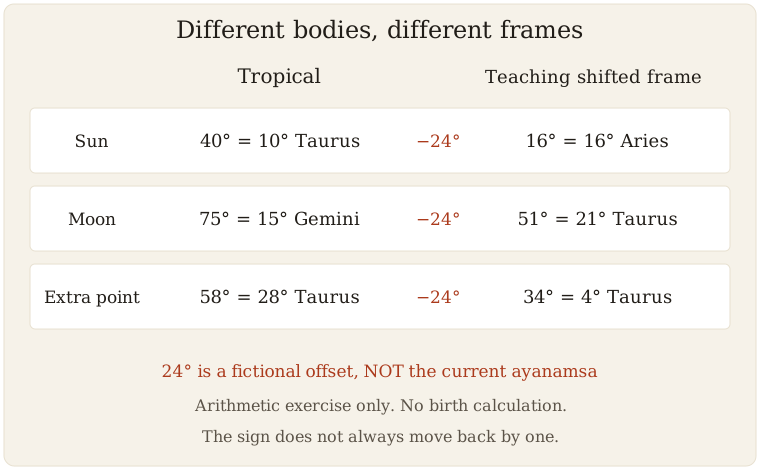
Moon Sign vs Sun Sign: Two Bodies, Two Questions
Your Sun sign and Moon sign need not match. Name the body and zodiac frame before comparing the results.
10 min readRead article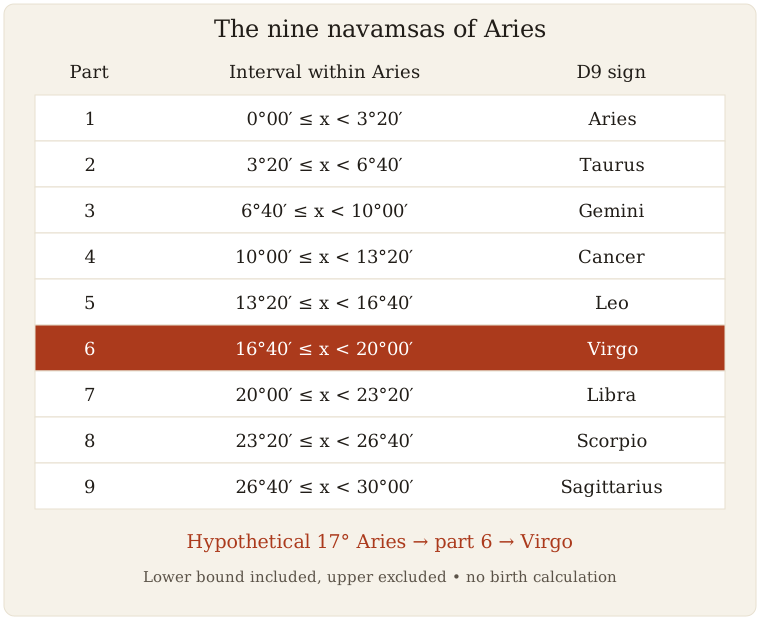
Navamsa Chart Basics: D9 Calculation and Limits
A traceable D9 calculation, not a marriage verdict. Learn the mapping before interpreting the diagram.
10 min readRead article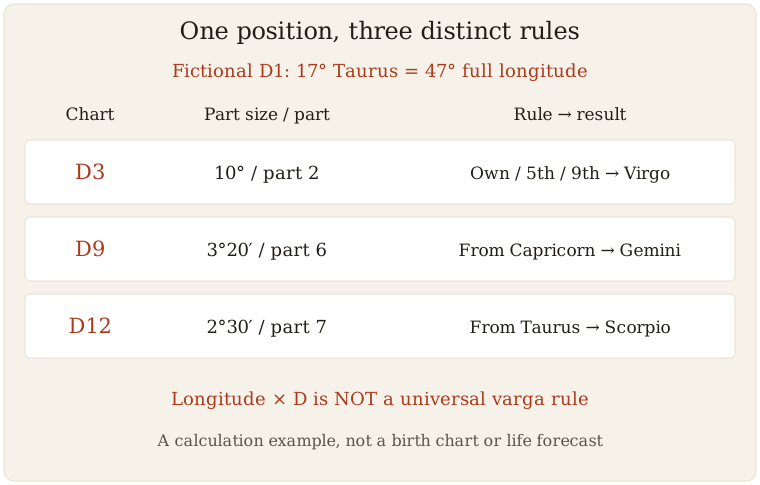
Divisional Charts: Sixteen Vargas, Different Mapping Rules
The D-number is not the whole algorithm. Compare three derived signs from one fictional natal point.
10 min readRead article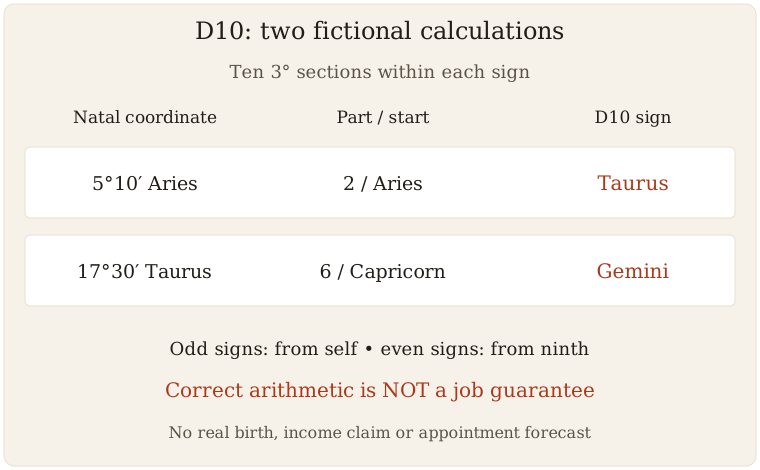
Career and Kundli: D10 Notation, Evidence and Better Decisions
A chart is not an appointment letter. Learn the traditional vocabulary and keep career choices grounded in checkable information.
10 min readRead article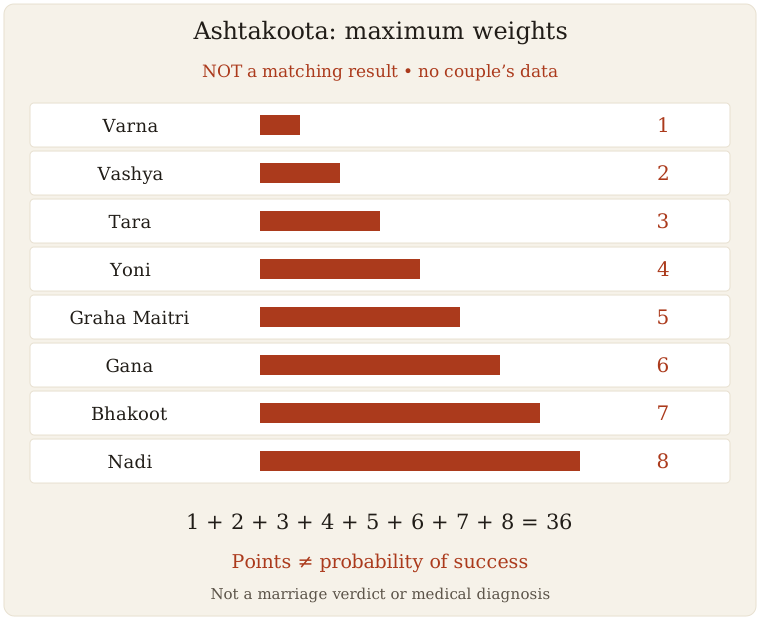
36 Guna Milan: Eight Weights, Source Differences and Limits
Eight comparisons add to36. They do not measure a person’s worth, medical risk or a couple’s future.
9 min readRead article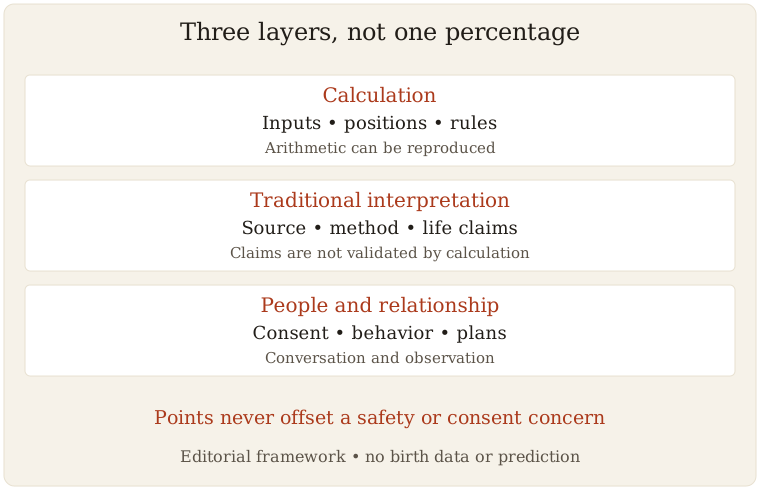
Kundli Matching Beyond Points: Reports, People and Consent
A longer report is not stronger evidence. Keep chart methods separate from people’s wishes, conduct and decisions.
10 min readRead article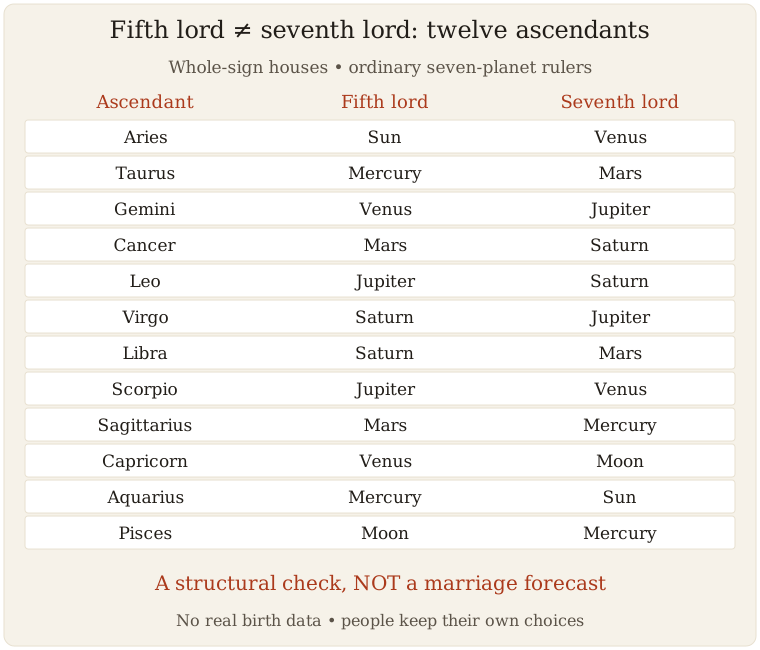
Love Marriage Yogas: Fifth and Seventh Links, With Limits
A chart connection is not a partner’s decision. Understand the rules, the disagreements and what they cannot establish.
10 min readRead article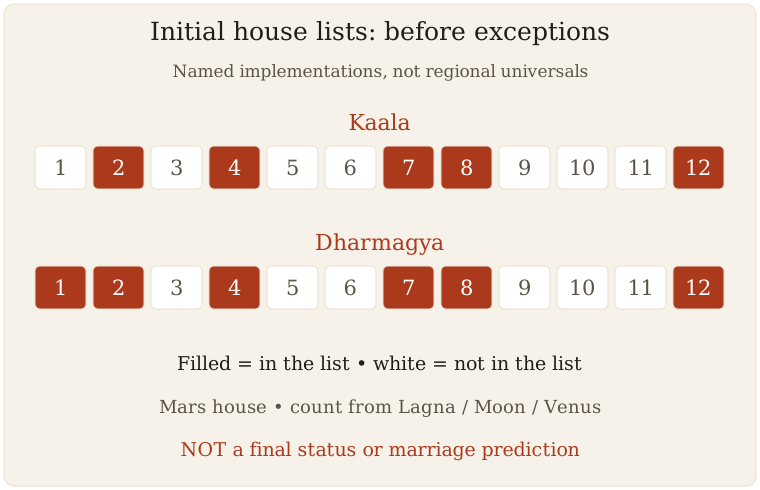
Mangal Dosh Matching: Compare the Rules Before the Verdict
Five-house and six-house tests are not interchangeable. Keep the initial flag, exceptions and pairwise interpretation separate.
10 min readRead article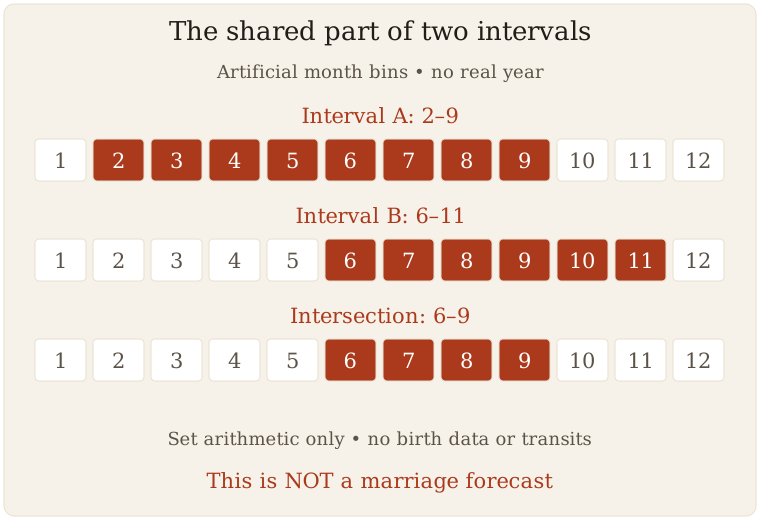
Marriage Timing in Astrology: Windows, Rules and Honest Limits
A forecast window is not an appointment a partner has agreed to keep. Read the method, its disagreements and its evidence limits.
10 min readRead article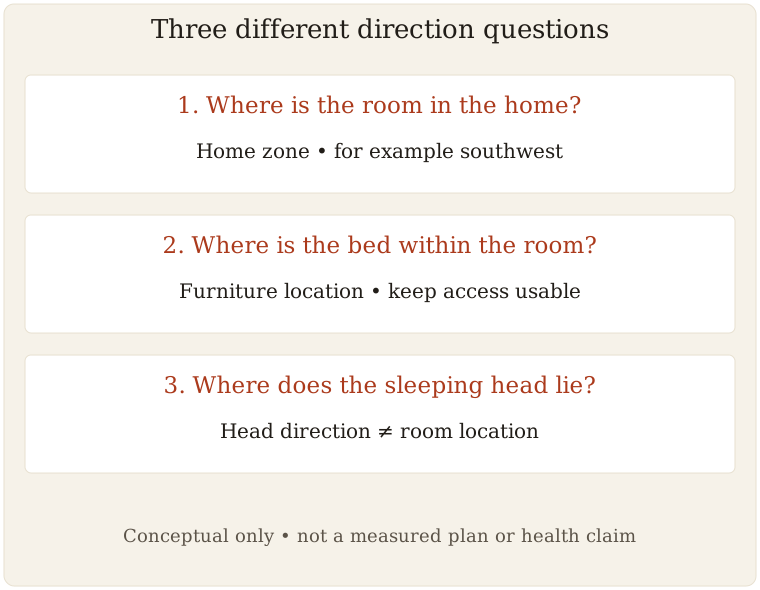
Bedroom Vastu: Separate Directions, Sleep Advice and Safety
A room zone, a bed location and a sleeping direction are three different questions. Cultural preferences do not replace safe access or medical care.
10 min readRead article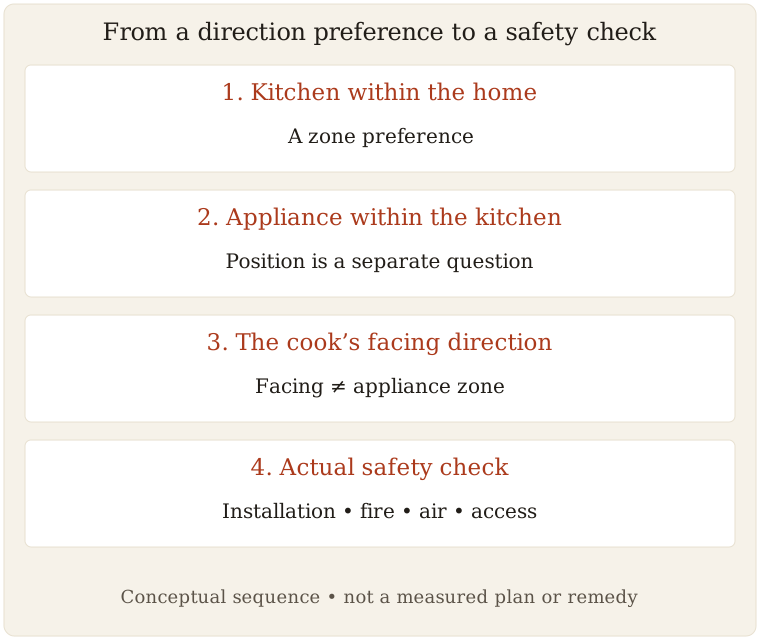
Kitchen Vastu: Read the Compass, Keep the Safety Check
Separate room location, stove position and the cook’s direction; preserve source disagreements and keep fire safety and cooking-air guidance distinct.
10 min readRead article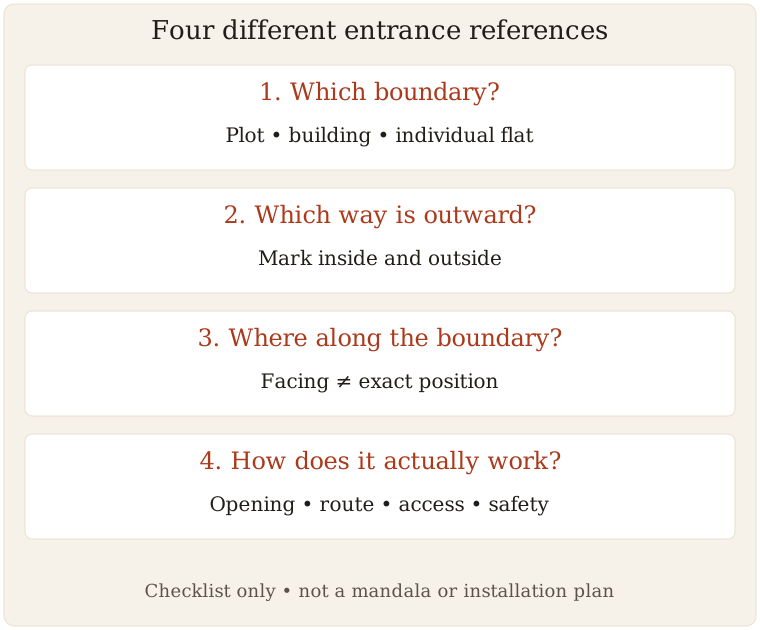
Main Entrance Vastu: Direction, Door Position and the Way Out
Compare entrance traditions without turning a direction into a verdict. Keep source disagreements, privacy, fall prevention and escape planning distinct.
11 min readRead article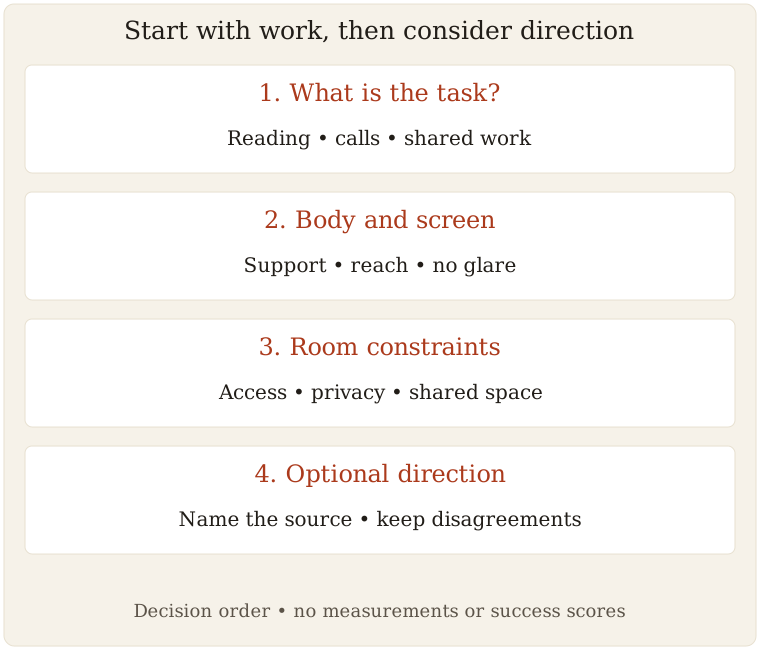
Office Vastu: A Direction Preference Is Not a Workstation Assessment
Compare conflicting office-facing advice with practical checks for posture, glare, access and breaks. No promises of profit or compulsory purchases.
10 min readRead article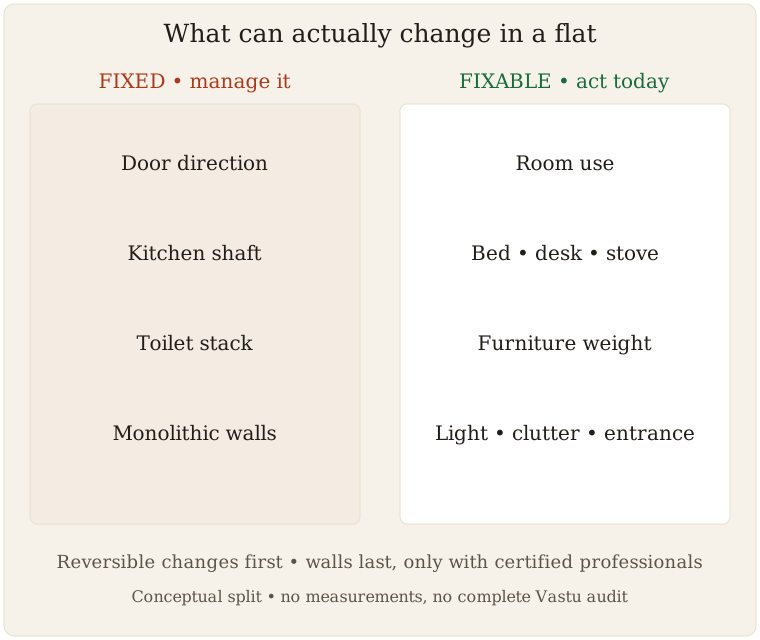
Vastu Remedies Without Demolition: Fix What Moves, Manage the Rest
Room-use swaps, bed and stove orientation, furniture weight, light, clutter and entrance care are reversible and free. Walls are a certified-professional matter, not a remedy.
11 min readRead article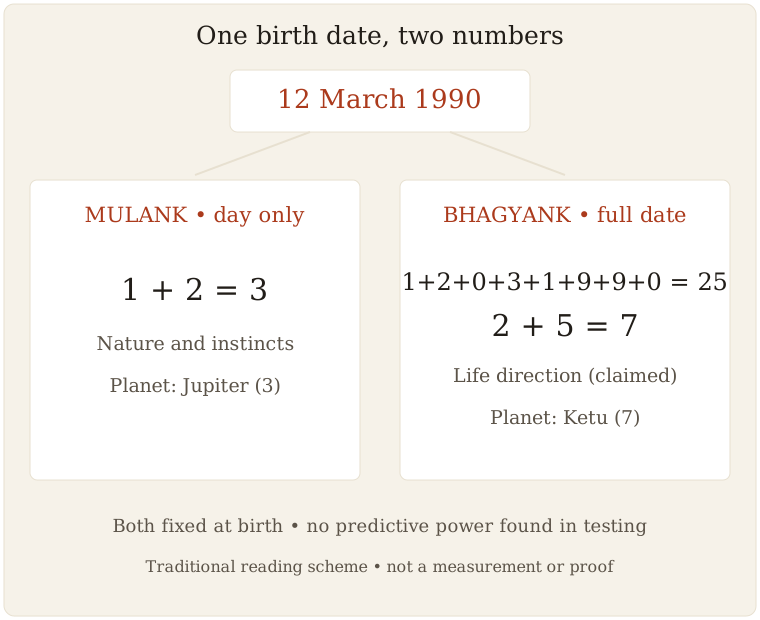
Mulank and Bhagyank: Two Birth Numbers Explained
The Mulank uses your birth day, the Bhagyank your full birth date. Both are fixed. Trait lists are tradition, and the one direct test found no predictive power.
9 min readRead article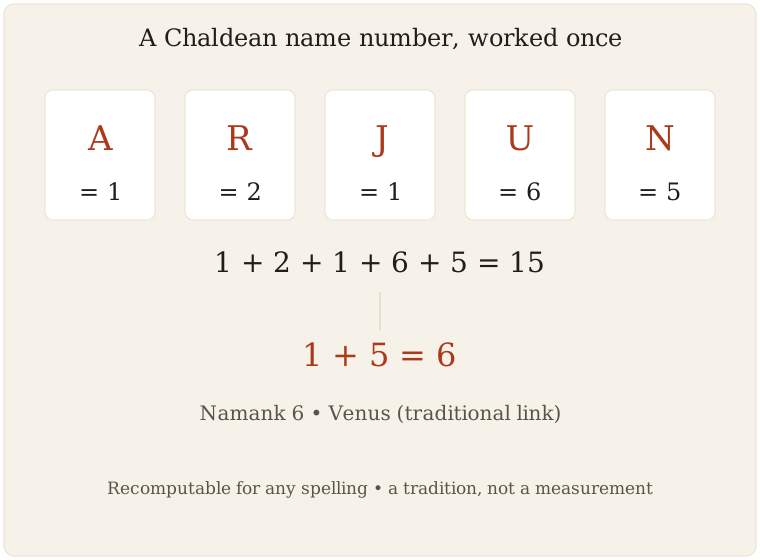
Name Number (Namank): Chaldean Chart and Limits
The only birth-linked number that can change comes from your name's spelling. Compute it yourself, treat trait lists as tradition, and never pay to fix a total.
9 min readRead article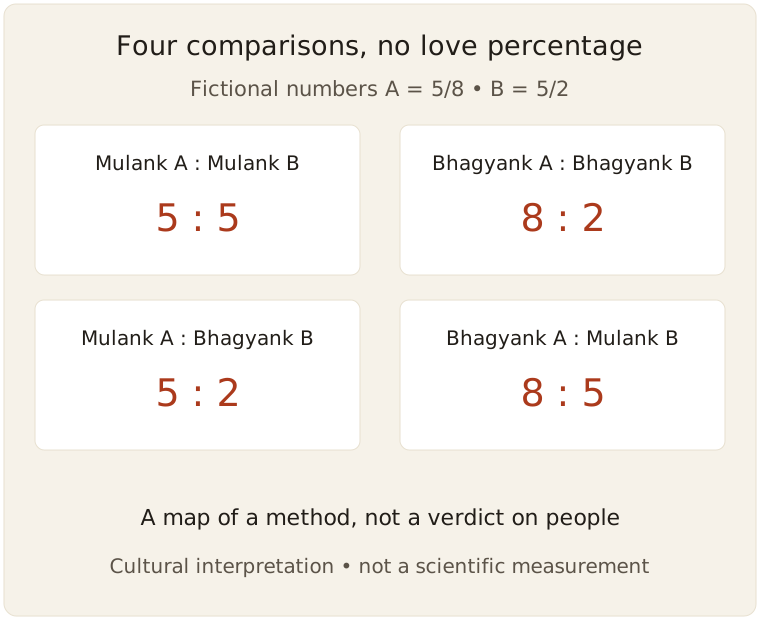
Numerology Compatibility: Methods and Limits
Different calculators compare different numbers. Learn the arithmetic and the limits without turning a cultural reading into a verdict on a relationship.
10 min readRead article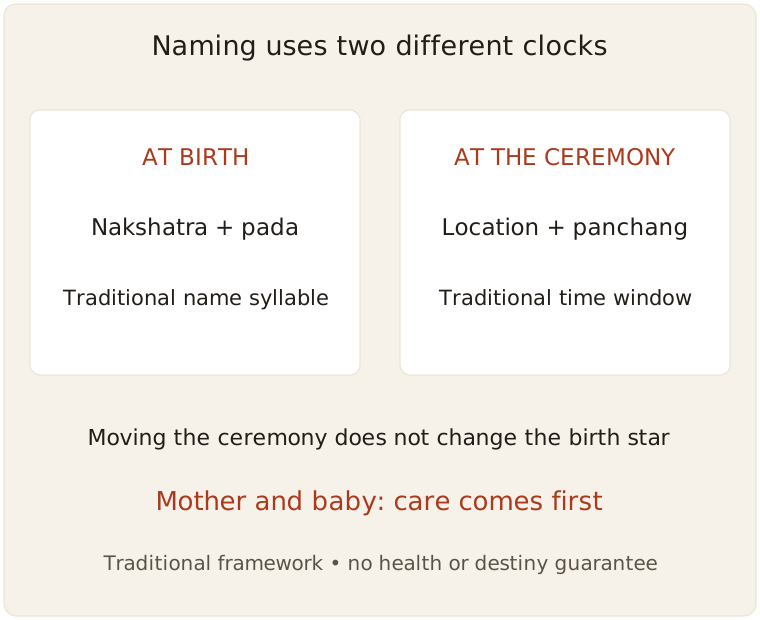
Namkaran Muhurat: Timing, Names and Safety
A naming ceremony welcomes a child. Understand the traditions, keep birth and ceremony timings separate, and put mother and baby first.
10 min readRead article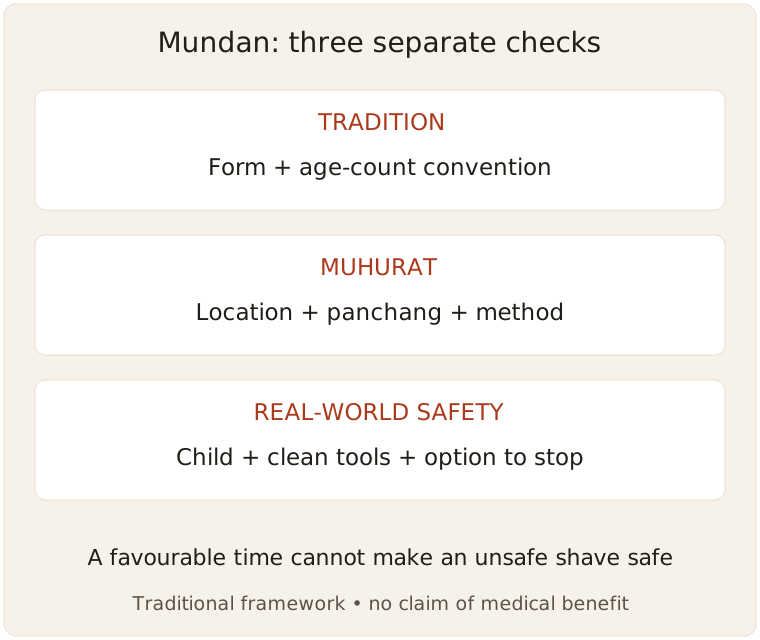
Mundan Muhurat: Tradition and Haircut Safety
Keep family tradition, calendar rules and actual haircut safety separate. A favourable time cannot make an unsafe shave safe.
11 min readRead article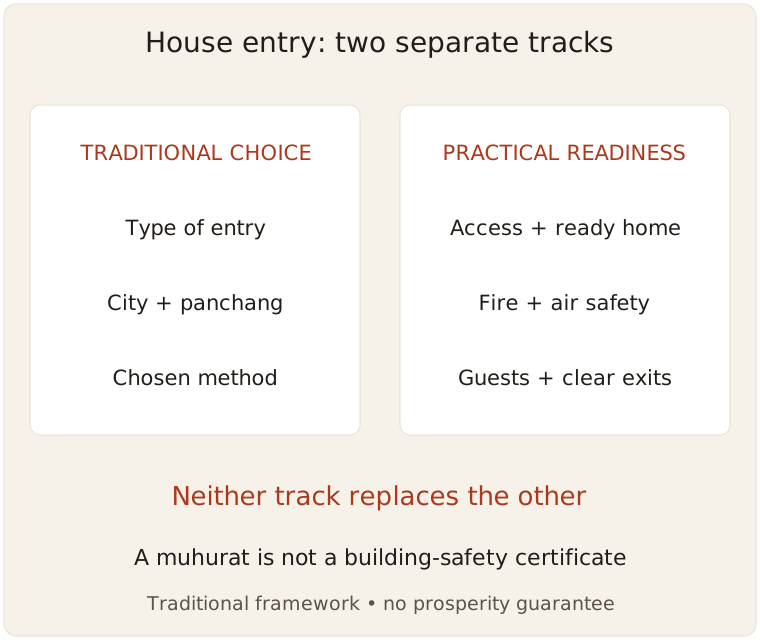
Griha Pravesh: Tradition and Home Readiness
Keep the traditional timing and the actual move on separate tracks. A muhurat is not a building-safety certificate.
11 min readRead article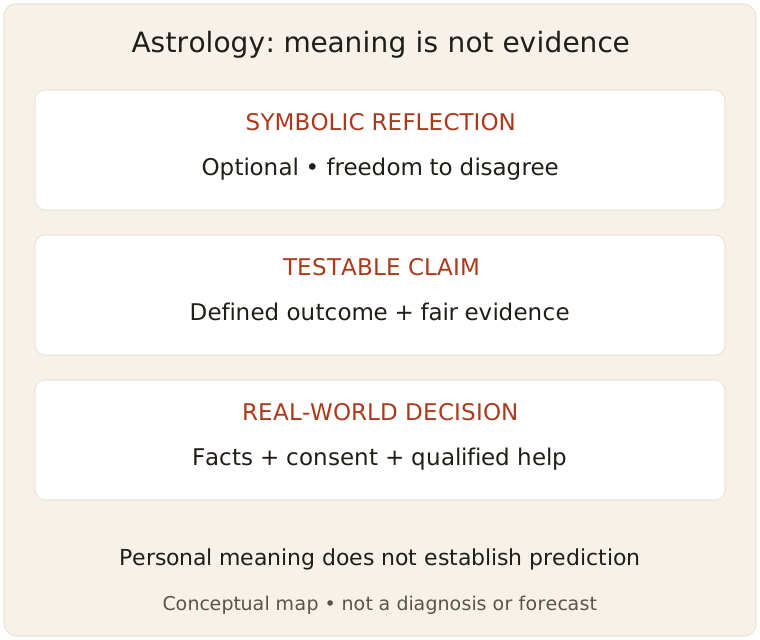
What Astrology Can and Cannot Do
A clear boundary between symbolic meaning and reliable knowledge.
10 min readRead article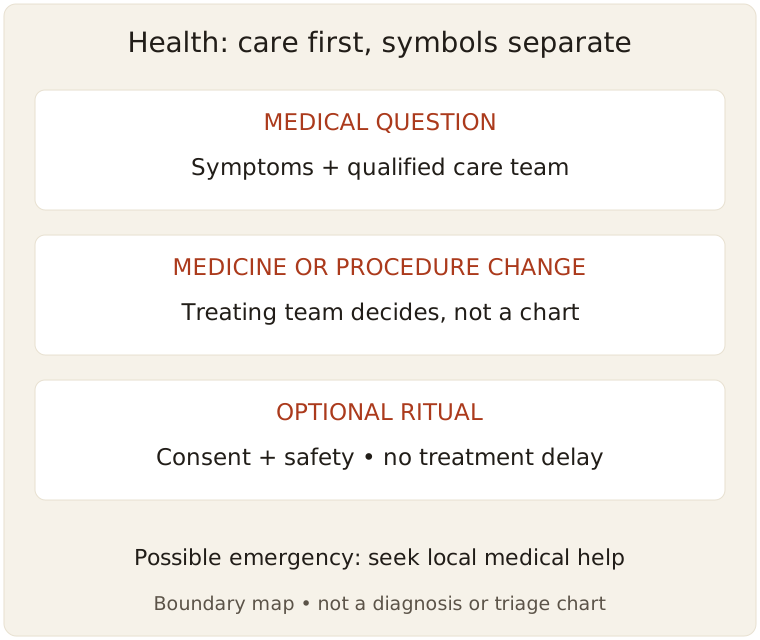
Medical Astrology: Limits and Safety
Cultural comfort must not delay medical assessment or treatment.
10 min readRead article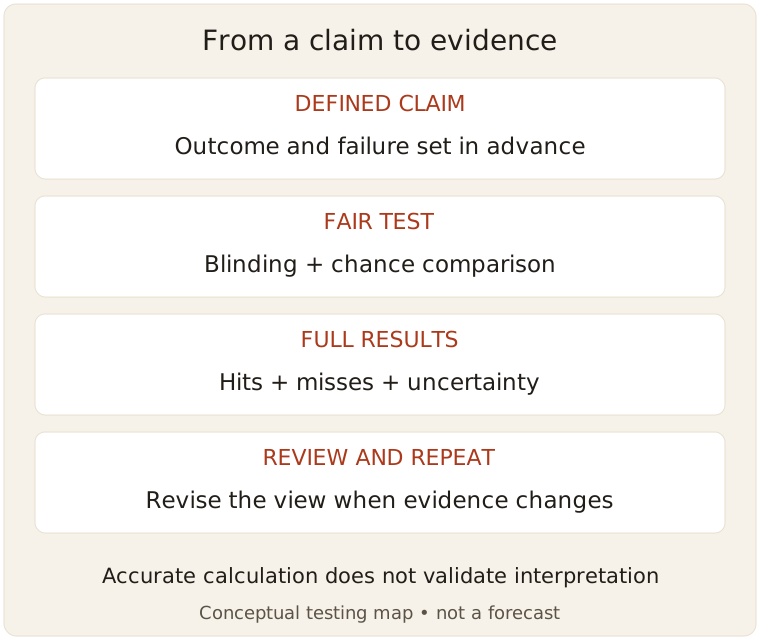
Astrology and Science: Evidence and Limits
What was tested, what was found, and what remains unproved.
10 min readRead articleCommon questions
What kind of articles are published here?
Here you will find simple astrology guides: Shani Sade Sati, Mangal Dosh, nakshatras, panchang, eclipses and 2027 transits. Every article notes the calculation basis and its limits.
Who writes the articles?
The editorial team writes the articles, and Aman Raj edits them and checks the calculations. We do not claim to be professional astrologers.
Panchang and planet positions use standard astronomical formulas. Astrological meanings come from tradition. Consult a professional for big decisions.
How we calculateMake a free kundli
Enter your birth date, time and city. See your ascendant, sign and nakshatra at once.