Amanta vs Purnimanta: One Fortnight, Two Month Names
Every day of a waning fortnight carries two correct month names: the amanta panchang ends its month at the new moon, the purnimanta at the full, and that single difference gives every dark-fortnight festival two names.
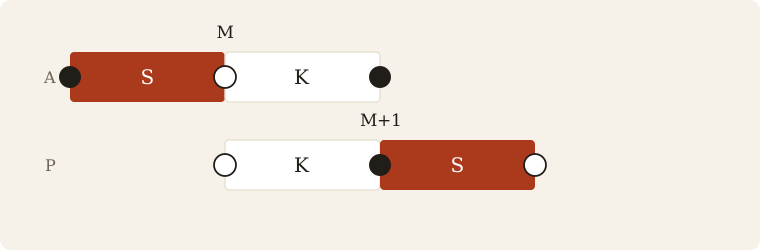
Two people open two panchangs on the same morning. One reads Shravana Krishna Ashtami, the other Bhadrapada Krishna Ashtami. Neither has misread, neither panchang has miscalculated, and both are naming exactly the same day, the same tithi, the same fortnight. They disagree only about which month it belongs to. This is the amanta-purnimanta difference, the single biggest cause of "your dates are wrong" in the Hindu calendar, as one of our sources puts it, and once its one moving part is seen, it is completely simple. This piece lays out the difference, the festivals it touches, the map of who follows which, and the one genuine classification dispute we found between sources, left unresolved as always.
Three sources, fetched on 31 October 2026, carry the article: drikpanchang's school FAQ, Nitya Deepam's explainer, and Whats My Tithi's guide. Where they disagree with each other, both positions are named. Where we worked an example ourselves, it is flagged.
Where a month ends
Everyone agrees on the unit: a lunar month is one complete cycle of the Moon's phases, about twenty-nine and a half days, divided into the shukla paksha, the waxing fortnight from new moon to full moon, and the krishna paksha, the waning fortnight back to new moon. The two conventions disagree about only one thing: where in that cycle the month's boundary falls. Amanta ends the month at amavasya, the new moon; anta means end, so the month runs from the day after one new moon to the next new moon, opening with the waxing fortnight. Purnimanta ends the month at purnima, the full moon, so the month runs from the day after one full moon to the next, opening with the waning fortnight. Both Nitya Deepam and Whats My Tithi state the definitions in these terms.
One line carries the whole system: amanta months start with shukla paksha and end at the new moon; purnimanta months start with krishna paksha and end at the full moon. Because the purnimanta month opens a fortnight earlier, at the full moon rather than the new, its name is already running while the amanta calendar still counts the previous month. The boundary moved; the days did not.
The fortnight that wears two names
Here is the part that matters in practice, and Nitya Deepam states it cleanly: for half of every month the two conventions agree completely, and for the other half they differ by exactly one month name. A shukla paksha day is named identically by both. A krishna paksha day is placed by purnimanta in the following month, because for purnimanta that waning fortnight is the opening half of the next month rather than the closing half of the current one. So during every waning fortnight, the purnimanta month name runs one month ahead of the amanta name, and during every waxing fortnight the two names coincide.
Nitya Deepam's worked example is Janmashtami, which falls on krishna paksha ashtami, squarely in the zone of disagreement: the amanta reckoning of the south calls it Shravana krishna ashtami, the purnimanta reckoning of the north calls the identical day Bhadrapada krishna ashtami. The same shape repeats for Maha Shivaratri, Magha krishna chaturdashi in one, Phalguna krishna chaturdashi in the other, and for every festival in a waning fortnight. Whats My Tithi supplies a live example from this very week: Karwa Chauth on Thursday 29 October 2026, whose Delhi panchang entry reads Kartik (Purnimanta) and Ashwin (Amanta) for the same day, while the Gujarati page calls it Aso Vad Choth, Aso being the Gujarati name for Ashwin. And Diwali, which falls on the closing amavasya itself, is Kartik Amavasya to a purnimanta calendar and Ashwin Amavasya, Aso Vad Amas in Gujarat, to an amanta one; in 2026 both name Sunday 8 November.
Crucially, this is a naming difference, not a dating difference. Nobody celebrates on a different day. Nitya Deepam is careful to separate this from a real date disagreement, which happens for other reasons: when a tithi spans two sunrises and two sources apply different tie-breaking rules, or when a regional tradition observes a festival differently. Those are genuine differences of day. The amanta-purnimanta gap is never one of them.
The map, and its one disputed border
The split is broadly regional and old. Drikpanchang's FAQ lists the amanta school for Andhra Pradesh, Assam, Gujarat, Maharashtra, Karnataka, Kerala, Tamil Nadu, West Bengal and Tripura, and the purnimanta school for Bihar, Chhattisgarh, Haryana, Himachal Pradesh, Jammu and Kashmir, Jharkhand, Madhya Pradesh, Orissa, Punjab, Rajasthan, Uttarakhand and Uttar Pradesh. Nitya Deepam's shorter list agrees on the broad stroke, amanta across the south and west including Telangana and Goa, purnimanta across the north, and adds that India's national civil calendar uses the amanta reckoning.
Now the disputed border, and we present it exactly as published. Whats My Tithi's guide states that Tamil Nadu, Kerala, West Bengal, Odisha and Assam count their calendar months by the Sun instead, meaning those regions run solar-month calendars in which the lunar-month question does not arise in the same way. That sits awkwardly with drikpanchang's list, which files Tamil Nadu, Kerala, West Bengal and Assam under amanta, and with Nitya Deepam's, which includes the southern states under amanta without qualification. The two pictures can be reconciled, lunar months for festivals, solar months for the civil count, but that reconciliation is our inference, not a sourced statement, and drikpanchang itself attaches an unusual disclaimer to its list: the information was collected from various sources and the site takes no responsibility for its authenticity. We record the disagreement unresolved. If you need to know a specific household, the reliable route is not the map but the festival test below. What the map does tell you, even with its disputed edges, is the shape of the answer: the amanta convention holds the south and the west, the purnimanta convention holds the north, and the states that sit between the sources' two lists, Odisha, Assam, Bengal and the far southern solar-calendar regions, are exactly where a family should check its own practice rather than trust any printed classification, ours included.
The fortnights ahead, concretely
Whats My Tithi publishes the coming waning fortnights with their two names, and the current stretch makes the whole system tangible. The krishna paksha running from 26 October 2026 to 9 November 2026 is Ashwin to an amanta reader and Kartik to a purnimanta reader, and inside it sit Karwa Chauth on 29 October, Dhanteras on 6 November and Diwali on 8 November. The next, 24 November to 9 December, is Kartik or Margashirsha depending on the school, with Utpanna Ekadashi on 4 December. Then Margashirsha or Pausha over the year-end, Pausha or Magha across January with Mauni Amavasya on 6 February, and Magha or Phalguna from 21 February 2027, closing with Maha Shivaratri on 6 March 2027. Every one of those festivals happens once, on one Gregorian day, for everyone; only the month label on the page changes hands at the full moon.
Walking one fortnight by hand
It is worth slowing down once and walking a single fortnight through both systems, using the boundary times Whats My Tithi publishes, and this walk-through is our own arrangement of their data. The full moon's tithi ended on 26 October 2026 at 9:41 AM IST, and from that moment the krishna paksha began. An amanta reader is inside the month that opened at the previous new moon on 10 October: its waxing half ran to the full moon, and now its waning half runs to the next new moon, whose tithi ends on 9 November at 12:31 PM. That whole stretch, start to finish, is Ashwin. A purnimanta reader opened a fresh month at that same 26 October full moon, and its name comes from the sankranti ahead of it, so the identical stretch of days is the opening half of Kartik. On 29 October, Karwa Chauth, both readers look up from the same breakfast to the same waning moon; one writes Ashwin krishna chaturthi, the other Kartik krishna chaturthi. On 8 November, Diwali night, the amavasya closes the fortnight: the amanta month of Ashwin closes with it, while the purnimanta month of Kartik reaches its middle and turns toward its waxing half. Two diaries, one sky, no error anywhere.
How a month earns its name
Both schools share the naming rule, and Whats My Tithi states it: each lunar month is named after the solar sign change, the sankranti, that falls inside it. Chaitra is the month in which the Sun enters Mesha, Vaishakha the one in which it enters Vrishabha, and so on to Phalguna and Meena. The page's current example: in 2026 the Sun enters Tula on 17 October, inside the month that began at the new moon on the night of 10 October, so that month is Ashwin. Because both schools apply the same sankranti rule to the same lunations, they always agree about which names exist; they disagree only about which days belong to which name.
The extra month both schools insert
Twelve lunar months come to about 354 days, eleven short of the solar year, so the calendar inserts an intercalary month, adhika masa, also called mala masa or purushottama masa, roughly every thirty-two and a half months, whenever a lunar month passes with no sankranti falling in it. Nitya Deepam explains the naming: the extra month takes the name of the month that follows it, prefixed adhika, and the following month is then called nija, the true one; festivals are observed in the nija month, while monthly observances like ekadashi occur in both, which is why an adhika year has twenty-six ekadashis instead of twenty-four. Whats My Tithi supplies the live instances: the last was Adhik Jyeshtha, 17 May to 15 June 2026, and the next by the same rule is Adhik Chaitra, 16 March to 13 April 2029. It also notes that the adhika month runs new moon to new moon in both systems, so in the purnimanta calendar it sits between the waning and waxing halves of the regular month, and that tradition keeps weddings and new beginnings out of the adhika month and gives it to worship. The next article in this series takes adhik maas apart in full; here the point is only that the extra month is common ground, not another difference between the schools.
Once the boundary is understood, reading any panchang becomes a two-step habit. During a waxing fortnight, read the month name as printed; both schools agree, and no second-guessing is needed. During a waning fortnight, expect two names and ask which school printed the page before comparing it with another. When a festival date in two calendars disagrees about the day itself, do not blame amanta-purnimanta; the cause lies in tithi tie-breaking or regional observance, as Nitya Deepam separates carefully, and that is a different article's subject. The small arithmetic of the adhika year is worth checking once by hand, and we did: twelve months carry twenty-four ekadashis, two to a month, and one inserted adhika month adds its own two, making the twenty-six that Nitya Deepam states. Our count, their claim, and they match.
Telling your family's convention
The sources offer four practical tests, and all four are quicker than any map. Nitya Deepam's first: ask which month Janmashtami falls in; Shravana means amanta, Bhadrapada means purnimanta. Whats My Tithi's version: look at Diwali or Karwa Chauth; Kartik means purnimanta, Ashwin or Aso means amanta. Nitya Deepam adds two more: the regional split is a good predictor for most households, and the month name a family uses for shraddha, the ancestral rites, is usually its real convention, because those are the observances families keep most conservatively. A calendar app that shows one month name is making a silent choice; the better ones, like the sources we read, print both names during every waning fortnight. And once you know your family's convention, Whats My Tithi's advice is to choose one system and set your calendar app to it explicitly if it offers the option; a panchang read in the wrong school will look wrong to you every dark fortnight while being perfectly right.
Questions on this article
Does this change which day a festival falls on?
No. Both systems agree completely on the tithi, the weekday and the phase of the moon; only the month name changes. Diwali on 8 November 2026 is Ashwin Amavasya to an amanta reader and Kartik Amavasya to a purnimanta reader, but the night is one. When two calendars genuinely give different days, the cause is a tithi tie-breaking rule or a regional tradition, not the month name, as Nitya Deepam spells out.
Which states follow which convention?
Per drikpanchang, amanta: Andhra Pradesh, Assam, Gujarat, Karnataka, Kerala, Maharashtra, Tamil Nadu, West Bengal; purnimanta: Bihar, Chhattisgarh, Haryana, Himachal, Jammu and Kashmir, Jharkhand, Madhya Pradesh, Odisha, Punjab, Rajasthan, Uttar Pradesh, Uttarakhand. One border is genuinely disputed: Tamil Nadu, Kerala, Bengal and Odisha count solar months, and our sources file them in different columns; we leave it unresolved and recommend the festival test instead.
How do I tell which convention my family follows?
Ask which month Janmashtami is kept in: Shravana means amanta, Bhadrapada means purnimanta. Second test, Maha Shivaratri: Magha means amanta, Phalguna means purnimanta. Or look at Diwali: a calendar calling it Kartik Amavasya is purnimanta; Ashwin or Aso means amanta. Nitya Deepam adds one more clue: the month name a family uses for shraddha is its real convention, because ancestral rites are kept most conservatively.
Is the extra adhik month counted differently too?
No. Per Nitya Deepam, the adhik month begins on the same day in both systems, at the new moon, because it is an inserted in-between month and not part of any regular month. In 2026, Adhik Jyeshtha ran 17 May to 15 June; the next is Adhik Chaitra, 16 March to 13 April 2029. Festivals are observed in the nija month, but monthly fasts like Ekadashi occur in both, which is why an adhik year has twenty-six Ekadashis instead of twenty-four; we recounted that by hand.


