Antardasha, Pratyantardasha and Below: Five Levels of One Proportion, and the Limit of the Input
The mahadasha chapter opens into nine sub-chapters; three more levels lie below, plus an honest computation: where the system's fineness outruns the fineness of the birth time.
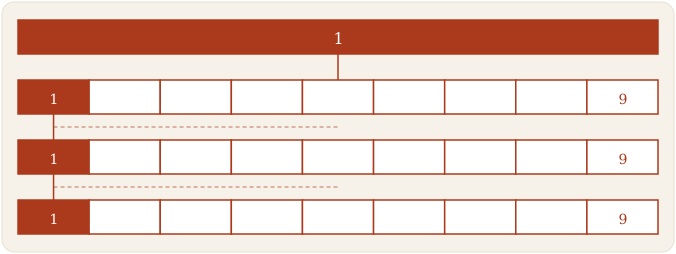
A nineteen-year Saturn mahadasha does not feel like nineteen identical years; in paramarsh's words, it has opening moves, hard middles and late releases. The framework that explains this changing weather is the sub-periods: nine antardashas inside the mahadasha, nine pratyantars inside each of those, and more below. The previous article (Vimshottari Dasha) gave the formula for the first two levels; this article opens the whole ladder, the arithmetic of all five levels, the hierarchy of interpretation, and the birth-time-precision audit that livepanditji runs per clock-minute, which we extend: the system's finest period is twenty minutes long, and an ordinary birth-time uncertainty overshoots it several times. The conclusion up front: the level system is consistent in arithmetic, but its deep levels are as meaningful as your birth time is precise, and that conclusion is the source's, not ours.
Two names, one period: antardasha and bhukti
First, the words. "Antardasha" literally means the inner dasha; "bhukti" is the name of the portion undergone in that period. paramarsh notes precisely that the two look at the same level from two sides: the first name locates the period inside the mahadasha, the second stresses the portion of experience. The sub-period's lord is called the antardashanath. The sequence is fixed: every mahadasha opens with the pairing of its own lord, a Saturn mahadasha with Saturn-Saturn, then Saturn-Mercury, Saturn-Ketu, Saturn-Venus and onward through the nine; the first name states the chapter, the second the window. And the nine sub-periods sum to the mahadasha by themselves, because in the proportional formula (mahadasha years x sub-lord years / 120) the years of all sub-lords sum to 120; this was verified in the previous article.
The arithmetic of five levels
livepanditji.com (27 October 2026) published the level table, and we re-verified every number ourselves. In the 120-year cycle: 9 mahadashas; 9x9 = 81 antardashas; 729 pratyantardashas; 6,561 sookshmadashas; 59,049 pranadashas, the powers of nine. Length bounds (on the 365-day year): the shortest pratyantar, Sun-Sun-Sun, is 6x6/120x6/120 years = 5.5 days; the longest, Venus-Venus-Venus, is 20x20/120x20/120 = 202.9 days. Sookshma: 6.6 hours to 33.8 days; prana: 20 minutes to 5.6 days. The averages also match: 120 years / 6,561 is about 6.7 days per sookshma, / 59,049 about 18 hours per prana. The source also notes that on the texts' 360-day year the same figures come out slightly shorter (sookshma minimum 6.5 hours); so the year-length assumption moves the table too. The figure above expands the first four levels. And the word meanings: sookshma = subtle, prana = breath; both names describe the period's size, not a new process; at every level the same one proportion is applied again.
The deep levels are in the texts
One confusion must go first: the sookshma and prana levels are not a modern software invention. Chapter 63 of the Brihat Parashara Hora Shastra is available under the title "Effects of Prana Dashas in Sukshma Dashas" (translation at divyachadhava.com); so the textual tradition runs result-reading down to the fifth level. This is a title-level warrant; we have not audited the chapter's result lists. The practical meaning: a practitioner using the deep levels stands on an old tradition, not a modern fashion; the question is not textual support but input precision, and that is the next section's subject.
One ladder, top to bottom: a worked example
Run the arithmetic once end to end; this example is our own computation. Suppose a Venus mahadasha begins. Level 1: Venus, 20 years. Level 2: the first antardasha, Venus-Venus, is 20 x 20/120 = 3.33 years, forty months; the next, Venus-Sun, is 20 x 6/120 = 1 year. Level 3: the first pratyantar inside Venus-Venus, Venus-Venus-Venus, is 3.33 x 20/120 = 0.556 years = 202.9 days, and the shortest inside it, Venus-Venus-Sun, is 3.33 x 6/120 = 60.8 days. Level 4: Venus-Venus-Venus-Venus sookshma = 0.556 x 20/120 = 33.8 days. Level 5: Venus-Venus-Venus-Venus-Venus prana = 33.8 x 20/120 = 5.6 days. At the other end, a Sun start: level 2 Sun-Sun = 0.3 years = 109.5 days; level 3 Sun-Sun-Sun = 5.5 days; level 4 = 6.6 hours; level 5 = 20 minutes. Every power of nine adds one more decimal place of fineness, and at every level the formula is the same: parent period x sub-lord years / 120. Because of this one formula a calculator prints 59,049 dates in milliseconds; the question is not the calculator's but the birth minute holding that date.
The limit of the input: the system's fineness versus the birth time's
This is the centre of this article, and the core computation is livepanditji's. Its argument: every Vimshottari date is counted from the Moon's position at birth; if the recorded time is off, the Moon is off, the balance at birth is off, and every boundary at every level slides by the same amount. At the mahadasha level that slide is measured in hours; at the sookshma-prana level the useful unit is a single clock-minute. In livepanditji's table, one minute of birth-time difference slides every date by 1.35 days (slow Moon, Sun nakshatra) up to 5.83 days (fast Moon, Venus nakshatra). The source itself writes the conclusion: the smallest slide is already longer than the average prana dasha, and the largest slide is longer than the longest prana dasha there is; even a birth time known only to the nearest five minutes leaves every date uncertain across a window 7 to 29 days wide, the same order as a whole sookshma dasha. These two levels, in the source's words, are only as real as the birth minute behind them.
From here on the computation is our own, standing on the source's table. Assumption: the birth time is known to plus-minus 15 minutes (a generous estimate for a hospital record). Then the shift window runs from 15 x 1.35, about 20 days, to 15 x 5.83, about 87 days; on a mean Moon our previous article's computation (the Moon at about 13.2 degrees a day, 15 minutes giving a balance shift of about 26 to 75 days) sits inside that range. Compare with the level lengths: the pratyantar minimum is 5.5 days, the sookshma maximum 33.8 days, the prana maximum 5.6 days. Conclusion: at a 15-minute input uncertainty the prana level is wholly a computational artifact (even its longest period is shorter than the shift), the sookshma level is submerged in most pairings, the pratyantar level's boundaries move by weeks, and the antardasha level is the depth at which a timetable on an ordinary birth time keeps its meaning. If you know the time to 5 minutes you can descend one level further, and even then the source's 7-to-29-day window still applies. So the five-level system's resolution has run far ahead of its input's resolution; this is no contradiction of the texts, it is an audit of the input. paramarsh records exactly the same practical conclusion: many modern practitioners stop at the pratyantar even though the sookshma layer appears in the traditional hierarchy, because each further division asks the recorded birth time to support a finer precision, and past a point going deeper erodes rather than improves the predictive value.
Why two calculators disagree at the deep levels
livepanditji lists three settings that barely show at the mahadasha level and decide dates down here. First, the year length: on the solar year a 20-year Venus mahadasha is about 105 days longer than on the 360-day year, and every sookshma inside it sits accordingly. Second, the ayanamsa: a different zodiac offset moves the Moon and so the balance. Third, the birth time as entered, including the time zone and any war-time or daylight-saving clock correction the program was or was not told about. When two printouts give sookshma dates a few days apart, one of these three is the first thing to check; neither program has made an error in the formula. This list is practical: before comparing two deep-level dates, match the two printouts' settings, otherwise you are comparing not two formulas but two assumptions.
The hierarchy of interpretation: promise and timing
In the layer above the arithmetic, the tradition assigns the levels their roles. paramarsh's formula sentence: the antardasha lord "activates and times what the mahadasha lord has promised". So the mahadasha holds the chapter's theme; the antardasha opens windows for that theme's events; the pratyantar is a finer level of event timing; and the deep levels, in practitioners' usage, serve day-and-hour precision work. Two ladders of this hierarchy are worth remembering. First, proportion: the deeper the level, the smaller the scope and the greater the input risk; see the computation above. Second, pair-reading: every sub-period is a blended flavour of two planets, and paramarsh discusses friendly and enemy pairings separately; both the two planets' natural friendship-enmity and their lagna-relative roles enter the reading. All of this belongs to the interpretation layer: not a measured science, but the tradition's method of reading.
One more concrete detail: the length spread within a level is itself a structure. At every level the shortest sub-period is the Sun's and the longest Venus's, because the year figures (6 to 20) are multipliers at every level; hence the pratyantar spread of 5.5 to 202.9 days, about 37 times. Practical meaning: even when two people in the same mahadasha are running an antardasha of the same name, their pratyantar calendars inside it are entirely different, because the opening balance and the antardasha's lord differ. This is why the tradition treats a sub-period list as chart-specific, not as any universal almanac table.
Common confusions
First confusion: antardasha and bhukti are different things. Two names for the same level. Second confusion: the mahadasha stays uniform and the sub-period brings a different rule. No; the same nine-fold proportion at every level, and each level's first sub-period is the lord paired with itself. Third confusion: sookshma and prana are modern inventions. The very title of BPHS chapter 63 is about the prana level. Fourth confusion: the deeper the level, the more precise the prediction. Read the input computation above; precision is bound to the input, not to the level depth. Fifth confusion: the chapter changes as soon as the sub-period changes. In the hierarchy the chapter belongs to the mahadasha; the sub-period is its window, and even within the tradition the result depends on the whole chart. Sixth confusion: the software's prana dasha list is the final truth. A list of 59,049 sub-periods makes input precision mandatory; without a precise birth time that list is arithmetic smoke.
Practical use
First, choose your level: with an ordinary birth time (uncertainty of minutes), read to the mahadasha-antardasha level; pratyantar when the birth time is well documented; sookshma and prana only when there is confidence in birth-time rectification. Second, in testing a reading: if a reading gives a prana-level date, first ask to what precision the birth time is known; without that answer the date is decoration. Third, in checking the arithmetic: compute any sub-period's length yourself, parent period x sub-lord years / 120; the formula is one at every level. Fourth, in expectation: read sub-periods as the language of changing weather inside a chapter, not as event guarantees; paramarsh's "promise and timing" frame is a good reminder of exactly this balance.
Three questions to ask before any sub-period reading: first, to which level does the reading descend, and is that level inside or outside the precision of my birth time? Second, in the mahadasha-lord and antardasha-lord pairing, who holds the promise and who opens the window; does the reading keep the two roles distinct? Third, are the sub-period lengths derived from the arithmetic or taken from a list; if from a list, does it assume the 365-day or the 360-day year, because that one assumption moves a pratyantar's length by up to two days? These three questions are this article's tools, and they can be asked without demanding loyalty to any particular school.
Sources and an honest note
The antardasha-bhukti word explanation, the antardashanath, the sequence rule, the "activates and times" hierarchy sentence and the discussion of friendly-enemy pairings are from paramarsh.app's antardasha guide; the five-level table (counts and length bounds), the word meanings, the 360-day-year note and the per-clock-minute birth-time computation (1.35 to 5.83 days per minute, the 7-to-29-day window at plus-minus 5 minutes, and the conclusion that these levels are only as real as the birth minute) are from livepanditji.com's article of 27 October 2026, all numbers independently re-computed by us; the title-level warrant of BPHS chapter 63 from divyachadhava.com; general context from prashnaonline.com. The plus-minus 15-minute extension (a shift window of 20 to 87 days, the level-submerging conclusions) is our own computation standing on the source's per-minute table, with assumptions stated above; the note that most practitioners stop at the pratyantar is from paramarsh. Everything tied to results is presented as a claim of the tradition; no measured connection between any sub-period and an event is established. This article is educational.


