Aquarius (Kumbha): The Water-Bearer of the Zodiac
Kumbha is the fixed air that pours for everyone: Saturn’s second sign, which does not build structures but reimagines them, and whose exaltation table stands empty. From the classical verse to the modern sign profile, the art of far sight and the challenge of closeness, with sources, and with an honest-limits note.
The climb has reached its height, and from the height, water is poured out for everyone below. The eleventh sign, Kumbha, is thirty degrees of fixed air, the water-bearer of the zodiac, and the sign Satyori's Kumbha guide calls humanitarian vision and unconventional thinking: the water-bearer pours knowledge for the benefit of the collective. This article audits that pouring in full: the sign's structure, the classical verse on an Aquarius Moon, Saturn's second house and the empty chairs of the exaltation table, the traditional tendencies in personality, career, relationships and health, and at the end an honest-limits note.
The sources are the usual four, each fetched for this article: Satyori's Kumbha rashi guide, a modern Jyotish reference last reviewed in May 2026; Wikipedia's Aquarius article for the tropical frame and the mythology, with its Aquarius constellation article for the older history; the Brihat Jataka's seventeenth chapter as republished in English translation at VedicPupil, which we read directly; and Panchangtime's Vimshottari dasha methodology table. Where the sources hedge or disagree, the hedge stays standing.
The eleventh cell: the structure
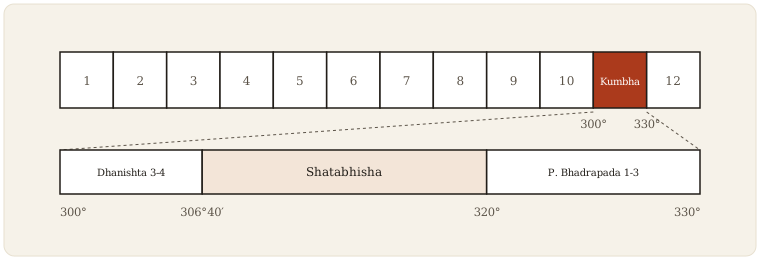
Kumbha is the eleventh sign of the zodiac, from 300 to 330 degrees. Its symbol is the water-bearer, which Satyori names Water-Bearer with Pot in brackets; the Wikipedia article on the constellation notes that the Hindu zodiac's own name, kumbha, means water-pitcher. Its element is air, its character Sthira, fixed, and its ruler is Saturn: the sign shares its lord with Makara but, per the guide, expresses Saturn's energy in a fundamentally different way. Where Makara builds within existing structures, Kumbha reimagines structures entirely; this is Saturn functioning not as the taskmaster but as the social reformer, the one who sees the flaws in the system and works tirelessly to correct them. As a fixed air sign, Kumbha combines intellectual conviction with remarkable persistence: unlike Mithuna, the mutable air that shifts perspectives fluidly, Kumbha arrives at its position through careful consideration and then holds it firmly. In the Vedic mapping of the Kalapurusha, the cosmic person of time across whose body the twelve signs lie, Kumbha is the calves and the ankles: the part that carries the body across distances, the walker's own equipment.
Three nakshatra segments fall within Kumbha: the third and fourth padas of Dhanishta, all of Shatabhisha, and the first three padas of Purva Bhadrapada. Each nakshatra spans 13 degrees 20 minutes of the zodiac, so Dhanishta's remaining two quarters run from 300 to 306 degrees 40 minutes, Shatabhisha from there to 320 degrees, and Purva Bhadrapada's first three quarters to 330; the arithmetic is ours from the standard nakshatra division. Two people both called Kumbha may therefore carry different nakshatras inside the same rashi, and in Jyotish the nakshatra carries its own weight. This collection carries a separate guide for each of the twenty-seven nakshatras, including Dhanishta, Shatabhisha and Purva Bhadrapada; here it is enough that the rashi sets the frame and the nakshatra paints the finer shade within it.
The reference tables add the smaller certainties. Wikipedia lists Aquarius as one of the three air signs alongside Gemini and Libra, the fixed air sign, with Leo as its opposite across the wheel, and its table records the rulers three ways: Saturn in the traditional scheme, Uranus in the modern, and Rahu, the ascending lunar node, in Vedic astrology. Satyori's quick-facts panel agrees on Saturn, air, fixed and the degrees 300 to 330, and adds the dosha column to which we return in the health note below.
Kumbha and Aquarius: two scales, one sky
They are two names for the zodiac's eleventh 30 degrees: Kumbha in the Vedic sidereal tradition and Aquarius in the Western tropical one. The tropical zodiac is tied to the equinox point and the sidereal to the stars, and an ayanamsha gap of about 24 degrees separates them, the figure Satyori's own FAQ gives, so your Western sun sign and your Vedic rashi can differ. On dates, Wikipedia's Aquarius page again disagrees with itself by a day, as its Capricorn page did: its summary table gives 20 January to 18 February for 2026, citing the US Naval Observatory's almanac, while its body text says the Sun is in tropical Aquarius between about January 20 and February 19. We keep both readings standing, as we have throughout this series. Vedic Kumbha is computed from the panchang, not from these tropical dates.
The water-bearer: from Enki's flood to Ganymede's cup
The figure above this sign has carried water for as long as records run. Wikipedia's Aquarius article records that the water carrier was originally Enki, or Ea, to the ancient Sumerians and Babylonia, and the constellation article fills in the colour: Aquarius stood in the quarter of the Sun's path called the Way of Ea, the 45 days on either side of the winter solstice, and was associated with the destructive floods the Babylonians regularly experienced, and thus negatively connoted; in Ancient Egypt the constellation was linked to the annual flood of the Nile, whose banks were said to flood when Aquarius put his jar into the river, beginning spring. In Greek tradition the figure came to be represented simply as a single vase from which a stream poured down toward Piscis Austrinus. In Greek mythology, the sign article says, the figure was interpreted as Ganymede, a beautiful Phrygian youth, the son of Tros, king of Troy, or, according to Lucian, also of Dardanus: while tending his father's flocks on Mount Ida, Ganymede was spotted by Zeus, who flew down in the form of a large bird and whisked him away to the heavens, where the boy has served as cupbearer to the gods ever since; Ovid has Orpheus sing the tale in the Metamorphoses. The constellation article keeps its own candidates under its own "sometimes": Deucalion, the son of Prometheus, who built a ship with his wife Pyrrha to survive the flood and sailed nine days to Mount Parnassus; and Cecrops I, the king of Athens who sacrificed water instead of wine to the gods. We keep every variant exactly where its source left it. The same page's Hindu astrology section names Kumbha Rashi, the water pot, ruled by Shani, a fixed air sign associated with innovation, humanitarianism and persistence, playing its role in individual horoscopes, compatibility matching and the timing of rituals.
The text's Kumbha Moon: Brihat Jataka
The Brihat Jataka's seventeenth chapter gives each Moon sign a verse-portrait, and we quote the Kumbha verse, 17.11, from the English translation at VedicPupil, fetched and read directly for this article. Moon in Aquarius: with a camel-like neck, prominent veins, a long, rough and hairy body, broad feet, thighs, back, hips, face and waist, and hard, or, as the translator's own bracket offers, aged-looking, jaratha; given to others' women, others' wealth and wrongdoing, meeting with loss and gain, fond of flowers, unguents and friends, enduring travel: so is one born in Aquarius, ghata. The site itself reduces the verse to a simple meaning: long body, fond of friends, flowers and perfume, can travel far; ups and downs in wealth; conduct needs care. This is one of the chapter's harsher portraits, and we quote it whole rather than softening it; the translator's bracketed alternative, "hard" beside "aged-looking", stays exactly as printed. The same chapter holds its own hedge in verse 17.13, which says these twelve Moon-sign natures hold when no other planet or condition in the chart affects that sign; otherwise the marks change. The tradition said first that its portraits are not verdicts. The twelve Moon-sign verses are twenty-eight lines among the chapter's four hundred and nine; that says how old these figures are, and also how much else the book contains.
Saturn's second house, and the empty chairs
Kumbha is Saturn's second sign, and the exaltation table leaves it conspicuously bare. Satyori's own FAQ prints the pair with its hedges attached: no planet is exalted in this sign, though Rahu is exalted here per some traditions; and no planet is traditionally debilitated here. Wikipedia's table spreads the same ground differently across eras: exaltation none traditionally, Pluto in the modern scheme, and Neptune as the modern fall, with the Sun recorded in detriment. Three sources' framings, two eras of practice, and one nodal hedge; we line them up and leave them unresolved, because that is where the literature leaves them. What the dasha table settles is time: per Panchangtime's Vimshottari methodology, Saturn's mahadasha runs 19 years, second only to Venus's 20 and ahead of Mercury's 17, Jupiter's 16, the Moon's 10, Mars's 7 and the Sun's 6. The reformer gets nearly the longest shift of all; changing structures, like building them, takes time.
Temperament, work and relationships: the tradition's map
Satyori's portrait: Kumbha natives are intellectually independent, socially conscious and genuinely eccentric, not for show but because they simply process the world differently than most. They value friendship deeply but maintain emotional distance even with close companions. Their objectivity is both their strength, they see systems clearly, and their limitation, they can intellectualize away genuine emotional needs. And they are often ahead of their time, advocating positions that society adopts decades later. The same page notes the shadow of the fixed air: strong opinions held with quiet conviction, which makes Kumbha natives principled and consistent but sometimes inflexible in their idealism, expecting others to live up to standards they have set through their own reasoning.
In careers the descriptive tradition places them in technology, social reform, science, research, nonprofit leadership, network building and humanitarian work; they make outstanding engineers, social entrepreneurs, scientists and community organizers, able to see large-scale patterns and think systematically about complex problems. They thrive in roles that allow them to work toward a vision larger than personal success, and struggle in environments that prioritize conformity over innovation. Satyori's own hedge stands here too: career outcomes depend on the tenth-house lord, planetary periods and overall chart strength.
In relationships, Kumbha natives offer intellectual companionship, unwavering loyalty to their principles and a genuine desire for their partner's independence. They can seem emotionally cool or detached, preferring ideas to feelings and often retreating into their inner world when overwhelmed. Partners who need constant emotional reassurance or who attempt to limit Kumbha's social world will face resistance; they are most compatible, per the guide, with partners who are intellectually stimulating, emotionally self-sufficient and share their values. The classical verse had already given the pattern its oldest line: the Aquarius Moon who endures travel and is fond of friends, a native built for the wide road and the wide circle rather than the single hearth.
On health the descriptive tradition ties Kumbha to the calves, ankles, circulatory system and nervous system, with tendencies toward poor circulation, varicose veins, ankle injuries and conditions related to nervous-system irregularity, including unusual or hard-to-diagnose conditions; Satyori adds that Saturn's influence combined with the air element creates a tendency toward Vata disorders that manifest in unexpected ways, and recommends regular movement, warm circulation-supporting practices and adequate rest for the active mind. Its dosha note gives Kumbha a strong Vata affinity through air and Saturn's cold, dry influence, producing irregularity, coolness and nervous sensitivity, and suggests warm, grounding, nourishing foods, regular daily routines, which Saturn actually supports when embraced, warm oil massage and practices that bring awareness from the mind into the body. All of this is that source's Ayurvedic framing, given in its name; this article offers no medical advice, and for any symptom the doctor is the authority. If you are pregnant, ill, elderly or on medication, any regimen the tradition mentions is not for you without a doctor's word.
The honest limits
Sign description is the tradition's framework, not measured psychology. Everything above is what the texts and one modern guide say about Kumbha, recorded with their names and their dates; it is not what we measured in any person. The Brihat Jataka itself conditions every mark on the rest of the chart not disturbing the sign, and Satyori itself conditions career on the tenth lord and the dashas. A rashi is one thread of a chart and no thread of your worth. Do not measure anyone else by their sign, and do not pour yourself into one either; being Kumbha is not being only this.
Keep one practical test as well: if some description here does not fit you at all, that is no fault of yours and none of the tradition's; the text laid down beforehand that these portraits are general. And if a description does fit, do not make it your ceiling; the tradition itself let this sign's water serve two purposes, the flood that destroys and the jar that waters the spring, and which one a life pours is practised, not fated, by choice, not by sign.
Short answers
What is the difference between Kumbha and Aquarius? A matter of scale: Vedic sidereal Kumbha is tied to the stars, tropical Aquarius to the equinox, and a gap of about 24 degrees separates them; one birth date can therefore fall in different signs in the two systems. Is any planet exalted in Kumbha? No planet traditionally; Satyori adds that Rahu is exalted here per some traditions, and Wikipedia's table records Pluto as the modern exaltation and Neptune as the modern fall, all of which we have kept standing as the sources wrote them. Are Aquarius people really detached? The tradition frames the distance as the price of the objectivity, and the classical verse's fond-of-friends native keeps a wide circle rather than a single hearth; the text itself says the marks change with the rest of the chart. Is reading personality from a sign scientific? No; it is the tradition's descriptive framework, presented here as exactly that, with sources.
Questions on this article
What is the difference between Kumbha and Aquarius?
They are two names for the zodiac’s eleventh 30 degrees: Kumbha in the Vedic (sidereal) tradition and Aquarius in the Western (tropical) one. The difference is that the tropical zodiac is tied to the equinox point and the sidereal to the stars; an ayanamsha gap of about 24 degrees separates them, so your Western sun sign and your Vedic rashi can differ. Wikipedia’s table gives 20 January to 18 February for tropical Aquarius in 2026 while its body text says about January 20 to February 19; Vedic Kumbha is computed from the panchang.
Is any planet exalted or debilitated in Kumbha?
Traditionally both seats are empty: per Satyori, no planet is exalted here and none debilitated, though Rahu is exalted here per some traditions. Wikipedia’s table adds the modern practice: Pluto as the modern exaltation, Neptune as the modern fall, and the Sun in detriment. We have kept all three framings exactly as the sources wrote them.
Are Aquarius people really detached?
The tradition frames the distance not as absence of feeling but as the price of objectivity: per Satyori, Kumbha natives value friendship deeply but keep emotional distance even with close companions, and retreat into their inner world when overwhelmed. The Brihat Jataka’s Aquarius-Moon verse calls the same native fond of friends and enduring of travel. And the text itself (17.13) says these marks change with the rest of the chart. Do not mould or measure any person by their sign.
Is reading personality from a sign scientifically established?
No, and this article makes no such claim. Sign description is the framework of the Jyotish tradition, carried through texts and practising astrologers over centuries; we present it as exactly that, with sources. Do not treat it as a substitute for psychology or medicine; as a way of reflecting on oneself it can be a cultural mirror, not a measuring instrument.


