Aries (Mesha): The First Spark of the Zodiac
Mesha is where the zodiac begins: the fire of Mars, a cardinal character, and the energy that steps before it thinks. From the classical verse to the modern sign profile, the courage to start and the challenge to sustain, with sources, and with an honest-limits note.
Where the zodiac’s story begins, there stands Mesha. The first thirty degrees, the first sign, and in the tradition’s language the head of the Kalapurusha, the part that goes foremost into every journey. Satyori’s Mesha guide compresses this sign’s energy into one line: it is the spark that starts the fire, not the sustained flame. This article audits that spark in full: the sign’s structure, the classical portrait, the ruling planet and the exaltation-debilitation reasoning, the traditional tendencies in personality, career, relationships and health, and at the end an honest-limits note.
Everything below comes from sources fetched on 31 October 2026: Satyori’s Mesha rashi guide, the seventeenth chapter of the Brihat Jataka available at VedicPupil (which we read directly, in that page’s English translation), and Wikipedia’s Aries article for the tropical-sidereal difference. Where a tendency belongs to a source, the source is named; where a note is ours, it is marked. Sign description is the tradition’s framework; we give it as description, not as diagnosis.
The first cell: the structure
Per Satyori, Mesha is the first sign of the zodiac, spanning 0 to 30 degrees. Its symbol is the ram, which lowers its head and pushes forward with single-minded resolve. Its element is fire, its character chara, cardinal, the initiating kind, and it is classed in the masculine group. The ruling planet is Mars. In the Vedic tradition the head of the Kalapurusha, the cosmic person of time across whose body the twelve signs are laid, falls in Mesha; that is why the head-first way of moving through life became this sign’s mark. Being a cardinal fire sign means this is the fire of initiative: the courage to begin, the bent to open a new path, the step before the plan. Satyori also writes it as the point where the soul initiates its journey into the world of action; being the first sign is not just an ordinal, it is the centre of this sign’s character.
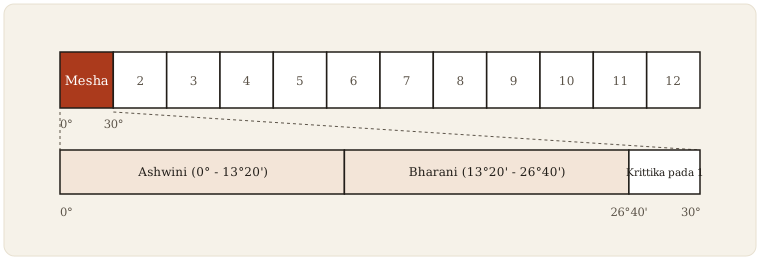
Mesha holds three nakshatra segments: all of Ashwini, all of Bharani, and only the first pada of Krittika. Each nakshatra in the zodiac spans 13 degrees 20 minutes, so Ashwini runs from 0 to 13:20, Bharani from there to 26:40, and Krittika’s first pada from 26:40 to 30; this follows the standard nakshatra division. Two Mesha natives can therefore belong to different nakshatras within the same sign, and in Jyotish the nakshatra carries its own weight. This site carries a separate guide for each of the twenty-seven nakshatras, including Ashwini, Bharani and Krittika; here it is enough that the sign sets the frame and the nakshatra paints the finer shade within it.
One more boundary line matters: in Indian usage ‘rashi’ usually means the Moon sign, the sign the Moon occupied at the moment of birth. The classical chapter we quote below is titled exactly that, Chandra-rashi-sheel, the characters of the Moon signs. A chart also has a lagna, the sign on the rising horizon, and a Sun sign; the three signify different things. And Satyori adds in one line that the condition of Mars in the chart strongly influences how Mesha expresses in a life. The sign, in other words, is one axis, not the whole picture.
Mesha and Aries: two scales, one sky
In Western astrology Aries is the same first sign: the ram, the fire element, the cardinal quality, Mars as ruler; per Wikipedia, in the tropical system it runs from 20 March to 20 April in 2026. But the tropical zodiac is bound to the equinox point, while the Vedic sidereal zodiac is bound to the stars. Satyori states the gap between them as an ayanamsha of about 24 degrees. The practical result: a person whose Western sun sign is Aries may have Mesha as the Vedic rashi, or may have Meena; it is not the date that changes but the scale. This article speaks of Vedic Mesha, and for date boundaries rely on your own panchang or chart calculation. One small instructive detail: Wikipedia’s table marks the tropical boundary with the year, ‘2026’, which means even that boundary shifts slightly from year to year; in no system is a sign’s edge a fixed wall, it is a calculated line.
What the classical text says: the Brihat Jataka’s Aries Moon
Varahamihira’s Brihat Jataka is among the root texts of Jyotish, and we read its seventeenth chapter, Chandra-rashi-sheel, directly on VedicPupil’s page; that chapter gives the results of the Moon in each sign. In that page’s translation, the portrait of a person with the Moon in Aries runs like this: round reddish eyes, fond of hot and light food, quickly pleased, a wanderer, amorous, weak in the knees, unsteady in wealth, brave, liked by women, knowing service, with poor nails, a scarred head, proud, the eldest among siblings, a spear’s mark on the palm, very fickle, and very much afraid of water. This portrait comes from a tradition many centuries old, and in its own words the life of that age shows through; we have recorded it as it stands.
The thirteenth verse of the same chapter lays down the condition that is so often dropped: these qualities arrive in full only when the Moon and the sign lord are both strong; otherwise the results need further consideration. Which is to say, the text itself calls sign description a general outline, not final without the particular chart. The tradition’s own caution remains as precise today.
One more detail from the page gives context: the Brihat Jataka is a work of 409 verses in 28 chapters, and the seventeenth chapter gives the Moon-sign results for all twelve signs, one verse each; the English we read is VedicPupil’s own translation. It is useful to know how compressed the classical description is: more than twenty traits in a single verse, without commentary. A modern sign guide, such as Satyori’s, unfolds those same seeds into the context of present-day life; the two are best read with one eye, the seed from the text, the growth from today’s commentary.
The engine of Mars
Mesha’s ruler is Mars, and per Satyori this is what explains the sign’s tempo: the raw energy of action, the impulse to act before thinking, the tendency to advance before planning. In the texts, Mesha natives are described as adventurous, independent, quick to anger and equally quick to forgive; Satyori gives this description citing the classical books. Rising fast and cooling fast are two faces of one fire: what flares quickly also settles quickly, and in Mesha anger does not stay deposited.
Mars has its place in the timing tradition too. Per PanchangTime’s Vimshottari dasha guide, the Mars mahadasha runs 7 years within the 120-year Vimshottari cycle, a cycle that unfolds from the birth Moon’s nakshatra. In the tradition’s way of speaking, when a Mesha native’s Mars period is running, the sign’s own engine sits in the driver’s seat for that stretch; this too is description, not prediction.
The exalted Sun, the debilitated Saturn
In Jyotish every planet has one sign of exaltation and one of debilitation, and Mesha sits in both lists. Per Satyori, the Sun is exalted here at 10 degrees, because Mesha provides the ideal environment for self-expression and individual will; and Saturn is debilitated here at 20 degrees, because Mesha’s impulsive nature resists the slow, restrained, methodical energy that Saturn requires. This reasoning is the tradition’s internal logic: the fit or friction between the temper of a planet and the temper of a sign. Do not read it as a physical measurement; it is the tradition’s own symbol-system, which we give as it stands. One pleasing agreement: Wikipedia’s tropical table also records the Sun’s exaltation and Saturn’s fall for Aries, so on this one point at least the two traditions share a conclusion.
Personality: the spark’s strength and its price
Per Satyori’s Mesha guide, Mesha natives are natural initiators who come alive on challenge and competition. Their way of speaking is direct, sometimes blunt, and can read as refreshing or abrasive depending on context. The courage is real: they step into situations others avoid. Along with it, the other side of the same picture: the attention span for any single pursuit can be short, and the great lesson for Mesha is to sustain what it starts. The spark lights the fire; keeping the flame is this sign’s life-work. The same growth area can also be read in reverse: the capacity to warm up a task that has gone cold is equally a Mesha speciality, and in teams this sign often does what the profile says, giving the stalled work its first push.
Career: where decisions must be quick
Per Satyori, Mesha natives excel in roles that ask for swift decision, physical courage or entrepreneurial drive: the military, surgery, athletics, emergency services, the leadership of startups. Given autonomy and a clear challenge they perform at their best; repetitive routine wears them down. A management role fits only when they can delegate the fine-grained work they find tedious. The same source’s own caution must be recorded too: real career outcomes depend on the tenth house lord, the dasha sequence and the strength of the whole chart; settling a career from the sign alone is considered incomplete even within the tradition.
Relationships: direct and warm
Per Satyori, in relationships Mesha natives are passionate, protective and sometimes possessive. They fall in love quickly and declare their interest with characteristic directness. A partner needs to value their independence: Mesha requires open room for its own pursuits and feels suffocated by clinginess. Conflicts usually resolve fast, because they speak their anger openly instead of storing it. The classical ‘quick to forgive’ becomes, here, a relationship’s real asset. The profile adds a balance too: the possessiveness can at times run high, and the direct word can land as harsh; the direction of growth is the one visible across the whole portrait, joining the impulse to patience.
Health tendencies and pitta
Per Satyori, Mesha’s traditional areas of vulnerability are the head, the brain and the adrenal system; tendencies to headaches, migraines, fevers and inflammatory conditions are linked with this sign, with a warning of burnout from an always-high output of energy. Connecting to Ayurveda, it says that the fire element and Mars rulership give Mesha a strong pitta affinity, and that cooling foods, moderate exercise and practices that channel the competitive fire constructively are, in its account, helpful. All of this is that source’s Ayurvedic framing, which we have given in its name; this article offers no medical advice, and for any symptom the doctor is the authority. One more remark from that page is worth noting: it speaks of moderate exercise rather than extreme exertion, that is, of not accidentally stoking one’s own fire further; the small detail is a good example of the pitta reasoning at work.
An honest-limits note (this section is ours)
Reading personality from a sign is the framework of the Jyotish tradition, not measured psychology. What we have given above is the description of the texts and modern astrology sources, with those sources named; we do not claim that any scientific link between birth sign and personality is established. The text itself, Brihat Jataka 17.13, says these qualities are general and incomplete without the chart’s strength. The most accurate use of this article is as a cultural mirror: an old language in which to reflect on one’s own tendencies. Do not measure anyone else by their sign, and do not pour yourself into one either; being Mesha is not being only this.
Keep one practical test as well: if some description in this article does not fit you at all, that is no fault of yours and none of the tradition’s; the text laid down beforehand that these portraits are general. And if a description does fit, do not make it your ceiling; the most important part of the spark’s story is that keeping the flame can be learned, and that learning comes from practice, not from a sign.
In sum
Three things are enough to understand Mesha. It is the zodiac’s first cell, 0 to 30 degrees, the fire of Mars with a cardinal character, the head of the Kalapurusha; and it holds the nakshatra segments of Ashwini, Bharani and Krittika’s first pada. From the classical verse to the modern profile its picture turns on one axis: the courage to begin, the direct word, quick anger and quick forgiveness, and ahead the challenge of carrying a beginning through to its end. The Sun is exalted here and Saturn debilitated, and that reasoning too is one of temperamental fit. And finally our own limit: all of this is the tradition’s language, given with its sources; not a measuring instrument, but a mirror.
Questions on this article
What is the difference between Mesha and Aries?
They are two names for the zodiac’s first 30 degrees: Mesha in the Vedic (sidereal) tradition and Aries in the Western (tropical) one. The difference is that the tropical zodiac is tied to the equinox point and the sidereal to the stars; an ayanamsha gap of about 24 degrees separates them, so your Western sun sign and your Vedic rashi can differ. Per Wikipedia, tropical Aries runs 20 March to 20 April in 2026; Vedic Mesha is computed from the panchang.
Why is the Sun exalted and Saturn debilitated in Mesha?
Per Satyori’s Mesha guide, the reasoning is temperamental: Mesha offers the ideal ground for self-expression and individual will, so the Sun is exalted here at 10 degrees; and Mesha’s impulsive nature resists the slow, restrained, methodical energy Saturn needs, so Saturn is debilitated here at 20 degrees. This is the tradition’s internal logic, not a physical measurement.
Are Mesha people really quick to anger?
The tradition’s description is that Mesha natives are quick to anger and equally quick to forgive; Satyori writes this citing classical texts, and the Brihat Jataka’s Aries-Moon verse also pairs fickleness with bravery. But this is astrology’s own language, not a psychological diagnosis; the text itself says the qualities hold fully only when both the Moon and the sign lord are strong. Do not mould or measure any person by their sign.
Is reading personality from a sign scientifically established?
No, and this article makes no such claim. Sign description is the framework of the Jyotish tradition, carried through texts and practising astrologers over centuries; we present it as exactly that, with sources. Do not treat it as a substitute for psychology or medicine; as a way of reflecting on oneself it can be a cultural mirror, not a measuring instrument.