Astrology and Science: Evidence and Limits
What was tested, what was found, and what remains unproved.
Science asks what a claim predicts
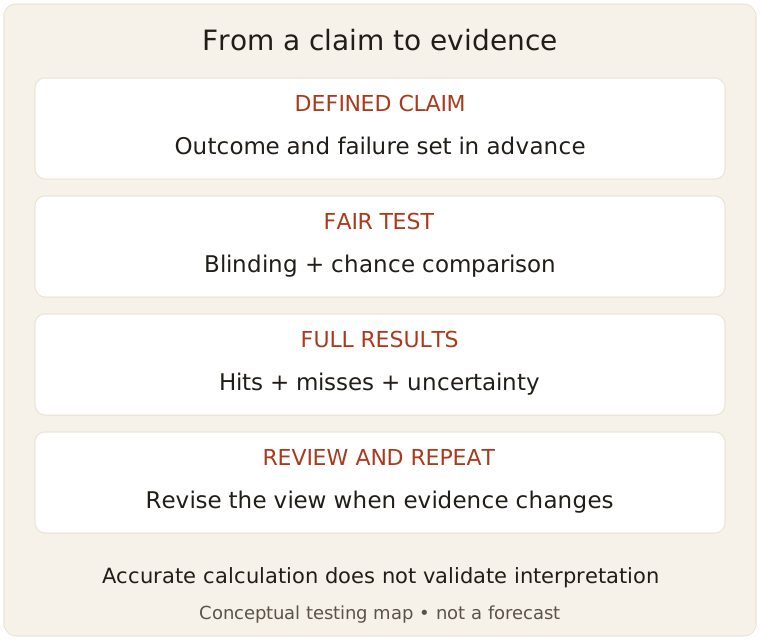
Astrology and science meet at a question: what evidence would show that a particular astrological claim is reliable? The answer is not supplied by a chart's beauty, a tradition's age, or the confidence of the person interpreting it. If a claim says something about personality, events, or outcomes in the world, we can ask what it predicts and whether the prediction survives a fair comparison. That is different from asking whether someone finds a symbol meaningful or enjoys a family observance.
The sources discussed here do not establish astrology as a reliable scientific method of prediction. This guide explains why, while keeping the limits of individual studies visible. It does not claim that one experiment has examined every technique ever practised. It also does not treat an untested claim as validated merely because a study used another system. Cultural interest and personal reflection can remain choices. Claims of knowledge about the world still need evidence appropriate to what they say.
Astronomy and astrology are different questions
NASA Space Place describes astronomy as the scientific study of objects and phenomena in space. It distinguishes astrology as the belief that positions of stars and planets can predict the future or describe people, and says those claims are not based on scientific evidence. Astronomers may calculate positions that also appear in astrological charts. Sharing some inputs does not mean the two activities have the same method, evidence, or purpose. A measurement of a planet's position is not a measurement of a person's character.
This distinction avoids a common shortcut: an accurate calculation cannot automatically validate every interpretation attached to it. A calendar can tell us when an event is scheduled without proving that the chosen date causes success. Likewise, a charting program can reproduce a convention accurately without demonstrating the convention's predictive claims. Ask separately whether the input is correct, whether the calculation follows its rules, and whether the interpretation has been supported. Those questions should not be collapsed into one claim that the software is scientific.
Precision is not the same as validity
A birth time written to the minute can look impressively precise. But precision describes detail, not necessarily truth or usefulness. If the recorded time is uncertain, the chart should not hide that uncertainty. Even if the time is correct, the claim that a configuration explains a trait remains a separate inference. Increasing the number of chart factors may make the description more elaborate without demonstrating that it predicts new information accurately. Complexity is not a substitute for a successful test.
Compare two questions: did the software place this planet where the chosen astronomical model says it belongs, and did the interpretation distinguish this person from other people? The first concerns calculation; the second concerns a proposed relationship between a chart and a life. Evidence for one cannot simply be carried across to the other. A useful explanation names which question it answered. It should not let technical language conceal that the more important predictive question is still unsupported.
Make the claim specific before seeing the result
UC Berkeley's account of scientific testing starts with expected observations: if an idea is correct, what should we see, and does that match what we observe? It also asks what we would expect if the idea were wrong or another explanation were correct. For an astrological claim, that means defining an outcome clearly enough that failure is possible. A statement that any change counts as confirmation does not separate a working method from an interpretation that can fit anything.
Consider a hypothetical prediction of a job offer within a defined month. Before the month begins, specify what counts as an offer, what the prediction applies to, and how a miss will be recorded. Do not turn it into a prediction of personal growth if no offer arrives. This example explains a testing principle, not a recommendation to base employment decisions on a forecast. A test should examine a claim without making the person's welfare depend on its success.
A fair comparison includes ordinary chance
Getting some answers right does not by itself show special ability. A comparison must ask how often the same result would occur without the proposed skill. In a task with five equally likely choices and one correct answer, random guessing succeeds one fifth of the time on average. Across twelve such questions the expected average is 2.4 correct answers. These are averages over repeated guessing, not a rule that each individual must obtain exactly that score.
A forecast about a common event needs a different baseline from a forecast about a rare event. Saying that someone will have a difficult conversation is not very informative if almost everyone would report one during the period. A useful test compares like with like and records the full set of results. Selecting only striking successes after the event can make almost any method look stronger. The comparison needs to be chosen before the most appealing pattern is known.
Why blinding matters
If a reader knows which description belongs to which person, that knowledge can affect interpretation even without deliberate dishonesty. A test can reduce that problem by withholding information that would reveal the answer. Blinding concerns who knows what during the test. Clear instructions, comparable materials, and a planned scoring rule also matter. These protections are not an insult to the participant; they help distinguish the claimed ability from ordinary clues, expectations, or accidental information.
Nature's publisher page for Shawn Carlson's 1985 paper states that two double-blind tests examined the thesis that natal charts accurately describe personality traits. That identifies the question and design at the abstract level. The publisher page alone is not a complete account of every result, and this guide does not invent effect sizes from it. Berkeley's educational assessment cites the paper among tests whose evidence did not support astrological ideas. Keep those two sources' roles separate: a primary publication record and a broader educational assessment.
A recent full-chart matching study
Clearer Thinking's detailed report describes matching information about twelve real people to their natal charts. For each person, participants chose one chart from five options. Its primary analysis included 152 participants with astrological experience who expected to perform better than chance. The report gives an average of 2.49 correct answers out of twelve, compared with the chance expectation of 2.4. It reports a 95 percent confidence interval for the average of 2.29 to 2.7 and no statistically significant advantage over guessing.
The small numerical difference between 2.49 and 2.4 is not evidence of a demonstrated useful skill just because the first number is larger. The report's analysis must be considered with its uncertainty and design. Participants could use full charts, rather than only sun signs; the charts were shown in Placidus and Whole Signs forms. The report also found no statistically significant relationship between greater experience and better performance. Confidence about having answered well did not establish that the answers were right.
Keep the study's scope attached to the conclusion
This was a Western-style chart-matching task reported by the organisation that ran it. It was not a direct trial of every Jyotisha technique, muhurat rule, or religious observance. Self-reported experience in another tradition does not turn the materials into a dedicated test of that tradition. The conclusion should stay tied to the actual task: the tested participants did not demonstrate better-than-chance matching under these conditions. That is meaningful negative evidence for the ability examined, not a census of every possible practitioner.
At the same time, scope is not a loophole that supplies positive evidence elsewhere. If someone claims that a different system reliably predicts a medical outcome or a marriage, they need evidence for that claim. Saying that a Western study did not test it is a description of a gap, not proof that it works. A fair standard applies symmetrically: do not overstate a negative result, and do not turn the absence of a direct test into a reason to trust a high-stakes forecast.
Statistical language should not become a certainty trick
A confidence interval describes uncertainty in an estimate under the analysis used. It is not a personal success range for every astrologer, and it does not mean there is a 95 percent chance that any one reading is correct. A result described as not statistically significant is not automatically proof of exact equality. Here the report's central finding is that its task did not demonstrate a reliable advantage over the chance comparison. The wording should not be made stronger or weaker to suit a preferred belief.
When reading another study, ask how many people were included, which outcomes were examined, which exclusions were made, and whether the analysis was selected after seeing the results. A single impressive number is not enough. A claim that may influence care, money, or another person's life needs useful accuracy in the relevant setting, not merely a suggestive result somewhere else. Statistical interest and practical reliability are different questions, and both deserve a clear answer.
Personal recognition is not a controlled test
The APA Dictionary calls the tendency to see general personality descriptions as specifically applying to oneself the Barnum effect. A statement about sometimes feeling confident and sometimes wanting reassurance may feel intimate while fitting many people. This does not make the feeling unreal. It means that recognition alone cannot tell us whether the description came from information unique to a birth chart. A fair test needs alternatives that are comparable in tone and plausibility, rather than one flattering account beside obvious nonsense.
Anecdotes also need their missing context. How many forecasts were made, how many failed, and how much interpretation was added afterwards? A remembered success can be sincere without establishing the method. These questions should be asked respectfully. They concern the quality of evidence, not the worth or intelligence of a person who finds a reading helpful. The same care should apply to a sceptic's favourite story. A conclusion earns trust by surviving fair checks, not by making the other side look foolish.
Replication and revision are part of the standard
Berkeley's testing guide explains that scientific conclusions respond to supporting and refuting evidence and may be revised. Its astrology assessment criticises the failure to change ideas in response to contrary findings. An isolated apparent success should therefore lead to further checks: can an independent team obtain a similar result, using a clear method and new observations? Repeating the same story is not replication. Neither is adding a new explanation after each failure while leaving the original claim untouched.
A proposed mechanism would also need examination, but a mechanism is not the only issue. A reliable effect can be investigated before every detail of its cause is known. Conversely, saying that the cause is mysterious does not remove the need to show the effect. The immediate question is whether the method actually performs as claimed. If a future study supplies strong, repeatable evidence for a specific ability, it should be considered. Openness to evidence is different from granting an unsupported claim authority today.
Culture does not need a borrowed scientific certificate
A person can study the language of nakshatras, enjoy a story, or mark a family date without claiming demonstrated prediction. A ritual's meaning may lie in belonging, memory, or chosen faith. Those experiences need not be disguised as laboratory results. They also do not settle an empirical claim about disease, personality, or future events. Keeping the categories distinct lets people discuss culture honestly while avoiding a false promise about what a chart knows.
Respect works in both directions. Someone may decline a reading without rejecting their family, and someone may enjoy one without agreeing that it controls their choices. Do not use an interpretation to label a child, accuse a partner, judge a colleague, or publish another person's private information. Cultural attachment does not supply consent for those actions. Where people disagree, discuss the actual decision and its consequences rather than making belief itself a condition of being included.
An evidence-first way to finish the conversation
Before accepting a scientific-sounding claim, ask for the exact claim, the original source, the method, the comparison, the full results, and the limitations. Check whether the source tested the same system and outcome being advertised. Be cautious when a seller offers certainty, hides misses, or says an urgent purchase is needed to prevent harm. A family's own devotional objects are distinct from a seller's product promises. Neither fear nor technical vocabulary should decide what you spend or whom you trust.
The practical conclusion is restrained but clear. The evidence discussed here does not support treating astrology as a reliable predictive science. Individual studies have limits, and unsupported claims remain unsupported rather than becoming true by default. Keep health, legal, financial, and relationship decisions grounded in relevant facts, qualified help, and consent. Optional reflection can remain optional. A responsible explanation admits what was tested, what was found, and what is still unknown without selling uncertainty back to the reader as fate.
Sources consulted
- NASA Space Place: astronomy and astrology
- UC Berkeley: astrology assessment
- UC Berkeley: testing scientific ideas
- Nature: Carlson 1985 publication and abstract
- Clearer Thinking: detailed full-chart study report
- APA Dictionary: Barnum effect