Baby Names by Nakshatra: The Avakahada Chakra and the Complete 108-Syllable Table
The first syllable of a name from the birth nakshatra's pada: the tradition, the arithmetic, the full table, the causes of variants, and a balanced view.
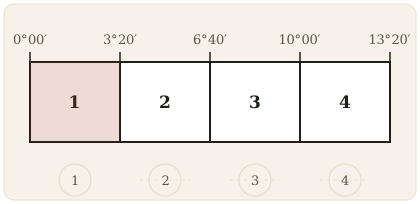
The naming ceremony carries a beloved tradition: giving a child a name that begins with the syllable of their birth nakshatra's pada. At the tradition's root sits a fixed table, the avakahada chakra, which assigns one syllable to each of the 108 padas of the 27 nakshatras. This article opens that table fully: its structure, its mathematical relationship to the twelve signs, the complete 27-row table itself, the method for finding your own baby's pada, and the results of our own verification exercise. We placed three independently published tables side by side, cell by cell, and found 99 of 108 cells identical, nine cells differing only in vowel length, and two famous divergences with documented historical causes. The table belongs to tradition; its use is a matter of culture, not destiny.
What the tradition is: the first syllable
The tradition is simple. Whichever pada of whichever nakshatra the Moon occupied at birth, that pada's syllable becomes the first syllable of the child's name. At the namkaran ceremony, or around it, the family chooses a name beginning with that syllable. Examples: a child born in Ashwini's first pada receives "choo", in the second pada "chay"; Magha's four padas carry maa, mee, moo, may. Notice two things. First, the syllable comes from the Moon's position, not the Sun sign. Second, it is pada-specific, not merely nakshatra-specific: two children born in the same nakshatra can receive different syllables when the Moon stood in different padas.
The avakahada chakra: a grid of 108 syllables
The table's foundation is the avakahada chakra: 27 nakshatras, four padas each, 108 padas in all, one syllable per pada. The pada arithmetic is developed in our pada article: each pada is a quarter of a nakshatra, 3 degrees 20 minutes of arc. The number 108, itself held sacred in the tradition, arises here quite naturally as 27 times 4. The syllable allocation also dovetails with the signs: nine padas, exactly 30 degrees, make one sign, so each sign holds exactly nine syllables in sequence, and the nine nakshatras through which a sign boundary passes, Krittika, Mrigashira, Punarvasu, Uttara Phalguni, Chitra, Vishakha, Uttara Ashadha, Dhanishta and Purva Bhadrapada, have their padas split across two signs. At three points a nakshatra and a sign end together, at the Ashlesha-Magha, Jyeshtha-Mula and Revati-Ashwini junctions; these are the same three junctions the tradition calls gandanta, analysed in our gandanta article.
The complete table: 27 nakshatras, 108 syllables
Below is the full table in pada order. It is the North Indian table as printed in Hindi panchangs; documented variants are recorded in later sections. Because Roman spellings can be ambiguous, the table gives Devanagari, and the reading guide that follows explains why Devanagari should be treated as final.
| Nakshatra | Pada 1 | Pada 2 | Pada 3 | Pada 4 |
|---|---|---|---|---|
| Ashwini | चू | चे | चो | ला |
| Bharani | ली | लू | ले | लो |
| Krittika | अ | ई | उ | ए |
| Rohini | ओ | वा | वी | वू |
| Mrigashira | वे | वो | का | की |
| Ardra | कू | घ | ङ | छ |
| Punarvasu | के | को | हा | ही |
| Pushya | हू | हे | हो | डा |
| Ashlesha | डी | डू | डे | डो |
| Magha | मा | मी | मू | मे |
| Purva Phalguni | मो | टा | टी | टू |
| Uttara Phalguni | टे | टो | पा | पी |
| Hasta | पू | ष | ण | ठ |
| Chitra | पे | पो | रा | री |
| Swati | रू | रे | रो | ता |
| Vishakha | ती | तू | ते | तो |
| Anuradha | ना | नी | नू | ने |
| Jyeshtha | नो | या | यी | यू |
| Mula | ये | यो | भा | भी |
| Purva Ashadha | भू | धा | फा | ढा |
| Uttara Ashadha | भे | भो | जा | जी |
| Shravana | खी | खू | खे | खो |
| Dhanishta | गा | गी | गू | गे |
| Shatabhisha | गो | सा | सी | सू |
| Purva Bhadrapada | से | सो | दा | दी |
| Uttara Bhadrapada | दू | थ | झ | ञ |
| Revati | दे | दो | चा | ची |
How to find your baby's pada
Reaching the pada takes three steps. Step one: cast the birth chart from the date, time and place of birth, using any reliable charting software or panchang service; the chart lists the Moon's nakshatra and pada directly. Step two: if only the nakshatra is known, the pada can be computed by hand. Divide the Moon's position within the nakshatra by 3 degrees 20 minutes; the first quarter is pada one, and so on. Step three: read the syllable for that pada from the table above. One caution: a small error in recorded birth time can change the pada, since the Moon spends roughly six hours in a pada on average; if the birth time is approximate, the syllable is approximate too. In that situation, whichever syllable the family settles on remains entirely within the tradition's spirit.
Our cross-check: three tables, 99 identical cells
We opened and read three independently published tables in full and compared all 108 cells: the tables at astrobabyname.com, vedicmarga.com and astroanktara.com. The result: 99 cells agree exactly. Nine cells differ, and every difference is a matter of vowel length or written form: Ashwini-1 gives choo or chu; Krittika-2 gives ee or i; Rohini-4 gives voo or vu; Ardra-1 gives koo or ku; Pushya-1 gives hoo or hu; Hasta-1 gives poo or pu; Purva Ashadha-4 gives dha with a long or short form; Dhanishta-3 gives goo or gu; Revati-3 gives cha with a long or short form. There is no dispute anywhere about the base consonant; the variation is long versus short vowel, which largely descends from Roman printing conventions. The practical conclusion: in these cells both forms are tradition-consistent; whichever form the family or priest recognises is the right one for that family.
Two famous variants: Shravana and Uttara Bhadrapada
Beyond these nine cells, two divergences are well known, and both have documented causes. The first concerns Shravana's entire row. Some tables give Shravana's syllables as khee, khoo, khay, kho; others give joo, jay, jo, gha. A source explains the reason: joo, jay, jo originally belonged to Abhijit, the nakshatra that sat between Uttara Ashadha and Shravana in the older 28-nakshatra count; tables that folded Abhijit into the 27 passed its syllables to Shravana. The second concerns Uttara Bhadrapada's fourth pada. Its syllable is "nya", a nasal consonant with which no name begins, so some tables print "da" in its place. Both cases show that table differences usually arise from history or printing practicality, not from deep disagreement.
The Roman-spelling trap: treat Devanagari as final
Tables written in English create an additional tangle: one Roman label can stand for two different sounds. "Ta" is sometimes the retroflex ट and sometimes the dental त; "Na" can be ण, न or ङ; "Dha" can be ध or ढ. The nine divergent cells we found are partly this same trap: "Chu" can be चू or चु. The rule is therefore simple: when deciding the syllable, treat the Devanagari as final; the Roman transliteration is only a helper. This is why the table above is given in Devanagari.
Regional traditions: one table does not fit all
This table belongs to the North Indian Hindi-panchang tradition. South India has its own regional nakshatra names, Krittikai for Krittika in Tamil, Tiruvonam for Shravana, and the Tamil, Telugu and Malayalam naming traditions carry their own distinct conventions, which this table does not cover; some regional lists give different syllable groups altogether. If your family tradition is South Indian, the table that governs is the one in your regional panchang or your family priest's practice. This regional variation repeats the central lesson of this article series: the "correct table" is the one your own tradition recognises.
How the syllable becomes a name
In practice families proceed in several ways, all of them valid within the tradition. The most direct: any preferred name beginning with the syllable, Chudamani for "choo", Manav for "maa". Some families limit the syllable to the calling name and keep the formal name independent; some give both names from the same syllable. Some traditions run alongside, naming by the sign's syllables or by deity remembrance. If no pleasing name exists from a syllable, or the syllable is unpronounceable like "nya", moving to a neighbouring pada's syllable or a family-custom syllable is itself recorded practice. The summary: the syllable is a direction, not a cage; the name ultimately belongs to the family's affection and taste.
Building a name list from the syllable
Once the syllable is known, the real work begins: finding beautiful, meaningful names that begin with it. Three habits help. First, open a Sanskrit dictionary or name lexicon at that syllable's pages; most syllables yield a dozen or more meaningful names. Second, be precise about the exact form: names from "choo" and "chu" belong to different cells, and if siblings' syllables are being matched, look at neighbouring padas. Third, test pronunciation and spelling: the name will be written in Roman script throughout life, so choose a form that stays clear in both scripts. Through all of this the syllable is only the starting point; the final choice grows from meaning, sound and the family's taste.
The ordering inside the table
Look closely and the table reveals internal order. In many nakshatras the four pada syllables follow the phonetic sequence of the alphabet, four forms of one class, as Pushya runs hoo, hay, ho, ha, or Magha runs maa, mee, moo, may. Elsewhere the syllables rotate through vowels in order. This is no accident: the avakahada chakra distributes syllables in roughly alphabetical sequence, so the alphabet completes itself about twice across the 108-syllable grid. The consequence is pleasant: knowing the nakshatra often lets you anticipate its four syllables, and the table can be understood rather than memorised. The same internal order underlies the rule that each sign receives nine syllables in sequence.
A worked example: from birth to syllable
Suppose the chart shows the Moon in Rohini, third pada, at birth. Walk the three steps. Step one is done: nakshatra Rohini, pada three. Checking step two: Rohini begins at 10 degrees of Taurus; pada three means the Moon stood between 6 degrees 40 minutes and 10 degrees within the nakshatra, and if the chart lists the Moon's exact position it should fall in that band. Step three: open Rohini's row, the third-pada cell: the syllable is "vaa". The name list now builds from that syllable: Vasav, Vaman, Varun, Vani, Varsha, whatever the family prefers. If the birth time is uncertain and the Moon stood near a pada boundary, keeping the neighbouring pada's syllable "vee" as a parallel list is a sensible precaution.
The relation to sign-syllable naming
Some families follow sign syllables instead of nakshatra padas: naming from the syllables assigned to the birth sign. The two traditions connect through the same arithmetic: since nine padas make one sign, each sign receives nine consecutive syllables from the table, and sign-syllable lists are usually selections from those nine. The traditions are therefore not rivals but layers of one another. If your family follows sign syllables, this table still explains their root. Our sign articles cover the signs' arithmetic and pada divisions in detail.
A balanced view: a matter of culture, not fate
The tradition's weight lies in its cultural beauty: a syllable tied to the exact astronomical moment of birth, living on inside the child's name, is a lovely act of remembrance. But keep the boundary clear. There is no demonstrated basis for claiming that a name from a particular syllable brings fortunate results, and a name chosen "outside" the syllable causes no harm. Crores of successful, happy lives carry names chosen entirely outside this table. Where a family honours the tradition, it is an act of love; where it does not, not honouring it is equally natural. This article series holds the same position throughout: understand the tradition, respect it, and never let it become an instrument of fear.
Common confusions
First confusion: the syllable belongs to the nakshatra. It belongs to the pada; the four padas of one nakshatra carry different syllables, so birth time and pada matter. Second: all tables are identical. Our check found 99 cells in agreement but nine with vowel-length differences, plus the famous Shravana row and Uttara Bhadrapada fourth-pada variants; naming your table matters. Third: the Roman spelling is enough. Roman labels can stand for two sounds; treat the Devanagari as final. Fourth: a name outside the syllable is inauspicious. This is a fear claim; the syllable tradition is a rite of affection, not a command.
Practical use
Use this article in three ways. First, in preparing a naming ceremony: derive the pada from the birth details, read the syllable from the table, and build a list of names from it, keeping Devanagari final. Second, in family discussion: if a table difference is debated, Shravana's syllables for instance, you now know the causes, Abhijit's history or vowel-length printing conventions; both sides can be tradition-consistent. Third, as method literacy: this article shows that a traditional table's reliability lies in its structure and its sources, and the cell-by-cell checking method used here applies to every panchang table you will meet.
Sources and the honesty note
Everything in this article comes from sources actually opened and read: the complete 108-syllable table, the nine-padas-one-sign structure, the nine sign-crossing nakshatras and the causes of the two famous variants from astrobabyname.com's nakshatra letters chart; independent verification tables from vedicmarga.com and astroanktara.com; and regional names plus Shravana-variant confirmation from mypanchang.com's nakshatra list. The 99-of-108 comparison count is our own, made by placing the three tables side by side cell by cell. In the table above we adopted the long-vowel forms, choo, voo and so on, recording the short forms as variants; that is an editorial choice, not a declaration of either form's primacy. This article is educational; it makes no claim about the results of any name or syllable.


