Bhakoot Dosh: The Arithmetic of 6-8, 2-12, 5-9, and the Rules That Erase It
The second-heaviest koota in matching: fearsome on paper, often waived in the tradition; the full arithmetic and cancellation rules, with sources.
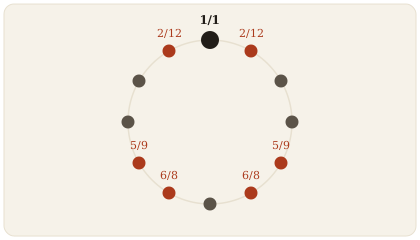
After Nadi, the word that alarms the most families in kundli matching is "Bhakoot Dosh": seven points, gone to zero the moment one of three distance relations appears. But the tarasetu.in source article says in its first line what is the soul of this article: this dosha "looks worse on paper than the tradition actually treats it". The reason is simple: the cancellation rules are so common that a raw Bhakoot zero is rarely the final word. This article opens the full arithmetic: the distance rule, the three failing relations, how many couples fall into them, the five Muhurta Chintamani cancellations, the clean-Nadi gate, and finally the checks before any decision.
The rule: the distance between the Moon signs
The Bhakoot koota counts only the two Moon signs: the distance from one partner's sign to the other's, counted both ways. The kaalapanchang.com source page gives the scoring table citing Muhurta Chintamani 6.31; we have not opened that text ourselves, the citation is the source's. The rule: 1/1 (the same sign), 3/11, 4/10 and 7/7 (opposite signs) take the full 7 points; 2/12 (Dwirdwadash), 5/9 (Nav-Pancham) and 6/8 (Shadashtak) take zero, and these three relations are called Bhakoot Dosh. The count always runs from the nearer side: if the bride's sign is the sixth from the groom's, the groom's is the eighth from hers; both are named one relation, 6-8. The figure above shows all twelve relations from a reference sign: the six marked positions are the zero ones.
Every second couple: the proportion check
Now the arithmetic, with its model stated plainly: let the Moon signs of two people fall independently among the twelve signs with equal probability. From any sign, of the twelve possible relations (including itself), six fail: 2, 12, 5, 9, 6 and 8. So the probability that two random people's Bhakoot line reads zero is 6/12, that is 1/2: every second couple. This is a model figure, not a survey, but since Moon signs are roughly evenly spread over long periods, it is a fair estimate. The conclusion is the one from the Nadi article, only stronger: a condition arriving for half of all couples cannot be read as a "marriage-breaking curse". Either half of all marriages should fail, or the raw zero is not the final word, and the tradition itself says the second.
The three failing relations: names and the traditional reading
The tradition gives the three relations distinct names and distinct subjects of concern; we repeat them as claims. Shadashtak (6-8): considered the sharpest; the traditional idiom speaks of enmity, health troubles and marital friction. Dwirdwadash (2-12): the idiom of expenditure and drain, resources flowing in one direction; one older directional method adds that within 2-12 the bride's sign being the twelfth from the groom's was held lighter than the reverse. Nav-Pancham (5-9): the idiom of progeny and fortune; and here an important subtlety: the astromedha.in source says many traditions treat 5-9 as mild and generally waive it, meaning one of the three relations is often not counted at all. The purpose of these names and subjects is to understand the reading tradition; they have no measured marriage-outcome basis.
The five Muhurta Chintamani cancellations
kaalapanchang.com, citing Muhurta Chintamani 6.32, lists five cancellation conditions. First, one lord: both signs are ruled by the same planet, such as Mesha-Vrishchika (both Mars) or Makara-Kumbha (both Saturn); per tarasetu.in, the classical reading nullifies the dosha. Second, friendly lords: the two lords are mutual friends under the classical friendship table, such as Mithuna-Makara (Mercury-Saturn) or Simha-Meena (Sun-Jupiter). Third, friendly Navamsha lords: the lords of the two Moon Navamshas are friends. Fourth, a full Tara: the Tara koota takes all three points. Fifth, Vashya present: the Vashya koota takes at least one point. Any one of these cancels the dosha. And the source adds a condition often missed: the entry gate of every cancellation is a clean Nadi, meaning if the Nadi dosha stands unresolved, the Bhakoot cancellation is not admitted under the classical rule. This is why Nadi and Bhakoot are checked together in any matching reading.
Where the lists diverge
The five cancellations are the mainstream, but the lists do not stop there. From the cancellation registry at doosrirai.in: many lists do not count Bhakoot when the Moon sign is shared with different nakshatras; for Shadashtak there is an explicit exemption list of friendly-lord sign pairs, Mesha-Vrishchika, Vrishabha-Tula, Mithuna-Makara, Karka-Dhanu, Simha-Meena, Kanya-Kumbha; and one panchanga method (VP) has a compound rule that 6-8 is inauspicious only when Graha Maitri or Vashya are both absent, and 2-12 and 5-9 only when both of both are absent. In the other direction, one popular rule, "if the groom's sign is more than six away from the bride's, no dosha", is one that an engine like Astro-Vision reports as common opinion while deliberately not implementing it, meaning even software disagrees on the lists. The lesson is the Nadi one: on hearing "there is Bhakoot Dosh", ask by which list, and which cancellations were checked.
Two examples
First example: groom Mesha, bride Vrishchika. The distance: Vrishchika is the eighth from Mesha, Mesha the sixth from Vrishchika, that is 6-8, a raw Bhakoot zero and the tradition's sharpest category. But both signs are ruled by Mars: the first cancellation applies, the dosha is nullified. Second example: groom Mithuna, bride Kanya. The distance is 4/10, which by the raw rule itself takes the full 7 points; here no dosha forms at all, although with both signs ruled by Mercury this pair also falls in the "one lord" category. Third example: groom Vrishabha, bride Mesha. 2-12, a raw zero; the lords are Venus and Mars, not friends in the classical table; what remains is the Navamsha-lord, Tara and Vashya checks. This is the order of every real examination: first the distance, then the five cancellations, then the list divergence, and at the end, if the question stays open, both full charts.
The method's limits and the balanced view
The limits are those of the whole ashtakoota, but they show most sharply in Bhakoot. The koota looks only at the Moon sign; the rest of the chart never enters. The cancellation lists are split at the level of both traditions and software, so two reports on the same couple can give opposite conclusions. And no measured link is established between matching scores and marriage outcomes. The balanced view follows: treating a Bhakoot zero as the final verdict goes against the arithmetic (half of all couples) and against the tradition (the reach of the cancellations); and discarding the whole method is unfair to the families who have practised it carefully for centuries. The useful path: check the rules in order, accept the list divergence, and rest the decision on conversation and a full chart review, not on one line's score.
Bhakoot within the weighting of the kootas
On the thirty-six point table of the ashtakoota, Bhakoot's 7 points are the second largest share after Nadi (8), and together with Tara (3), Graha Maitri (5) and Vashya (2) they form the middle block of a matching reading. One useful consequence of this weighting: even when Bhakoot falls to zero, 29 points remain in play, so any matching report that decides on the Bhakoot line alone is counting seven of thirty-six and ignoring the other twenty-nine. In the reading method of the source pages too, Bhakoot is never a lone question: the whole matching section of the kaalapanchang tradition reads it together with Tara, Graha Maitri, Vashya and Nadi, and as shown above, the Nadi even becomes the entry gate of the cancellations. The practical meaning: on a Bhakoot zero, two tasks come first, the cancellation check and the total of the remaining six kootas; only after that is there anything to weigh.
The directional method and the nakshatra nuance
Some lists also count the direction of the distance: within 2-12, when the bride's sign is the twelfth from the groom's, the tradition holds it lighter than the reverse; within 6-8 too, some panchanga methods read the bride's side being sixth or eighth differently. These distinctions are not in every list, and software reports rarely show the direction at all. The second nuance is at nakshatra level: one sign holds quarters of three nakshatras, and the doosrirai.in registry also carries the rule that many lists do not count Bhakoot when the sign is shared with different nakshatras, meaning sign distance and nakshatra distance are separate questions. The takeaway for the reader: when a report shows "2-12", it is proper to ask from which direction it was counted and whether the nakshatra difference was checked, because in many lists these two questions change the result.
Common confusions
First confusion: Bhakoot Dosh means the marriage should not happen. The raw zero arrives for half of all couples, and the cancellation rules settle a large number of cases; the decision rests on rule-checking, not on the score. Second: 6-8 means the end. The tradition itself gives a friendly-lord exemption list for 6-8, and pairs like Mesha-Vrishchika are nullified by the very first rule. Third: if the Nadi is fine, the Bhakoot is automatically fine. It is the reverse: in one source method the condition for a Bhakoot cancellation is a clean Nadi; the two are separate questions and both must be checked. Fourth: an expensive puja is necessary to erase the dosha. Within the method the answer is cancellation-checking and a full review; pressure to spend is a warning sign.
Five questions for any reading
Five questions open up the whole method in any Bhakoot report or consultation. First: which distance is it, 2-12, 5-9 or 6-8, and from which direction was it counted, because 5-9 is commonly waived and the directional distinction changes weight in some lists. Second: were all five cancellations checked in order, or only lord friendship; if Navamsha lords, Tara and Vashya were skipped, the examination is incomplete. Third: when the sign is shared, was the nakshatra difference looked at. Fourth: what is the Nadi position, since in one source method it is the entry gate of the cancellations. Fifth: which list or software did the counting, and does that list include the 5-9 waiver, the exemption list and the VP compound rule. A reading that answers all five is complete within the method; one that does not rests on a raw score, and the limits of the raw score are what this article has shown.
Practical use
Use this article in three ways. First, as method literacy: knowing both Moon signs you can count the distance yourself, apply the five cancellations in order if a zero appears, and see from the figure that the zero zone is half the ring, no rarity. Second, as decision safety: on hearing "there is Bhakoot Dosh", ask three questions: which distance, which cancellation was checked, and what the Nadi position is. Third, for family conversation: raise the level of the debate by accepting the list divergence, and weigh a mild relation like 5-9 with the mild weight the tradition itself gives it; not every zero carries the same heaviness.
Sources and the honesty note
The distance scoring table (7 or 0), the citations of Muhurta Chintamani 6.31 and 6.32, the five cancellations and the clean-Nadi entry gate come from the Bhakoot Dosha page at kaalapanchang.com; we have not opened that text ourselves, the citations are the source's. The names and reading subjects of the three relations, the common waiving of 5-9, and the "a raw zero is rarely the final word" conclusion are from astromedha.in; the "fearsome on paper, mild in tradition" remark and the friendship examples are from tarasetu.in; the list divergence, exemption list, the VP compound rule and Astro-Vision's non-implemented opinion are from the cancellation registry at doosrirai.in; the directional-method note is from stevenphilley.com. The one-in-two figure is our own: 6 of 12 relations from any sign fail, uniform-distribution model; real birth distributions may differ slightly. Everything about effects is presented as the tradition's claim; there is no established measured link between matching scores and marriage outcomes. This article is educational; it makes no claim about any couple's marriage or future.


