Budhaditya Yoga: The Sun-Mercury Conjunction, and the Difference Hidden in a Few Degrees
One of the most common yogas of all: the quality hides in the very degree gap that most reports never measure; the rule, the arithmetic and the graded reading.
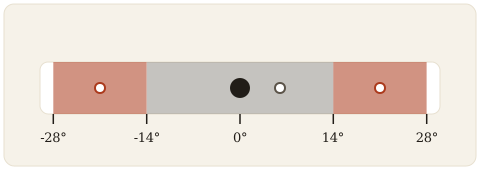
Budhaditya Yoga begins with a paradox. The rule says: the Sun and Mercury must share one sign, meaning it needs closeness. And the tradition's quality test says: Mercury must stand far enough from the Sun, meaning it needs distance. The yoga lives inside this tension, and that is why most popular reports, which merely show "conjunction: present", cannot tell its real story. Mercury is the Sun's closest companion and never strays more than 28 degrees from it, so sharing a sign is not exceptional for it, it is ordinary. This article opens the full arithmetic hidden behind that one report line: the combustion thresholds, the modelled commonness, the real meaning of the name Nipuna, the tiers of strength, and the divergence of the sources.
The rule: one sign, one name
The raw rule is at its simplest: in the birth chart (the rashi chart), if the Sun and Mercury occupy the same sign, Budhaditya Yoga is present. The name explains itself: Budha plus Aditya, Mercury with the Sun. The kalmanas.com source gives another traditional name: Nipuna Yoga, and this name describes the yoga's promise more precisely than its grander framing. Nipuna means skilled, proficient, the craftsman who has mastered the relation between intention and execution; the tradition ties this yoga not to abstract intelligence but to intelligence applied precisely: the capacity to speak, write, calculate, negotiate and organise. Whichever house the conjunction occupies, the tradition says this skill shows more in that house's field of life; more in kendras and trikonas, less or later in the dusthanas (6, 8, 12).
The geometry that explains everything
The key to this yoga is one astronomical fact: Mercury is an inner planet. Seen from Earth, Mercury never appears more than 28 degrees from the Sun; that is its maximum elongation. As a result, Mercury is always in the Sun's sign or the signs adjacent to it. The figure above shows this band: the Sun at zero, and the possible range of 28 degrees on each side. Now note: the average distance also follows from the geometry. If Mercury's distance is spread roughly evenly across this band, the average separation comes out to 14 degrees, and the astrology.proxaai.com source says exactly this: "the average Sun-Mercury separation is only about 14 degrees". This comparison shows our simple model sits close to practice, and it becomes the basis of the next section's arithmetic.
The arithmetic: raw rule, combustion condition, and two figures
Now the commonness arithmetic, with our model's assumptions stated: the Sun falls anywhere in its sign with equal probability, and Mercury's elongation is spread roughly evenly between -28 and +28 degrees from the Sun. In this model, the probability that Mercury shares the Sun's sign comes to about 53 percent, meaning the raw rule is met in about every second chart. Now add the combustion-free condition (a distance over 14 degrees): about 15 percent remains, roughly one chart in seven. A third figure is more instructive still: among the charts meeting the raw rule, about 72 percent have Mercury inside the combustion limit, meaning in most "technical yoga" charts Mercury is combust; proxaai's source claim, "in the majority of charts where this yoga technically exists, Mercury is also combust", agrees with our independent calculation. Remember, all these figures are model estimates, not a survey of actual birth charts; but they illuminate the tradition's own warning: hearing the yoga's name is not enough, one must measure the degrees.
Combustion: the three lines of 14, 12 and 7 degrees
In the tradition, combustion is the state in which a planet comes so close to the Sun that its independent expression is "burnt" in the Sun's light. The sources' thresholds: per satyori.com and kalmanas.com, Mercury direct within 14 degrees is combust, Mercury retrograde within 12 degrees (retrograde Mercury is closer to Earth, so the limit is stricter); and within 7 degrees is "deep combustion", where kalmanas calls the yoga "nominal at best". rajvidya.com attributes this threshold to "How to Judge a Horoscope", volume two. An interesting disagreement is also on record: navagraha.app reports that some teachers treat closeness itself as the yoga's condition and read it as "a brilliant, sometimes overpowering intellect", while others count a combust Mercury as damage to the yoga; both views persist in modern practice. The practical conclusion for the reader: look at the Sun-Mercury degrees in your report; that single number tells you which view's territory you are standing in.
The tiers of strength: from full Nipuna to nominal
The kalmanas.com grading reads this yoga in three tiers. The top tier, which it calls "full Nipuna": Mercury combustion-free by a safe margin (15 degrees or more, direct), in Virgo or Gemini (its own signs, and Virgo also its exaltation), the conjunction in a kendra or trikona, the Sun in reasonable dignity too, and free of malefic aspect; such a yoga behaves like a minor raja yoga in the field of intellect, giving recognition built on articulate and analytical skill. The middle tier: Mercury combustion-free, a comfortable sign, a kendra-trikona, one mild malefic contact; the yoga delivers reliable results. The bottom tier: Mercury combust or in Pisces (debilitation), the conjunction in a dusthana; the yoga is nominal, or a capability that "never quite gets recognised". satyori.com says the same in distance bands: 15-28 degrees ideal, 14-20 moderate, below that diminished. Note that graded reading is the reading here: the sentence "Budhaditya is present" is meaningless without a tier.
The textual map and the divergences
The sources' map of the texts: per kalmanas.com, the Phaladeepika is the primary classical source of this yoga, describing it simply as "Mercury with the Sun" and giving no degree threshold; the degree judgment is left for the reader to apply from the general principles of combustion. Per rajvidya.com, the Brihat Parashara Hora Shastra counts it among the named yogas, the Phaladeepika speaks of learning and fame, and the Saravali echoes similar results; these citations are the sources', we have not opened the texts ourselves. Two interesting divergences. First, Bhaskara Yoga: per rajvidya, a special configuration, Mercury in the second from the Sun, the Moon in the eleventh from Mercury, and Jupiter in the fifth or ninth from the Moon, is named Bhaskara Yoga, with results given as great wealth, valour and mastery of scripture, music and astrology. Second, in the Krishnamurti Paddhati (KP) the definition of Nipuna Yoga is widened: the Sun placed in Mercury's constellation or sub-division also counts as the yoga. These divergences show that "Budhaditya" is not one rule but a family of rules.
Compared with Gaja Kesari: two yogas of intelligence
The sources carry an elegant comparison that separates the two yogas: Gaja Kesari is the yoga of the Moon and Jupiter, of emotion and wisdom; Budhaditya is the yoga of the Sun and Mercury, of purpose and analysis. Gaja Kesari is held to give breadth of knowledge and the social gift of inspiring trust; Budhaditya, precision of analysis and the professional gift of exact communication. When both occur together, the tradition calls it a rare and formidable combination. This comparison is also a reading key: in a chart, "intelligence" is not one thing; the tradition measures it through at least two distinct instruments, and each instrument demands its own grading.
Two examples: from degrees to tier
First chart: the Sun at 5 degrees of Virgo, Mercury at 24 degrees of Virgo, direct. The raw rule is met: one sign. The gap is 19 degrees, outside the combustion limit (14), inside the ideal band; Mercury is both in its own sign and exalted. Now see the house: if this conjunction falls in the tenth house, in the kalmanas tiers this moves towards "full Nipuna". Second chart: the Sun at 11 degrees of Virgo, Mercury at 18 degrees of Virgo, retrograde. The raw rule is met again, but the gap is only 7 degrees, and for retrograde Mercury the limit is 12; Mercury is deeply combust. kalmanas places exactly this kind of picture in the "nominal" tier: the conjunction holds in name, but Mercury's independent discriminative function is held to be absorbed into the Sun. Same sign, same conjunction headline, two entirely different tiers; that difference is what measuring degrees means. Consider a third, mixed picture too: the Sun in Aries (exalted), Mercury 16 degrees away but the conjunction in the sixth house; now Mercury is combustion-free and the Sun strong, yet the house is a dusthana, so the tradition reads it in the middle tier: capability present, recognition late or limited.
The Sun's condition, the dispositor, and dasha timing
Three further factors shift the tier. First, the Sun's own condition: the Sun is the centre of the conjunction; if the Sun is debilitated (Libra) or afflicted, the base of the conjunction shakes, because in the tradition the yoga's result is built from the strength of both members. Second, the sign lord: if the lord of the sign hosting the conjunction stands strong in the chart, the yoga gains support; this is the "dispositor" principle the sources call the host planet's strength. Third, timing: per the sources, the yoga's themes activate in the mahadashas and antardashas of the Sun and Mercury, and in some readings in the dasha of the sign lord too; that is, even a strong yoga can stay in the background before its period arrives. Add the three together and the full checklist emerges: conjunction, degree gap, motion, Mercury's sign, the Sun's sign, house, dispositor, malefic contact, and dasha, nine checks in all, of which most popular reports show only the first two.
Common confusions
First confusion: Budhaditya means genius. The tradition's word is Nipuna, proficient, not genius; the promise is a capable, reliable, organised mind, not exceptional brilliance. Second: a visible conjunction means a full yoga. Without the combustion check the news of a conjunction is incomplete; in our model, most technical-yoga charts have Mercury combust. Third: retrograde Mercury is bad. The sources say retrograde Mercury is not inherently weak, its threshold is merely stricter; and in some readings a retrograde Mercury gives inward depth as well. Fourth: a combust Mercury is "repaired" by an expensive puja. Within the method the answer is graded reading and waiting for the dasha; pressure to spend is a warning sign. Fifth: this yoga is rare. Under the raw rule it is among the most common of all; what is rare is the full-tier Nipuna, not the conjunction.
Practical use
Use this article in three ways. First, for self-measurement: take the Sun's and Mercury's degrees from your chart (reports list both the sign and the degree), measure the gap, apply the 14-degree limit (12 if Mercury is retrograde), and then derive the tier from the sign dignity (Virgo-Gemini best, Pisces weakest) and the house (kendra-trikona versus dusthana). Second, for testing reports: if a report or an astrologer says "you have Budhaditya Yoga" without stating the degree gap, ask that one question; if no answer comes, treat the conclusion as incomplete. Third, for expectation management: read this yoga as a supporting indication of intellectual skill, not a certificate of brilliance; and remember that the full-tier Nipuna is itself called "relatively rare" in the sources.
Sources and the honesty note
The combustion thresholds (14/12/7 degrees), the identification steps, the explanation of the name Nipuna, the tier system, "proficiency not genius" and the retrograde-Mercury myth-reality distinctions are from kalmanas.com; the 14-degree average separation and the "in most technical yogas Mercury is combust" claim are from astrology.proxaai.com; the ideal 15-28 degree band is from satyori.com; Bhaskara Yoga, the KP widening, the "How to Judge a Horoscope" citation and the Saravali remark are from rajvidya.com; the two-view disagreement is from navagraha.app. The three commonness figures (about 53 percent raw, 15 percent combustion-free, 72 percent combust among technical yogas) come from our own simple model, with its assumptions: the Sun uniform within its sign, Mercury's elongation uniform within ±28 degrees; these are model estimates, not a count of real charts, although two sources independently agree with us on the average separation and the combust majority. Everything about effects is presented as the tradition's claim; there is no established measured link between any yoga and intellectual outcomes. This article is educational; it makes no claim about any person's intelligence, ability or future.


