Cancer (Karka): The Shelter of the Zodiac
Karka is the shell that keeps feeling safe: the Moon’s own sign, cardinal water, and a fortune that waxes and wanes like its ruler. From the classical verse to the modern sign profile, the art of sheltering and the refusal to be pushed, with sources, and with an honest-limits note.
The spark is struck, the ground holds it, the word is carried, and then the tide comes in. The fourth sign of the zodiac, Karka, is that tide: thirty degrees of cardinal water, the crab that carries its home on its back, and the sign Satyori’s Karka guide names the mother principle, the protective shell that creates a safe inner world where feelings can be felt without threat. This article audits that shelter in full: the sign’s structure, the classical verse on a Cancer Moon, the ruling planet and a famous exaltation-debilitation pair, the traditional tendencies in personality, career, relationships and health, and at the end an honest-limits note.
Everything below comes from sources fetched on 31 October 2026: Satyori’s Karka rashi guide, the seventeenth chapter of the Brihat Jataka available at VedicPupil (which we read directly, in that page’s English translation), Wikipedia’s Cancer article for the tropical-sidereal difference and the crab’s mythology, and PanchangTime’s Vimshottari dasha guide for the Moon’s period. Where a tendency belongs to a source, the source is named; where a note is ours, it is marked. Sign description is the tradition’s framework; we give it as description, not as diagnosis.
The fourth cell: the structure
Per Satyori, Karka is the fourth sign of the zodiac, spanning 90 to 120 degrees. Its symbol is the crab, and that page reads the symbol precisely: the crab carries its home on its back, the way Karka natives internalize their sense of belonging. Its element is water, its character chara, cardinal, the initiating kind, and it is classed in the feminine group. The ruling planet is the Moon. In the Vedic tradition of the Kalapurusha, the cosmic person of time across whose body the twelve signs are laid, Karka is the chest and heart: the seat of emotion, nurturing and the desire for security. Being a cardinal water sign means this is the water that moves first; Satyori’s comparison is exact, that where Mesha charges forward physically, Karka moves toward what it loves emotionally. The initiative is the same; the element decides its direction.
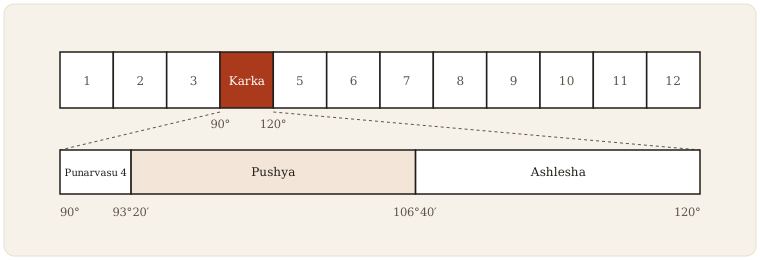
Karka holds three nakshatra segments: the fourth pada of Punarvasu, all of Pushya, and all of Ashlesha. Each nakshatra in the zodiac spans 13 degrees 20 minutes, so Punarvasu’s last quarter runs from 90 to 93:20, Pushya from there to 106:40, and Ashlesha from 106:40 to 120; this follows the standard nakshatra division. Two Karka natives can therefore belong to different nakshatras within the same sign, and in Jyotish the nakshatra carries its own weight. This site carries a separate guide for each of the twenty-seven nakshatras, including Punarvasu, Pushya and Ashlesha; here it is enough that the sign sets the frame and the nakshatra paints the finer shade within it.
One more boundary line matters: in Indian usage ‘rashi’ usually means the Moon sign, the sign the Moon occupied at the moment of birth. The classical chapter we quote below is titled exactly that, Chandra-rashi-sheel, the characters of the Moon signs. For Karka this matters doubly, because Karka is the Moon’s own sign; when the subject of the whole chapter stands here, it stands in its own house. A chart also has a lagna, the sign on the rising horizon, and a Sun sign; the three signify different things. And Satyori adds in one line that the condition of the Moon in the chart strongly influences how Karka expresses in a life. The sign, in other words, is one axis, not the whole picture.
Karka and Cancer: two scales, one sky
In Western astrology Cancer is the same fourth sign: the crab, the water element, the cardinal quality, the Moon as ruler, and Capricorn opposite; per Wikipedia’s table, in the tropical system the Sun transits it from 21 June to 22 July in 2026. One detail on that page marks the spot astronomically: the Sun enters Cancer at the summer solstice in the Northern Hemisphere, so the tropical sign’s gate is the year’s longest day. But the tropical zodiac is bound to the equinox point, while the Vedic sidereal zodiac is bound to the stars. Satyori states the gap between them as an ayanamsha of about 24 degrees. The practical result: a person whose Western sun sign is Cancer may have Karka as the Vedic rashi, or may have Mithuna; it is not the date that changes but the scale. This article speaks of Vedic Karka, and for date boundaries rely on your own panchang or chart calculation.
The creature itself has worn several shells. Per Wikipedia, in ancient Egypt this sign was conceived as a scarab beetle and in Mesopotamia as a turtle, and in each case the animal was imagined pushing the Sun across the heavens, initiating the summer solstice; the crab became standard through the Greek Karkinos, the crab that pinched Heracles’ toes during his fight with the Lernaean Hydra and was crushed underfoot, then placed in the sky by Hera. The naturalist Richard Hinckley Allen, quoted on the same page, called Cancer the most inconspicuous figure in the zodiac, whose mythology apologizes for its being there. For a sign whose whole character is the quiet shelter, there is something fitting in being the constellation that apologizes for itself. The same page adds a modern tenderness: because of the word’s association with the disease, some astrologers call people born under this sign moon children.
What the classical text says: the Brihat Jataka’s Cancer Moon
Varahamihira’s Brihat Jataka is among the root texts of Jyotish, and we read its seventeenth chapter, Chandra-rashi-sheel, directly on VedicPupil’s page, in that page’s own English translation of the Sanskrit. The chapter gives each sign’s result when the Moon stands in it, and here the chapter comes home: the Cancer verse, 17.4, describes the man born when the Moon is in its own house. In that translation: he walks quickly with a slight bend, with a high waist, ruled by women, with good friends, an astrologer; meets with many homes, loss and wealth, like the Moon, waxing and waning; short, with a thick neck, brought round by gentle persuasion, affectionate to friends, fond of water and gardens. The fortune image is the chapter’s most self-aware moment: the Moon’s own sign gives a fortune that behaves like the Moon, full one fortnight and thin the next.
As with the Gemini verse, the page flags its own doubtful syllable, and we keep the flag flying: where the translation says ‘brought round by gentle persuasion’, the translator notes the text reads vamsha samna while vasham samna, comes under control by conciliation, is the expected reading. The correction matters to the portrait: this is the sign that cannot be pushed but can be persuaded. The page’s simple meaning for the verse, and the tradition’s habit of mixing body, temper and fortune unsorted, we have preserved as they stand.
The seventeenth chapter’s thirteenth verse sets the condition that applies to every sign: the stated qualities come fully only when the Moon is strong and the sign’s lord is strong; otherwise the indications require further consideration. For Karka the two are one: the Moon is the sign lord, so the classical condition here reduces to a single light, the Moon’s own strength in the chart. In plain words, the text itself says a sign reading is a general sketch, not a verdict on any one birth chart. The tradition’s own caution remains as precise today.
One more detail from the page gives context: the Brihat Jataka is a work of 409 verses in 28 chapters, and the seventeenth chapter gives the Moon-sign results for all twelve signs, one verse each; the English we read is VedicPupil’s own translation. It is useful to know how compressed the classical description is: some twenty traits in a single verse, without commentary. A modern sign guide, such as Satyori’s, unfolds those same seeds into the context of present-day life; the two are best read with one eye, the seed from the text, the growth from today’s commentary.
The ruling planet: the Moon in its own house
The Moon is Karka’s lord, and per Satyori the sign embodies what the Moon stands for here: emotion, nurturing and the desire for security. The Moon is the swiftest of the grahas, and the tradition reads its phases into the sign’s temperament; the modern profile on the same page speaks of emotional tides that shift with the Moon’s phases, an image the classical verse already carries in its waxing-and-waning fortune. The Moon has its place in the timing tradition too. Per PanchangTime’s Vimshottari dasha guide, the Moon mahadasha runs 10 years within the 120-year Vimshottari cycle; when a Karka native’s Moon period runs, the sign’s own light governs that stretch. This too is description, not prediction.
Karka also holds the tradition’s crispest exaltation-debilitation pair, and Satyori gives both reasonings. Jupiter is exalted here, at 5 degrees, because this sign amplifies Jupiter’s benevolence through emotional wisdom and genuine compassion. And Mars is debilitated here, at 28 degrees, because the warrior planet’s aggressive drive is softened and diffused by Karka’s emotional sensitivity: Mars needs to act, but Karka needs to feel first. Readers of this series will notice the mirror: the Sun is exalted in Mars’s sign, and Mars is debilitated in the Moon’s. These are the tradition’s internal reasonings, which we give as it gives them, not physical measurements.
Personality, career, relationships: the traditional tendencies
The traditional personality description, per Satyori’s Karka profile: emotionally perceptive, deeply caring, fiercely protective of those they love. The sensitivity is named both gift and vulnerability: Karka absorbs the emotional atmosphere of any room it enters, keeps long emotional memories, and can hold hurts for years if they are not consciously processed; an outer shell of toughness or humour often masks a tender interior that only trusted intimates see. The classical verse’s ‘ruled by women’ and ‘fond of water and gardens’ become, here, the same theme in a modern key: this is the sign organized around shelter, and the tradition has said so without interruption from Varahamihira’s century to ours.
For career, Satyori’s list follows the care pathway: nursing, counseling, social work, early childhood education, hospitality and food-related businesses, and, on the side of belonging, real estate, history and any field connected to heritage or tradition. The reasoning matters more than the list: strong intuition makes Karka effective where emotional intelligence is the job, in HR, therapy and customer relations, and this sign performs best in work environments that feel like family. The same page adds the tradition’s own hedge, that career outcomes depend on the tenth-house lord, planetary periods and overall chart strength; a sign preference is not an employment forecast.
In relationships, per the same profile, Karka natives are among the most devoted and nurturing partners, creating homes that feel like sanctuaries, and expressing love through feeding, caring and emotional attention. The profile names the cost plainly: the moodiness can be challenging, the emotional tides shift with the Moon’s phases, and a partner needs to understand that rhythm rather than take it personally. Security and commitment are named prerequisites for Karka to open fully, and second chances after broken trust are rare. The classical ‘affectionate to friends’ becomes, here, a loyalty with a gate. We give that reading in the source’s name; whether it fits any one person is that person’s own testimony.
Health: the traditional reading
Per Satyori, Karka’s areas of concern are the chest, stomach, breasts and lymphatic system, with tendencies toward digestive issues that fluctuate with emotional state, water retention and chest congestion; the page names emotional eating a common pattern and says this sign’s health is unusually responsive to its mental state, so addressing emotional wellbeing directly, rather than only treating physical symptoms, is essential for Karka constitutions. Its dosha note ties the sign to kapha affinity through the water element and the Moon’s cool, nourishing nature, with fluid retention and weight fluctuation, and suggests warm lightly-spiced foods, regular activity against stagnation, and journaling to process feelings rather than store them. All of this is that source’s Ayurvedic framing, which we have given in its name; this article offers no medical advice, and for any symptom the doctor is the authority. If you are pregnant, ill, elderly or on medication, any regimen the tradition mentions is not for you without a doctor’s word.
The honest limits
Sign description is the tradition’s framework, not measured psychology. Everything above is what the texts and one modern guide say about Karka, recorded with their names and their dates; it is not what we measured in any person. The Brihat Jataka itself conditions every result on the strength of the Moon and the sign lord, and here those two are one light; Satyori itself conditions career on the rest of the chart. A rashi is one thread of a chart and no thread of your worth. Do not measure anyone else by their sign, and do not pour yourself into one either; being Karka is not being only this.
Keep one practical test as well: if some description in this article does not fit you at all, that is no fault of yours and none of the tradition’s; the text laid down beforehand that these portraits are general. And if a description does fit, do not make it your ceiling; the most important part of the crab’s story is that a shell is something its bearer grew, and what was grown once can be grown again, by practice, not by sign.
Questions on this article
What is the difference between Karka and Cancer?
They are two names for the zodiac’s fourth 30 degrees: Karka in the Vedic (sidereal) tradition and Cancer in the Western (tropical) one. The difference is that the tropical zodiac is tied to the equinox point and the sidereal to the stars; an ayanamsha gap of about 24 degrees separates them, so your Western sun sign and your Vedic rashi can differ. Per Wikipedia, the Sun transits tropical Cancer from 21 June to 22 July in 2026; Vedic Karka is computed from the panchang.
Why is Jupiter exalted and Mars debilitated in Karka?
Per Satyori’s Karka guide, the reasoning is temperamental: Karka amplifies Jupiter’s benevolence through emotional wisdom and genuine compassion, so Jupiter is exalted here at 5 degrees; and Mars needs to act while Karka needs to feel first, so the warrior planet is debilitated here at 28 degrees. This is the tradition’s internal logic, not a physical measurement.
Are Cancer people really moody?
The tradition’s description is that Karka’s emotional tides shift with the Moon’s phases; Satyori advises a partner to understand that rhythm rather than take it personally. The Brihat Jataka’s Cancer-Moon verse also ties fortune to the waxing and waning Moon. But this is astrology’s own language, not a psychological diagnosis; the text itself says the qualities hold fully only when both the Moon and the sign lord are strong, and here those two are one light. Do not mould or measure any person by their sign.
Is reading personality from a sign scientifically established?
No, and this article makes no such claim. Sign description is the framework of the Jyotish tradition, carried through texts and practising astrologers over centuries; we present it as exactly that, with sources. Do not treat it as a substitute for psychology or medicine; as a way of reflecting on oneself it can be a cultural mirror, not a measuring instrument.


