Career and Kundli: D10 Notation, Evidence and Better Decisions
A chart is not an appointment letter. Learn the traditional vocabulary and keep career choices grounded in checkable information.
A career question can hide several different decisions: what to study, whether to accept an offer, how to find stable income, or whether to leave a job. A kundli cannot turn those questions into a reliable prediction of a job title, salary or appointment date. It can be studied as a traditional symbolic system, but a calculation and a practical decision need different kinds of evidence. Keeping that boundary visible is especially important when training costs, family expectations and a person's confidence are involved.
This guide explains what practitioners mean by the tenth house, its lord and the D10 Dasamsa. It shows a small, checkable D10 calculation rather than a made-up person's future, then gives a separate career-exploration method based on interests, skills, work values and actual opportunities. The practical method is our editorial worksheet, not an astrological remedy. You do not need a favorable placement to learn a skill, apply for work or ask for fair treatment.
First name the decision, not the planet
Before opening a chart, write the decision in ordinary language. Choosing between two courses is different from choosing between two signed offers. Looking for income now is different from exploring a profession over several years. A broad question such as which career is destined for me can encourage an answer too vague to test. A concrete question makes missing information visible: entry requirements, fees, transport, hours, accessibility, the work itself and the alternatives available.
None of those facts can be read from a house number. A reader who does not know the available training or actual job conditions cannot establish that a profession is suitable. If you also want a cultural reading, keep it in a separate column. Do not let a symbolic label silently replace the decision you started with. A chart's description of authority, for example, is not evidence that a specific employer will provide responsibility, pay on time or treat staff well.
What the traditional career vocabulary means
DharmSetu's career lesson describes the tenth house as action and public standing, the tenth lord as another factor in that reading, and D10 as the divisional chart associated with profession. It distinguishes the sixth-house employment and service themes, seventh-house business and public-dealing themes, and eleventh-house gains. These are descriptions of a traditional interpretive framework. They are not measured predictors of employment, business survival or income.
The same lesson assigns work and sustained effort themes to Saturn, authority to the Sun and commerce or communication to Mercury. Such correspondences explain the language a practitioner is using. They do not establish that someone with a particular Mercury placement has accounting skill or that a Sun placement qualifies them for public office. Skill, legal eligibility and experience require their own evidence. A planet's name is not a professional credential.
Keep the sign, house, occupant and lord distinct. The tenth-house sign is not the same thing as a planet sitting there. Its traditional ruler can be located elsewhere. A reading may refer to any of those, but a responsible explanation names which. An empty tenth house means no displayed graha occupies it, not that the person has no work or future. The absence of a symbol from a box is not the absence of a life opportunity.
What D10 adds to the notation
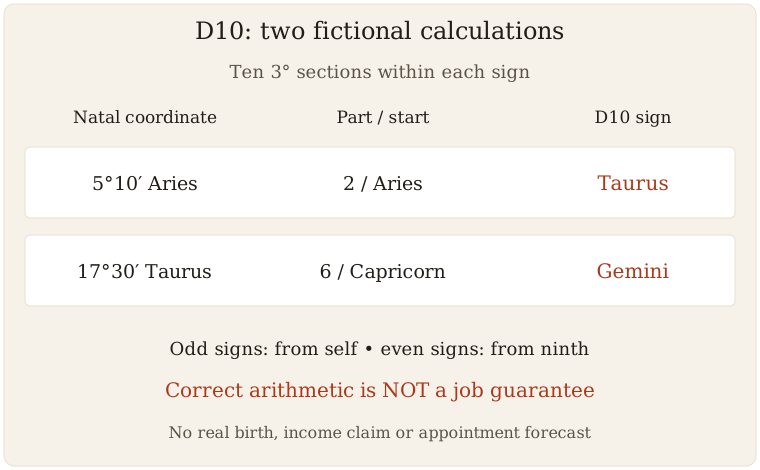
D10 is a derived chart, not a second sky observed at the office. Its sign assignments are calculated from natal positions under a rule. The displayed BPHS chapter-six translation, especially verse thirteen, gives the common Dasamsa starting points: from the sign itself in odd signs and from its ninth sign in even signs. Each thirty-degree sign has ten three-degree sections. Identifying a section and assigning its sign are separate steps.
Here odd and even refer to sign numbers starting with Aries as one. Aries, Gemini, Leo, Libra, Sagittarius and Aquarius are odd; Taurus, Cancer, Virgo, Scorpio, Capricorn and Pisces are even. For an even sign such as Taurus, its ninth sign is Capricorn when Taurus is counted as the first. Proceeding through sections from that starting point produces the derived signs. This arithmetic is checkable independently of any claim about a person's profession.
The diagram uses two fictional points. At five degrees ten minutes Aries, the point is in the second three-degree section; starting from Aries gives Taurus in D10. At seventeen degrees thirty minutes Taurus, it is in the sixth section; starting from Capricorn gives Gemini. The examples agree with those printed on the consulted Jagannath Hora website's D10 page. We do not imply a connection between that website and any uninspected desktop program.
Calculation is not a career verdict
In these examples lower boundaries belong to their section and upper boundaries begin the next. Exactly six degrees is the start of section three, not the end of section two for assignment purposes. A rounded display can hide a value just below that boundary. Keep the unrounded source coordinate when comparing results. The diagram has no birth date, birth time, city, actual graha or named person, so it should not be mistaken for a calculated natal reading.
A D10 sign does not by itself supply a D10 house. Houses need the chart's declared reference, usually its derived lagna in the consulted practitioner material. A birth-time change can alter that lagna and the house labels. A planet's derived sign and its house are different records. Do not take the number ten in D10 to mean that every displayed factor occupies the tenth house, or treat a D1 tenth-house statement as automatically a D10 tenth-house statement.
Read practitioner cautions without endorsing their promises
The Jagannath Hora page says D10 should be read with D1 and warns that no placement guarantees or forbids a specific career result. It also makes stronger claims elsewhere about particular planets producing authority, late success or career rises. We preserve that tension: the caution exists, but it does not turn the stronger assertions into established facts. Its interpretive content remains the website's account of a tradition, not evidence that these effects occur.
DharmSetu similarly rejects naming a modern job title from a chart and calls modern occupation mappings analogies rather than fixed doctrine. It nevertheless suggests that a chart can describe a person's working tendencies. That is still an empirical claim if presented as accurate knowledge about a person. We do not upgrade it into a validated personality assessment. A modest-sounding statement about preferred work style also needs checking against actual experience, not automatic acceptance.
The lesson also calls career questions less consequential than marriage questions. That is the author's framing, not ours. Work can affect housing, health, debt, migration and safety. A confident but unsupported statement can cause real loss even if it sounds encouraging. We therefore treat career decisions as serious and avoid ranking their stakes against someone else's relationship decisions. The boundary applies to reassuring promises as well as frightening predictions.
Why planet-to-profession lists are not selection tools
A modern job title can contain many different tasks. A designer may spend time researching users, negotiating a brief, using software, presenting work and managing invoices. Several traditional planet labels could be attached after the fact. The ability to find a symbolic match does not show that the chart selected the job before it was known. It may simply show how flexible the analogy is. Avoid turning that flexibility into confidence about a student's future.
The opposite mistake is exclusion: being told that a profession is not in your chart. A symbolic association cannot establish that you are unable to learn engineering, teach, manage a business or create art. Real barriers may exist, including qualifications, cost, discrimination or access to training; those deserve direct attention. A chart should not add a fabricated barrier. The useful question is what a route requires and what support would make it possible.
Job versus business is not a house-number switch
Practitioner pages often contrast sixth-house service with seventh-house business. We describe that convention without using it to choose your income model. A business decision needs information about customers, pricing, cash flow, contracts, taxes, licensing and personal risk. An employment decision needs the actual role, terms, benefits, hours and working conditions. Neither becomes safe because a symbolic house is called strong. A shared label also does not make all businesses or all jobs alike.
Do not resign, borrow money, pay for a course or reject an offer solely on that contrast. If you want to explore self-employment, a limited test may answer a more useful question than a verdict: will a real customer pay for a clearly defined service? Keep any test within affordable limits and check legal requirements. This is general decision guidance, not financial advice or a promise that a trial will succeed.
Timing claims need their own evidence
Dasha vocabulary refers to traditional period systems. A period label does not demonstrate that an employer will hire, a promotion will happen or an exam result will change. The career lesson describes interpreting periods connected with work-related houses; the D10 page likewise uses timing language. Neither source supplies evidence here establishing that a particular appointment date can be predicted. Treat exact salary, company-name or government-job guarantees as unsupported, not as stronger expertise.
Separate a practical deadline from a predicted favorable time. Applications, entrance requirements and contract dates should be checked with the institution or employer. Waiting for a supposed window can lose an actual opportunity; rushing for one can create avoidable cost. If an estimate of birth time is uncertain, retain that uncertainty rather than adjusting the time until a past career story fits. A fitted story is not independent confirmation of the input.
A practical assessment is a starting point too
CareerOneStop's self-assessment guide separates interests, skills and work values. Interests concern activities you enjoy; skills concern knowledge and abilities; work values concern qualities important in a job or workplace. These are useful distinct questions. Being interested in a task does not mean you already have the skill, and being good at it does not mean you want a workplace where that task fills every day.
The guide explicitly limits its assessments: they do not guarantee liking a career, ensure local availability or capture every difference within a profession. It recommends broadening perspective with more than one assessment and talking with other people. Do not replace astrology with an equally absolute reading of an assessment score. A questionnaire can generate options to investigate. It should not assign a permanent identity or override a person's account of their circumstances.
Interests are not planets or fixed identities
My Next Move's interests guide uses six named areas: Realistic, Investigative, Artistic, Social, Enterprising and Conventional. These group preferences for activities such as practical work, finding facts, creating, helping, leading or organizing information. We do not equate them with six planets, zodiac elements or chart houses. Such a conversion would add a new unsupported mapping to a career tool designed around different questions.
The Interest Profiler help page explains that its career matches combine interests with preparation level, called Job Zones. It suggests exploring another zone while keeping education and training in view, considering a top interest separately, and talking with a counselor or someone who knows you. These are exploration routes, not promises. The resources are US-oriented, so do not assume their occupation lists, training pathways or opportunity indicators describe your local market.
A worksheet that keeps evidence separate
Our suggested worksheet has a column for the actual decision, one for what you know, one for what you need to check and one for a small next step. For a course, that might mean checking prerequisites, total fees and a sample lesson. For a role, it might mean reading a current description and talking with someone doing similar work. If you keep a cultural chart note, put it outside the evidence column and label it as interpretation.
Choose next steps that can change your mind. A short task sample may show that a job's central activity differs from its attractive title. A conversation may reveal a qualification you need. A timetable may make an otherwise appealing course impractical. Record what happened, not merely whether it felt destined. This creates information you can use even when the result is that an option is not right for you.
Use support without handing over your agency
A teacher, career counselor or experienced worker can help you interpret evidence, but ask what their recommendation is based on. Be cautious if advice requires an expensive ritual or gemstone to remove a career barrier. A paid service should explain its fees and limits; urgency, humiliation and guaranteed outcomes are not substitutes for evidence. Do not share identity documents, workplace information or detailed birth records with a site merely because it offers a free career prediction.
Berkeley's Understanding Science distinguishes testable expectations from vague ones and reports that careful studies of specific astrological expectations did not support their validity. Accurate chart arithmetic does not establish career prediction. You can value a cultural practice without allowing it to close an educational or work opportunity. The next useful step is usually a checkable action in the world, not a declaration that a future job is already written.
Questions on this article
Can a kundli guarantee a government job?
No. A chart is not evidence of selection, eligibility or an appointment date. Check the institution’s actual requirements and notices.
What does D10 mean?
A derived chart using ten3° sections per sign under a declared mapping. It is not the tenth house and not a second physical sky.
Does an empty tenth house mean no career?
No. Empty means no displayed graha occupies that house. It does not establish the absence of work or opportunity.
Are interest assessments guarantees?
No. The consulted CareerOneStop guide says they do not guarantee liking a career or its availability locally. Use them to generate options to check.


