Planetary Donations Audited: The Classical BPHS List, the Modern Colour Tables, and the Gap Between the Layers
A cow with her calf, a conch, a bullock and a horse in the classical list; jaggery, sesame and lentils in the modern tables: the two layers of planetary donation, the gap between them, and the rules they share.
In the remedy-map article, daan was the category prescribed when a gem is risky, because in the tradition's own belief, a donation addresses a graha without amplifying it. But when you ask what to donate for each planet, the answer depends entirely on which layer you open. A classical chapter we opened and read for this article gives one list: a cow with her calf, a conch, a bullock, gold, robes, a horse, a black cow, iron weapons, and a goat. The internet's modern tables give a completely different one: jaggery, wheat, red cloth, moong dal, turmeric, black sesame. And the modern tables do not agree with each other either. This article keeps the two layers separate, measures the gap between them, and records the conduct rules where both layers meet.
Layer one: the remedy chapter of the Brihat Parashara Hora Shastra
We opened the remedy chapter of the foundational Parashari text in full, in the English translation at divyachadhava.com. There it is chapter 84, remedies from the malevolence of the grahas, 27 verses. The chapter's frame is a complete graha-worship rite, and charity is one limb of it, not a standalone list. The sequence runs like this. First the idols: the nine grahas are made respectively of copper, rock crystal, red sandalwood, gold (both Budha and Guru), silver, iron, glass and bell metal, or drawn in their own colours; the idol measure is 108 of one's own fingers. Then the meditation forms: Surya on a chariot of seven horses, Chandra on ten, Mangal on a lamb, Budha on a lion, Shani on a donkey, Rahu on a lion, Ketu on a donkey. Then the offerings: flowers and garments of the graha's colour, sandal, lamp, guggul, his metal and his grains, and all of these are then distributed to Brahmins; verses 15-16 make that distribution itself the appeasement. Then mantra japa, then havan, then the feeding of Brahmins, and finally the charity list of verse 25.
Verse 25's classical charity list, in the nine-graha order: for Surya a cow with her calf, for Chandra a conch, for Mangal a bullock, for Budha gold, for Guru robes, for Shukra a horse, for Shani a black cow, for Rahu weapons made of iron, for Ketu a goat. The Brahmin-feeding menu of verses 23-24 is also graha-wise: for Surya rice cooked with jaggery, for Chandra rice cooked in milk, for Mangal havishya, for Budha paddy cooked in milk, for Guru curd and rice, for Shukra rice with ghee, for Shani rice cooked with sesame-seed powder, for Rahu rice cooked with meat, for Ketu rice cooked with cereals. Note what this list is made of: livestock and prestige goods, with Brahmins as recipients; the chapter contains no list of planet-coloured grocery items at all.
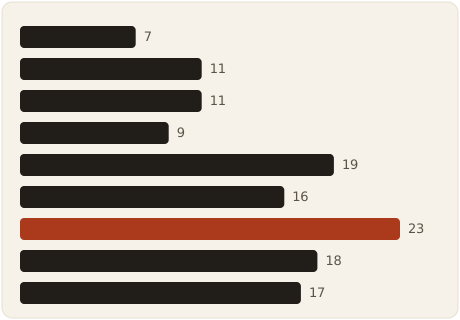
The chapter's mantra counts sit in verses 17-20: Surya 7,000, Chandra 11,000, Mangal 11,000, Budha 9,000, Guru 19,000, Shukra 16,000, Shani 23,000, Rahu 18,000, Ketu 17,000. The total is 131,000, our own computation. Hidden in that list is a cross-check: astrojanampatrika, a source of our earlier articles, gave the Shani bija mantra's count as 23,000, and that is exactly this chapter's Shani number; one modern list's figure has now met its classical text. And a scale distinction: the purascharana rule of our japa article ran in lakhs; these graha-shanti counts run in thousands. The two counting traditions belong to different scales of rite. The havan materials are graha-wise too, verses 21-22: aak, palash, khair, chirchiri, pipal, goolar and shami woods, doob grass for Rahu and kush for Ketu; 108 or 28 offerings, mixed with honey, ghee, curd or milk.
The chapter-number audit: 84 or 87?
A textual discrepancy belongs here, because it touches a citation in our earlier articles. grahavaani, a source of our remedy-map article, attributed the bija mantras and remedies to BPHS "chapter 87." When we opened translations for this article, we found: the table of contents of the R. Santhanam translation (the full-text copy on archive.org) shows the remedy chapter as chapter 84, and divyachadhava's full text also numbers it 84; meanwhile wisdomlib's page for the Girish Chand Sharma translation lists chapter 87 as Inauspicious Births, not remedies. In other words, grahavaani's "chapter 87" citation matches neither translation we opened. All three readings are on record; we do not certify any edition, but this much is settled: the remedy material exists in the text, and its location in the Santhanam numbering is 84.
Layer two: the modern colour tables
Now the layer the internet actually serves. We opened two tables. The first, astrologymag (2018): Surya, jaggery, red cloth, wheat, gold, a calf, ruby, molasses; Chandra, silver, rice, milk, white flowers, ghee, camphor; Mangal, copper, red cloth, sandalwood, red coral, sindoor; Budha, green cloth, feeding "glass" to a cow, whole moong dal, emerald; Guru, turmeric, yellow cloth, yellow sapphire, topaz, besan laddus, yellow flowers; Shukra, curd, diamond, white flowers, fodder to a cow, white cloth, opal; Shani, black cloth, sesame seeds, iron items, urad dal, mustard oil, black onyx, blue sapphire; Rahu, gomed, lead, blue flowers, blue cloth, blanket, mica; Ketu, cat's eye, sesame oil, a multi-coloured blanket. Days: each graha's own weekday, with Wednesday or Saturday evening for Rahu and Ketu. The second, modernastro: Surya, wheat, jaggery, copper, red cloth; Chandra, rice, milk, white cloth, silver; Mangal, red lentils, red cloth, copper; Budha, green moong dal, green cloth, books; Guru, yellow lentils, turmeric, gold, bananas; Shukra, white rice, white sweets, perfume, silk; Shani, black sesame, mustard oil, iron, blue or black cloth; Rahu, blankets, coconuts, blue cloth on Wednesday; Ketu, blankets, sesame and seven grains on Tuesday.
The comparison of the two tables is the most instructive part of this layer. For Mangal, one table has sandalwood, coral and sindoor, the other red lentils; for Budha, one has cow-feeding and emerald, the other books; for Guru, one has besan laddus, the other bananas; for Shukra, one has curd, diamond and opal, the other sweets, perfume and silk; for Ketu's day, one says Wednesday or Saturday, the other Tuesday. One more detail: astrologymag's Budha row prints "feed glass to cow," plainly a typo for grass; we record the printed reading and mark the correction as our inference. The conclusion from these disagreements is not that one table is wrong; it is that this layer is not a copy of any one text but a living convention of colour-day correspondence, to which every list-maker adds a version. And one market test: where a modern list slips gemstones into the donation items, ruby, emerald, blue sapphire, gomed, cat's eye, a gem-seller's interest has entered the list; the classical chapter's charity list contains no gemstones.
Conduct rules: where the two layers meet
The item lists differ, but the conduct rules converge. astrologymag's four rules. One, donate only the items of a planet that is malefic for you; donating a benefic planet's items was considered giving away your good energy, so a chart check comes first. This rule is the daan form of the gem caution: this chart-reading advice is the tradition's own caution, not proof of daan's effectiveness. Two, give to someone with whom you have no self-interest; a gift to your servant or driver does not count as daan under this definition. Three, give with respect and sincerity, never as a formality. Four, the amount follows your capacity; in the source's own words, the concept is sacrifice, not bribery: if you can donate a cow, good, but if you can donate only a glass of milk, that too is complete. modernastro states the same principle from the other side: regular small donations on the correct day with genuine feeling outweigh one large reluctant donation; and it adds the recipient tradition, feeding crows for Shani and cows for Shukra, and giving in the graha's hora on its day. vidhata's Shani layer, audited in our sade-sati article, joins here: black sesame was taken to represent accumulated karma, donating it was called a symbolic transfer of karmic weight, and the recipients are the elderly, the poor and labourers. Repeat the privacy rule as well: the vidhata-based principle from the remedy-map article, regularity above magnitude and privacy above display, is the core style of the daan category.
The year's donation days
Alongside its table, astrologymag gives a calendar of days on which donation is specially regarded: Purnima and Amavasya among the panchang tithis, solar and lunar eclipses, all Sankrantis and especially Makar Sankranti, Akshaya Tritiya, and Ekadashi. This list comes from the panchang layer, not the graha-table layer; graha-wise daan and tithi-wise daan are two different calendars. The first runs on the graha's weekday for the pacification of a specific graha; the second is the year's general donation festivals, days the panchang calls punya-kala. Our panchang cluster will open the computation of those tithis separately; here it is enough to record that a list mixing the two calendars is doing two layers' work in one.
A practical adoption sequence
If something from this layer is to be adopted, the sequence the sources yield is this. The first step is not an item but a conduct: choose a regular, small, quiet giving practice, say a small packet of sesame or oil reaching someone in need every Saturday, without display or announcement. The second step is the day: if the graha-wise layer is adopted, the graha's own weekday; modernastro adds the graha's hora, whose detail belongs to our coming hora article. The third step is the recipient: free of self-interest, meaning outside any employment relationship; in the Shani layer, the elderly, the poor, labourers. The fourth step is the amount: by capacity, never by strain; the source's own example, a cow and a glass of milk, both complete. The fifth step is continuity: tradition-durations like forty days or 51 Saturdays appear in the vidhata layer; the universal rule is that regularity stays above magnitude. And one step not to take: buying a gemstone that a list prints as a "donation" item; that is a purchase, not a donation, and it must pass the gem category's tests, not this one's.
Limits
This cluster's fixed boundaries hold here: in none of the consulted sources did we find measured physical evidence for any fruit of daan as a remedy; the language of results, from pacification to karmic transfer, is the tradition's belief. Daan has a separate, ordinary value that needs no belief at all: goods reaching someone in need carry their own meaning, which is why this category's risk profile is entirely unlike the gem category's. Three cautions: apply the market test to any donation list that includes gems; apply the chart-reading limit to the "donate only for malefic planets" advice; and read the modern tables' mutual disagreements as variety within a living convention, not as one table's error.
Three questions for any daan list
First, which layer: the classical chapter (cow with calf, conch, bullock, horse, Brahmin recipients) or a modern colour table (jaggery, sesame, dals, needy recipients)? Second, whose list and whose day: the two modern tables differ on six of nine planets, so ask "whose list" before asking "which is the right list." Third, has a gem slipped into the list: the classical chapter's charity list is gem-free; a gem-bearing donation list mixes remedy and retail, and the remedy-map article's ladder test applies right there.
Source note: this article has four sources. The classical layer: the remedy chapter of the Brihat Parashara Hora Shastra, in divyachadhava.com's full English translation, which we opened and read ourselves (divyachadhava.com/en/sanatan-sahitya/bphs-chapter-84-remedial-measures-from-the-malevolence-of): the idol metals, meditation forms, offering distribution, mantra counts, havan woods, Brahmin-feeding menu and the verse-25 charity list are all from that chapter. The chapter-number audit: the R. Santhanam translation's table of contents (archive.org/stream/BPHSEnglish) shows the remedy chapter as 84; wisdomlib's G.C. Sharma page lists chapter 87 as Inauspicious Births; grahavaani's "chapter 87" citation differs from both, and the discrepancy is recorded. The modern layer: astrologymag's navagraha table, four conduct rules, capacity principle and auspicious-days list (astrologymag.com/navagraha-daan-items-reduce-planets-malefic-energy-with-charity/, 30 July 2018); modernastro's table, hora timing, recipient tradition and intention principle (modernastro.com/astrology/vedic/remedies/charity). The Shani detail is from vidhata, as recorded in our sade-sati article's sources. The 131,000 total is our own arithmetic. In none of the sources did we find measured evidence for any fruit of donation; all effect language is presented as the tradition's belief.


