Divisional Charts: Sixteen Vargas, Different Mapping Rules
The D-number is not the whole algorithm. Compare three derived signs from one fictional natal point.
A divisional chart is a new arrangement derived from the same natal positions, not another sky observed at another time. In Jyotisha these charts are called vargas. A rule divides a sign into sections and assigns a sign to each section. The result can be drawn as another kundli with its own derived ascendant. The number in D9 or D10 identifies a division scheme; it does not automatically tell you the entire mapping rule. Learning that distinction prevents a large collection of colorful charts from becoming a collection of unexplained claims.
This introduction maps the familiar sixteen-chart set, compares a few calculation rules, and explains why some shortcuts fail. It includes the important unequal-part D30 exception, uncertainty and source disagreements. Traditional topic associations are described as associations, not scientifically established channels of influence. A mathematically reproducible varga does not demonstrate that it predicts work, children, illness or past lives. Read the notation and the limits together.
One source position, several derived labels
The Varga encyclopedia entry defines varga as a set or division and describes parts of zodiacal signs. The original longitude remains the starting evidence. A D1 sign locates a factor in the natal zodiac; a divisional sign is an assignment obtained from that position under a stated rule. A planet labeled Virgo in D9 has not physically left its natal sign. The two labels belong to different representations of the same input.
For a useful record, keep the factor, natal sign and within-sign degree, full longitude, chosen varga and mapping method. Add the derived sign separately. Do not overwrite D1 when another panel appears. The ascendant can also be mapped, giving a starting point for house counting in the derived chart. House numbers should then identify which chart and reference they belong to. A seventh-house statement without that label is incomplete when several charts are open.
The sixteen-chart list is a particular set
The displayed BPHS chapter-six text and translation at VedicPupil lists the familiar sixteen schemes in its opening verses. The sequence is D1, D2, D3, D4, D7, D9, D10, D12, D16, D20, D24, D27, D30, D40, D45 and D60. Notice the gaps. It is not every integer from one to sixteen and not every integer through sixty. A software menu containing additional charts is a broader menu, not proof that this named set has changed.
The encyclopedia also describes smaller groupings: shadvarga includes D1, D2, D3, D9, D12 and D30; saptavarga adds D7. It discusses tenfold and sixteenfold groupings as well. These are sets of schemes, not extra divisions of one displayed chart. A beginner need not open them all at once. First identify which set a writer means and which particular chart a statement refers to.
A compact guide to the traditional topic map
In the encyclopedia's table, D1 Rashi covers general matters; D2 Hora is associated with wealth and family; D3 Drekkana with siblings and nature; D4 Chaturthamsa with fortune and property; D7 Saptamsa with children; D9 Navamsa with spouse, dharma and relationships; D10 Dasamsa with actions in society and profession; D12 Dvadasamsa with parents. These are headings within a tradition. They do not measure an actual person's bank balance, fertility, ability or relationship quality.
The same table associates D16 Shodasamsa with vehicles and comforts, D20 Vimsamsa with spiritual pursuits, D24 Chaturvimsamsa with learning, D27 Saptavimsamsa with strengths and weaknesses, and D30 Trimsamsa with difficult indications. It gives broader auspicious or unfavorable effects for D40, general character and conduct for D45, and past-birth or karma themes for D60. We use neutral descriptions rather than treating alarming labels as facts about a reader.
ePandit's chart guide labels maternal-side inheritance for D40 and paternal-side inheritance for D45 as later tradition. That qualification differs from the encyclopedia's broader table headings and should remain attached to those specific associations. Do not silently promote every modern topic label into a uniquely settled classical definition. The source of a topic assignment matters just as the source of a calculation does.
Equal section size does not supply a sign assignment
For many familiar schemes, section size is thirty degrees divided by the scheme number. D2 halves are fifteen degrees, D3 thirds ten degrees, D4 quarters seven degrees thirty minutes, D9 ninths three degrees twenty minutes, D10 tenths three degrees, and D12 twelfths two degrees thirty minutes. These sizes locate a point's section. They do not by themselves say which zodiacal sign that section receives.
For example, identifying the second ten-degree part of Taurus is not yet a D3 sign result. The declared Drekkana rule must assign the section. Likewise dividing a sign into twelve pieces does not say that every natal sign's first piece begins from Aries. Keeping section selection and sign assignment as separate steps makes it much easier to notice when a calculator or explanation has skipped a rule.
Three schemes, three different rules
The displayed BPHS chapter gives Drekkana's thirds and the sign's own, fifth and ninth sequence in verses seven and eight. Thus Taurus's three ten-degree sections map to Taurus, Virgo and Capricorn in that rule. Dvadasamsa, described in verse fifteen, begins from the natal sign and proceeds through twelve successive signs. Navamsa's common rule begins from the natal sign for movable signs, the ninth for fixed signs and the fifth for dual signs, as the previous article explains.
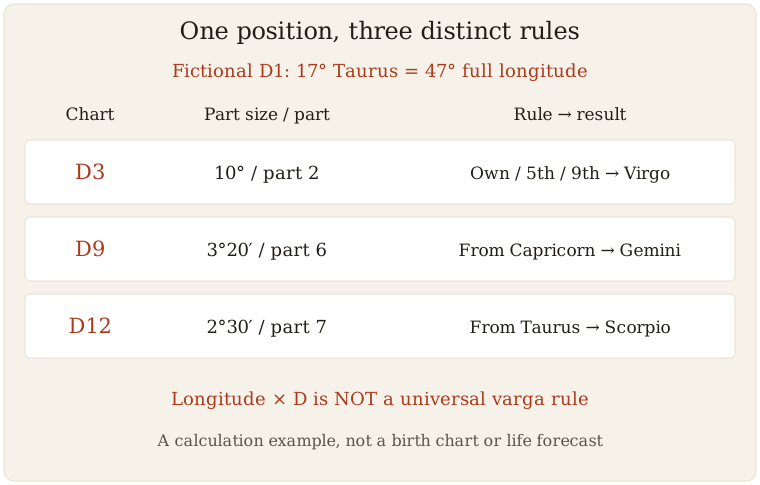
These differences are not decorative wording. Take a fictional point at seventeen degrees Taurus. For D3 it is in the second ten-degree section and maps to Virgo. For D9 it is in the sixth three-degree-twenty-minute section; Taurus starts from Capricorn, making the result Gemini. For D12 it is in the seventh two-degree-thirty-minute section; counting from Taurus gives Scorpio. The same original position yields three derived signs because the rules differ.
Our diagram uses exactly this fictional point. It contains no date, birth time or observed planetary position. The rows separately name the section size, selected section and result, so the arithmetic is visible. The point remains at seventeen degrees Taurus in D1. The three output signs are not three competing claims about where the physical point was. They are results of three declared transformations.
Why multiply every longitude by D is unsafe
For the common Navamsa mapping, multiplying full longitude by nine and wrapping into a full circle reproduces the sign assignment. That does not prove a general rule for every D-number. Seventeen degrees Taurus is forty-seven degrees from zero Aries. Three times forty-seven gives one hundred forty-one degrees, Leo, which is not Virgo from the declared D3 rule. Twelve times forty-seven wraps to two hundred four degrees, Libra, not Scorpio from the declared D12 rule.
The D9 check works in the same example: nine times forty-seven wraps to sixty-three degrees, Gemini. The success of one transformation and failure of the others demonstrates the limitation directly. A varga calculator needs its specific rule, not merely its denominator. Before trusting a menu of dozens of charts, ask whether it documents their mappings and variants. A familiar D9 formula applied indiscriminately can produce a correct Navamsa alongside incorrect charts.
D2 Hora and the unequal D30 exception
The displayed BPHS translation describes Hora as half a sign and gives alternating Sun and Moon ownership: in odd signs Sun then Moon, and in even signs the reverse. This introduces another kind of assignment rather than a universal cyclic multiplication. This introduction does not try to settle every Hora variant. Read which convention a program uses before treating a difference as a mistake. The name Hora alone is not a complete software specification.
D30 needs even greater care. The BPHS displayed verses twenty-seven and twenty-eight and DKSCORE's calculator explanation describe five unequal shares for odd signs: five, five, eight, seven and five degrees, associated in order with Mars, Saturn, Jupiter, Mercury and Venus. Even signs reverse the order. The five widths sum to thirty degrees. In this traditional rule, D30 is not simply thirty one-degree sections read through a generic formula.
For an even sign, the reversed widths are five, seven, eight, five and five, associated with Venus, Mercury, Jupiter, Saturn and Mars. Distinguish ownership and the subsequent sign-display convention if a program draws a kundli. A table of five rulers is not automatically a full account of how every software implementation labels signs. Our introduction states the consulted partition and does not invent an implementation for any uninspected engine.
Classical displays are sources, not infallible typesetting
We also consulted Siva.sh's displayed Phaladeepika chapter-three verse four, Sanskrit with English translation. It corroborates the Hora reversal, Drekkana own/fifth/ninth, and unequal Trimsamsa pattern. Its English line calls Dwadasamsas thirteenth portions, although the name and the BPHS displayed verse identify twelfths. We flag that apparent translation or typesetting slip rather than silently presenting thirteen as another valid divisor.
Directly reading a displayed chapter or verse does not establish the accuracy of every translation or constitute a critical edition of a classical book. We cite the pages actually inspected and keep their scope clear. Similarly DKSCORE's page describes a sixteen-chart set plus D6 and D8. The extra charts are explicitly additional, not eighteen members of a sixteen-member list. Careful source reading is part of chart literacy, not an obstacle to it.
Finer division means greater input sensitivity
D60's equal half-degree scale is far smaller than D3's ten-degree scale. A small change in a natal coordinate can therefore cross a finer boundary without crossing a coarser one. This is an arithmetic observation, not proof that the finer output reveals more truth about a life. More subdivisions increase the need to know the input; they do not improve a poor birth record by themselves.
Modern guides give rough ascendant time scales and, in some cases, a local stability window. These should not become fixed universal clocks. Signs rise at different rates, and a point near a boundary may change with a smaller time shift than an average suggests. The ascendant's sensitivity is also not the same as every planet's sensitivity. Do not tell a reader that all factors change every minute merely because a high-numbered chart is displayed.
If birth time is approximate, preserve an interval and identify what the calculation can keep stable. A rectified estimate remains an estimate unless independent evidence establishes it. Do not choose an exact minute by selecting the chart whose story feels most reassuring. That makes interpretation decide the supposed input and hides uncertainty. A clear unresolved result is better than a false level of precision.
Read the chart title before reading its houses
Each derived chart may have its own mapped ascendant and house count. DKSCORE explicitly states that its displayed houses are whole signs counted from that chart's lagna. This is the documented convention of that service, not permission to assume every chart package implements every house method identically. Keep D1, D9 or D10 labels beside house claims. A factor can have one natal house and a different derived-chart house without changing its original astronomical coordinate.
North and South Indian drawing styles are another separate choice. Fixed house positions versus fixed sign positions affect where a label appears on the sheet, not the mapping rule. Compare signs and reference points before comparing screen locations. A small unlabelled thumbnail is a poor source for precise claims. Use the corresponding table when available and preserve the original output for checking.
A beginner's working method
Begin with one well-labeled D1 and one relevant derived chart. Record the birth inputs, timezone convention, zodiac and ayanamsa. Name the varga method and retain the natal longitude. Calculate the section with exact units, then apply the specific assignment rule. Record the derived sign and its chart's house reference separately. This is our editorial worksheet for preventing category mistakes, not a classical sequence promising successful prediction.
For conflicting results, compare original coordinates first, then mappings, rounding and boundary conventions. For nodes, check the chosen node convention when relevant. Keep a method disagreement distinct from an input disagreement. If documentation is missing, say so rather than reverse-engineering a life story from the output. A precise-looking chart without a traceable rule is not a substitute for a checked calculation.
Exact boundaries need an explicit convention
For the equal-part examples here, the lower boundary belongs to its section and the upper boundary belongs to the next section. A D3 point at exactly twenty degrees is therefore in the third section, not the second. The displayed seventeen-degree example avoids a boundary so that it teaches mapping rather than uncertainty. In software checks, use integer arcminutes or another exact representation instead of rounded decimal labels when possible.
Zero degrees is the start of a sign; thirty degrees belongs to the next sign and should be normalized before assigning a section. A display rounded to twenty degrees may conceal a value just below the boundary. Preserve the original precision before comparing two screenshots. For an unequal scheme, calculate its actual cumulative boundaries instead of importing the equal-part convention's section width. These are arithmetic safeguards, not added interpretations.
Traditional topics do not establish outcomes
A D7 topic heading does not diagnose fertility. A D10 heading does not determine a suitable job. A D30 heading does not predict an accident, and a D60 heading does not establish facts about a previous life. The sources describe traditions of interpretation; those descriptions should not turn into medical, financial or moral verdicts. People's choices, consent and actual circumstances remain necessary information.
Berkeley's Understanding Science explains that careful tests of specific astrological expectations did not support validity and that vague expectations may fit many outcomes. Reproducing a division rule is a mathematical success, not evidence for its life claims. Learn vargas as a cultural system if you wish, with declared methods and recoverable inputs. The useful result is clearer understanding of the diagrams and their limits, not a larger stack of unsupported certainties.
Questions on this article
Are all vargas calculated by multiplying longitude?
No. The common D9 shortcut works for that mapping, but it fails for the D3 and D12 examples here. Each scheme needs its declared assignment rule.
Does D30 have thirty equal parts?
Not in the consulted traditional rule. It uses five unequal shares totaling thirty degrees, with odd and even signs reversing their order.
Does a higher D-number mean a more reliable prediction?
No. Finer boundaries increase input sensitivity, not evidence for life predictions. An uncertain birth time remains uncertain.
What is the D40 and D45 source difference?
The encyclopedia lists broad effect and character topics. ePandit calls maternal D40 and paternal D45 inheritance a later tradition. That qualifier must remain.


