The eleventh house: gains, income, fulfillment
A guide to the eleventh house as the traditional symbol of income, fruit and the social network.
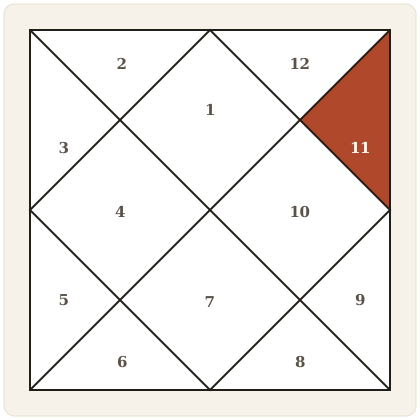
A chart contains two houses tied to money, and most readers never separate them. The second house is Dhana Bhava: stored wealth, family assets, the accumulation you already hold. The eleventh house is Labha Bhava: incoming income, the flow of earning, the fruit that ripens right now from your action. One is a tank, the other a river. The tradition also calls the eleventh the house of wish-fulfillment, and in modern income-based life many practitioners count it among the strongest wealth indicators of all. In this article we read Labha Bhava on its own terms: income, fulfillment of desires, elder siblings, and the social network through which gain arrives - and we will also mark clearly where interpretation must stop.
Labha Bhava: the house of income, not assets
The Sanskrit name Labha Bhava unpacks its own core. Labha is what is obtained: salary, income, earnings, success, the result of an effort. The tradition places it in the category of "fruit": in the tenth house you act, in the eleventh the fruit of that action ripens and arrives. So calling it the house of assets would be wrong; stored wealth is the second house's subject. Labha Bhava is the house of flow, not of storage. The difference is not merely verbal: a person can have excellent income and weak savings, or strong assets and modest inflow. The tradition reads these two conditions through two different houses, and merging them flattens the financial picture.
Labha Bhava in the Parashari text
In the Brihat Parashara Hora Shastra the twelve houses are treated in sequence from chapter 12 to chapter 23, and the eleventh house's place falls in chapter 22. There, income, gains, fulfillment of desires, the elder sibling and various kinds of obtainment are listed. Note that the list includes "fulfillment of desires": Labha Bhava was held to be the house not only of money but of any wish coming true. From the birth of a child to the attainment of a post, whatever is obtained falls, in the tradition, into the category of labha. This breadth matters, because modern usage has narrowed the house to income alone, while the text's meaning is wider: everything that enters life in the form of "fruit."
Against the second house: savings versus flow
The second and eleventh houses together form the two sides of economic life. The second house is the wealth you have: family assets, savings, accumulated capital - and also speech and food. The eleventh house is the wealth that comes to you: income, gains, earnings. In chart interpretation this difference yields a practical conclusion: if the second house is strong and the eleventh ordinary, the tradition reads a condition where the person holds assets but the flow of fresh earning runs slow; if the eleventh is strong and the second weak, earning runs well but wealth does not stay. If both are strong, the tradition takes it as a favourable indication for the economic condition. All of these are tendency-indications; a person's actual income or savings are known from their bank account, not from a chart.
The house of wish-fulfillment: the kama trikona
The twelve houses are divided into the trikonas of the four purusharthas - dharma, artha, kama and moksha. Houses one, five and nine belong to dharma; two, six and ten to artha; three, seven and eleven to kama; and four, eight and twelve to moksha. The eleventh house is the final house of the kama trikona. Kama here means not mere lust but desire and aspiration. The third house is the first push and initiative of desire, the seventh its extension into relationship and partnership, and the eleventh its completion. This structure deepens the meaning of Labha Bhava: it is the place where aspirations are fulfilled. That is why the tradition calls it the house of wish-fulfillment - and why its interpretation demands restraint: the fulfillment of desires and the blind growth of desires are two directions of the same house.
Elder siblings
Among Labha Bhava's subjects is a family relationship: the elder sibling, the brother or sister older than you. In the tradition younger siblings are read from the third house and elder ones from the eleventh. In the karaka tables Saturn is named the karaka of the elder brother: Saturn's slow, senior, disciplining nature matches the traditional picture of the older brother. The interpretation of this subject follows the same general rule: house, house lord and karaka are weighed together, and no single indication guarantees a conclusion. Any chart-based claim about your relationship with an elder sibling can only be a symbolic tendency; real relationships are built in real life.
The network: gain's social means
One modern and highly usable reading of Labha Bhava is this: it is the house of your social network. The tradition calls it the house of friends, groups and the circle through which gain reaches you. The reasoning is direct: income and opportunity almost never arrive alone; they arrive through people. The eleventh house symbolises that group-field where the fruit of your action finds recognition. For the same reason, some traditions tie it to large organisations, assemblies and collective ventures. Western astrology calls the eleventh house primarily the house of friendship and groups; the Vedic tradition puts gain and income in the front row, with the network as the means by which gain arrives. The two reading styles show two sides of one structure.
The fruit of the tenth: the arc from dharma to release
The chart's last four houses, nine through twelve, form a coherent arc: in the ninth house dharma, the right direction; in the tenth karma, action along that direction; in the eleventh labha, the fruit of the action; and in the twelfth vyaya, release and dissolution. The eleventh house's place in this arc is "result." Two things follow. First, the reading of Labha Bhava is incomplete without the tenth house: the fruit will be of whatever action was performed. Second, it is also incomplete without the twelfth: what comes also goes, and the tradition treats income and expenditure as two parts of one cycle. A reader who declares an economic future from the eleventh house alone is cutting the arc to manufacture meaning.
The eleventh lord: which direction gain comes from
The central formula of house interpretation applies here too: the house lord carries its house's affairs to wherever it sits. Whichever house the eleventh lord occupies, the tradition takes the channel of gain to be tied to that house's subjects. The eleventh lord in the second house turns earning into accumulation; in the third, gain through one's own effort, skill or younger siblings; in the fifth, through education, creativity or speculative subjects; in the tenth, directly through the field of work; and if the eleventh lord sits in the eleventh itself, the tradition takes it as a settled indication of the gain-tendency. This formula makes the reading change chart by chart - and that is also its limit: it is a direction-indication, not a declaration of income sources. A person's actual earning is made by their work, their market and their decisions.
Upachaya: a house that grows with time
The eleventh house is an upachaya: houses three, six, ten and eleven are called "growing." The traditional property of upachaya houses is that their results increase with time, and even natural malefics placed in them are held to give relatively favourable results. For Labha Bhava this was taken to mean that planets here, benefic or malefic, work in the direction of increasing gain. The tradition goes so far as to say that any planet in the eleventh house expands its own subject. The view is useful, but to conclude from it that a planet in the eleventh guarantees gain goes beyond the texts' method. A tendency to grow and a certainty of growth are two different things.
The karakas: Jupiter and Saturn
The chief karaka of Labha Bhava is Jupiter: Brihaspati is the universal significator of expansion, growth and obtainment, and his place in the subject of gain is natural. In the karaka tables Saturn is also named the karaka of the elder brother, as noted above. These two karakas show the house's two tones: Jupiter's expansive, optimistic gain, and Saturn's slow, hard-earned gain. The difference serves interpretation: a Jupiter-dominant eleventh house is tied by the tradition to income that arrives through accessible opportunities, while a Saturn-dominant eleventh is tied to income that is late but stable. Still, these are symbolic style-differences; no claim about the amount or timing of anyone's income can be built from them.
Shins and ankles: the body's pointer
In the division of the body among the houses, the eleventh house's parts are the shins and ankles - the lower leg. In the kalapurusha chart the eleventh sign is Aquarius, and Aquarius too is tied to this same part of the leg. Traditional medical astrology connected affliction of this house with problems of the shins and ankles. The same warning needs repeating here that this series holds as its method: this is a symbolic correspondence, not a medical diagnosis. Pain in the leg or any health problem is answered by a physician. Astrology should never take the place of medicine in health decisions.
Labha Bhava in a modern economy
Many modern practitioners count the eleventh house among the strongest wealth indicators in contemporary charts, and the reason is the changed shape of economic life. In ancient society the chief forms of wealth were land and inherited assets, which are subjects of the second and fourth houses. Today most people's wealth arrives as income: salary, professional earning, business profit, and opportunities coming through networks. All of these are Labha Bhava's subjects. So in modern interpretation the eleventh house, its lord and its occupants have moved to the centre of financial questions. But note: the house's growing importance does not change the nature of interpretation. Labha Bhava is still a tendency-indicator, not an account book of income, and the basis of any financial decision should be real financial information.
Common confusions
First confusion: a strong Labha Bhava means a lottery or sudden wealth. In the tradition labha means the fruit of action; for windfall wealth the texts look to other combinations, and a claim of "money without work" from any house is the language of the marketplace, not of the tradition. Second confusion: no planet in the eleventh house means weak income. An empty house is normal; the reading proceeds through sign, lord and aspects. Third confusion: more gain is always better. In the tradition wish-fulfillment and greed are two directions of the same house; as the final house of the kama trikona, the eleventh is also held to be the place where desires expand blindly. Fourth confusion: Labha Bhava is only about money. The wish-fulfillment tradition ties it to every kind of attainment, not only financial ones.
Practical use: a balanced view of income and desire
The balanced use of Labha Bhava lies in two questions. First: what are the sources of my income, and how do they connect to my work? Labha Bhava's tradition asks you to see income as the fruit of action, which routes income-growth through improving the field of work, not through waiting for an indication. Second: which of my aspirations are worth fulfilling? As the house of wish-fulfillment, the eleventh is an invitation to review your desires, not to chase them blindly. Do not make the chart a promissory note of income; make it a framework for reflecting on your work, your network and your aspirations. That is the method of this series.
A note on sources and honesty
The facts in this article come from sources actually opened and read: for the overview of the twelve houses, satyori.com's article "The Twelve Bhavas (Houses) in Jyotish," which lists BPHS chapter references, karakas, body-part divisions, the upachaya classification and the purushartha trikonas. Where a text is named, such as chapter 22 of the Brihat Parashara Hora Shastra, that rests on the reference in that secondary source; we have not consulted the original Sanskrit text directly and do not present it otherwise. Where traditions differ, as in the Western versus Vedic emphasis for the eleventh house, we have stated the disagreement. This article is educational; it offers no guarantee about any person's income, wealth or future, and financial decisions should not be taken on its basis.
Questions on this article
What does the eleventh house signify?
The tradition places income, gains, fulfillment of desires, elder siblings and the social network here. It is the fruit of the tenth house's action; these are symbolic meanings, not evidence about any person.
What is the difference between the second and eleventh houses?
The second house is stored wealth and savings; the eleventh is incoming income and earnings. One is the store, the other the flow. Reading them together flattens the financial picture.
Does a planet in the eleventh house guarantee gains?
No. The eleventh is an upachaya, so the tradition holds its planets to work in the direction of growth, but a tendency to grow and a certainty of growth are different things. No house or planet guarantees income.
Which planets are karakas of the eleventh house?
Jupiter is the universal karaka of gains; the karaka tables name Saturn for the elder brother. Jupiter for gain through open opportunities, Saturn for gain that is late but stable - these are symbolic style-differences, not claims about income amounts.


