The fifth house: children, intelligence, creativity
A guide to the fifth house as the traditional symbol of children, intelligence, creativity and past merit.
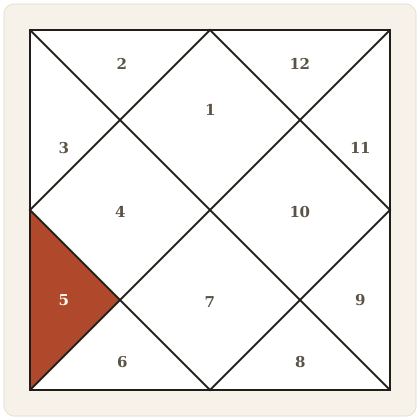
The fifth house of the chart goes by two names: Putra Bhava, the "children house", and Vidya Bhava, the "knowledge house". The two names are two ends of one thread: this house covers everything that grows onward from us - children, intelligence, creativity, mantra and devotional practice, romance before marriage, gains based on speculation, and in the tradition's language purvapunya, the merit of past lives that ripens in this one as ease, capacity or grace. Its body region is the upper abdomen and stomach. The fifth is a trikona, the chart's most auspicious grouping, which is why the fifth lord is counted a natural benefic for every ascendant, even when the planet is otherwise considered cruel. This article explains what the fifth house covers, how it is read, and where the tradition's boundary lies.
Two names, two threads
The name "Putra Bhava" is direct - the subject of children. But the name "Vidya Bhava" keeps this house from being only a children's house. In the tradition "putra" has never meant only biological offspring: a disciple is counted as a child in the lineages, and a creation - a composition, a book, a discovery - comes under the same heading of "offspring". From this angle the two names merge: this is the house from which something new is born - a child, an idea, a work or an understanding. The Parashari tradition discusses this house in its own dedicated chapter, and its list of significations places intelligence, mantra, romance and speculative gain alongside children. The formula that threads the whole list is purvapunya: the invisible capital that, according to the tradition, shows up as capacity for effort and ease of opportunity.
The subject of children: the most sensitive reading
The first subject of the fifth house is children - having them, the relationship with them, their well-being. The karaka planet is Jupiter, and the tradition reads this theme from three levels: the house, the fifth lord and Jupiter. While listening to the tradition's language, keep one thing firm: these are all "indications", never a verdict on anyone's fortune of children. Every health question tied to children - conception, fertility treatment, pregnancy - belongs to modern medicine, and its only address is a qualified doctor. In today's life families are formed in many shapes - adopted children, chosen children, happily child-free marriages - and reading the tradition's symbols to declare one shape "correct" is not this tradition's purpose. The more useful lesson of this house is this: our bond with children is made not only of birth but of raising, and the quality of raising is built from patience and presence, not from a chart.
Intelligence, creativity and higher learning
The second great subject is buddhi - the capacity to analyse, understand and create. Keep one fine distinction in mind: foundational education and the atmosphere of learning are seen from the fourth house; the fifth house is what lies beyond that - the capacity to use knowledge in one's own way, the strength to create something new, and discernment. The tradition discusses clear thinking and creative output under a strong fifth house. In modern language this house's reach extends to everyone who "makes" - writers, artists, researchers, teachers, entrepreneurs. This is tendency-thinking, not a certificate of talent: creativity's real arithmetic is practice, feedback and time, and that arithmetic is open to a person of any chart.
Mantra and inner practice
A quiet subject in the traditional list is mantra and worship - inner practice done with concentration. From this house the tradition sees which way a person's leaning toward inner practice tilts. Its practical meaning still works today: any method of concentration - japa, meditation or deep study - gives the mind what the mantra tradition promises, and that experience is available to any chart. On this subject too the tradition itself teaches balance: practice is not the name of escaping life's work but a support for doing that work with a clear mind.
Romance before marriage
Among the fifth house's subjects is love and romance, especially the relationship before marriage. (Marriage and partnership are seen from the seventh house.) The tradition discusses the romantic inclination and emotional expression from this house. For the modern reader the same rule is useful here as in every house: these are tendency-indications, not a prewritten map of anyone's love life. Relationships are built from conversation, consent and respect, and in any relationship the decisions about safety and boundaries come from judgement, not from a chart.
Speculation and chance gain: the subject needing most caution
The traditional list also records "speculation" - gain based on guessing - in the fifth house. In ancient form this was the subject of gambling and wagers; in the modern extension people connect it to the stock market and trading. Pause here for a plain statement: no house of any chart justifies any financial risk. The decision to trade stocks, crypto or any betting game rests on an understanding of risk, on savings and on qualified financial advice - not on the fifth lord's condition. The balanced meaning of reading this theme in the tradition is that a person recognises their own risk temperament: are they comfortable with guessing or with steadiness. That self-knowledge can be useful; every link beyond it - how much money, where, when - belongs to arithmetic and specialists.
Purvapunya: the tradition's deepest philosophical subject
The fifth house's most distinctive meaning is purvapunya - the capital of past actions that, according to the tradition, ripens as ease in this life. The balanced way to understand it is this: purvapunya is the tradition's lesson in humility. Where some things arrive without special effort - a capacity, an opportunity, a teacher - the tradition teaches gratitude, not pride. And where some things ripen slowly even with effort, the same principle teaches patience, not defeat. From this angle the fifth house is the corner of the chart that says: do not mistake what you received for talent, and do not mistake what you must build for fate.
Trikona, the fifth lord and raja yoga
By classification the fifth house is a trikona: the first, fifth and ninth houses are counted as the chart's most auspicious zones. From this comes an important rule: the fifth lord is counted functionally benefic for every ascendant, even when the planet is cruel by nature, because trikona lordship is itself an auspiciousness. And when the lords of the fifth or ninth join the kendra lords - by conjunction, mutual aspect or exchange of signs - a raja yoga forms in the tradition: the strongest combinations for elevation. Here too keep two layers apart: a yoga forming is a capacity, and the tradition itself says a yoga ripens in its dasha. A raja yoga printed in a chart is no guarantee of a life, just as a seed is no guarantee of a harvest.
Where the fifth lord sits
In traditional shorthand: the fifth lord in the fifth itself speaks of the intelligence and children themes standing firm; in the ninth, of learning joining fortune; in the tenth, of creativity becoming the career - one whose work is making things; and in the second, of accumulation through intelligence. When the fifth lord is strong in a kendra or trikona, the house's themes are considered supported, and the condition of the karaka Jupiter is weighed alongside at the end. All of these are symbolic readings: conclusions about anyone's children, talent or fortune come not from them but from the facts of a life.
Planets in the fifth house
In traditional shorthand: Jupiter in the fifth house is counted very favourable, with talk of intelligence, learning and happiness through children. The Moon here speaks of emotional creativity and attachment to children; Mercury of writing-intelligence and a talent tilted toward games of skill; Venus of artistic creation and romantic expression; the Sun of confident, leadership-shaped creativity. Mars in the fifth is discussed as competitive intelligence and the energy of sport; Saturn as learning that ripens late but deep, and circumstances asking patience in the children theme. Rahu is discussed as unconventional creativity with a special caution toward speculative appetite, Ketu as the intelligence of practice and a certain detachment in the children theme. All of these are tendency-indicators; the sign, the aspects and the lord's condition keep reshaping the final picture.
The question of time: when it activates
The fifth house's themes - events tied to children, the display of creativity, achievement in learning - are seen coming forward when the mahadasha or antardasha of the fifth lord or of the karaka Jupiter runs. Jupiter's mahadasha lasts sixteen years, and the tradition reads it as a period of learning, expansion and guidance. The value of this discussion lies in understanding a leaning, not in fixing the date of an event. Planning a child, studying or making something - the real time-setters of these are health, circumstance and preparation, and each of those has its own specialist.
Common misconceptions
First: "a cruel planet in the fifth house means no children." Never. The house, its lord and the karaka together give tendency-indications, and every health question tied to children belongs to modern medicine. Second: "an empty fifth house means childlessness or a dull mind." Empty houses are normal; then the fifth lord, the aspects and Jupiter are read. Third: "the fifth house is only about children." This house also covers intelligence, creativity, mantra, romance and purvapunya; children are one subject, not the whole interpretation. Fourth: "a raja yoga means success is certain." A yoga is a capacity; the tradition itself says it ripens in its dasha, and even ripened fruit is picked only by effort.
The fifth house in our times
In modern life every old subject of the fifth house is alive in a new form. "Creation" is now an economy - content, design, music, apps; in the tradition's language these are all offspring of Vidya Bhava. On the subject of children modern medicine has widened the options, and this is the clearest example of how symbol and capability travel separate roads: where the tradition once read indications, science now extends a hand. And "speculation" is now in every phone, from trading apps to fantasy leagues; here lies the fifth house's most modern lesson - that recognising one's appetite for guessing is necessary, feeding it is not. The essence of knowing this house is this: recognise which style of creating and learning is yours, and keep taking regular steps in that direction. Whatever purvapunya may be, this life's capital is built by practice.
A reading exercise: keep symbol and evidence apart
Take a hypothetical chart with Leo in the fifth house, so the fifth lord is the Sun. Suppose the Sun sits in the tenth house. The student first reads the framework: the house (the fifth, creativity and learning), the lord (the Sun, in the tenth, the career field), the karaka (Jupiter, in its own condition). The traditional reading: a leaning toward creativity becoming the profession. Now the second step - this is a tendency-statement, not the person's verdict. Perhaps that person is an engineer who writes on weekends; perhaps a teacher for whom the classroom itself is the creation. The real information will come from their education, skills and preferences. Record what matches, record what does not, and never invent an interpretation to force a match. This exercise keeps the tradition a study, not a superstition.
At a glance: the fifth house's subjects
| Aspect | Traditional subject |
|---|---|
| Names | Putra Bhava, Vidya Bhava |
| Main subjects | Children, intelligence, creativity, mantra practice, romance before marriage, speculative gain, purvapunya |
| Body region | Upper abdomen, stomach |
| Karaka | Jupiter (children, wisdom and the ripening of merit) |
| Classification | Trikona (1, 5, 9) - the most auspicious zone; the fifth lord is functionally benefic for every ascendant |
| Special combination | Raja yoga - when the fifth or ninth lord links with kendra lords |
| Related houses | Foundational education - the 4th; fortune and long journeys - the 9th; marriage - the 7th |
An honest note
Astrology is a traditional system, not laboratory science. Take decisions about children, health, education or money with qualified professionals - doctors, teachers, financial advisers; treat the chart as context, never the only basis. Especially for any worry tied to children, the first address is a qualified doctor. Sources actually consulted for this article: the fifth house's significations, Jupiter's karaka role, the trikona classification and the raja-yoga structure from satyori.com/jyotish/articles/twelve-houses-overview/; planetary karaka confirmations from satyori.com/reference/grahas/; and the Vimshottari dasha years from panchangtime.com/methodology/vimshottari-dasha. Our aim is to explain the tradition in plain words, not to sell fear or make promises.
Questions on this article
What does the fifth house signify?
The tradition places children, intelligence, creativity, mantra practice, romance before marriage, speculative gain and purvapunya here. These are symbolic meanings, not evidence about any person.
Which planet is the karaka of the fifth house?
Jupiter, as the significator of children, wisdom and the ripening of merit.
Does a cruel planet in the fifth house block children?
No. The house, its lord and the karaka together give tendency-indications; every health question tied to children belongs to modern medicine, and its address is a qualified doctor.
What is a raja yoga of the fifth house?
When the lord of the fifth or ninth house links with the lord of a kendra (1, 4, 7, 10) by conjunction, aspect or exchange, the tradition calls it a raja yoga. It is a combination of capacity; the tradition itself says a yoga ripens in its dasha - it is no guarantee of success.


