Lagna in Vedic astrology: the first house
The lagna is the sign rising on the eastern horizon at birth and the first house of the chart. Learn how it is fixed and how the tradition reads it.

Open a Vedic birth chart and the very first thing a jyotishi looks at is not a planet, not a sign: it is the lagna. The lagna is the sign rising on the eastern horizon at the moment of birth, and it becomes the first house of the chart. The tradition calls the first house Tanu Bhava, the house of the body, and treats it as the anchor of everything else: the twelve houses, the reading order, even which planets count as helpful for this particular person. This article explains what the lagna is, how it differs from the Moon sign and the Sun sign, how it is fixed, and what the tradition means when it calls a lagna strong or weak.
What the lagna is, in plain terms
Because the Earth rotates, the signs keep rising over the eastern horizon in turn, the same way the Sun appears to rise and set. The sign climbing over the eastern horizon at the exact moment of birth is the lagna, the ascendant. Since all twelve signs rise within twenty-four hours, the lagna changes roughly every two hours on average, though the exact span varies with latitude and season. This is why tradition puts so much weight on an accurate birth time: a difference of a few minutes shifts the degree of the lagna, and sometimes changes the lagna itself.
The standard Vedic convention for drawing the houses is the whole sign system: the entire sign holding the rising degree becomes the first house, the next sign becomes the second house, and so on around the zodiac. The exact rising degree is the bhava madhya, the strongest point of the house, but the house boundaries follow sign boundaries. This is a major geometric difference from Western house systems such as Placidus, and one reason the same birth data can produce two charts that look quite different.
Lagna, Moon sign and Sun sign: three different things
This is the most common confusion for readers, so it deserves a clear answer.
- Lagna (rising sign): the sign rising in the east at birth. It is tied to the body, the direction of the temperament and the frame of the life. It changes roughly every two hours.
- Moon sign (janma rashi): the sign the Moon occupied at birth. The tradition reads it as the indicator of mind, emotions and mental habits; the dasha calculation and naming syllables are tied to it. It changes about every two and a half days.
- Sun sign: the sign the Sun occupied at birth. This is what most newspaper horoscopes use. It stays put for about a month.
One person can, and often does, have all three in different signs. So "what is my rashi?" has no one-word answer; first you must ask which rashi you mean. Vedic chart reading starts from the lagna, because the whole map of the twelve houses is built from it.
What the first house covers
In the Parashara tradition the first house, Tanu Bhava, governs what arrives packaged with the body at birth: build and complexion, the head and face, vitality, the tilt of the temperament, and the angle of personality that shows before a word is spoken. The Sun is named as the natural karaka of the first house in its role as soul-significator, though many traditions treat the lagna itself as already complete.
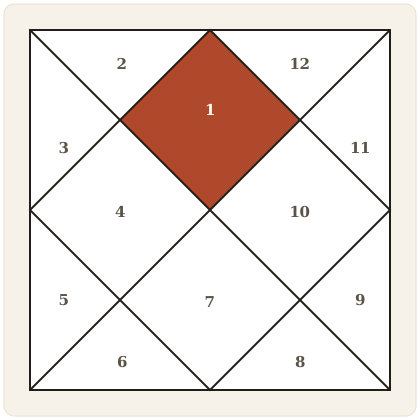
The first house also has a structural distinction: it is the only house that is both a kendra (1, 4, 7, 10) and a trikona (1, 5, 9). The kendras are the chart's pillars and the trikonas its most auspicious stations; holding both titles gives the first house its double weight. From this comes the traditional rule of order: do not begin commenting on a chart before examining the lagna and the lagna lord.
The lagna lord: the chart's representative
The planet that rules the rising sign is the lagna lord, the lagnesh. The tradition treats it as the lifelong proxy for the native's well-being: wherever it sits, it carries the question "who am I" with it. A lagna lord in the tenth house ties identity to work and public life; in the fourth, to home and mother. The lagna lord's strength, whether it sits in its own sign, exalted, in a friend's sign, under benefic aspect, is the first measure of the chart's overall direction; when the lagna lord is struggling, the tradition says even the chart's good combinations deliver slowly. This is not a verdict, it is the tradition's order of assessment: lagna and lagnesh first, everything else after.
The twelve lagnas at a glance
Each lagna has a different lord, and the tradition pairs each with a tilt of temperament. The table below is the traditional thumbnail sketch, not a fixed personality ruling, because the planets occupying the lagna, the lagna lord's condition and the aspects on the first house reshape this picture in every chart.
| Lagna | Lord | Traditional tilt (in brief) |
|---|---|---|
| Aries | Mars | Initiating, energetic, direct |
| Taurus | Venus | Steadiness-loving, patient, drawn to comfort and beauty |
| Gemini | Mercury | Curious, talkative, many interests at once |
| Cancer | Moon | Feeling, caring, tied to home and family |
| Leo | Sun | Self-assured, drawn to lead, wanting respect |
| Virgo | Mercury | Analytical, organised, detail-seeking |
| Libra | Venus | Balance-seeking, sociable, invested in relationships |
| Scorpio | Mars | Intense, enduring, inward-turned |
| Sagittarius | Jupiter | Optimistic, meaning-seeking, open |
| Capricorn | Saturn | Disciplined, slow but lasting, duty-taking |
| Aquarius | Saturn | Idea-driven, independent, society-facing |
| Pisces | Jupiter | Imaginative, compassionate, living in the inner world |
Notice two things. First, Mercury, Venus, Mars, Jupiter and Saturn each lord two lagnas, because seven planets rule twelve signs. Second, this same lordship logic later decides which planet is functionally benefic for your chart: for Cancer lagna, Mars lords both the fifth and the tenth and is called the yogakaraka. The right question is never "is this planet good or bad" but "what is this planet for this lagna".
When planets sit in the lagna
A planet occupying the first house is read as the most visible layer of the personality, the colour that shows in a first meeting. In the traditional shorthand: the Sun in the lagna speaks of self-projection and leadership; the Moon, of emotional openness; Mars, of energy and directness; Mercury, of speech and quick response; Jupiter, of dignity and trustworthiness; Venus, of grace and charm; Saturn, of seriousness and restraint. Rahu in the lagna is discussed as an unusual, magnetic unconventionality; Ketu, as a detached, inward-leaning presence. These are tendency-indicators, not settled outcomes: the planet's sign, the aspects falling on it and the lagna lord's condition together finish the picture. An empty lagna is no shortcoming either; then the lagnesh and the aspects carry the full weight, and most charts have most of their houses empty.
How the tradition weighs a strong lagna
Whether a lagna is "strong" is never decided from one factor; the assessment runs in layers, roughly in this order:
- The lagna lord's dignity: own sign, exaltation or a friend's sign is strength; debilitation or an enemy's sign is read as an area needing support.
- The lagna lord's house: a lagnesh in a kendra or trikona is called well-placed; in the 6th, 8th or 12th, the tradition speaks of greater effort being asked.
- Aspects on the lagna: the aspect of a benefic like Jupiter is held to support the lagna; malefic aspects are read as challenges to work with.
- Occupants of the lagna: a planet in its own or exalted sign in the lagna is said to give the personality a clear direction.
- Timing: when the lagna lord's dasha runs, the affairs of the first house are seen as activated.
The heart of this order is that judging a lagna is a relational calculation: house, house-lord and karaka must be read together, or any conclusion stays half-formed. This is the tradition's method of reading, not a keyword list to memorise.
How the houses are counted from the lagna
Once the lagna is fixed, the other eleven houses fix themselves: the next sign is the second house, the sign after that the third, and so on, with the twelfth house being the sign just before the lagna. If Leo rises, Virgo is the second house, Libra the third, and Cancer the twelfth. The houses then fall into their classical groupings, and the tradition reads the chart's frame from these groups. The kendras (1, 4, 7, 10) are the four pillars: self, home, partner and work. The trikonas (1, 5, 9) are the dharma stations, the most auspicious in the tradition. The 6th, 8th and 12th are the dusthanas, the difficult houses, where struggle brings learning. The 3rd, 6th, 10th and 11th are the upachayas, the growing houses, whose affairs are seen to improve with time and effort. This grouping matters because a planet's results are decided not by its nature alone but by its house-lordship: the lord of a trikona is counted as delivering good results for every lagna, whatever the planet.
One more useful lens: the twelve houses are also divided among life's four aims: dharma, artha, kama and moksha. Houses 1, 5, 9 belong to dharma; 2, 6, 10 to artha; 3, 7, 11 to kama; and 4, 8, 12 to moksha. In that map the first house is the gateway of the dharma trikonas, the point where the life-journey starts. This is why the tradition treats the lagna not merely as "the house of the body" but as the first thread of the life's direction.
Common misconceptions about the lagna
First: "my lagna is bad." No lagna is bad in itself; every lagna has its own lagnesh, its own yogakaraka planets and its own way of learning. Second: "lagna and rashi are the same thing." As shown above, these are three distinct markers moving at three different speeds. Third: "the birth date is enough." The lagna needs both birth time and birth place, because the rising sign changes with both. Fourth: "an empty lagna means a weak personality." Empty houses are normal; most houses in most charts are empty, and then the lord and the aspects decide. Fifth: "the lagna cannot change, so nothing can." The tradition treats the chart as a map of tendencies, not a lock on fate; choice and effort have always had a recognised place in it.
The lagna in daily life
The lagna's most everyday use is in choosing time. When a panchang marks a shubh muhurat, the lagna of that moment is being examined: for starting a venture, a lagna is chosen whose qualities match the work, and for entering a new home the tradition prefers a stable (fixed-sign) lagna. The second use is self-knowledge: knowing your lagna sets the house map of your chart, and only then do statements about the second, seventh or tenth house mean anything. The third use is asking better questions of an astrologer: "what is the condition of my lagna lord?" draws a far sharper answer than "what does my future hold".
How to find your lagna
You need three things: the birth date, the birth time (as exact as possible) and the birth place. From these three the chart is cast, and the sign written in the first house is your lagna. If the birth time is unknown, the tradition offers prashna charts and birth-time rectification, but those run on estimation and should be treated as estimates. The birth certificate or hospital record is the most reliable source. Even half an hour shifts the lagna degree, so conclusions drawn from an estimated time deserve to be held just as loosely.
Check the record before interpreting
Keep the source of the birth time and record whether it is exact or approximate. Check date, AM or PM, birthplace and time zone before interpreting a surprising result. Compare programs using identical inputs and settings. Do not insert a made-up minute merely to make an uncertain time look precise.
| Check | Record |
|---|---|
| Birth time | Recorded time and uncertainty range |
| Place | Birth city, not current residence |
| Ayanamsha | Name used by each calculation |
| House method | Whole-sign or another method |
What the numbers in this diagram mean
The numbers in this article's diagram label houses, not signs. In an actual North Indian chart the house positions stay fixed while numbers written inside may identify zodiac signs. A 5 in the top house can therefore mean Leo in the first house, not the fifth house. Read the chart legend before interpreting its numbers.
An honest note
Astrology is a traditional system, not laboratory science. The meanings tied to the lagna and the first house rest on centuries of symbolic thought, and for decisions about personality, health or livelihood, qualified professionals such as doctors and counsellors remain the first resort. Sources actually consulted for this article: the twelve houses' significations, karakas, the kendra-trikona-upachaya classification and the whole sign convention from satyori.com/jyotish/articles/twelve-houses-overview/; planetary lordships and karaka assignments from satyori.com/reference/grahas/; and sign-lordship cross-checked at saravali.github.io/astrology/dignities.html. Our aim is to explain the tradition in plain words, not to sell fear or promise outcomes.
Questions on this article
What is the difference between lagna and rashi?
The lagna is the sign rising on the eastern horizon at birth and changes roughly every two hours. The Moon sign is the sign the Moon occupied and changes about every two and a half days. Vedic chart reading starts from the lagna.
How do I find my lagna?
The chart is cast from the birth date, exact birth time and birth place; the sign in the first house is the lagna. A birth certificate or hospital record is the most reliable source for the time.
What does an empty lagna mean?
Nothing unusual; most houses in most charts are empty. With an empty lagna, the condition of the lagna lord and the aspects on the first house carry the full weight.
What is the lagna lord (lagnesh)?
The planet ruling the rising sign is the lagna lord. The tradition treats it as the lifelong proxy for the well-being of the native, and chart reading begins with the lagna and its lord.