The fourth house: mother, home, happiness
A guide to the fourth house as the traditional symbol of mother, home, property and inner footing.
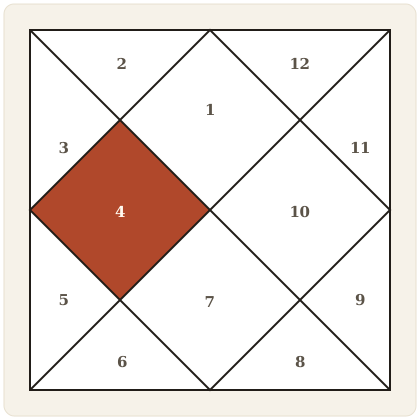
The fourth house of the chart is called Sukha Bhava, the "happiness house", and in older sources also Bandhu Bhava, the "kin house". The two names together sketch its map: everything that gives a life its roots - mother, home, land and immovable property, vehicles, the comforts of domestic life, foundational education, and the inner sense of being settled or unsettled in the world. Its body region is the chest, heart and lungs. The fourth is a kendra, one of the four most powerful pillars of the chart, and the tradition counts a strong fourth house among the cleanest indicators of a contented, well-anchored life. This article explains what the fourth house covers, how it is read, and where the tradition ends and practical decision-making begins.
The subjects hide in the names
In this tradition a house's names are the first key to its interpretation. "Sukha Bhava" says the core question here is comfort and contentment - the kind of happiness that comes not from earning but from being settled. "Bandhu Bhava" says this is the house of one's own people - and the first of one's own is the mother, with whom life's first bond forms. The Parashari tradition discusses this house in its own dedicated chapter, and its list of significations is the one given above: mother, home, immovable property, vehicles, domestic comforts, foundational education and the heart, in both the anatomical and the emotional sense. Notice that "heart" can be counted twice: once as an organ, once as inner steadiness. The whole astrology of the fourth house rests on this double meaning - the outer shelter and the inner shelter are two rooms of one house.
Mother and the emotional foundation
The first and most sensitive subject of the fourth house is the mother. The karaka planet is the Moon, the significator of mind and mother, and the tradition reads this theme from three levels at once: the house, its lord and the karaka. When all three are balanced, support from the mother and emotional security are discussed; when one level is strained, effort or sensitivity in that direction is discussed. One point must be kept plain here: the tradition itself calls these "indications", never verdicts on anyone's life or health. A mother's health belongs with her doctors, and the bond between mother and child is built by lived conduct, not by a chart. For the modern reader the more useful meaning of this house is this: our emotional foundation - the security received in childhood, the atmosphere at home, the inner sense of belonging - colours decisions for the rest of life. The chart is a symbolic map of that foundation; calling it strong or weak to stamp a mother or a child with a label is not the purpose of this tradition.
Home, land and immovable property
The most concrete subject of the fourth house is immovable property: the house one lives in, land, a farm, a building. Some sources assign Mars as a co-karaka for exactly this theme, since Mars is called the planet of land. The tradition discusses the acquisition of one's own home under a strong fourth house, and repeated changes of residence or sustained effort around housing under a strained one. Hearing this, keep one flexible rule in mind: astrology describes tendencies; property decisions are described by documents. Buying or selling a home rests on papers, price, loan terms and legal checks, and a chart does no work in any of them. The real benefit of knowing one's fourth house is recognising one's own relationship with "home": does one want stability or new addresses, does one earn for roots or for freedom. That self-knowledge makes property decisions better; no dasha does.
Vehicles and domestic comforts
The traditional list also places vehicles and comforts in this house - in ancient form the chariot and the bed, in modern form the car, household goods and every arrangement of ease. The same formula applies here: the house describes a leaning; the decision to buy is described by budget and safety. The timing of a vehicle purchase is tied in the tradition to a favourable dasha of the Moon or the fourth lord, but the right purchase is the one that fits income, insurance and need. The "comfort" theme runs a little deeper: the tradition also reads here where a person finds rest - one person in the work of the home, another in travel away from it. A quiet fruit of studying the fourth house is that we recognise what our own rest actually consists of, and stop imposing our definition on others.
Foundational education: the schooling of the base
A less-heard subject of the fourth house is foundational education - the learning that begins at home and on which all later knowledge stands. (Higher intelligence and creative learning are seen from the fifth house; here the talk is of the base: early discipline, the habit of reading and writing, the first atmosphere of learning.) The tradition discusses a student's early environment from the condition of this house. From a modern view the theme is equally precise: education research also shows that the home atmosphere deeply affects a child's capacity to learn, though that fact comes from research, not from a chart. Tradition and research meet here on one practical lesson: the foundation of learning is laid at home, and working on a foundation is never too late.
A kendra pillar and the moksha trikona
By classification the fourth house sits in two different groups, and both explain its character. The first group is the kendra: the first, fourth, seventh and tenth houses are counted as the four pillars of the chart - self, home, partner and work. The more of these pillars are strong, the more stable the tradition calls the basic structure of a life. The second group is the moksha trikona: the fourth, eighth and twelfth houses together form life's inward-turning thread of feeling, mystery and release. This double membership brings out the fourth house's real face: it is the centre of the inner life. The tenth house is outer work and standing; the fourth is its exact opposite pole - private life, home and peace of mind. When reading a chart, the tradition often weighs the fourth and tenth together: where a life is visible (the tenth) and where it is anchored (the fourth).
Where the fourth lord sits
Whichever house a house-lord occupies, that house's affairs are read as connected from there. In traditional shorthand: the fourth lord in the tenth speaks of a deep tie between home and career - working from home, or relocating for work; the fourth lord in the ninth, of contentment and roots tied to learning, faith or a distant place; the fourth lord in the second, of ancestral property and a home joined to the family; and the fourth lord in the twelfth, of living away from the birthplace or settling abroad. The lord's dignity - own sign, exaltation, a friend's sign - strengthens or weakens these leanings, and the condition of the karaka Moon is kept alongside at the end. All of these are symbolic readings: conclusions about anyone's home or mother come not from them but from the facts of a life.
Planets in the fourth house
In traditional shorthand: the Moon in the fourth house is counted favourable, with talk of attachment to the mother and emotional contentment, along with a sign of the mind's restlessness. Venus here speaks of interest in a beautiful home and comfort; Jupiter of an atmosphere of learning and guidance in the home; Mercury of a household full of reading and conversation. Mars in the fourth speaks of involvement with land and property and of energy in the home; the tradition also weighs it in the context of Kuja dosha, whose balanced meaning is treated in a separate article. Saturn here describes responsibilities of the home and slow but solid building; the Sun speaks of the father's image and self-respect at home. Rahu is discussed as an unconventional home or frequent changes of place, Ketu as a leaning toward detachment from home or a simpler life. All of these are tendency-indicators; the sign, the aspects and the lord's condition keep reshaping the final picture.
The question of time: when it activates
The fixed chart shows possibilities; the dasha tells which possibility comes forward when. The fourth house's themes - buying a home, events tied to the mother, a change of place, inner unrest or calm - are seen coming into discussion when the mahadasha or antardasha of the fourth lord or of the karaka Moon runs. The Moon's mahadasha lasts ten years, and the tradition reads it as a period centred on home, mother and mind. By transit too, the passage of the slower planets through the fourth house is discussed. The value of all this discussion lies in understanding a leaning, not in fixing the date of an event. Moving house, buying property or caring for one's mother - the real time-setters of these are circumstance, income and responsibility.
Common misconceptions
First: "a cruel planet in the fourth house means danger to the mother." Never. The house, its lord and the karaka give indications together, and an indication means a tendency, not a verdict on anyone's life or health. A mother is cared for with love and medicine. Second: "an empty fourth house means a homeless life." Empty houses are normal; most houses in most charts are empty, and then the lord and the aspects are read. Third: "the fourth house is only about the mother." This house covers the entire inner foundation - home, comfort, education, vehicles, property; the mother is its first subject, not its only one. Fourth: "property bought at an auspicious muhurta always pays off." Muhurta is the tradition's time-consideration; a property's outcome is decided by price, documents and upkeep.
The fourth house in our times
Perhaps no other house's meaning has shifted in modern life as much as the fourth's. Home is no longer the ancestral village - it is a rented flat, the city of the job, sometimes another country. The modern question of the "happiness house" has become: where is one's footing? In the tradition's language this is exactly the fourth house's inquiry, only in a new form. The bond with the mother now runs on video calls; foundational education has entered online classrooms; even the vehicle is now a cab subscription. Yet the fourth house's core question is still the same: where is the inner person anchored? The modern benefit of reading this house is recognising what our contentment actually rests on - a place, relationships, or constant movement - and then arranging life accordingly. That recognition can begin from a chart, but its proof is given only by the life that is lived.
A reading exercise: keep symbol and evidence apart
Take a hypothetical chart with Cancer in the fourth house, so the fourth lord is the Moon. Now suppose the Moon sits in the tenth house. The student first reads the framework: the house (the fourth, home), the lord (the Moon, in the tenth, the career field), the karaka (the Moon itself). The traditional reading: a deep tie between home and work - perhaps working from home, or changing homes for work. Now the second step, which is this article's real lesson: this is a tendency-statement, not the person's verdict. The real information about that person's home and work will come from their job, their city, their family. They may have lived in one house all their life; they may change cities every two years. Record what matches, record what does not, and never invent a story to force a match. This exercise keeps the tradition a study, not a superstition.
At a glance: the fourth house's subjects
| Aspect | Traditional subject |
|---|---|
| Names | Sukha Bhava, Bandhu Bhava |
| Main subjects | Mother, home, immovable property, vehicles, domestic comfort, foundational education |
| Body region | Chest, heart, lungs |
| Karaka | The Moon (mother and emotional well-being); in some sources Mars as co-karaka for land |
| Classification | Kendra (1, 4, 7, 10) - one of the chart's four pillars; part of the moksha trikona (4, 8, 12) |
| Axis | With the tenth house - private life versus public work |
| Related houses | Higher learning - the 5th; leaving home - the 12th; career - the 10th |
An honest note
Astrology is a traditional system, not laboratory science. Take decisions about home, property, health or relationships with qualified professionals - lawyers, financial advisers, doctors; treat the chart as context, never the only basis. For any worry tied to a mother or family, the first address is conversation and proper care, not a chart. Sources actually consulted for this article: the fourth house's significations, the Moon's karaka role, and the kendra and moksha-trikona classifications from satyori.com/jyotish/articles/twelve-houses-overview/; planetary karaka confirmations from satyori.com/reference/grahas/; and sign-lordship verified at saravali.github.io/astrology/dignities.html. Our aim is to explain the tradition in plain words, not to sell fear or make promises.
Questions on this article
What does the fourth house signify?
The tradition places the mother, home, immovable property, vehicles, domestic comfort, foundational education and inner contentment here. These are symbolic meanings, not evidence about any person.
Which planet is the karaka of the fourth house?
The Moon, as significator of mother and emotional well-being. Some sources also treat Mars as a co-karaka for landed property.
Is a cruel planet in the fourth house bad for the mother?
No. The house, its lord and the karaka together give tendency-indications; a chart never decides anyone's life or health. A mother is cared for with love, conversation and medicine.
What does an empty fourth house mean?
An empty house is normal - most houses in most charts are empty. Then the house-lord's condition, the aspects and the karaka Moon are read.


