Gaja Kesari Yoga: Jupiter in a Kendra from the Moon, and the Arithmetic of a Common Yoga
The most celebrated benefic yoga in astrology, and the arithmetic that shows how common it is under the raw rule; the rule, the conditions and the balanced reading.
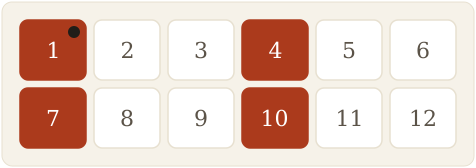
No yoga in astrology carries a name as famous as "Gaja Kesari". The elephant and the lion, strength and dignity; from families registering horoscopes to matrimonial listings, the name is presented as if its mere presence in a chart were a certificate of exceptional destiny. Now place a plain piece of arithmetic against that: four of the twelve houses are kendras, and under the raw rule it is enough for Jupiter to occupy any kendra from the Moon, so under a simple uniform-distribution model this yoga would appear in roughly every third chart; this is a model estimate, not a survey of real charts, though the navagraha.app source page arrives at the same estimate on simple counting, and our own calculation also yields 4/12, that is 1/3. This article untangles that tension: what the rule is, what the texts say, where the texts diverge, how strength grading works, when the yoga matures, and what a balanced reading looks like.
The rule: a kendra from the Moon
The popular form is simple: find the house the Moon occupies in the chart and count from there; if Jupiter sits in the 1st, 4th, 7th or 10th house from it, the yoga is present. Jupiter sitting with the Moon counts as the "first house", so a Moon-Jupiter conjunction is also this yoga. Note that the counting is relative to the Moon in the rashi chart; which house Jupiter occupies from the ascendant is irrelevant to this raw rule. The figure above shows exactly this: the dark dot marks the Moon's first house, and the four highlighted cells (1, 4, 7, 10) are the positions where Jupiter completes the rule. A kendra in astrology is an angular house: the four pillars of the chart, considered its strongest positions.
One chart in three: the proportion check
Now the arithmetic that settles the relation between this yoga's popularity and its promises. The model is stated plainly: in a random chart, Jupiter falls at any of the twelve possible distances from the Moon with equal probability. Four of the twelve distances (1, 4, 7, 10) are kendras, so under the raw rule the probability of the yoga forming is 4/12 = 1/3. Since the positions of the Moon and Jupiter are independent of each other and the signs fill roughly evenly over long periods, this is a fair estimate; navagraha.app likewise says "roughly one chart in three on simple counting", so a second source agrees with the same model estimate, even though no one has published a large survey of actual birth charts. The conclusion deserves repeating: a yoga present in one of every three charts cannot by itself be a rare distinction. Either every third person should be unusually respected and successful, or the raw rule is not the whole story. The tradition itself says the second, and the next section shows how.
Two definitions: the popular and the classical
Here lies an important finding. Read the verse of Brihat Parashara Hora Shastra 36.3 itself, available at enjoylearningsanskrit.com: "kendre devagurau lagnac candrad va subhadrgyute, nicastarigrairhine yogo 'yam gajakesari". That is: Jupiter in a kendra from the ascendant or from the Moon, conjoined with or aspected by a benefic, and free from debilitation, combustion and an enemy sign, only then is this Gaja Kesari. Note three differences: the text also accepts a kendra from the ascendant (the option is more generous), but at the same time imposes the conditions of benefic contact and freedom from debilitation, combustion and inimical sign (overall far stricter). According to the vidhata.app source article, Santhanam's commentary on this very verse adds one more fact: plain Moon-Jupiter angularity, without the remaining conditions, is what Phaladeepika 6.14 calls simply "Kesari Yoga", and Phaladeepika 6.16 gives its effects. In other words, the popular "kendra from the Moon" definition is actually Phaladeepika's Kesari Yoga, which modern usage has renamed Gaja Kesari.
The divergence of the texts: Saravali's absence
The vidhata.app source extends one more detail that startles regular readers: Kalyana Varma's Saravali does not carry this yoga under either name. Of three major classical texts, one has no such yoga at all, one defines it with strict conditions, and one keeps it in a simple form under the name "Kesari". This does not mean the yoga is "wrong"; it means it is a prominent but not indispensable yoga within the textual tradition, and a large part of its present fame is a construction of later tradition and popular astrology. The practical lesson for the reader: when someone says "there is Gaja Kesari", the first question should be by which definition, Phaladeepika's simple angularity or the conditioned definition of the BPHS, because the result sets of the two are very different.
Strength grading: when the yoga actually speaks
Both sources (navagraha.app and vidhata.app) converge on one point: read the yoga as a grade, not a yes-or-no. The main strength factors. Jupiter's sign dignity: Jupiter in its own sign (Sagittarius, Pisces) or exalted (Cancer) empowers the yoga; debilitated (Capricorn) it weakens it. The Moon's fullness: a waxing Moon near full lends strength; a dim Moon near the new moon thins the yoga. Distance from dusthanas: better if neither planet sits in the 6th, 8th or 12th from the ascendant. Malefic contact: close conjunction or aspect of Saturn, Rahu or Mars reduces the yoga's flow; the aspect of benefics (Venus, Mercury) increases it. And combustion: Jupiter too close to the Sun loses its significator power. The result of this grading is that one raw rule spans an entire range: on one side an exalted Jupiter, a full Moon and benefic aspect, on the other a debilitated combust Jupiter and a dim Moon, both looking identical in a report that says "Gaja Kesari Yoga present".
Cancellation and weakness: when the yoga stays on paper
The cancellation list from vidhata.app: the Moon is weak (within five degrees of the Sun, an uncancelled Kemadruma, or debilitated in Scorpio without Neechabhanga); Jupiter is combust or retrograde in the 6/8/12; or either planet is in close conjunction with Rahu or Ketu. Any one of these reduces the yoga's real flow so much that only technical presence remains. A social fact connects here: telling someone "your chart has Gaja Kesari Yoga" and then announcing auspicious results or the cost of "completing" it is the most common misuse of this yoga, because the raw rule is met in one of every three charts anyway. The order of examination is what this article's figure and grading describe: first the angularity, then the textual definition, then the strength factors, and finally the dasha.
Timing: dasha and the "second half of life" convention
When does the yoga "wake"? The sources answer: during the mahadasha of Jupiter or the Moon, or their sub-periods, when the yoga's themes become active. A popular notion holds that Gaja Kesari's results ripen in the second half of life, around the forties; vidhata.app honestly notes that this is practitioner convention, not a textual rule, stated by neither the BPHS nor Phaladeepika. The distinction is not small: if you are waiting out your life on a claim that is not in the texts at all, you should know it. One plausible reason for the convention is practical: Jupiter-like qualities, patience, judgement, reputation, generally show with experience, so readers tied the timing estimate to experience.
What the tradition says, and what it does not
List the textual promises as claims: BPHS 36.3-4 (cited via vidhata.app) calls the native of this yoga splendorous, wealthy, intelligent, endowed with laudable virtues and dear to the ruler; Phaladeepika 6.16 speaks of victory over enemies, lofty speech in the assembly, long life, renown and sharp intelligence. Modern readers usually read this as slow but durable social standing, recognition for genuine judgement, and the capacity to recover from failure. Now the limits, which matter just as much. This is not a Raj Yoga: Raj Yoga is the separate category of kendra-trikona lord connections; the two can co-occur but are not synonyms. It is not a wealth guarantee: the question of wealth centres on the 2nd, 10th and 11th houses and the dasha. And it is not a certificate of character: no configuration present in one chart in three can be proof of any person's deeds or future.
What the name teaches: the elephant and the lion
Gaja means elephant, kesari means lion. In the tradition's language of images, the elephant stands for steadiness, memory and the capacity to bear weight; the lion for dignity, courage and natural respect. Together they form the picture that readers of this yoga call "respected judgement": not power alone, not wisdom alone, but the balance of the two. This image analysis is also useful because it tells the yoga's real traditional depth: the texts name Jupiter as the significator of knowledge and the Moon as the significator of the mind; when knowledge supports the mind, the mind grows steady and dignified, and that inner picture was cast outward as the "elephant-lion". Remember the image, but do not take the image as proof: the beauty of a name changes nothing about how common a yoga is or about any person's future.
Two examples
First chart: the Moon in Cancer, two days before the full moon; Jupiter in Aries, that is the tenth house from the Moon, in the sign of its friend Mars, with no malefic conjunction. The raw rule is met: a kendra (10). The grading: the Moon in its own sign and nearly full, Jupiter in a friend's sign, free of dusthanas; in the sources' lists this is a strong instance of the conditioned category, and it is for pictures like this that the tradition recites its admiring results. Second chart: the Moon in Scorpio, on the eve of the new moon; Jupiter in Aquarius, the fourth from the Moon, but within three degrees of Rahu. The raw rule is met again: a kendra (4). But the grading falls: the Moon debilitated and dim, Jupiter conjoined with Rahu; two major factors of vidhata.app's cancellation list are present here. Both reports will print the same line, "Gaja Kesari Yoga: present", and the difference between the two is this article's core lesson.
Common confusions
First confusion: if there is Gaja Kesari, life will surely succeed. One chart in three carries this configuration; success is the fruit of many factors and of effort. Second: the Moon-Jupiter conjunction alone is Gaja Kesari. The conjunction is only one kendra position (the first); the 4th, 7th and 10th form the yoga by the same rule, and one part of the tradition even assesses the conjunction case separately because there the Moon's fullness matters still more. Third: if the yoga is weak it must be "fixed" with a puja. Within the method the answer is strength grading and waiting for the dasha; pressure to spend under any name is a warning sign. Fourth: this yoga is rare. The arithmetic is above: one in three in the model. A claim of rarity itself demands examination.
Practical use
Use this article in three ways. First, for self-checking: find the Moon's house in your chart and count from there; if Jupiter is in the 1st, 4th, 7th or 10th, the raw rule is met; then derive the grade from the strength list (Jupiter's sign dignity, the Moon's fullness, dusthana distance, malefic contact, combustion). Second, for testing claims: on hearing "you have Gaja Kesari", ask by which definition, and what the strength grading is; remember the model-estimated commonness, and recognise claims like "it ripens in the second half of life" as convention, not textual rule. Third, for balance: if you value the tradition, read this yoga with the mild weight its own sources give it, as one supportive indication, not as proof of destiny.
Sources and the honesty note
The verse of BPHS 36.3, its word meanings and translation are quoted directly from the scripture page at enjoylearningsanskrit.com; the effects of 36.3-4, Santhanam's reference to Phaladeepika 6.14/6.16, Saravali's absence, the strength and cancellation lists, and the "ripens late" convention note are from the yoga article at vidhata.app; we have not opened the full texts of the BPHS or Phaladeepika ourselves, and these citations are the sources'. The counting method of the angularity, the strength and weakness lists, the "roughly one chart in three" statement and dasha activation are from navagraha.app. The one-in-three figure is our own: 4 of 12 distances are kendras under a uniform-distribution model; it is a model estimate on the raw Moon-only rule, not a prevalence measured in actual birth charts, and under the stricter classical definition the share would naturally be smaller. The claim of Saravali's absence is vidhata.app's; we have not inspected any edition of the Saravali ourselves. Everything about effects is presented as the tradition's claim; there is no established measured link between any yoga and life outcomes. This article is educational; it makes no claim about any person's reputation, wealth or future.


