Gandanta explained: the full arithmetic of the three junctions
Where a gandanta begins and ends, how its length is counted, and how to check any moment for it yourself.
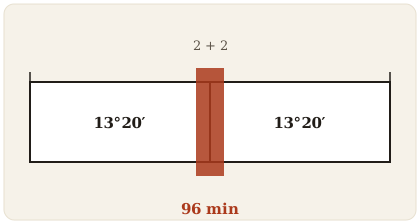
Gandanta is the one panchang concept that appears in three separate lists: nakshatra gandanta, tithi gandanta and lagna gandanta. All three share a single underlying formula: wherever one panchang unit ends and the next begins, a small transition zone around that seam is called gandanta, the end of the knot. Our gandmool article analysed the six nakshatras, their tradition and the fear attached to them; this article is its mathematical companion. The questions here are: exactly where does a gandanta zone begin and end, how is its length counted, and how can you check for yourself whether a given moment falls in one. The whole article is about measurement and computation, not prediction.
The unit first: what a ghati is
Gandanta lengths are counted in ghatis, so begin there. One ghati is 24 minutes: the 24 hours of day and night divided into 60 ghatis. Half a ghati is 12 minutes, two ghatis are 48 minutes. A related unit is worth knowing: two ghatis make one muhurta, 48 minutes, and the day-night cycle holds 30 muhurtas. So when a text says "two ghatis" for gandanta, another reading of the same quantity is "one muhurta". One point to note: the ghatis of nakshatra gandanta are counted in the time of the Moon's motion, that is, it is a time measure, not an angular one; below we also show the conversion into degrees, because modern panchangs and software display degrees.
Nakshatra gandanta: the exact zones of the three junctions
According to verse 43 of the marriage chapter of Muhurta Chintamani, accessed through secondary sources, the last two ghatis of Jyeshtha, Revati and Ashlesha and the first two ghatis of Mula, Ashwini and Magha form the nakshatra gandanta. Chapter 92 of the Brihat Parashara Hora Shastra translation gives the same. The junctions are three: Cancer to Leo at 120 degrees, where Ashlesha ends and Magha begins; Scorpio to Sagittarius at 240 degrees, where Jyeshtha ends and Mula begins; and Pisces to Aries at 360, that is 0, degrees, where Revati ends and Ashwini begins. At each junction the gandanta zone runs from 48 minutes before the Moon reaches the junction to 48 minutes after it crosses. In all, 96 minutes per junction, three times a month.
From time to arc: converting ghatis into degrees
Modern panchangs and software report the Moon's position in degrees, so converting the 48 minutes into arc is useful. The Moon's mean motion is about 13.18 degrees per day, roughly 0.00915 degrees per minute. In 48 minutes the Moon covers on average about 0.44 degrees, that is about 26 minutes of arc. So the angular zones of nakshatra gandanta are approximately: 119°34' to 120°26', 233°34' to 240°26', and 359°34' to 0°26'. These boundaries rest on mean motion; the Moon's real speed varies somewhat, so the textual method treats counting by time as primary. The most direct method is to read the moment of the junction crossing from a panchang and apply 48 minutes on each side. Treat the angular figures as a convenience conversion for comparison, not as fixed boundaries.
A worked example: the Moon at 119°40'
Suppose one evening the Moon's sidereal longitude is 119 degrees 40 minutes. Is this gandanta? First the distance to the junction: 120 degrees minus 119°40' leaves 0°20', that is 0.333 degrees. Dividing by the mean motion of 0.00915 degrees per minute gives about 36 minutes, so the Moon is on average 36 minutes before the junction. Thirty-six minutes is less than 48, so this moment is inside the gandanta zone. The nakshatra count alongside: 119°40' divided by 13°20' gives 8.98, the last part of the ninth nakshatra Ashlesha, its fourth pada. So this moment lies in both Ashlesha's final pada and the gandanta zone. The same two-line computation can be repeated for any moment; all it needs is the Moon's position and its mean speed.
Tithi gandanta: the junctions of the Moon-Sun distance
The second gandanta list concerns the tithis. A tithi is a unit of the elongation between Moon and Sun: every 12 degrees of growth makes one tithi. In the tradition, the last ghati of the fifth, tenth and fifteenth tithis and the first ghati of the first, sixth and eleventh tithis are called tithi gandanta. That is three junctions: Panchami to Shashthi, Dashami to Ekadashi, and Purnima or Amavasya to Pratipada. Notice the pattern: these are the boundaries of the four-part divisions of the paksha, and the fifteenth tithi's junction is the very point where the paksha itself turns. Since one tithi lasts about 60 ghatis, one ghati of tithi comes to about 12 minutes of elongation. Here too the primary measure is time: read the moment of the tithi change from the panchang and apply 24 minutes on each side.
Lagna gandanta: the junctions of the rising cycle
The third list concerns the ascendant. The last half ghati of Cancer, Scorpio and Pisces ascendants and the first half ghati of Leo, Sagittarius and Aries ascendants are called lagna gandanta. Half a ghati is 12 minutes. Note that the junctions are the same three: water sign to fire sign, exactly as in nakshatra gandanta. The difference is that the moving point here is not the Moon but the rising point, the lagna, which changes sign roughly every two hours. So lagna gandanta occurs several times a day, whenever the Cancer-Leo, Scorpio-Sagittarius or Pisces-Aries ascendant change takes place. One practical caution: the time a sign takes to rise depends on latitude, so the clock of lagna gandanta differs from city to city; check it from a panchang or software set for the very place in question.
All three gandantas in one table
Place the three lists side by side and the structure becomes clear. Nakshatra gandanta: the moving point is the Moon, the unit is the nakshatra, the junctions are the three water-to-fire sign boundaries, the length by the textual view is two ghatis on each side, the frequency is three times a month. Tithi gandanta: the moving quantity is the Moon-Sun elongation, the unit is the tithi, the junctions are Panchami-Shashthi, Dashami-Ekadashi and Purnima-Amavasya to Pratipada, the length is one ghati each side, the frequency three times a paksha. Lagna gandanta: the moving point is the ascendant, the unit is the sign, the junctions are the same three water-to-fire boundaries, the length is half a ghati each side, the frequency roughly daily. Observe also the order of lengths: longest for the nakshatra, shortest for the lagna; this is exactly the reverse of the speed at which these units change. There is a plain good sense in this proportion: the faster a point moves, the smaller its transition zone is kept, so that the marked moments stay rare and manageable.
Disagreement over duration: not one count but several
The tradition is not unanimous about the length of gandanta, and from a computational point of view this disagreement matters. The list of Muhurta Chintamani and the BPHS translation gives two ghatis on each side of every junction, 96 minutes in all. The Piyushadhara commentary on Muhurta Chintamani quotes other works and authorities such as Ratnamala, Vasishtha and Narada holding different views. Jyotish Kalpdrum gives a separate count for each nakshatra: at the beginnings, 3 ghatis of Ashwini, 3 of Magha and 9 of Mula; at the ends, 11 of Ashlesha, 5 of Jyeshtha and 12 of Revati. By the longest list, the gandanta at the end of Revati runs to 12 ghatis, 4 hours 48 minutes, while the shortest list makes the same zone 48 minutes. This sixfold spread shows that gandanta duration is a decision of the tradition, not an astronomical necessity.
Further "gand" lists: the general habit of the panchang
The source page enumerates several other "gand" conditions at birth: tithi kshaya, Vyatipata, Vaidhriti, Shoola, Paridhi, Bhadra, Yamaghanta, Dagdha, Krishna Chaturdashi, Amavasya and others. The purpose of listing them here is not to multiply fear but to show that "marking transitions and special combinations" is a general method of panchang thinking; gandanta is simply its best-known member. Most of these have their own computations: Vyatipata and Vaidhriti, for instance, are two of the panchang's 27 yogas, derived from the sum of the longitudes of Moon and Sun. The sensible way to read any such list is the same one applied to gandanta: first what is measured, then where the boundary lies, then which tradition assigns which length, and finally what purpose the mark was meant to serve.
How to check: from panchang or software
Checking a moment for gandanta yourself takes three steps. Step one: obtain the Moon's position in sidereal degrees for that moment from a reliable panchang or chart software, and note which ayanamsa it uses. Step two: see whether the position falls inside the three angular zones, 119°34' to 120°26', 233°34' to 240°26', or 359°34' to 0°26'; if it does, the moment is in the textual nakshatra gandanta zone. Step three: for tithi and lagna, read the day's tithi-change and lagna-change times from the panchang and apply the 24-minute and 12-minute windows on each side. Prefer the time-based check, because the textual method's primary measure is the ghati; the angular boundaries are a convenience conversion from mean motion. One more caution: different panchang traditions may use different ayanamsas, which can shift the Moon's sidereal position by some minutes of arc; right at the edge of a junction this difference becomes decisive, so check against the tradition you actually follow. There is also an easier route: several panchang websites publish ready-made lists of gandmool and gandanta start and end moments; the source page itself gives fifty such spells from October 2026 to December 2027, each lasting 42 to 54 hours. Reading the moments directly from such a list is also a good way to cross-check your own computation.
Electional use versus birth interpretation
The most consistent use of gandanta is in muhurta: avoiding the junction moment when electing a time for an auspicious act. That is a coherent rule of electional astrology. A separate matter is drawing conclusions about a person born at such a moment; that is prediction, and this series' position is explicit: the fear statements attached to birth gandanta are unexamined traditional claims with no modern evidence. Keep the two subjects apart: choosing a moment is a decision, in which skipping seam moments is simple and consistent with the tradition; declaring a birth moment lucky or unlucky is a claim that cannot be tested. The gandmool article analyses that question in full; here it is enough that the computation is neutral and the interpretation tradition-dependent.
Common misconceptions
First misconception: gandanta lasts a whole nakshatra or a whole day. The textual list is the 96 minutes around the junction; calling an entire nakshatra gandanta is the broadened panchang-list convention. Second misconception: the three gandantas are one thing. Nakshatra, tithi and lagna gandanta measure different moving points, have different lengths and very different frequencies; lagna gandanta occurs nearly daily, nakshatra gandanta three times a month. Third misconception: gandanta has one fixed duration. As shown above, lists from 48 minutes to nearly 5 hours exist in the tradition. Fourth misconception: anything begun in gandanta fails. That is a predictive claim; the mathematics only marks a transition moment, it pronounces no outcome.
Practical use
The arithmetic of this article serves three purposes. First, panchang literacy: on reading "gandanta", now ask which gandanta, by which list, of what length; most confusion dissolves right there. Second, electional practice: if you follow traditional muhurta, you can check your chosen moment yourself with the three steps above, without depending on anyone's fear-laden reading. Third, panchang study: gandanta computation is a fine exercise that practices all three units, nakshatra, tithi and lagna, at once, because it involves arc arithmetic, ghati arithmetic and junction structure together. And in every use the same limit holds: this is a method of measuring time, not an announcement of events.
A note on sources and honesty
The facts in this article come only from sources actually opened and read: for the two-ghati nakshatra list, the three junctions, the Piyushadhara disagreements and the shanti references, the gandmool page at sanatanbodh.in, which lists its own references to Muhurta Chintamani and BPHS; for the tithi gandanta and lagna gandanta definitions, the Jyotish Kalpdrum ghatis and the list of other "gand" conditions, the "Gand Mool Vichar" page at sushmajee.com. The conversion of ghatis into degrees, the angular boundaries and the worked example are our own computations, based on the Moon's mean motion of 13.18 degrees a day; the primary textual measure is time. We did not consult the original Sanskrit texts directly. This article is educational; it makes no claim about the outcome of any moment or person.
Questions on this article
How many kinds of gandanta are there?
Three: nakshatra gandanta, at the Moon's three water-to-fire sign junctions; tithi gandanta, at the Panchami-Shashthi, Dashami-Ekadashi and Purnima-Amavasya to Pratipada boundaries; and lagna gandanta, at the ascendant changes over the same three junctions. Each has its own length and frequency.
How long does a gandanta last?
The tradition is not unanimous. In the Muhurta Chintamani list, nakshatra gandanta is two ghatis on each side of the junction, 96 minutes in all; tithi gandanta one ghati each side; lagna gandanta half a ghati each side. Works like Jyotish Kalpdrum give 3 to 12 ghatis for different nakshatras. So there is no single fixed length; naming the list is essential.
How do I convert gandanta into degrees?
Taking the Moon's mean motion of about 13.18 degrees a day, 48 minutes come to about 0.44 degrees, roughly 26 minutes of arc. The approximate angular zones of nakshatra gandanta are therefore 119°34′ to 120°26′, 233°34′ to 240°26′, and 359°34′ to 0°26′. This is a convenience conversion based on mean motion; the textual method's primary measure is time, the ghati.
How do I check a moment for gandanta myself?
Take the Moon's sidereal position for that moment from a panchang or software and see whether it falls in the three angular zones. A more precise method: read the junction-crossing moment from the panchang and apply 48 minutes on each side. For tithi and lagna, apply 24-minute and 12-minute windows around that day's change moments. Ready-made time lists are also available on several websites.


