Gandmool nakshatra: the facts about the six nakshatras
Six nakshatras, three junctions, the textual list versus the panchang list, and how to understand gandmool through arithmetic instead of fear.
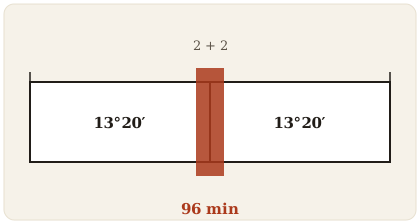
Gandmool heads the list of astrological terms that arrive with fear attached: "the child was born in gandmool" silences many a household. This article tests that fear against mathematics and the textual lists. Gandmool is no mystery: it is a set of six nakshatras sitting at three junctions of the ecliptic, where one sign ends, another begins, and a nakshatra ends at the same point. The classical texts treated these junctions as a small sensitive zone; the fear market turned that zone into a large business. To see the difference, we look first at the structure, then at what the texts actually say, then at the disagreements within the tradition, and finally at a balanced modern view.
What gandmool is: three junctions
Six nakshatras are called gandmool: Ashwini, Ashlesha, Magha, Jyeshtha, Mula and Revati. They come in three pairs, each pair sitting on one junction: Ashlesha to Magha, where Cancer ends and Leo begins; Jyeshtha to Mula, where Scorpio ends and Sagittarius begins; and Revati to Ashwini, where Pisces ends and Aries begins. Panchang usage classes the first of each pair, Ashlesha, Jyeshtha and Revati, as "ganda" kind and the second, Ashwini, Magha and Mula, as "moola" kind; together they make gandmool. Some sources also call these the gandanta nakshatras, because their link is directly with the three gandanta junctions. The Moon crosses all three pairs roughly every 27 days, so gandmool appears in the panchang three or four times a month, and each spell lasts about two days while the Moon traverses both nakshatras. In other words, gandmool is not a rare date on the calendar but a routine condition running somewhere nearly every week.
The astronomy of the junctions
Why these junctions exist, and why no others, is pure arithmetic. A nakshatra spans 13 degrees 20 minutes; a sign spans 30 degrees. Their boundaries coincide only where both measures complete together, and that happens every 120 degrees: 9 nakshatras equal 4 signs equal 120 degrees. So the ecliptic holds exactly three such points, at 120, 240 and 360 (that is, 0) degrees. One more feature: at each junction a water sign (Cancer, Scorpio or Pisces) ends and a fire sign (Leo, Sagittarius or Aries) begins. The tradition read this water-to-fire transition as a "gandanta", the end of a knot. The whole structure is a natural seam in the astronomical grid; nothing in it is inherently auspicious or inauspicious, a value judgement the tradition added later. Consider also the rhythm: the Moon's sidereal month is about 27.3 days, so these crossings repeat with clockwork regularity. An event that has recurred several times a month for thousands of years cannot sensibly be classed as an extraordinary omen, because extraordinariness requires rarity. The same regularity is what makes the panchang beautiful: gandmool is simply the seam where the nakshatra measure and the sign measure, two independent grids laid over the same sky, happen to meet. A seam is a structural feature of the measuring system, not a verdict on the sky itself.
"Ganda" and "moola": the naming confusion
Two misunderstandings begin with the name itself. First, when people say "Mool nakshatra" they often mean only Mula, the nineteenth nakshatra; whereas in common usage "mool" refers to the whole group of six. Kedar Datt Joshi, the Hindi commentator of Muhurta Chintamani, records exactly this, that the six are popularly called "mool". Second, treating "gandmool" as a single fault; panchang tradition treats it as the combined name of two kinds, ganda and moola. Clearing the naming matters because half the fear grows out of verbal confusion: until it is clear which structure is being discussed, the claims made about it cannot even be tested.
The classical texts: Muhurta Chintamani and BPHS
According to classical references available through secondary sources, verse 43 of the marriage chapter of Muhurta Chintamani calls the last two ghatis of Jyeshtha, Revati and Ashlesha and the first two ghatis of Mula, Ashwini and Magha the nakshatra gandanta; one ghati is 24 minutes, so 48 minutes on each side of the junction. Chapter 92 of Brihat Parashara Hora Shastra, in translation, likewise gives two ghatis on each side of the same three junctions. Notice how small the textual list is: 96 minutes per junction, three junctions in a sidereal month, which on a schematic uniform-motion count comes to 288 minutes in a 27.3-day sidereal month, about 0.7 percent of the time. The title of that BPHS chapter is itself instructive: "Remedies from birth in gandanta." The text treats it as remediable, not as a curse.
Disagreement over the duration
The tradition is not unanimous about how long the gandanta lasts, and that fact deserves attention. The Piyushadhara commentary on Muhurta Chintamani quotes other works and authorities, Ratnamala, Vasishtha and Narada, giving different lengths for the junction. Jyotish Kalpdrum gives a still different count: 3 ghatis at the start of Ashwini, 3 of Magha, 9 of Mula; and 11 ghatis at the end of Ashlesha, 5 of Jyeshtha and 12 of Revati. So one tradition makes the junction 96 minutes; another stretches some junctions to hours. When the very boundary of a concept shifts this much between authorities, calling any one list the "final truth" is not scholarship but selection. This history of disagreement shows gandmool as an evolving convention of the tradition rather than a fixed astronomical rule.
The panchang list versus the textual list
An important practical distinction, rarely explained: the textual gandanta is 48 minutes on each side of the junction, while panchang gandmool lists count all six nakshatras in full. The difference is large. Assuming the Moon's mean motion, about 13.18 degrees a day, the 80-degree arc of six nakshatras is about 22 percent of the 360-degree nakshatra cycle, so the Moon spends about 22 percent of the sidereal month in them. The textual list's three 96-minute windows total about 0.7 percent of that same denominator, the total time of the sidereal month. Both figures rest on the schematic assumption of uniform motion; the Moon's real speed varies somewhat, so treat them as approximate comparison values, not fixed boundaries. So the first question on hearing "it is gandmool today" should be: by which list? The panchang list is a broad cautionary flag; the classical reckoning is its narrow core. Reading the two together multiplies the fearful weight of the calendar many times over, and understanding this difference alone dissolves most needless anxiety.
The traditional fear statements
Honesty also requires recording the fearful side of the tradition rather than hiding it. Some classical lines, such as a verse attributed to Jatakabharana quoted in our source, attach extremely severe outcomes to births in particular tithi-weekday-nakshatra combinations. We do not repeat their contents here; it is enough to record that such statements exist in the literature, and our method is to record them with an explicit label: claims of the old predictive tradition, never verified by any modern test, unfalsifiable because of their vague language, and not endorsed by us in any sense. A mathematical check is also worth making: by mean motion the Moon spends about 22 percent of the sidereal month in these six nakshatras, roughly every fourth or fifth birth; crores of ordinary, successful, happy people were born in precisely these nakshatras.
Mool shanti: the custom and its disputed timing
For a child born in gandmool the tradition prescribes a mool shanti ceremony, and even its timing is disputed: the Piyushadhara commentary quotes Shaunaka allowing the rite on the twelfth day after birth or when the birth nakshatra returns, and the learned perform it on the birth nakshatra day itself; Drik Panchang speaks of the twenty-seventh day or the return of the same nakshatra, since the Moon returns to it in about 27 days. When and how to hold it is a matter of family custom; asking your own purohit is the proper route. This series' view: if the ceremony gives the family peace, it is respectable as a cultural practice; but holding it out of fear, or at excessive expense, contradicts the tradition's own intent, because the texts call it a remedy, not an unavoidable curse.
Birth in gandmool: the balanced view
Now place the whole question together. The structure is astronomical: three seam lines. The textual list is narrow: 96 minutes per junction. The panchang list is broad: six full nakshatras. The fear statements belong to the old predictive tradition: unverified and unfalsifiable. The shanti custom belongs to family practice. The balanced conclusion from all of this: birth in gandmool is a calendrical fact, not a diagnosis. Roughly one birth in four or five worldwide falls within these six nakshatras by simple arithmetic, and the hospitals of every country discharge such newborns every week without incident. A child's future, health or relationships are shaped by upbringing, environment and opportunity, not by the nakshatra on the birth record. If the family tradition performs mool shanti, it is a rite of affection; but under no circumstances is the belief that something is "wrong" with the child either the intent of the textual method or supported by facts. One practical caution is also fair: a market sells expensive shanti rituals on gandmool fear, and that market's interest lies in keeping the fear alive. Before paying for any remedy, ask what the textual list says, how long the zone is, and whether it is required or merely customary. An answer delivered with fear deserves suspicion; an answer delivered with calm facts deserves attention.
Tithi gandanta and lagna gandanta: the other junctions
The gandanta idea is not limited to nakshatras. The tradition also has tithi gandanta: the last ghati of the fifth, tenth and full or new moon tithis and the first ghati of the following tithis; and lagna gandanta: the last half ghati of Cancer, Scorpio and Pisces ascendants and the first half ghati of Leo, Sagittarius and Aries ascendants. All three share one pattern: wherever one panchang unit ends and another begins, a small transition zone is treated as sensitive. This makes it clear that gandanta is not a specific fault list but a general habit of panchang thinking: treating transition moments as delicate. Understanding that habit is the key to placing every new "ganda" list in its proper proportion.
Gandanta in muhurta: a matter of electional astrology
The oldest and most consistent use of gandanta is in muhurta: Muhurta Chintamani counts it as a fault in wedding elections, meaning one avoids the junction moment when choosing a time for an auspicious act. That use is coherent: a method whose entire purpose is choosing the smoothest moment naturally skips seam moments. It also clarifies a vital distinction: avoiding a moment in an election and drawing conclusions about a person born at that moment are two different things. The first is a choice; the second is a prediction. In the classical tradition gandanta's primary home is the first, while popular fear drags it into the second. Turning an electional rule into a verdict on births is a displacement of subject.
Common misconceptions
First misconception: a child born in gandmool is a danger to the family. This is an unverified predictive claim; the texts treat it as remediable and modern evidence offers it no support. Second misconception: "mool" means only Mula nakshatra. In common usage it is the group of six; Mula is also the nineteenth nakshatra. Third misconception: gandmool has one fixed duration. The ghati counts differ considerably between traditions, as shown above. Fourth misconception: marriages cannot happen during gandmool. The muhurta tradition advises avoiding the junction moment; it does not ban the date altogether, and declaring a whole two-day panchang spell unstable goes many times beyond the textual list.
Practical use
Gandmool knowledge has three balanced uses. First, in electional practice: if you follow traditional muhurta, avoiding the 96-minute junction is simple and consistent with the tradition. Second, in panchang literacy: when you see gandmool dates, you now know this is the whole-nakshatra list, and the textual list is its small core; knowing the difference is the strongest remedy for anxiety. Third, in family conversation: if gandmool comes up around a birth, share the facts: this is an ordinary calendrical condition lasting several days every month, crores of healthy lives have begun on these very days, and mool shanti can be a rite of affection, never a payment of fear.
Source and authenticity note
The facts in this article come only from sources actually opened and read: for the six nakshatras, three junctions, classical references, ghati disagreements, shanti-timing disagreements, ganda-moola kinds and duration arithmetic, the gandmool page at sanatanbodh.in, which lists its own references to Muhurta Chintamani and BPHS; for tithi gandanta, lagna gandanta, the Jyotish Kalpdrum ghatis and the Jatakabharana quotation, the "Gand Mool Vichar" page at sushmajee.com. We did not consult the original Sanskrit texts directly; every classical statement reaches us through these secondary sources, and the harsher statements such as Jatakabharana's are recorded as historical claims, not endorsed. The 22 percent and one percent figures are our own arithmetic from the structure. This article is educational; it makes no claim about any person's or child's future.
Questions on this article
What does birth in gandmool mean?
It means only that at the moment of birth the Moon was in one of the six nakshatras: Ashwini, Ashlesha, Magha, Jyeshtha, Mula or Revati. This is a calendrical fact; by mean motion the Moon spends about 22 percent of each sidereal month in these six nakshatras, so it is no rare condition.
Is a child born in gandmool really in danger?
There is no evidence for this. The texts themselves treat it as remediable, not as a curse. The fear statements are unexamined claims of the old predictive tradition; crores of healthy, successful people were born in these very nakshatras. A child's future is shaped by upbringing and environment, not by the birth nakshatra.
When is mool shanti performed?
The tradition is not unanimous: one view performs the rite on the twelfth day after birth or when the birth nakshatra returns; another on the twenty-seventh day or the return of the same nakshatra. The proper route is to ask your family purohit. If the rite gives the family peace it is a rite of affection; performing it out of fear or at excessive expense contradicts its intent.
What should be avoided during gandmool days?
The muhurta tradition advises avoiding the junction moment, about 96 minutes around the seam, when electing times for auspicious acts. That is not a ban on the date. Treating a whole two-day panchang spell as unstable goes many times beyond the textual list; ordinary daily work continues as usual.


