Gemini (Mithuna): The Two Voices of the Zodiac
Mithuna is the bridge between speaker and listener: Mercury’s mutable air, two perspectives held at once, and the challenge of depth. From the classical verse to the modern sign profile, the art of connecting and the cost of scattering, with sources, and with an honest-limits note.
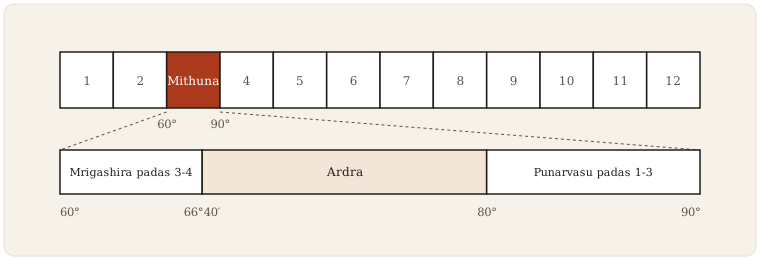
Mesha strikes the spark, Vrishabha holds the ground, and then something must carry the word between them. The third sign of the zodiac, Mithuna, is that carrying: thirty degrees of mutable air, the couple whose two figures face each other, and the sign Satyori’s Mithuna guide describes as the bridge between speaker and listener. This article audits that exchange in full: the sign’s structure, the classical verse on a Gemini Moon, the ruling planet and a curiously hedged exaltation, the traditional tendencies in personality, career, relationships and health, and at the end an honest-limits note.
Everything below comes from sources fetched on 31 October 2026: Satyori’s Mithuna rashi guide, the seventeenth chapter of the Brihat Jataka available at VedicPupil (which we read directly, in that page’s English translation), Wikipedia’s Gemini article for the tropical-sidereal difference and the twins’ mythology, and PanchangTime’s Vimshottari dasha guide for Mercury’s period. Where a tendency belongs to a source, the source is named; where a note is ours, it is marked. Sign description is the tradition’s framework; we give it as description, not as diagnosis.
The third cell: the structure
Per Satyori, Mithuna is the third sign of the zodiac, spanning 60 to 90 degrees. Its symbol is the couple, often rendered as the twins, and that page reads the symbol precisely: the interplay between two perspectives, the bridge between speaker and listener, the dance of ideas. Its element is air, its character dwiswabhava, mutable, the kind that moves between states, and it is classed in the masculine group. The ruling planet is Mercury. In the Vedic tradition of the Kalapurusha, the cosmic person of time across whose body the twelve signs are laid, Mithuna is the arms, shoulders and hands: the parts that reach out, gesture and write, which is why exchange, craft and message keep returning in this sign’s portrait. Being a mutable air sign means this is the mind in motion; Satyori calls Mithuna the most adaptable and mentally agile of all the rashis, and its natives, in the classical description it cites, curious, articulate and perpetually in motion, mentally if not physically.
Mithuna holds three nakshatra segments: the third and fourth padas of Mrigashira, all of Ardra, and the first three padas of Punarvasu. Each nakshatra in the zodiac spans 13 degrees 20 minutes, so Mrigashira’s remainder runs from 60 to 66:40, Ardra from there to 80, and Punarvasu’s first three quarters from 80 to 90; this follows the standard nakshatra division. Two Mithuna natives can therefore belong to different nakshatras within the same sign, and in Jyotish the nakshatra carries its own weight. This site carries a separate guide for each of the twenty-seven nakshatras, including Mrigashira, Ardra and Punarvasu; here it is enough that the sign sets the frame and the nakshatra paints the finer shade within it.
One more boundary line matters: in Indian usage ‘rashi’ usually means the Moon sign, the sign the Moon occupied at the moment of birth. The classical chapter we quote below is titled exactly that, Chandra-rashi-sheel, the characters of the Moon signs. A chart also has a lagna, the sign on the rising horizon, and a Sun sign; the three signify different things. And Satyori adds in one line that the condition of Mercury in the chart strongly influences how Mithuna expresses in a life. The sign, in other words, is one axis, not the whole picture.
Mithuna and Gemini: two scales, one sky
In Western astrology Gemini is the same third sign: the twins, the air element, the mutable quality, Mercury as ruler, and Sagittarius opposite; per Wikipedia’s table, in the tropical system the Sun transits it from 21 May to 21 June in 2026. But the tropical zodiac is bound to the equinox point, while the Vedic sidereal zodiac is bound to the stars. Satyori states the gap between them as an ayanamsha of about 24 degrees. The practical result: a person whose Western sun sign is Gemini may have Mithuna as the Vedic rashi, or may have Vrishabha; it is not the date that changes but the scale. This article speaks of Vedic Mithuna, and for date boundaries rely on your own panchang or chart calculation.
The twins themselves are older than either system’s current form. Per Wikipedia, in Babylonian astronomy the stars Pollux and Castor were known as the Great Twins, named Lugal-irra and Meslamta-ea, the Mighty King and the One who has arisen from the Underworld; in Greek mythology they are the Dioscuri, Castor and Pollux, twins of different fathers, one mortal and one divine, and when Castor died, Pollux begged Zeus to share his immortality, which was granted by uniting them in the heavens. Two-in-one, mortality asking divinity for company: the image has carried the tension of duality for three thousand years. A modern echo, from the same page: NASA named its two-person capsule Project Gemini after the sign, because the spacecraft carried two astronauts. Where the Vedic reading differs is in emphasis: Satyori’s couple is not two rivals or two fates but two perspectives held at once, and that page warns the duality is often misunderstood as fickleness when it is more accurately the ability to hold multiple views simultaneously.
What the classical text says: the Brihat Jataka’s Gemini Moon
Varahamihira’s Brihat Jataka is among the root texts of Jyotish, and we read its seventeenth chapter, Chandra-rashi-sheel, directly on VedicPupil’s page, in that page’s own English translation of the Sanskrit. The chapter gives each sign’s result when the Moon stands in it. The Gemini verse, 17.3, in that translation: fond of women, skilled in the arts of love, with coppery eyes, knowing the sciences, a messenger, with curly hair, sharp-minded, knowing jest, gesture and dice; with handsome limbs, sweet speech, fond of song, knowing dance, finding pleasure in the company of eunuchs, with a high nose. And on appetite: the verse’s reading there is uncertain, and the page says so honestly, noting that the text reads prabha kshana-ruci while prabhakshana-ruci, fond of food, is the expected reading. We have kept the translator’s note as it stands, because a tradition that can flag its own doubtful syllable is a tradition describing itself accurately.
The page’s own simple meaning compresses the verse: charming, witty, sharp, loves food, music and dance. Notice what the classical portrait is made of: not a moral ranking but a temperament, a person built for exchange, for arts, for company, for the quick commerce of jest and gesture. The word ‘messenger’ sits at the centre of the verse, and fourteen centuries later the modern profile will say the same thing in office language. The classical style mixes body, temper and fortune without sorting them, coppery eyes next to sharpness of mind, and we have kept them unsorted.
The seventeenth chapter’s thirteenth verse sets the condition that applies to every sign: the stated qualities come fully only when the Moon is strong and the sign’s lord is strong; otherwise the indications require further consideration. In plain words, the text itself says a sign reading is a general sketch, not a verdict on any one birth chart. The tradition’s own caution remains as precise today.
One more detail from the page gives context: the Brihat Jataka is a work of 409 verses in 28 chapters, and the seventeenth chapter gives the Moon-sign results for all twelve signs, one verse each; the English we read is VedicPupil’s own translation. It is useful to know how compressed the classical description is: some twenty traits in a single verse, without commentary. A modern sign guide, such as Satyori’s, unfolds those same seeds into the context of present-day life; the two are best read with one eye, the seed from the text, the growth from today’s commentary.
The ruling planet: Mercury, the messenger’s engine
Mercury is Mithuna’s lord, and per Satyori the sign embodies what Mercury stands for here: the mind’s capacity for communication, exchange and duality. The same page gives Mercury’s gifts a concrete shape: facility with language, with numbers, and with systems of classification, which is why it calls Mithuna natives natural translators between worlds. If Vrishabha’s Venus collects things, Mithuna’s Mercury collects what things mean. Mercury has its place in the timing tradition too. Per PanchangTime’s Vimshottari dasha guide, the Mercury mahadasha runs 17 years within the 120-year Vimshottari cycle; when a Mithuna native’s Mercury period runs, the sign’s own engine sits in the driver’s seat for that stretch. This too is description, not prediction.
On exaltation and debilitation, Mithuna’s entry in Satyori’s quick facts is unusual: both lines carry the same hedge. Rahu is listed as exalted here, per some traditions; Ketu is listed as debilitated here, per some traditions. That is, the source itself declines to state either as settled, and we record it exactly that way. The contrast with the neighbouring signs is instructive: the Sun’s exaltation in Mesha and the Moon’s in Vrishabha are given without hesitation, while Mithuna’s nodal points arrive with a qualifier attached. Where a source marks its own uncertainty, the honest rendering keeps the mark.
Personality, career, relationships: the traditional tendencies
The traditional personality description, per Satyori’s Mithuna profile: intellectually vibrant, socially skilled, endlessly curious. One sentence on that page does the work of a chapter: Mithuna natives collect information the way Vrishabha collects possessions, voraciously and with genuine pleasure. The wit is quick and the conversation sparkling, and the same page names the cost: the energy can scatter across too many interests, and the growth edge for Mithuna is depth, learning to stay with one subject long enough to master it rather than skimming many. The classical verse’s ‘sharp-minded, knowing jest and gesture’ becomes, here, the same instrument in a modern room: the mind that connects is also the mind that flits, and the tradition does not pretend otherwise.
For career, Satyori’s list runs along the information pathway: writing, journalism, teaching, sales, marketing, translation, coding, and any field requiring rapid information processing; outstanding communicators, content creators and networkers. The reasoning matters more than the list: careers combining intellectual stimulation with social interaction suit Mithuna best, while isolated roles or positions demanding prolonged focus on a single task without variety are where this sign struggles. The same page adds the tradition’s own hedge, that career outcomes depend on the tenth-house lord, planetary periods and overall chart strength; a sign preference is not an employment forecast.
In relationships, per the same profile, Mithuna needs intellectual connection above all else: physical attraction alone will not sustain interest, and the partner must match a conversational range and respect a need for mental stimulation. The profile names the misunderstanding to avoid: Mithuna can appear emotionally detached because it processes feelings through the intellect rather than the heart, and partners threatened by a wide circle of friendships will find this sign challenging. The classical ‘sweet speech’ becomes, here, a courtship of words. We give that reading in the source’s name; whether it fits any one person is that person’s own testimony.
Health: the traditional reading
Per Satyori, Mithuna’s vulnerable areas are the lungs, arms, hands and nervous system, with tendencies toward anxiety, insomnia, respiratory issues and the conditions of nervous overstimulation; the page notes that a mind that rarely rests can show up as physical tension in the shoulders and arms, and names grounding practices, adequate sleep and reducing information intake as essential medicine for Mithuna constitutions. Its dosha note ties the sign to vata affinity through the air element and Mercury’s mobile, quick-changing nature, producing lightness, speed and variability in body and mind, with warm grounding foods, regular routines and oil massage suggested as counterweights. All of this is that source’s Ayurvedic framing, which we have given in its name; this article offers no medical advice, and for any symptom the doctor is the authority. If you are pregnant, ill, elderly or on medication, any regimen the tradition mentions is not for you without a doctor’s word.
The honest limits
Sign description is the tradition’s framework, not measured psychology. Everything above is what the texts and one modern guide say about Mithuna, recorded with their names and their dates; it is not what we measured in any person. The Brihat Jataka itself conditions every result on the strength of the Moon and the sign lord; Satyori itself conditions career on the rest of the chart. A rashi is one thread of a chart and no thread of your worth. Do not measure anyone else by their sign, and do not pour yourself into one either; being Mithuna is not being only this.
Keep one practical test as well: if some description in this article does not fit you at all, that is no fault of yours and none of the tradition’s; the text laid down beforehand that these portraits are general. And if a description does fit, do not make it your ceiling; the most important part of the twins’ story is that the two perspectives are a beginning, not a finish, and depth, like every skill, is learned by practice, not assigned by signs.
Questions on this article
What is the difference between Mithuna and Gemini?
They are two names for the zodiac’s third 30 degrees: Mithuna in the Vedic (sidereal) tradition and Gemini in the Western (tropical) one. The difference is that the tropical zodiac is tied to the equinox point and the sidereal to the stars; an ayanamsha gap of about 24 degrees separates them, so your Western sun sign and your Vedic rashi can differ. Per Wikipedia, the Sun transits tropical Gemini from 21 May to 21 June in 2026; Vedic Mithuna is computed from the panchang.
Which planet is exalted and which debilitated in Mithuna?
Here the source itself hedges: in Satyori’s quick facts Rahu is exalted in Mithuna per some traditions, and Ketu debilitated per some traditions. That is, the nodal assessments are not unanimous, and we have recorded them with exactly that qualifier. For comparison, the Sun’s exaltation in Mesha and the Moon’s in Vrishabha are given without any such condition.
Are Gemini people really fickle?
Satyori writes directly that Mithuna’s duality is often misunderstood as fickleness when it is more accurately the ability to hold multiple perspectives at once; the cost is that energy can scatter across too many interests, and the growth edge is depth. The Brihat Jataka’s Gemini-Moon verse also keeps sharpness, jest and artistic skill together. But this is astrology’s own language, not a psychological diagnosis; the text itself says the qualities hold fully only when both the Moon and the sign lord are strong.
Is reading personality from a sign scientifically established?
No, and this article makes no such claim. Sign description is the framework of the Jyotish tradition, carried through texts and practising astrologers over centuries; we present it as exactly that, with sources. Do not treat it as a substitute for psychology or medicine; as a way of reflecting on oneself it can be a cultural mirror, not a measuring instrument.


