How a Transit Is Read: Counting from the Moon Sign, the Favourable-House Table, and the Complete Vedha Audit
The two-question machine of transit reading: is the house favourable, and is it pierced. The table, the exemptions, the reversed layer, and the one place where two sources disagree.
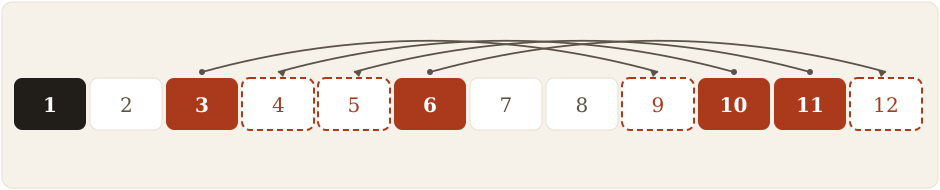
"Saturn is in Pisces right now" says nothing about anyone by itself. The same sky belongs to everyone; what differs is which house Pisces becomes when counted from your birth Moon sign. The traditional method of transit reading starts exactly there: count the house from the Moon sign, then ask two questions. Is this house one the text lists as favourable for this graha? And if so, is that favourable placement pierced by another planet sitting in its vedha house? This article audits that two-question machine in full: the table from the Phaladeepika's transit chapter, its two exemptions, the disputed layer of reversed vedha, the distribution of results across thirds of a sign, a worked example, and finally the boundary where transit meets the dasha.
The first rule: count from the Moon sign
The opening verse of chapter 26, in vedicpupil's translation, fixes the reference: the natal Moon sign is the main base for judging transits, more than the ascendant. The results of moving planets are counted from it. This arrangement builds a different map for every reader: for an Aries Moon, Pisces is the twelfth house; for a Gemini Moon, the tenth; for a Cancer Moon, the ninth. That is why one transit notice, "Jupiter is in Cancer", is twelve different house placements for the twelve signs. Our Rahu-Ketu article recorded tempora's "ascendant first, then the Moon" convention; the Phaladeepika's transit convention gives the Moon first place. A reader should know both source conventions exist; recording which convention belongs to which textual tradition matters as much as the house number itself.
The master table: which houses are favourable for which graha
The chapter's second verse gives the whole list at once. In vedicpupil's translation: for the Sun, 3, 6, 10, 11; for the Moon, 1, 3, 6, 7, 10, 11; for Jupiter, 2, 5, 7, 9, 11; for Mars and Saturn, 3, 6, 11; for Mercury, 2, 4, 6, 8, 10, 11; for Venus, all but 6, 7, 10; and Rahu and Ketu like the Sun. livepanditji has tabulated the same list with its vedha points, and we matched the two sources row by row. The table below is that match:
| Transiting graha | Favourable house → its vedha house |
|---|---|
| Sun | 3 → 9, 6 → 12, 10 → 4, 11 → 5 |
| Moon | 1 → 5, 3 → 9, 6 → 12, 7 → 2, 10 → 4, 11 → 8 |
| Mars | 3 → 12, 6 → 9, 11 → 5 |
| Mercury | 2 → 5, 4 → 3, 6 → 9, 8 → 1, 10 → 8, 11 → 12 |
| Jupiter | 2 → 12, 5 → 4, 7 → 3, 9 → 10, 11 → 8 |
| Venus | 1 → 8, 2 → 7, 3 → 1, 4 → 10, 5 → 9, 8 → 5, 9 → 11, 11 → 6*, 12 → 3* |
| Saturn | 3 → 12, 6 → 9, 11 → 5 |
| Rahu-Ketu | same as the Sun (26.2) |
The asterisk marks a genuine source disagreement, and we record it instead of hiding it. The chapter's Venus verse, by the order of its phrases, pairs 11 → 6 and 12 → 3; livepanditji's table pairs them the other way, 11 → 3 and 12 → 6. Every other row, the Sun, Mars-Saturn, Mercury, Jupiter and Venus's first seven pairs, matches both sources exactly. Which order is original for Venus's last two pairs cannot be settled from the sources consulted; a reader who needs the vedha of Venus's 11th or 12th transit should treat it as an open question.
A few features of the table are worth seeing at first sight, and livepanditji lists them separately. Mars and Saturn share one list: three of the upachaya houses, 3, 6, 11, pierced from 12, 9 and 5 respectively. The Sun adds the 10th to the same three. Jupiter's five-house list also means a Jupiter transit in the 1st, 3rd, 4th, 6th, 8th, 10th or 12th is not counted favourable in this textual reckoning, the most direct contradiction of "Jupiter is always auspicious". Venus has the longest list, nine houses; only 6, 7 and 10 fall outside. And the Moon's list, 1, 3, 6, 7, 10, 11, is the same one the Chandra Bala and Chandrashtama tradition uses for the daily Moon: the Moon changes signs every two and a half days, so this row becomes the day-to-day layer, while Saturn's identical row runs on a two-and-a-half-year layer. One table, a different timescale per graha speed; this is the most useful structural fact of transit reading.
Vedha: a favourable transit can be stopped
Vedha literally means a piercing. The rule is simple: when a graha transits a favourable house from the Moon and another graha simultaneously sits in its paired vedha house, the favourable result counts as obstructed. Ernst Wilhelm's Gocara note says it directly: the affairs of the obstructing planet take precedence; those of the benefit-giving planet are not furthered. livepanditji's worked example brings it alive: for a Capricorn Moon, Pisces is the 3rd house, in Saturn's favourable list, and its vedha point is the 12th, Sagittarius; so for as long as Saturn holds Pisces, the check is: who is in Sagittarius? From November 2026 to 3 June 2027, Mercury passes through for about 19 days, Venus about 26, the Sun about 29, but the Sun does not count, see the exemption below. A slow graha's favourable transit lasts months, and the fast grahas cross its vedha sign in days or weeks; the transit is not cancelled, it is pierced in stretches.
The Phaladeepika itself grants two exemptions: no vedha between the Sun and Saturn, and none between the Moon and Mercury. livepanditji records the traditional reason too: both pairs are father and son in the Puranic genealogy, Saturn the Sun's son, Mercury the Moon's. Wilhelm's note carries the same exemption as "planets in a father-son relationship do not cause vedha to each other".
A disputed layer should also be recorded. Some later tables run the pairing in reverse: the ill result of a graha in an unfavourable house is blocked by a graha in its paired house; this is usually called vipreet vedha. Wilhelm's table already contains the reverse form: if the Moon is in the 2nd, its ill effects are obstructed by a planet (other than Mercury) in the 7th. livepanditji gives only the direct case in its table and sets the reverse form apart as a later layer. Our conclusion: both forms are in circulation, and asking which form a given transit reading applies is fair.
How the text writes results: Sun, Moon and Mars as examples
The table does not only say "favourable or not"; the chapter's later verses write the result of each house too, and their language is worth reading. From vedicpupil's translation, some of the Sun's houses: in the 1st, tiredness, money loss, anger, illness and travel; in the 5th, money trouble and confusion; in the 6th, the removal of obstacles; in the 9th, trouble, sadness and a blocked mind; in the 10th, great success in work; in the 11th, position, honour, wealth and relief from illness. Note that even the unfavourable list changes its subject by house: the 1st house touches the body and fatigue, the 2nd wealth, the 4th mind and position. This house-by-house subject counting is half of transit reading; the "good-bad" label alone is not.
The Moon's verse carries a small but instructive irregularity. The translation enumerates only eleven results for the twelve houses, in order: better fortune, money loss, victory, praise, good health, comfort, trouble, illness, wishes fulfilled, joy and expense; vedicpupil itself remarks that the verse lists eleven results, so do not match them house by house. We record it the same way as the Venus pairing gap: textual traditions carry such irregularities, and recording them rather than smoothing them over improves reading. For Mars: in the 1st, inner grief and heat ailments; in the 2nd, care with wealth and speech; in the 3rd, victory and gold; in the 4th, care with position and the stomach; in the 5th, fever, misplaced worry, child-related trouble or quarrels with close people; in the 6th, the end of enemy trouble, relief from illness, victory, wealth and success in work.
Even within a sign, results are not even
Wilhelm's note adds one more traditional subtlety: each graha delivers its effect more in a particular third of the sign. The Sun and Mars in the first third, the Moon and Saturn in the last third, Jupiter and Venus in the middle third, and Mercury and Rahu evenly through the whole sign. So even inside "Saturn is in Pisces" the tradition treats intensity as changing over time. Chapter 26 names two further modifiers beyond this: the bindus of ashtakavarga, which strengthen or weaken a transit's result, and the nakshatra latta, a nakshatra-level vedha computation. Our consulted sources treat both only briefly; we record that these layers exist in the tradition without expanding them.
Transit and dasha: which sits above
Our dasha articles already carried paramarsh's distinction between a mechanical and a mature reading: a transit house gives one line, but without the whole chart that line is a half. tempora's node note says it more directly: in personal timing the dasha layer sits on top; transit is background, not the clock. This article's table should therefore be read under one condition: house number and vedha describe structure, not an announcement of results. A reading that stops at "Jupiter is in the 5th now, a good time" is exactly the mechanical reading the tradition itself has criticized.
A practical warning about dates belongs in the same family: transit dates depend on the ayanamsa and the time zone. vedara lists the causes of date disagreements in its tables, among them the ayanamsa method, rounding and time zone; our 2027 transit articles have shown these as spreads of hours. When one table site gives one day and another the next, no one has necessarily erred; the first question should be about method.
Common confusions
First: "a Venus transit is good for everyone." Venus's favourable list is the longest, but 6, 7 and 10 are not in it, and even a favourable placement can be pierced. Second: "Jupiter is auspicious in every house." Jupiter's list is five houses; 1, 3, 4, 6, 8, 10 and 12 are outside it. Third: "a favourable transit means a guaranteed result." If another graha sits in the vedha house, the textual reading counts the result obstructed. Fourth: "the Sun and Saturn block each other." The vedha rule's two exemptions are exactly these two pairs. Fifth: "count transits from the ascendant." The Phaladeepika convention gives the Moon primacy; the ascendant-first convention belongs to sources like tempora; both are on record. Sixth: "the yearly forecast is all there is to transit." The year-level sign note is the coarsest use of this machine; at the daily layer the Moon itself changes signs every two and a half days, and its own list, 1, 3, 6, 7, 10, 11, is the basis of the Chandra Bala tradition.
Practical use
First, fix your birth Moon sign; every house count starts from it. Second, apply the two questions to any transit claim: is the house in the favourable list, and is the vedha house empty. Third, ask the claimant for their method: direct vedha or reversed, from the Moon or from the ascendant, dates on which ayanamsa. Fourth, for slow grahas remember piercing in stretches: fast grahas cross the vedha sign for days or weeks, they do not cancel a months-long chapter. Fifth, do not take timing decisions from transit alone: the dasha layer sits above, and a transit house is structure, not an announcement.
Three questions before reading any transit analysis: first, is it counted from the Moon sign or the ascendant; both conventions are prevalent and change the houses. Second, has vedha been checked, and in which form; the direct layer is the Phaladeepika's, the reversed layer appears in later tables and notes like Wilhelm's. Third, which layer is the reading claiming; sign-level background or event-dates, because the second claim lies beyond this instrument's capacity, as the sources themselves say.
Source note: this article rests on three primary sources. The favourable-house list, the vedha pairs, the two exemptions and the reversed-vedha distinction: Phaladeepika chapter 26, in vedicpupil's English translation (vedicpupil.in/library/books/phaladipika/chapter-26). The tabulated form, the Puranic explanation of the exemptions, the note on reversed vedha and the worked Capricorn-Moon example: livepanditji (livepanditji.com/blog/gochar-vedha-table-transit-from-moon/, 27 October 2026). The father-son exemption, the distribution of results across thirds of a sign, and the reverse form of obstruction for unfavourable houses: Ernst Wilhelm, Gocara (vedic-astrology.net/FreeClasses/Gocara.pdf). The primacy of the dasha layer and the background-versus-clock language: tempora (tempora.ltd/findings/rahu-ketu-transit) and paramarsh, both consulted earlier. Causes of date disagreements: vedara (vedara.me). The order difference between our two consulted sources on Venus's last two vedha pairs is recorded as unresolved.


