Griha Pravesh: Tradition and Home Readiness
Keep the traditional timing and the actual move on separate tracks. A muhurat is not a building-safety certificate.
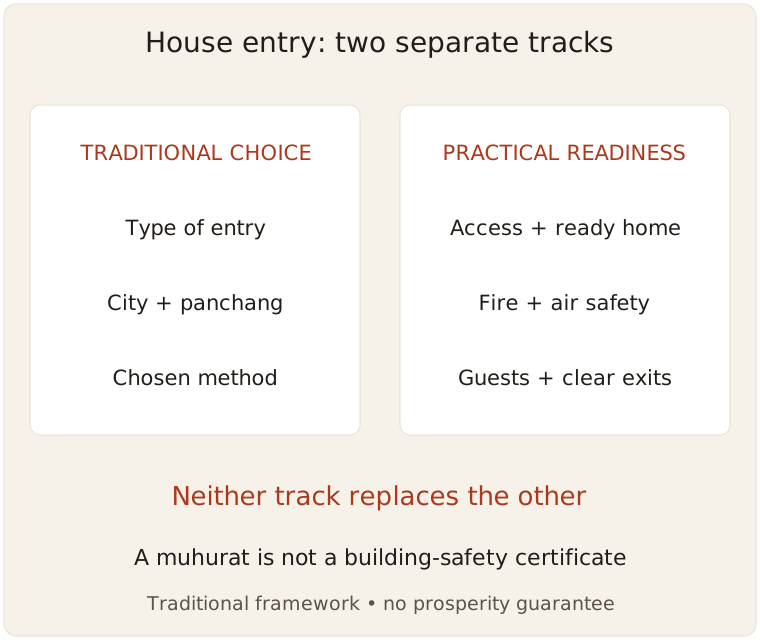
Entering a home is both a ritual and a practical move
Griha pravesh is the ceremonial entry into a home in many Hindu households. It may include prayer, a kalash, blessings, food, and an expression of gratitude to the people who helped make the home possible. The ceremony can mark belonging without claiming that a selected minute controls the household's future. A muhurat is a traditional preference for timing. It is not a certificate that a building is safe, a substitute for possession or occupancy checks, or a reason to light a fire in an unsuitable room.
This guide separates the traditional calendar from the practical move. It explains why different kinds of entry have different rules, why city-specific windows matter, and how to prepare a modest ceremony without fear or compulsory purchases. It does not choose a date for an unnamed location, give legal approval to occupy a property, or guarantee prosperity. A good housewarming should make the household feel welcome, not leave it carrying new risks or debt.
First identify what kind of entry you mean
Contemporary guides often use three labels: apurva for first entry into a newly built home, sapurva for return after travel or a long absence, and dwandva for re-entry after a calamity or rebuilding. MuhuratChoghadiya presents this three-part explanation. The labels are useful conversation starters, but their application is not always identical across summaries. A newly purchased resale flat, for example, is new to its owner without being newly built.
PujaDeep's Muhurta Chintamani account offers separate options for a new house and an old or rebuilt one. Its old-house explanation includes a home built by others as well as rebuilding after fire or flood. Before comparing calendars, state the actual situation: newly constructed, resale, rented, return after absence, or repaired after damage. Ask how the chosen tradition classifies it. Do not impose a new-construction rule on every change of address just because the home feels new.
What the new-house rule says
In the VedicPupil translation, Muhurta Chintamani 13.1 names Uttarayana and the lunar months Jyeshtha, Magha, Phalguna, and Vaishakha. It describes soft or fixed nakshatras and a fixed ascendant with further relationships to the birth chart. Verse 13.4 excludes Sunday, Tuesday, rikta tithis, Amavasya, and Chaitra, alongside additional chart conditions. These are rules within a named historical astrological method. They do not establish that a household moving on another day will be harmed.
PujaDeep's short summary and Mokshology's city page broadly follow these month, weekday, tithi, and nakshatra filters. Their lists are still not a universal personal verdict. A calendar may apply only some layers of a longer text. A family should be able to ask which conditions were checked and which were not. A clear explanation is more useful than a long list of restrictions presented without a source.
Old and rebuilt houses have a different allowance
MC 13.2, as translated on VedicPupil, allows additional months including Margashirsha, Kartika, and Shravana for an old house or one rebuilt after danger such as fire. It also adds Shatabhisha, Pushya, Swati, and Dhanishtha and says that examining the setting of Jupiter and Venus is not essential there. PujaDeep preserves this distinction in a separate old-or-rebuilt-house section. Mokshology also notes the broader allowance.
This is a concrete reason not to tell every reader that those months are absolutely prohibited for all house entries. MuhuratChoghadiya gives a broader prohibition in its general account, while the chapter-based sources distinguish cases. The difference should remain visible. It may reflect scope, commentary, or practice; this article does not invent agreement between them. For a repaired building, structural and service safety must be established independently before any ceremonial re-entry.
Not every useful date is a personal muhurat
A general list can filter days by lunar month, tithi, weekday, and nakshatra. More detailed methods may add ascendant, house conditions, birth-chart relationships, door direction, and other checks. VedicPupil's chapter contains these layers, while Mokshology says its dates display further checks that they do not meet. A listed date therefore needs to be read together with its explanation, not treated as a blanket seal of approval.
A personal recommendation would need the ceremony location, acceptable date range, the household's intended tradition, and any personal information that method genuinely requires. Do not collect full birth details automatically if a general ceremony plan is all the family wants. Equally, do not pretend that an unpersonalised list checked personal conditions. This guide explains the process and does not claim to have completed a private calculation.
Location, sunrise, and the end of a window
PujaDeep describes a city-based calendar that follows the local sunrise-to-sunrise day and divides time at relevant transitions. A tithi or nakshatra can change during a civil date. A favourable morning interval is not permission to shift the ritual several hours later without rechecking. Two cities in the same time zone can have different sunrise-based conditions, so a relative's screenshot needs location verification.
Record a selected interval with a full date, local start and end, city, and time zone. For an overseas ceremony, use the venue's local clock and any seasonal clock change. Online guests can receive converted joining times. Do not make the ceremony follow the caller's home-city calendar merely because that person arranged the prayer. Practical precision helps everyone arrive; it does not turn the tradition into demonstrated prediction.
Lunar months are not fixed Gregorian blocks
Magha or Vaishakha is not simply another name for a whole Gregorian month. PujaDeep says its implementation uses amanta lunar months and a sidereal solar framework. Another calendar may use a different month convention or commentary. That can change how a headline month list maps onto civil dates. A reader should not select a date by guessing which English month usually overlaps a Sanskrit name.
Ask the source to state the civil window and the convention behind it. If two sources disagree, compare their city, month system, entry category, and included checks before declaring one wrong. Avoid stacking every exclusion from every source into a harsher master rule. The household is choosing a cultural observance, not trying to pass a test in which every additional restriction creates extra safety.
Read door-direction rules as tradition, not engineering
MC 13.5 discusses direction-related tithi groups and the position described as the Sun on the left. VedicPupil provides a translation and simplified account; Mokshology notes that door direction can narrow its general list. These are particular astrological conventions. They are not building-code requirements and do not show that a south-facing or differently arranged home is dangerous or morally inferior.
Do not demolish a doorway, alter a load-bearing structure, or make an expensive renovation because a short online guide lists a directional concern. Any physical change needs proper technical advice and the permissions applicable to the property. A ritual can express the family's hopes while the actual building is assessed through relevant professional and local processes. One system must not be used to impersonate the authority of the other.
Possession and readiness come before invitations
Before fixing a gathering, confirm that the household has permission to enter and use the property. A key handover, a purchase agreement, a rental start, and lawful readiness for occupancy are not always the same event. The exact documents and approvals depend on the property and jurisdiction, so this guide does not invent a universal checklist of legal certificates. Ask the responsible owner, manager, builder, or appropriate professional what is required in this case.
Then check practical readiness: safe access, completed hazardous work, usable water and sanitation, appropriate electrical and gas arrangements, and clear exits. These are planning prompts, not an inspection performed by this article. If workers are still handling exposed wiring, major repairs, or other hazards, a short ceremony is not a workaround. Delay the gathering or choose another setting until the actual issues are addressed.
Separate the symbolic entry from the full move
Families sometimes need to coordinate movers, work schedules, tenancy dates, and a preferred ritual interval. Identify what is being timed: the first spoken prayer, carrying a kalash inside, or beginning residence. Different households understand this differently. Confirm the meaning with the people involved instead of promising that an elaborate move will fit inside a narrow interval.
A small symbolic welcome and a later practical move may be manageable if the family accepts that distinction. Do not claim universal religious permission for this arrangement, and do not violate a lease, safety restriction, or building policy to achieve it. Make the plan flexible enough that a delayed truck or an unfinished room does not become a spiritual emergency. Essential shelter and safe logistics should not be sacrificed to an unverified minute.
A simple ceremony is still a real choice
Traditional descriptions include Vastu worship, a full pot, flowers, recitation, and gratitude. MC 13.7 also describes honouring the people involved in the work, including craftsmen. Contemporary households may add Ganesh worship, a lamp, food, or a small gathering. These are examples, not a compulsory shopping list or a single procedure that every home must reproduce.
Agree on who leads, which language is used, whether there is an officiant, how long the ritual lasts, and what materials are actually wanted. A family's own devotional objects are distinct from a seller's claim that a new item is necessary. Do not turn gratitude into pressure to purchase metals, stones, paid corrections, or packages. If payment for a service is wanted, understand its scope and price before committing.
Open flames need their own safety plan
The US Fire Administration advises considering battery-operated flameless candles. For lit candles it recommends stable holders, at least twelve inches from things that can burn, and extinguishing them when leaving the room or home or going to bed. It also advises against candles in sleeping areas. These are candle-safety recommendations from a fire authority, not a validation of any particular ritual arrangement.
If the ceremony uses a diya, incense, or another flame, do not assume that calling it sacred removes the need to assess heat, tipping, clothing, decorations, children, pets, and the venue's rules. A havan is not the same appliance as a candle; candle advice alone is not a complete havan safety plan. Ask for a suitable arrangement, including a non-flame alternative where needed. Never cover or disable alarms to make a ceremony easier.
Carbon monoxide is separate from visible smoke
CDC describes carbon monoxide as an odourless, colourless gas that can cause sudden illness and death. Fuel-burning equipment can produce it, and it can build up indoors. CDC says never to burn charcoal indoors and never to use a generator inside a home or garage, even with doors and windows open. It recommends operating generators outdoors more than twenty feet from windows, doors, and vents.
These warnings matter if someone proposes charcoal, improvised heat, or generator power during a housewarming. Opening a window is not permission to ignore an explicit indoor-use prohibition. Use properly installed equipment according to its requirements and seek qualified advice for combustion arrangements. A ritual calendar cannot assess air quality. If people become unwell or an alarm sounds, leave for safety and seek appropriate emergency help rather than continuing the ceremony.
Food, guests, and accessibility are part of welcoming
A good host plan includes dietary needs, drinking water, seating, toilets, and access for people who cannot manage stairs or long standing. These are editorial planning suggestions, not an assertion that this article has checked a venue. Keep routes and exits clear rather than filling every space with decorations, luggage, or food tables. Ask before assuming that older relatives can sit on the floor or that everyone can fast.
Keep children away from hot vessels, flames, loose coins, and small ritual objects. Put heavy kalash arrangements where they will not fall, and keep spilled water or milk from becoming a slipping hazard. A short invitation should state the actual address and entry instructions without publishing private documents or full household birth records. Ask permission before sharing photographs or identifying people who did not agree to be public.
After damage, safety is not a ritual category
The traditional old-or-rebuilt allowance is not authorisation to re-enter after a fire, flood, gas problem, or structural incident. Relevant emergency services, building authorities, and qualified professionals determine what is safe and permitted in the actual setting. A prayer cannot reverse water damage, unstable construction, contaminated services, or electrical hazards. Keep the ceremonial and technical decisions separate.
If the household is displaced, prioritise safe accommodation and essential needs. A later blessing can mark recovery when the home is ready. Do not blame residents for the damage because of an earlier entry date, doorway direction, or omitted ritual. The sources consulted describe traditions and interpretations; they do not supply evidence that a household's misfortune was caused by failing a calendar rule.
A useful house-entry planning sheet
Write the entry category, property readiness, city, acceptable date range, chosen tradition, and the exact part of the event being timed. Add the local interval and its source when it has actually been checked. Then independently record access arrangements, utilities, fire and air-safety decisions, guest needs, and any service costs that the household has approved. Unresolved practical hazards are reasons to stop, not details to hide beneath an auspicious heading.
Keep a fallback date or a simpler non-flame welcome. Make clear that the plan can change if access, health, or readiness changes. Griha pravesh can offer prayer, belonging, and gratitude without guaranteeing wealth or preventing every future problem. The home becomes liveable through sound construction, lawful access, maintenance, care, and the people who live there. Let the ceremony celebrate those things rather than claim to replace them.
Sources consulted
- Muhurta Chintamani chapter 13: translated house-entry rules
- Mokshology: city-specific rules, exceptions, and unchecked conditions
- MuhuratChoghadiya: entry types and contemporary ceremony account
- PujaDeep: separate new and old/rebuilt house methods
- US Fire Administration: candle safety
- CDC: carbon monoxide and combustion safety