36 Guna Milan: Eight Weights, Source Differences and Limits
Eight comparisons add to36. They do not measure a person’s worth, medical risk or a couple’s future.
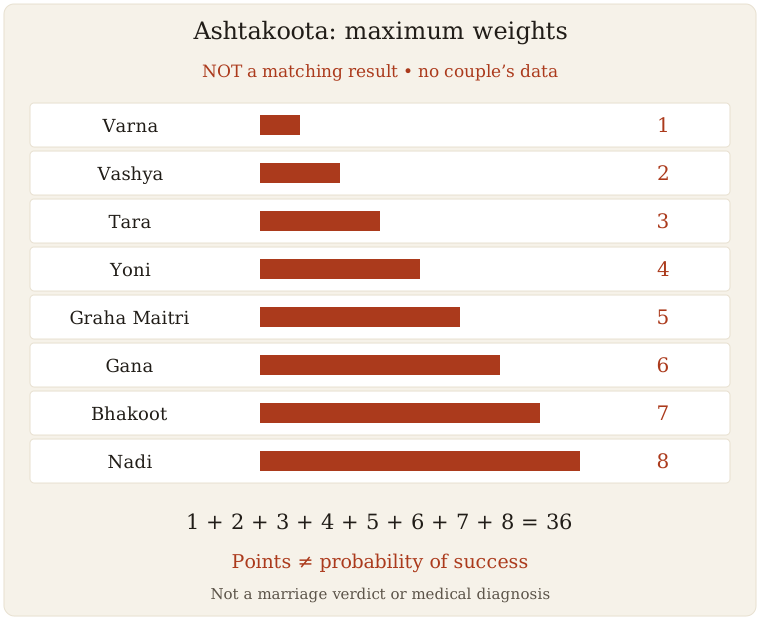
Thirty-six gunas are the maximum points in a particular traditional matching system called Ashtakoota. They are not thirty-six independently observed qualities of a couple, and a score is not a probability that a marriage will work. Eight comparisons have different maximum weights, from one to eight. Their sum is thirty-six. Understanding that arithmetic is a useful first step because a large-looking total can otherwise sound like a measurement of two people's whole relationship.
This guide explains the eight headings, the meaning of the total, regional and software differences, and the limits of familiar thresholds. It does not grade a real couple. It does not treat a low score as a reason to reject a person or a high score as permission to ignore their wishes. Fertility, genetics, health, consent and relationship safety cannot be established by a lunar classification. Cultural understanding and decisions about people must remain separate.
What the system actually compares
Mokshology's explanation of its matching method describes comparisons based on two natal Moon positions: their signs, nakshatras and, where relevant to a rule, padas or sign halves. The tradition assigns categories to those positions and compares the categories. This is different from observing how two people communicate, manage money or respect a boundary. A report can contain accurate category lookups while knowing nothing about either person's behavior.
The Kaala Panchang points guide likewise distinguishes the lunar score from other planets, the ascendant and divisional charts. A full kundli report may place those beside the score, but they are not extra points secretly included in thirty-six. Ask which section is the Ashtakoota table and which is a separate interpretation. Keeping the components visible prevents a report from changing its scope midway through the explanation.
The eight maxima, in order
The consulted guides agree on these maximum weights: Varna one, Vashya two, Tara three, Yoni four, Graha Maitri five, Gana six, Bhakoot seven and Nadi eight. Adding one through eight gives thirty-six. These are maximum points, not the points automatically awarded to everyone. Each comparison uses its own table or counting rule to produce a result up to that maximum. The names and the weights alone are not enough to reproduce every pair's score.
Our diagram is a maximum-weight reference, not a matched couple's result. It shows all eight labels and makes the addition explicit. Do not interpret a full row in that diagram as evidence that a person has passed a test. No birth positions were entered. Nor does a larger weight establish that a heading is more scientifically important. It shows how this scoring convention distributes its own points.
Varna and Vashya: describe the labels without ranking people
Varna has a maximum of one point and compares traditional categories assigned to Moon signs. Sources gloss it differently: Kaala Panchang uses spiritual nature and ego alignment, while KismatAstro's guide speaks of work, responsibility, temperament or outlook. These are interpretive glosses, not a demonstrated personality measurement. Historical category names can overlap caste vocabulary. We do not use them to infer a person's caste, rank a community or assign human worth.
Vashya has a maximum of two and compares assigned groups associated with lunar signs. Mokshology documents separate halves for Sagittarius and Capricorn in its chosen table. Other sources may use different group tables. Words such as control or influence in traditional explanations must not become a relationship rule giving one person authority over another. Consent and equal dignity do not depend on which group a calculator assigns. A symbolic hierarchy is not permission for coercion.
Tara and Yoni: counts and symbols, not medical facts
Tara has a maximum of three. Mokshology describes counting from each person's nakshatra to the other's in cycles of nine. That is a traditional star-distance calculation, not a measurement of physical distance between the people. If a report gives a partial score, ask for its stated counting convention rather than guessing from the headline total. The word wellbeing in a source's interpretation does not turn the result into a health test.
Yoni has a maximum of four and compares animal symbols attached to nakshatras. Practitioner sources link the heading to physical or intimate compatibility. An animal label cannot establish sexual preferences, comfort, consent, orientation or a person's conduct. Those are not facts a lunar table has observed. Discussing intimacy requires respect and voluntary conversation; no favorable Yoni score creates an obligation. A low score likewise supplies no evidence that either person is unsuitable or defective.
Graha Maitri and Gana: table relationships are not observed friendship
Graha Maitri has a maximum of five and compares traditional relationships between the rulers of the two Moon signs. The planets' assigned friendship is a rule within the system, not a report of friendship between the people. Two people with the same total can have different component scores. A strong-looking Graha Maitri result should not erase evidence that they struggle to listen or resolve differences. Actual behavior needs attention in its own right.
Gana has a maximum of six and compares nakshatra groups commonly named Deva, Manushya and Rakshasa. These names are traditional labels, not a moral diagnosis. In particular, Rakshasa must not be used to call someone dangerous, unkind or less worthy. A report has assigned a category to a lunar position, not investigated character. Observe honesty, respect and safety directly. Neither praise nor stigma becomes justified merely because a label has an old name.
Bhakoot and Nadi carry fifteen points together
Bhakoot has a maximum of seven and concerns the relation between the two Moon signs. Nadi has a maximum of eight and compares assigned nakshatra groups, commonly called Adi, Madhya and Antya. Together their maxima are fifteen out of thirty-six, a little over two-fifths of the scale. That concentration explains why their scoring conventions can have a large effect on the total. It does not show that they measure the most important parts of a marriage.
Some practitioner descriptions attach family, health or genetic language to these headings. These are traditional assertions, not established clinical conclusions. Matching or differing Nadi is not a genetic test, a fertility assessment or evidence about a future child's health. If a couple has a medical or family-history question, it belongs with qualified healthcare advice based on actual information. No remedy or recalculation can be represented here as removing a biological risk identified only by astrology.
What eighteen out of thirty-six does and does not mean
Eighteen is half of thirty-six. Mokshology and KismatAstro describe eighteen as a commonly used traditional minimum. KismatAstro also prints bands such as workable, very good and excellent. Kaala Panchang explicitly declines verdict bands and calls eighteen a later convention rather than a minimum in the cited verse. These are different choices in presenting a scoring tradition. We do not adopt either website's band as a validated relationship threshold.
A total of eighteen does not mean a fifty-percent chance of success. Thirty-six does not mean certainty, and seventeen does not measure failure. The denominator is the maximum of a weighted table, not the size of an outcome study or a probability scale. A percentage display can be mathematically obtained by dividing a score by thirty-six, but naming it compatibility percent adds a claim the division does not establish. Keep the units as points.
Historical claims in the consulted sources disagree
Kaala Panchang attributes the eight increasing weights to Muhurta Chintamani chapter six, while treating the eighteen threshold as later practice. Doosri Rai's comparison of matching traditions makes the broader claim that the modern eight-weight total and its pass-mark apparatus are later conventions. Mokshology cites the classical work for eight increasing comparisons. Those accounts should not be collapsed into a single confident origin story. Their historical scope differs.
For this article we read those modern explanatory pages, not the cited Sanskrit edition of Muhurta Chintamani itself. We therefore report the attribution disagreement rather than claiming to have settled it through a primary-text reading. Agreement on today's familiar weights is sufficient for the arithmetic diagram; it does not settle when each part of the apparatus became standard. A recoverable source and an honest limit are better than an unsupported precise history.
Why two calculators can disagree
First compare the actual lunar inputs: birth details, timezone treatment, chosen zodiac and ayanamsa, resulting Moon sign, nakshatra and relevant pada. Then compare the category tables and scoring conventions. Mokshology acknowledges editions and regional tables differ. Kaala Panchang notes customary matrices and half-point handling. A different total is not automatically proof of fraud, but neither should it be waved away without an explanation. The report should let you identify which component changed.
Do not search many calculators until the preferred answer appears and then call that the correct one. Preserve the method and the original inputs. If a Moon lies near a category boundary, approximate time may leave more than one result possible. KismatAstro says approximate birth time usually gives the same lunar result; that general statement must not hide a boundary case. Show the uncertainty instead of selecting a reassuring side.
Direction and exceptions must be visible
Some traditional tables distinguish the bride's and groom's positions. Mokshology explicitly asks which person's data occupies which position and notes directional differences in several rules. Renaming the columns Person One and Person Two does not automatically make an asymmetric table symmetric. A report should state its convention rather than silently swap people to improve the score. Where a historical rule does not describe a couple's situation, acknowledge that limitation rather than invent a universal extension.
Sources also discuss exceptions or cancellations, especially around Bhakoot and Nadi. An exception is another rule within a chosen tradition, not a scientifically demonstrated repair of a relationship or medical issue. Keep the raw component points and any exception note distinguishable. Ask whether the software has changed the number, changed its verbal advice or only added context. Without that distinction, two reports may look contradictory while presenting different layers.
Ten Poruthams are not thirty-six points in another font
Mokshology describes a South Indian ten-Porutham comparison as ten rule-based agreements rather than the same eight weighted points. Its list includes Dina, Gana, Mahendra, Stree Deergha, Yoni, Rasi, Rasi Adhipati, Vasya, Rajju and Vedha. Shared names do not guarantee identical scoring. Regional practice is varied, so avoid claiming every family in a region uses one method or treats every item the same way.
A result of seven agreements out of ten cannot be converted into an Ashtakoota score by multiplying by thirty-six. The systems compare different items under different rules. Similarly Mars matching and D9 interpretation may appear in a broader kundli report without becoming a ninth koota. Identify the method before comparing totals. The next article discusses what a report outside the point table may contain, without promising that adding more astrological factors validates prediction.
Relationship conversations ask different questions
The Gottman Institute's premarital conversation article recommends talking about romance, social life, work and money, including children, beliefs, chores and financial goals. These are questions two people can actually answer and revisit. We cite its conversation prompts, not a guarantee that asking a list ensures a lasting marriage. Discussion is not a score and should not be turned into an interrogation or demand for unwanted disclosure.
Our practical suggestion is to keep a separate page for consent, safety, expectations and unresolved decisions. Can both people say no without punishment? How will they share responsibilities? What are their plans for work, where to live and family involvement? A lunar score does not answer these. A high result cannot excuse threats or controlling conduct, and a low result should not be used to shame a willing couple.
Read the report without handing over the decision
If you choose to study guna milan, ask for the eight component scores, their maxima, the chosen tables, any uncertainty and separately labeled exceptions. Share birth details only with the other person's permission and only as needed. Avoid publishing a partner's chart or a stigmatizing label to a family group without consent. No score entitles a third party to decide a person's intimate life or demand payment for a promised cure.
Berkeley's Understanding Science explains that careful tests of specific astrological expectations did not support their validity. Reproducing a traditional score is a mathematical task, not evidence that it predicts marriage outcomes. Learn the eight weights if they help you understand a cultural report, but keep people larger than the number. Their wishes, conduct, circumstances and ability to make a free decision matter independently of thirty-six points.
Questions on this article
Why is the maximum36?
The eight maxima run from1 through8; their sum is36. These are weighted table points, not36 independently observed relationship traits.
Does18 mean a50-percent chance of success?
No.18 is half the maximum table score, not a measured probability of marriage success. The threshold is presented differently by the consulted sources.
Can Nadi establish genetic or fertility risk?
No. A lunar classification is not a genetic test or fertility assessment. Take actual health questions to qualified healthcare professionals.
Are ten Poruthams another36-point score?
No. The consulted explanation uses ten rule-based agreements, not the same eight weighted items. Do not convert totals between them.


