Hora: The Planetary Hour That Built the Order of the Weekdays
The hora cuts day and night into twelve planet-ruled parts each; the jump of three yields the week’s order, the seven-pointed star draws it, and two thousand years of documentation follow, every step with its source.
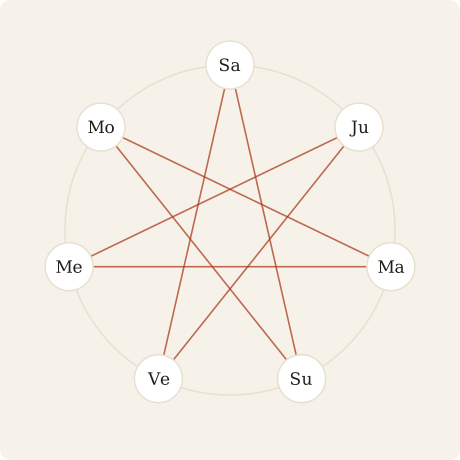
Why does Wednesday follow Tuesday? Why is the week Sun, Moon, Mars, Mercury, Jupiter, Venus, Saturn, an order that matches no astronomical arrangement you can see in the sky? The answer is the oldest piece of computation most people use without knowing it. Underneath the weekday sits the hora, the planetary hour, and the strange order of the days is what falls out when the hora sequence is run honestly through twenty-four hours. The panchang still prints horas every day, and this piece follows the whole chain: what a hora is, how the sequence runs, how the week falls out of it, and the two-thousand-year paper trail, with every classical reference flagged for how it reached us.
Four sources, fetched on 31 October 2026, carry this article: kaalpanchang's derivation page, panchang.now's hora explainer, Wikipedia's planetary-hours article, and Christopher Warnock's renaissanceastrology.com essay. Where any of them quotes an older writer, Vettius Valens, Dio Cassius, Chaucer, William Lilly, that is an indirect citation and is marked as such.
The unequal hours
A hora is one-twelfth of a span of light or darkness, not sixty minutes. The daylight from sunrise to sunset is divided into twelve horas, and the night from sunset to the next sunrise into twelve more, giving twenty-four for the full day, as both panchang.now and the renaissanceastrology essay state. Because daylight and darkness are equal only at the equinoxes, a day hora and a night hora are almost never the same length, and each breathes with the season, longer summer day horas, longer winter night horas. The renaissanceastrology essay, quoting William Lilly's Christian Astrology of 1647, page 482, records the old English name for the system: the unequal hours. We did not fetch Lilly; that attribution is indirect. The same essay fixes the boundaries the Indian way as well: the planetary day begins at sunrise and ends at the next sunrise. A hora printed for another city, or lifted from a generic table, is an approximation, because the twelfths are of your sunrise and sunset.
The Chaldean ladder
The horas are ruled by the seven classical planets in one fixed sequence: Saturn, Jupiter, Mars, Sun, Venus, Mercury, Moon, repeating endlessly. All four sources agree on the sequence and on its rationale: it orders the planets by decreasing apparent speed, which in the ancient planetary-spheres model is also furthest to nearest. Wikipedia gives the sequence that model's usual name, the Chaldean order, and adds a caveat worth keeping: objectively, the Sun, Venus and Mercury all advance by 360 degrees a year on average, so the ordering belongs to the geocentric frame's way of reckoning, not to modern orbital periods. The order is a model's order. It is also astonishingly old: Wikipedia traces the planetary-hours system to Hellenistic astrology, with possible roots in older Babylonian astrology, both claims attributed there rather than independently verified by us.
Now the mechanism that builds the week. The day's first hora belongs to the day's own planet, the vaar's lord, and each following hora steps one place down the Chaldean ladder. Twenty-four horas later, because 24 is three times seven plus three, the sequence has run three full rounds of the seven planets and three further steps. So tomorrow's first hora, and therefore tomorrow's name, belongs to the planet three places along the ladder from today's ruler. Kaalpanchang works the whole chain, and it is worth following once: from the Sun, three along (Sun, Venus, Mercury, Moon) lands on the Moon, Monday; from the Moon (Moon, Saturn, Jupiter, Mars) lands on Mars, Tuesday; Mars to Mercury, Wednesday; Mercury to Jupiter, Thursday; Jupiter to Venus, Friday; Venus to Saturn, Saturday; and three along from Saturn returns to the Sun. The peculiar order of the weekdays is not a list someone memorised into being; it is the hora sequence viewed one day at a time.
An old explanation, often retold
This derivation is not a modern reconstruction. Wikipedia's history section records that the astrological order of the days was explained by Vettius Valens in the second century and by the historian Dio Cassius, and that Chaucer gave the same explanation in his Treatise on the Astrolabe. All three reach us through Wikipedia's article; we did not fetch the originals, so treat them as indirect citations. The renaissanceastrology essay adds that the medieval Latin day-names carried the planets openly, and that English swapped in Teutonic gods for four of them: Tuesday is Tiw's day, Wednesday Wotan's, Thursday Thor's, Friday Frigg's, leaving Sunday, Monday and Saturday wearing the Roman planets. The seven-day week, that essay concludes, comes directly from this astrological machinery.
The most evocative evidence is a scratched wall. Wikipedia records a Pompeian graffito that calls 6 February of the year 60 a Sunday, even though by the modern reckoning that date was a Wednesday. Valens, the same article notes, says the first hour of the day began at sunset, following Greek and Babylonian convention, not at sunrise. If the graffito writer was using the sunset convention, then his Sunday is the day modern astrology's sunrise convention calls Wednesday, and the apparent mismatch becomes a match: the week running through Pompeii is our week, unbroken since at least the first century. That inference is Wikipedia's sourced reconstruction, and we present it as such; the chain has a sunset-shaped assumption inside it. The same history notes that Alexandrian Christians in the fourth century were still numbering the days one to seven in both overlapping naming systems. Separately, the renaissanceastrology essay claims the cycle of weekdays has never varied or been interrupted since its introduction, surviving even the Gregorian calendar reform, which changed dates but not days; that is the essayist's claim, plausible and widely repeated, and we flag it as his.
One worked hora, start to finish
The computation is short enough to do on an envelope, and we do it here with our own numbers, flagged as our own worked example rather than any source's. Suppose your almanac gives sunrise at 6:12 am and sunset at 6:36 pm for your city today, a Wednesday. The daylight is 12 hours 24 minutes, that is 744 minutes, so each day hora runs 744 divided by 12, exactly 62 minutes. Wednesday belongs to Mercury, so the first hora, 6:12 to 7:14 am, is Mercury's. Then the ladder steps: the second, 7:14 to 8:16, is the Moon's; the third, Saturn's; the fourth, Jupiter's; the fifth, Mars's; the sixth, the Sun's; the seventh, Venus's; and the eighth brings the sequence back to Mercury, as every seventh step must. The twelfth day hora ends at sunset, 6:36 pm, and the night horas, each one-twelfth of the night, take over from there, still walking the same ladder. If you want Jupiter's window for a financial errand on this Wednesday, the day table gives you the fourth hora, 9:18 to 10:20 am, and the eleventh, 4:32 to 5:34 pm, one more pass through the cycle. Any panchang app showing horas is doing exactly this division underneath, and now you can check it.
Whose sunrise: the two conventions
One detail in the history deserves its own paragraph, because it changes what a date means. The modern astrological convention, and the Indian panchang's, starts the planetary day at sunrise. But Wikipedia's history records Vettius Valens saying the first hour of the day began at sunset, following Greek and Babylonian convention. The two conventions assign different planet names to the same stretch of time, and the Pompeian graffito is exactly where this matters: a wall scratched before 79 AD calls 6 February 60 a Sunday, the modern tables say Wednesday, and the mismatch dissolves only if the writer was counting his day from the previous sunset. Readers who enjoy cross-checking old dates should keep both conventions in hand. For everyday panchang use the question never arises: every source we read computes from sunrise, and the day's first hora is the weekday's own planet.
How the panchang uses a hora
In practice the hora is a quick filter, one step below a full muhurta. Panchang.now lists the traditional alignments: Jupiter's hora for teaching, learning, ritual and financial matters; Mercury for communication, study and travel; Venus for art, music and relationships; the Sun for leadership and dealings with authority; the Moon for emotional matters and water-related activity; Mars for physical activity, surgery and competition; Saturn for long-term planning, manual labor and discipline. The same page calls hora-picking a common pre-muhurta filter for everyday timing, which places it correctly in the hierarchy: finer than the day's general quality, coarser than an election that weighs tithi, nakshatra, yoga and karana together.
If you have read our choghadiya piece, the family resemblance is no coincidence. Kaalpanchang points out that choghadiya and hora both open on the weekday's ruling planet, because the weekday is the planet of its first hora. The two systems then part ways: hora divides each span by twelve and keeps the planetary names, choghadiya divides by eight and renames the slots by their judged nature. Same ladder, different staircases, and the same clock minute can sit in a Jupiter hora and an avoided choghadiya at once without contradiction, because the two dials answer two different questions.
There is also a small pleasure hidden in the figure above, and the renaissanceastrology essay points at it with its figure of the heptagram of the week. Draw the seven planets on a circle in the Chaldean order, then join them in the order of the days, and the weekday sequence traces a perfect seven-pointed star, the same star whichever day you start from. The week is not only computable; it is drawable, and medieval and renaissance writers drew it exactly this way.
Where you meet horas today
The system never left daily life. Newspaper panchang columns and every serious panchang app carry the day's hora table alongside rahu kaal and choghadiya; kaalpanchang notes that the traditional GhadiChakra lays the day's horas out directly, so a reader never needed to compute the jump of three to use the hours, only to understand them. Panchang.now describes its own dashboard the same way, a full twenty-four-hora timeline per city with each window's start, end and ruling planet. When two apps disagree about which hora is running, the cause is almost always upstream: different sunrise or sunset values for the same city move every boundary, and the occasional app that starts the day at midnight instead of sunrise is simply using a different convention than the panchang tradition described here.
And where did the system itself come from? Our sources locate its origin in Hellenistic astrology with possible older Babylonian roots, and kaalpanchang notes that because the scheme was shared across the ancient world, the Roman and hence modern European weekday planets match the Indian ones day for day. How and when the planetary week took root in India is a question none of our four fetched sources examines, so we leave it open rather than repeat the confident paragraphs other summaries recycle. What is on record is the machine itself, and it runs identically in Delhi and in Rome.
Using the hours well
Read the hora for your own city and date, since its boundaries come from your sunrise and sunset. Use it the way the sources describe, as a light everyday filter: a Venus hora for the difficult conversation that needs warmth, a Mercury hora for the application you are about to send, a Jupiter hora for the class you are about to teach. Do not ask it to carry what it was never built to carry; no source we read treats a hora as sufficient for marriage-level timing. And when you next glance at a calendar and wonder why Friday sits where it does, you will know: the week is a seven-pointed star, and we have been walking it, one jump of three at a time, for two thousand years. No memorised list holds a civilisation's weekdays in place across empires, calendar reforms and languages; only a machine does that, and the hora is the machine.
Questions on this article
Is one hora sixty minutes long?
No. A hora is one-twelfth of the daylight or the night, so its length changes with city and season; only near an equinox is it about an hour. William Lilly called them the unequal hours for exactly this reason (indirect citation). The clock hour runs in equal boxes from midnight; the hora runs from sunrise, in twelfths of your own day.
Why is the order of the weekdays so strange?
Because the order is not a list but a computation. Each day is named for the planet of its first hora, the horas run the Chaldean ladder from Saturn to the Moon, and twenty-four hours make three full rounds plus three steps, so the next day’s ruler is the planet three places along. Sun to Moon, Moon to Mars, Mars to Mercury: the jump of three is the week’s order. Vettius Valens and Dio Cassius gave this same explanation in antiquity (indirect citation).
Do hora and choghadiya give the same answer?
Often not, and that is no contradiction. Both start from the same planetary cycle and the same weekday lord, but the hora divides the span by twelve and keeps the planet names, while the choghadiya divides by eight and renames the slots by their judged nature. The same minute can sit in a Jupiter hora and an avoided choghadiya at once; the two dials answer two different questions.
Where did the planetary week in India come from?
Our sources place the system’s origin in Hellenistic astrology with possible Babylonian roots, and note that because the scheme was shared, the Roman and Indian weekday planets match day for day. How and when the planetary week took root in India is a question none of our four sources examines, so we leave it open. What is on record is the machine, and it runs the same everywhere.


