How a Shubh Muhurat Is Chosen: The Funnel from Year to Hour
A muhurat is not picked but filtered: from the season vetoes to the two-hour lagna sieve, the ordered stack of five sieves that narrows 365 days to a window a few hours wide.
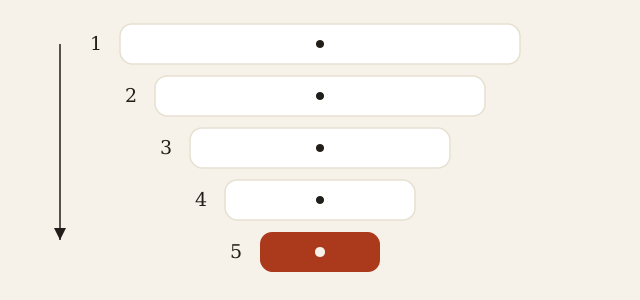
A Hindu wedding date is not picked; it is filtered. Between "sometime next winter" and "Saturday 21 November 2026, between 6:48 in the morning and midnight," stands a stack of sieves, each one removing a layer of the calendar until a window a few hours wide remains. Muhurta shastra, the electional branch of Jyotish, is that stack, and its logic is the reverse of birth-chart astrology: instead of reading the chart a person was born into, it constructs the best possible chart for an event to be born into, as one of our sources puts it. This piece walks the whole funnel in order, from the prohibitions that can veto an entire season down to the two-hour ascendant window, using marriage as the running example, because marriage is where the classical rules are most detailed. Every rule we cite from a classical text reached us through a modern summary, and we say so each time.
Three sources, all fetched on 31 October 2026, carry the article: dekhopanchang's muhurta-selection guide and its companion teaching module, both of which summarise the Muhurta Chintamani, the Dharmasindhu and B.V. Raman's Muhurtha, and drikpanchang's published 2026 marriage-muhurat list for New Delhi, which lets us test the rules against real printed dates. Where those classical books are quoted, the citation is indirect.
The five limbs, and what "shuddhi" means
Every traditional panchang prints five daily elements: tithi, the lunar day; vara, the weekday; nakshatra, the Moon's mansion; yoga, the Sun-Moon angular combination; and karana, the half-tithi. When all five are favourable for the planned act, the day carries what the texts call panchanga shuddhi, purity of the five limbs. The honest note our guide adds is that perfect shuddhi is rare, and the system is built for that reality: it ranks the limbs so that a real day, with its inevitable mix of strengths and weaknesses, can still be read. Nakshatra is primary, tithi secondary, yoga tertiary, karana and vara supporting, and below the five limbs sits the lagna, which belongs not to the day but to the hour. The funnel is this ranking, made physical: each sieve is finer than the one above it, and the sieves are allowed to disagree, with the ranking deciding.
The veto layer: when a whole season closes
Before any day is examined, two prohibitions can close an entire stretch of the year, and both of our guides place them above everything else. The first is combustion. When Venus or Jupiter sits too close to the Sun to be visible, the texts the guide cites, Muhurta Chintamani and Dharmasindhu, forbid marriage outright: Venus governs conjugal happiness, Jupiter dharma and progeny, and neither can be "burnt" for a wedding. The guide gives the working numbers: Venus counts as combust within 10 degrees of the Sun, 8 if retrograde, and this happens roughly twice a year for a month or two each time; Jupiter within 11 degrees, roughly once a year. No favourable nakshatra, no clever lagna, overrides this; it is called the strongest hard prohibition in the system.
The second seasonal veto is the calendar's own: the adhik maas, the inserted thirteenth month our previous piece examined, in which optional ceremonies for gain, including weddings, wait for the nija month. A family choosing a 2026 date thus already watched one gate close from 17 May to 15 June and reopen after. Both vetoes share a character worth noticing: they are not judgments about a day but about a season, and they are checked first precisely because no amount of downstream quality repairs them.
The month: a preference, not a ban
Within an open season, the lunar fortnight matters, but more softly than most people assume. Shukla paksha, the waxing half, is universally preferred for beginnings because the growing moon symbolises growth, our guide says; yet it also records that no classical text explicitly forbids krishna paksha for marriage, and that several traditions, particularly in South India, use waning-fortnight dates when the nakshatra and lagna are excellent. The practical rule it distils: waxing is the default, waning is permissible with a strong nakshatra such as Rohini, Anuradha or Swati and a favourable lagna. Notice what this means for the funnel's shape: the paksha narrows the field by preference, while the day-level limbs below do the real cutting.
The day: tithi, vara, and the primary filter
Three of the panchang's five limbs belong to the day, and they do not weigh equally. The guide states the hierarchy plainly: nakshatra first, then tithi, then yoga, with karana and vara supporting.
The tithi rules for marriage, from Muhurta Chintamani's sixth chapter as summarised by the guide: the 2nd, 3rd, 5th, 6th, 7th, 10th, 11th, 12th and 13th tithis are auspicious; the 4th, 9th and 14th, the rikta or "empty" tithis, are forbidden. B.V. Raman's list is stricter still, additionally avoiding the 8th, purnima and amavasya. We present both lists side by side because they are both in use; the difference between them is a documented disagreement between authorities, not an error to fix.
The weekday carries the same quality of documented disagreement. Muhurta Chintamani, per the guide, lists Sunday, Wednesday, Thursday and Friday as auspicious for marriage; B.V. Raman replaces Sunday with Monday; both exclude Tuesday, Mars's day of conflict, and Saturday, Saturn's day of delay. And then the same guide notes that the texts themselves give the weekday "less importance" in the final assessment, a supporting factor only. Hold that thought for two paragraphs, where the real 2026 calendar makes it vivid.
The nakshatra is the primary filter, the single most important panchanga factor for marriage, and both texts supply lists. The guide gives thirteen auspicious nakshatras, Rohini, Mrigashira, Punarvasu, Pushya, Uttara Phalguni, Hasta, Chitra, Swati, Anuradha, Uttara Ashadha, Shravana, Uttara Bhadrapada and Revati, and nine forbidden ones, Ashwini, Ardra, Ashlesha, Vishakha, Jyeshtha, Mula, Purva Ashadha, Shatabhisha and Purva Bhadrapada, citing Muhurta Chintamani's marriage chapter with the Jyotirnibandha's pada-level exceptions, all indirect citations. A good nakshatra can partially compensate for a mediocre tithi, the companion module explains, but a bad nakshatra undermines even the best tithi; that asymmetry is why the nakshatra sits at the top.
The supporting limbs: yoga and karana
The yoga and the karana work as quality control. Nine of the twenty-seven nitya yogas are listed as forbidden for marriage, Vishkambha, Atiganda, Shula, Ganda, Vyaghata, Vajra, Vyatipata, Parigha and Vaidhriti, and the guide preserves a nuance most summaries drop: the text itself marks a narrow visha ghati, a "poison period," inside each inauspicious yoga, and some practitioners avoid only that window rather than the whole yoga. Among the karanas, Vishti, better known as Bhadra, is the severe one, forbidden by all cited sources for any auspicious activity; the other three fixed karanas, Shakuni, Chatushpada and Naga, are also inauspicious, while the seven movable karanas are all acceptable, with Taitila specifically noted as propitious for marriage. Both limbs yield to the lagna, the guide adds: a well-chosen ascendant with Venus or Jupiter rising "completely destroys all adverse influences," again the text's claim as the guide reports it.
The hour: lagna, the finest sieve
The lagna, the sign rising on the eastern horizon at the moment of the ceremony, changes roughly every two hours, and that makes it the finest-grained tool in the stack. Muhurta Chintamani, as quoted by the guide, makes the strongest claim in the entire system for it: even where other favourable conditions are absent, a properly chosen lagna removes the defects created by the other components. For marriage the guide's table ranks Mithuna, Kanya and Tula lagnas best; Vrishabha, Karka, Dhanu and Meena good; Simha, Makara and Kumbha neutral; Mesha and Vrischika to be avoided. The companion module adds the working rules: the lagna lord should be strong, not debilitated, combust or retrograde, and benefics, Jupiter, Venus, Mercury, Moon, are wanted in the kendras, the 1st, 4th, 7th and 10th houses. It also gives the activity map for other ceremonies: business openings favour the 1st, 10th or 11th house emphasis, education the 2nd or 5th, travel the 3rd or 9th, which is a reminder that the funnel's filters are reset for every kind of beginning.
One classical override stands above even this. The Brihat Samhita's 103rd chapter, as the guide reports it, describes the godhuli lagna, the evening moment when the cows come home and the dust they raise glows in the sunset, and calls it the most excellent hour for marriage, one in which "the character of the nakshatra need not be considered" and "the tithi need not be considered." It is presented as the only override that supersedes all five limbs at once. We did not fetch the Brihat Samhita; the citation is indirect, and we note that a rule this sweeping functions in practice as a release valve for exactly the situations where the sieves leave nothing.
The funnel, tested against a real calendar
Rules become believable when a printed panchang survives them. Drikpanchang's 2026 marriage list for New Delhi gives us the test, and two of its November windows walk the funnel end to end. Saturday 21 November 2026 carries a muhurat from 6:48 in the morning to eight minutes past midnight, with Revati nakshatra and the Dwadashi tithi: both on the auspicious lists above, the tithi the 12th, the nakshatra one of the thirteen. Tuesday 24 November opens its window at 23:25, running to 6:52 the next morning, on Rohini nakshatra and the Pratipada tithi, again both passing. The page marks four November days shubh in all.
And here the documented disagreement stops being theoretical. The weekday lists above exclude Saturday and Tuesday for marriage; drikpanchang's list offers both a Saturday and a Tuesday. We do not reconcile this, because the sources themselves supply the frame: the weekday is a supporting factor in the hierarchy, outranked by nakshatra, tithi and lagna, and a working panchang weighs the whole stack rather than vetoing a day whose Revati or Rohini is excellent. What we record, unresolved, is that a rules-summary and a practicing almanac part ways exactly where the hierarchy said they could.
Assembled, the guide's synthesis runs in five steps, and it is worth printing as a single ranked list, because it is the article in miniature: first, Venus and Jupiter must not be combust, and this overrides everything; second, the nakshatra must be favourable, the primary panchanga filter; third, the lagna should be well chosen, the most powerful corrective; fourth, tithi, yoga, karana and vara supply supporting quality; fifth, shukla paksha is preferred but not mandatory when the stronger factors are good. The overall philosophy the guide names is just as important as the list: muhurta selection is not about finding a perfect time, since perfection essentially never occurs, but about avoiding the worst combinations and maximising the best available factors. A system with this many moving parts that demanded perfection would have no weddings at all.
The last fine filters
Inside a chosen window, the daily micro-clocks still apply, and they are the subjects of our earlier pieces: rahu kaal is avoided within the day, the hora can be matched to the activity, and the choghadiya offers a coarser good-and-bad division of the same hours. These operate below the muhurat, trimming it, never establishing it; a marriage window is not built from choghadiya upward. The same ordering instinct runs through the whole system, from the combustion veto down: big gears first, small gears last. Readers who have followed this series already own the parts; this piece is the assembly drawing. The limbs are not five separate superstitions but one machine with a known precedence order, and once the order is understood, any printed muhurat stops being an oracle's answer and becomes a receipt you can audit.
Using the funnel yourself
For a reader planning an actual ceremony, the stack implies a practical order of operations. Start with the season: check combustion periods and the adhik maas before falling in love with a month. Then take a published list, drikpanchang's or your regional panchang's, and read what it prints per window, because the nakshatra and tithi named there tell you which filters the date already passed, and because the list is computed for a stated city, with timings that move when the city changes. Bring two or three candidate windows to your family priest rather than one, and expect the priest's ruling to come first, as every source we read says in its own way; the texts disagree with each other often enough that a living authority is part of the system, not an appeal against it. And treat the funnel as a way to understand a date, not as a promise about a marriage: the sources describe what the rules select, not what a wedding will bring.
Questions on this article
Which factor matters most when choosing a muhurat?
The hierarchy in the cited texts: first, Venus and Jupiter must not be combust, which overrides everything; then the nakshatra, the primary panchanga filter; then the lagna, the most powerful corrective; then tithi, yoga, karana and vara as supporting factors; and shukla paksha preferred but not mandatory. Perfect shuddhi is rare, so the system works by avoiding the worst combinations and maximising the best available factors, not by hunting a perfect time.
Is marriage forbidden in the waning fortnight?
Per our guide, no classical text explicitly forbids marriage in the krishna paksha. Shukla paksha is universally preferred because the waxing moon symbolises growth, but several traditions, particularly in South India, choose waning-fortnight dates when the nakshatra (like Rohini, Anuradha or Swati) and the lagna are excellent. The paksha is a preference, not a prohibition.
Why do panchangs list Saturday or Tuesday weddings if the texts exclude them?
We found this contradiction live: Muhurta Chintamani and B.V. Raman (indirect citations) exclude Tuesday and Saturday, yet drikpanchang’s 2026 list offers Saturday 21 November (Revati, Dwadashi) and Tuesday 24 November (Rohini, Pratipada) as auspicious. The sources themselves supply the frame: the weekday is a supporting factor in the hierarchy, and a working panchang weighs the whole stack rather than vetoing a day with an excellent nakshatra-tithi-lagna. We leave it recorded and unresolved.
What is godhuli lagna?
Per the Brihat Samhita’s 103rd chapter (through our guide, indirect citation), the godhuli lagna is the evening moment when the cows return home and the dust they raise glows in the sunset; it is called the most excellent hour for marriage, one in which the nakshatra and the tithi need not be considered. It is presented as the only override that supersedes all five panchanga limbs at once.


