How to Read a Kundli: Signs, Houses and a Worked Example
Read the diagram without confusing a sign number with a house number. A step-by-step cultural guide, with declared assumptions and limits.
A kundli becomes much less mysterious when its numbers stop doing two jobs at once. A small 4 may mean Cancer, the fourth sign, rather than the fourth house. A planet can occupy a house without owning it. A chart drawn as a diamond can contain the same information as a square grid. Learning these distinctions is the first task. Prediction is a different task, and one that does not have scientific support. This guide teaches the traditional diagram's grammar: what its boxes mean, how to locate the ascendant, how to separate a sign from a house, and how to record a placement before interpreting it.
Our structural sources are Wikipedia's entries on Kundali, Bhava and Hindu astrology. We also inspected the Drik Panchang kundali output and the Stellium chart-rendering documentation. For the distinction between calculation and validated prediction, we use UC Berkeley's Understanding Science. The reading order below is our teaching method, not a quotation from an ancient book.
Start with the document, not a forecast
A natal kundli is a representation of positions at birth. The Kundali entry calls it a janmapatra and explains that it records the navagrahas in twelve zodiacal signs. These nine traditional factors are the Sun, Moon, Mercury, Venus, Mars, Jupiter, Saturn, Rahu and Ketu. They are not nine physical planets in the modern astronomical sense: the Sun is a star, the Moon is a satellite, and the nodes are intersection points associated with the Moon's orbit. Knowing that vocabulary prevents the word planet from quietly importing a false physical description.
Before studying the boxes, read the header. Record the birth date, the time as supplied, the place, and the time convention used by the calculator. Keep an uncertain time uncertain. Do not turn a family memory of the morning into an exact minute merely because a form requires one. The ascendant is specific to time and place, as the Kundali source explains. A document with an uncertain input can still be studied as a document, but it should not be presented as a precise personal result.
Also record whether the chart is sidereal or tropical, the chosen ayanamsa when relevant, and the house system. The Hindu astrology entry explains that Jyotisha primarily uses a sidereal zodiac, whereas most Western astrology uses a tropical reference. Stellium's documentation explicitly makes sidereal conversion and ayanamsa configurable. Two calculators can therefore disagree without either screenshot proving a transcription error. First compare their settings. Do not settle the disagreement by choosing the interpretation that sounds more flattering.
The first key: signs have their own numbers
The zodiac is divided into twelve equal signs of thirty degrees each. The conventional sign numbers are 1 Aries or Mesha, 2 Taurus or Vrishabha, 3 Gemini or Mithuna, 4 Cancer or Karka, 5 Leo or Simha, 6 Virgo or Kanya, 7 Libra or Tula, 8 Scorpio or Vrishchika, 9 Sagittarius or Dhanu, 10 Capricorn or Makara, 11 Aquarius or Kumbha, and 12 Pisces or Meena. This order belongs to the signs. It does not say that Aries must be the first house in every birth chart.
Write the sign key beside an unfamiliar chart until it becomes automatic. If the ascendant cell contains 4, read Cancer ascendant, not fourth-house ascendant. A longitude such as ten degrees of Cancer describes a point within that sign, not a tenth house. Degrees, sign numbers and house numbers are separate fields. A useful transcription gives each its own column rather than placing several unexplained numbers together.
The second key: learn what stays fixed in the layout
In the North Indian format, houses stay in fixed positions. The first house is the upper central diamond, and subsequent houses are counted counter-clockwise. The sign numbers placed inside those houses change with the ascendant. The Kundali article and Stellium's technical guide agree on this distinction. If Cancer rises, the top diamond represents house one containing sign four. The next house contains sign five in the whole-sign example. A drawing without its sign labels is missing information.
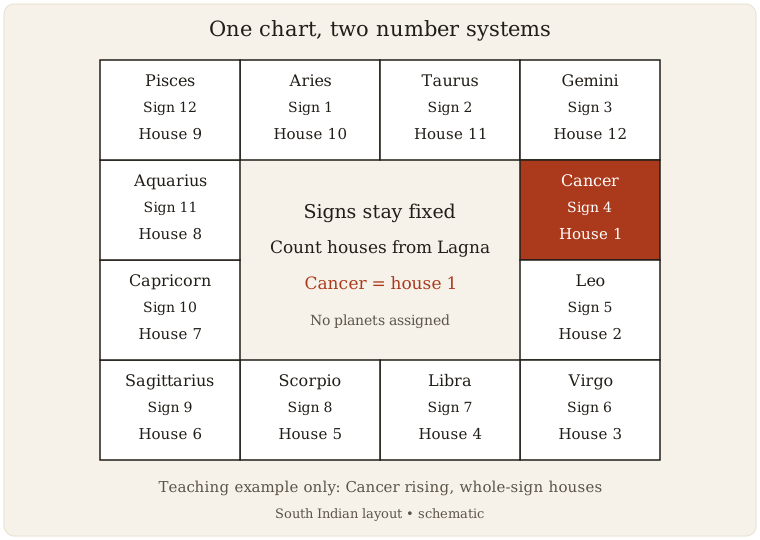
In the South Indian format, the signs stay fixed. Aries occupies the second cell from the left in the top row; the remaining signs follow clockwise around the outer cells. The ascendant marker moves to the appropriate sign. Houses must then be counted from that marker. The central empty space is not an extra house. Our diagram uses this format because it lets the reader compare every sign number with a separately labeled house number without squeezing text into triangular cells.
The Eastern Indian format is also sign-centric, according to the Kundali source, but its ordering is different: Aries occupies the upper central cell and the signs proceed anti-clockwise. Do not carry the South Indian clockwise instruction into that layout. Regional drawing styles are not separate planetary skies. They are conventions for arranging information. When converting one format into another, compare the sign occupied by each factor and the ascendant, not the factor's position on the sheet.
Our worked example: Cancer rising, whole-sign houses
The illustration is a teaching example, not a calculated birth chart. It assigns Cancer to the first house and uses whole-sign houses. It contains no date, birth time or planetary placements. Count inclusively from Cancer: Cancer is house one, Leo two, Virgo three, Libra four, Scorpio five, Sagittarius six, Capricorn seven, Aquarius eight, Pisces nine, Aries ten, Taurus eleven, and Gemini twelve. The sequence wraps from Pisces back to Aries without restarting the house count.
This makes two common errors visible. Aries still carries sign number one, yet it is the tenth house in this example. Cancer still carries sign number four, yet it is the first house. Neither number is wrong because they label different things. If we invented a planet in Aries for a separate exercise, its sign would be Aries and its whole-sign house would be ten. That would be a placement statement, not evidence that the person must follow a particular career.
Use the same method for another hypothetical ascendant. Start with its sign as house one and continue through the zodiac. Keep the example separate from a real person's chart. A classroom exercise does not need a plausible-looking birth date, and adding one without calculating the sky would turn an honest schematic into a misleading horoscope. The diagram deliberately highlights Cancer's cell and leaves planets out.
Whole-sign is a stated assumption, not the only house system
The Bhava entry describes a common traditional approach in which sign boundaries and house boundaries coincide. It also names other systems, including Sripathi and the Placidus system incorporated into Krishnamurti Paddhati. That qualification matters. The convenient sentence one sign equals one house is valid for the whole-sign exercise; it should not be silently applied to every chart labeled bhava or chalit. A planetary sign and its assigned house need not be interchangeable across systems.
If a rashi chart and a separate bhava chart appear to move a planet, first ask which division is being displayed. Record both labels rather than overwriting one. The general Hindu astrology page speaks broadly of thirty-degree houses, while the more specific Bhava entry explicitly discusses alternatives. We retain the qualification rather than pretending the sources establish one universal house geometry. Beginners need a declared convention more than a false appearance of unanimity.
Read the twelve houses as traditional topic headings
The Bhava source associates the first house with the person, appearance and character; the second with family, resources and speech; the third with communication, effort and younger siblings; and the fourth with home, mother, education and property. These are traditional topic groups. They tell you where a practitioner would begin a discussion, not what will happen. A house associated with health is not a medical test, and a house associated with wealth is not a bank balance.
The fifth includes children, affection, recreation and devotion. The sixth includes illness, disputes and service-related themes. The seventh includes spouse and business partnership. The eighth includes longevity, obstacles and inheritance among other difficult traditional topics. These lists should not become labels applied to a person. In particular, no isolated eighth-house factor licenses a death prediction, and no seventh-house placement determines whether somebody is worthy of a relationship.
The ninth includes higher learning, philosophy, religion and mentors; the tenth profession, status and public roles; the eleventh gains, friends and hopes; and the twelfth expenses, sleep, retreat and liberation. Some subjects overlap across houses and across source lists. Keep that overlap visible. A topic heading is an index into an interpretive tradition, not a unique diagnostic compartment. For consequential questions, ordinary evidence about the person's circumstances remains necessary.
Occupant, sign ruler and house lord are different labels
An occupant is a graha placed in a house. A house lord, in the whole-sign method used here, is the ruler of the sign assigned to that house. The Drik Panchang output separates residents, owner, rashi and aspects into different fields, which is a useful practical reminder. An empty cell means no displayed graha occupies it. It does not mean the house has vanished, that its topics cannot occur, or that it has no ruler in the traditional system.
In our Cancer example, the Moon rules the first-house sign and the Sun rules the second-house sign Leo. Mars rules Aries and Scorpio, which occupy houses ten and five here. Mercury rules Gemini and Virgo, houses twelve and three. Jupiter rules Sagittarius and Pisces, houses six and nine. Venus rules Taurus and Libra, houses eleven and four. Saturn rules Capricorn and Aquarius, houses seven and eight. These are the seven-graha rulerships in the Hindu astrology source's sign table; its additional node co-rulership entries are not needed for this introductory exercise.
Write a neutral sentence before adding interpretation: the tenth-house sign is Aries; its ruler is Mars; Mars's actual position must be read elsewhere in the chart. Do not claim Mars occupies the tenth merely because it rules that house. Ownership and residence are different relationships. A worksheet with columns for house, sign, ruler and occupant makes this error much easier to catch.
Add classifications without turning them into verdicts
The Bhava entry groups houses one, four, seven and ten as kendras; one, five and nine as trikonas; six, eight and twelve as dusthanas; and three, six, ten and eleven as upachayas. The first belongs to both the kendra and trikona groups. The sixth belongs to both dusthana and upachaya groups. These overlaps show why a single word such as difficult or growing cannot summarize an entire chart. The groups describe different traditional lenses.
The same source arranges the houses by four aims: dharma at one, five and nine; artha at two, six and ten; kama at three, seven and eleven; moksha at four, eight and twelve. Treat these sets as a memory aid for the tradition's organization of life topics. They do not establish that somebody is spiritual, wealthy or unsuccessful. Classification is a step in reading the notation, not proof of a life outcome.
Only then read degrees, nakshatras and extra marks
The Hindu astrology source describes twenty-seven commonly used nakshatras, each spanning thirteen degrees twenty minutes, with four padas of three degrees twenty minutes each. A graha's sign and its nakshatra describe the same longitude through different divisions. Record both if the output supplies them, but do not assume that a sign boundary and a nakshatra boundary always coincide. The degrees are what locate the point within those divisions.
Drik Panchang's inspected output includes separate columns and a legend for retrograde, combustion and raw longitude, along with D1 and D9 sections. Read the legend before interpreting an R, C, arrow or flame. A symbol is a software convention until its meaning is established. Keep D1 and D9 notes separate: a placement printed in a divisional chart must not be copied into the natal sign chart as though the two panels were interchangeable.
Aspects, dashas and transits belong to later layers
In the Hindu astrology source's graha-aspect list, the Sun, Moon, Mercury and Venus aspect the seventh from their position; Jupiter additionally has fifth and ninth aspects, Mars fourth and eighth, and Saturn third and tenth. The same list labels the nodes' fifth and ninth aspects as belonging to some traditions. Preserve that phrase. Do not combine a node rule from one school with another school's reading and call the result universal. This guide does not attempt a full aspect-strength calculation.
A natal chart is the birth reference. Gochara refers to later transits relative to that reference. Dasha is a traditional timing framework; the source describes Vimshottari's initial period through the natal Moon's nakshatra and describes subperiods. These are different layers, not three names for one chart. Record which dasha system and which transit date are being discussed. Increasing the number of subdivisions cannot repair uncertain birth data or demonstrate that a prediction is true.
A repeatable reading sheet, and an honest stopping point
Our suggested sheet has a header for inputs and settings, a sign-number key, a clear ascendant label, and twelve rows listing house, sign, ruler and occupants. Add longitudes and source-specific symbols only after those rows agree with the chart. Mark a blank, unreadable or uncertain field as such. Then list any later aspect, dasha or transit assumptions separately. This is a method for preventing transcription mistakes, not a promise of predictive accuracy.
Berkeley's Understanding Science explains that precise astrological claims can be tested, while vague claims may fit almost any outcome; the careful studies it discusses did not support astrology's validity. Accurate sky calculations and attractive charts do not establish the further claim that those positions determine personality or events. Learn the diagram as cultural and historical literacy if it interests you, but use medical care, financial evidence, consent and real conversation for decisions about health, money and relationships. Reading a chart should leave you better informed about its notation, not less free to choose.
Questions on this article
What do the numbers in a kundli mean?
Sign numbers run from Aries 1 to Pisces 12. They are not automatically house numbers. In our Cancer-ascendant whole-sign example Cancer is sign 4 but house 1, while Aries is sign 1 but house 10.
How do North and South Indian charts differ?
North Indian charts keep houses fixed and change the sign labels. South Indian charts keep signs fixed and mark the ascendant in its sign. Compare placements by sign, not by position on the sheet.
Does an empty house mean nothing will happen?
No. Empty means no displayed graha occupies that house. Its sign and traditional ruler remain. This is chart notation, not evidence that a topic will be absent from life.
Can reading a kundli reliably predict the future?
Astrological predictions do not have scientific support. Accurate astronomical calculation does not validate personality or event claims. Use the chart for cultural study, not as a substitute for medical, financial or relationship evidence.


