Jupiter in Vedic astrology: karaka of wisdom, fortune and expansion
Jupiter signifies wisdom, children, fortune and growth. Learn the traditional signs of a strong or weak Jupiter, the Jupiter mahadasha, and simple remedies.

In Vedic astrology Jupiter, called Guru or Brihaspati, holds the title of teacher of the gods. It is the largest planet in the solar system, and the tradition counts it first among the benefics. Where the Sun is authority and the Moon is the mind, Jupiter is discernment: the faculty that tells right from wrong and meaning from noise. From Jupiter's placement, the tradition reads the indications for wisdom, children, fortune and the expansion of life. This article explains that tradition in plain words: what Jupiter is the karaka of, what a strong or weak Jupiter is said to look like, how the 16-year Jupiter dasha is viewed, and what the simple remedies are.
What is Jupiter the karaka of?
A karaka is the planet that "signifies" a subject. In the classical texts, Jupiter signifies:
- Wisdom and discernment: the capacity to learn, education, philosophy, ethics and good judgment.
- Children: indications around children are read from Jupiter together with the fifth house.
- Fortune and expansion: the opening of opportunities, the tendency toward financial and social growth.
- The husband in a woman's chart: a classical convention, parallel to Venus as the karaka of the wife.
- Teachers and guidance: schoolteachers, spiritual teachers, mentors and institutions of learning.
From this comes the popular saying that a strong Jupiter softens many flaws in a chart, because good judgment accompanies every decision.
Own sign, exaltation and debilitation
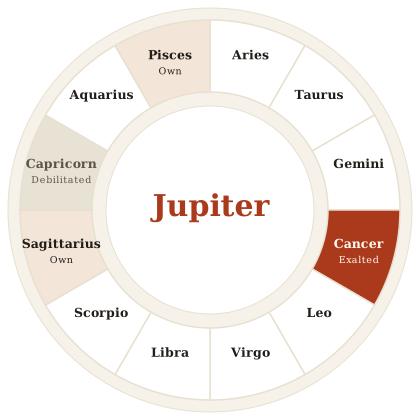
Every planet is said to have signs that feel like its own home and signs where it is a guest. The traditional placements for Jupiter:
| State | Sign | Traditional meaning |
|---|---|---|
| Own sign | Sagittarius and Pisces | Jupiter at home; wisdom and beneficence express themselves naturally |
| Exalted | Cancer (deepest at 5 degrees) | Held to be the strongest placement; the meeting of knowledge and compassion |
| Moola-trikona | Sagittarius 0-10 degrees | Exaltation-like, slightly milder beneficence |
| Debilitated | Capricorn (deepest at 5 degrees) | Expansion can lose its direction; practicality outweighs idealism |
Notice the symbolism the tradition gives. Cancer is a water sign tied to the mind: when Jupiter's knowledge meets compassion, the tradition calls it the best combination. Capricorn is Saturn's practical sign; there Jupiter's idealism knocks against hard structures. These placements, with their degrees, come from the classical dignity table whose source is given in the last section.
Jupiter in the twelve houses
The core rule: Jupiter expands the subjects of the house it occupies. The traditional outline in brief:
| House | Jupiter's traditional effect |
|---|---|
| 1st (lagna) | A benevolent, learned disposition, respect; a tendency toward weight gain is also mentioned |
| 2nd | Sweet speech, a tendency to accumulate wealth, family growth |
| 3rd | Courage tempered by judgment; warm ties with siblings, an interest in writing |
| 4th | Comforts of home and vehicle, the mother's affection, a peaceful mind |
| 5th | Happiness through children, success in education, creative intelligence; considered an excellent spot for Jupiter |
| 6th | Victory over opponents through judgment; progress in service fields |
| 7th | Indications of a principled, wise spouse; trust in partnerships |
| 8th | Interest in hidden knowledge; the tradition also mentions longevity here |
| 9th | Rising fortune, pilgrimages, the teacher's grace; among the finest spots for Jupiter |
| 10th | Respect in teaching, consulting, law and management |
| 11th | Many sources of income; standing in large groups |
| 12th | Spiritual leanings, a charitable nature, talk of foreign residence |
Remember that a house result never runs alone: Jupiter's sign, aspects, conjunctions and dasha all reshape the picture. The same placement can tell two very different stories in two charts.
Jupiter in the signs: the traditional temperament
Jupiter spends about a year in each sign, so everyone born in the same year shares a "Jupiter sign". Read sign results as the language of a collective tendency, not a personal verdict:
| Sign | Traditional temperament |
|---|---|
| Aries | Initiative in knowledge; leadership in teaching |
| Taurus | Practical use of knowledge; good sense in money management |
| Gemini | A great deal of study, with a warning against scattering |
| Cancer (exalted) | Compassionate wisdom; the makings of a teacher and counsellor |
| Leo | Dignified knowledge; leadership of institutions |
| Virgo | Analytical knowledge; leaning toward accounts, law, medicine |
| Libra | Teaching through justice and balance; diplomacy |
| Scorpio | Hidden knowledge, research, an interest in the esoteric |
| Sagittarius (own) | A natural pull toward philosophy and dharma; love of travel |
| Capricorn (debilitated) | The challenge of applying knowledge; structure versus ideals |
| Aquarius | Knowledge for society's good; science meeting philosophy |
| Pisces (own) | The knowledge of compassion, practice and imagination |
Signs of a strong and a weak Jupiter
The tradition counts Jupiter strong when it is:
- in its own sign or exalted,
- in a kendra (1, 4, 7, 10) or trikona (5, 9) house,
- joined or aspected by benefic planets,
- directionally strong: Jupiter gets dig-bala in the first house,
- neither retrograde nor combust, and free of harsh conjunctions or aspects from malefics.
The traditional signs of a weak Jupiter include debilitation (Capricorn), an enemy sign, combustion by the Sun, and harsh association with Rahu, Ketu, Saturn or Mars. All of these are tendency-indicators, not fate. No single planet in a chart ever tells the whole story; the tradition itself treats the total picture as decisive.
The Jupiter mahadasha: 16 years
In the Vimshottari system the Jupiter mahadasha runs 16 years, the fourth longest after Venus (20), Saturn (19) and Mercury (17). The tradition views this period as a season of learning, stability and expansion, especially when Jupiter is strong in the chart. The traditional lengths and characters of the sub-periods:
| Sub-period | Length | Traditional character |
|---|---|---|
| Jupiter-Jupiter | 2 years 1 month 18 days | Expansion of knowledge, meeting a teacher, auspicious beginnings |
| Jupiter-Saturn | 2 years 6 months 12 days | Achievement through discipline; slow but solid progress |
| Jupiter-Mercury | 2 years 3 months 6 days | A happy marriage of study and writing |
| Jupiter-Ketu | 11 months 6 days | Spiritual leaning; a tendency to detach from the worldly |
| Jupiter-Venus | 2 years 8 months | Growth of wealth and comforts; education in the arts |
| Jupiter-Sun | 9 months 18 days | Position and prestige; benefit from government and institutions |
| Jupiter-Moon | 1 year 4 months | Mental contentment, the mother's wellbeing, public respect |
| Jupiter-Mars | 11 months 6 days | Energy with judgment; work tied to land and justice |
| Jupiter-Rahu | 2 years 4 months 24 days | The tradition calls this a Guru-Chandal test; balance through restraint and good company |
Dasha results are not fixed either: the same Jupiter-Rahu is a warning about risky decisions in one chart and a door to foreign or unconventional study in another. Context is everything.
Retrograde and combust Jupiter
Jupiter is retrograde for about four months of the year. Astronomically this is the apparent reversal of motion seen from the earth; the planet never truly moves backward. The tradition calls a retrograde Jupiter's intellect "inward-turned knowledge": such natives do not accept new things quickly but test them inside first. Some teachers also count a retrograde planet as stronger, since it appears closer to the earth; views differ, and we present both. A combust Jupiter, one very close to the Sun, is described as "scorched" knowledge; but since Jupiter is counted a friend of the Sun, this state is judged less harshly for it than for other planets. In both states, the result keeps changing with house, sign and dasha.
Hamsa yoga and Guru Chandal yoga
Among the five mahapurusha yogas, Hamsa yoga forms when Jupiter sits in a kendra house in its own or exalted sign. The tradition counts it among the finest combinations for wisdom, integrity and honour; such a native is said to separate milk from water like the legendary swan. On the other side, Jupiter joined or aspected by Rahu is called Guru Chandal yoga, linked to a tendency toward misused knowledge, a misleading teacher or confused belief. Here too the tradition itself lists cancellations: a strong Jupiter in kendra or trikona, a benefic aspect, or benefic house-lordship all reduce the effect. The plain meaning: beware anyone selling fear in the name of a single yoga; a yoga is always read with the whole chart.
Jupiter in education, children and marriage
As the natural karaka of the fifth house, Jupiter is tied to both education and children. The custom of checking Jupiter's position for a child's schooling comes from there. In matchmaking too, Jupiter's aspect is counted auspicious; the seventh house receiving Jupiter's aspect is said to grow patience and trust in the relationship. In a woman's chart the tradition takes Jupiter as the husband's karaka, which is why classical matching gave it special weight. In today's context, take the practical meaning: the tradition treats education, family and marriage as "fields of expansion", and Jupiter is the planet of expansion. For anxieties about children, the tradition looks at Jupiter and the fifth house together, and in such matters modern medicine and counselling deserve exactly the same place as in any other subject.
Jupiter in the panchang and in transit
Thursday is dedicated to Jupiter; the custom of yellow clothes, turmeric, saffron and chana remedies on that day grew from this. Guru-Pushya yoga, Pushya nakshatra falling on a Thursday, is counted especially auspicious in muhurta shastra: for beginning new studies, receiving a mantra and starting financial ventures. In transit, Jupiter stays about a year in one sign, so "Jupiter's transit" is the spine of the annual horoscope. The tradition counts Jupiter in the 2nd, 5th, 7th, 9th and 11th from the birth sign as auspicious. Note that transit results are collective tendencies; for a personal result the birth chart and dasha are the accepted basis. The part of the year when Jupiter is retrograde is called a season of review and inward study.
Classical correspondences
| Subject | Jupiter |
|---|---|
| Day | Thursday |
| Direction | North-east (ishanya) |
| Colour | Yellow, saffron |
| Metal | Gold |
| Gemstone | Yellow sapphire (wear only after showing the kundli) |
| Deity | Brihaspati (Indra in some lists) |
| Dasha length | 16 years (Vimshottari) |
| Element | Ether (akasha) |
| Transit cycle | The full zodiac in about 12 years |
Brihaspati, teacher of the gods
In the Puranas, Brihaspati is a sage of the Angirasa line and the priest of the gods. The gods' strategy for victory in their wars with the asuras is credited to him, which produced the epithet "the teacher of policy". A famous story: the episode of Jupiter's wife Tara with the Moon, and the birth of Mercury from it, which set off the Tarakamaya war between gods and asuras. The story's astrological symbol is striking: from Jupiter (discernment) and the Moon (the mind) comes Mercury (the intellect); in other words, intellect is born when judgment and mind meet. Guru Purnima, the day a disciple sits at the teacher's feet, falls on Ashadha Purnima and remains India's biggest day of honouring teachers.
The simple remedies
The tradition's remedies for a weak Jupiter:
- Fasting and charity: a Thursday fast; donating yellow items, chana, turmeric, bananas and yellow cloth, especially to teachers or a school.
- Mantra: chanting "Om Brim Brihaspataye Namah"; the Vishnu Sahasranama is also linked to Jupiter.
- Conduct: honouring teachers and elders, giving the gift of learning, donating books; the tradition files Jupiter's remedies under "service and respect".
- Gemstone: the yellow sapphire in a golden-yellow shade is considered Jupiter's stone; show your kundli before wearing it, since Jupiter is not judged benefic for every chart.
Keep in mind that remedies are a support within the tradition, not a guaranteed fix for any problem. Decisions about education, health or money belong first with qualified specialists.
Jupiter's lesson for our times
In an age when information is free but discernment is rare, Jupiter's symbol is more relevant than ever. In the tradition's language, Jupiter-strength means "the ability to recognise good advice". Its modern form: not taking every viral claim as true, asking for the source behind any "guaranteed" promise, and consulting an experienced guide before big decisions. It is also worth noticing that the tradition makes Jupiter the karaka not only of religion but of teaching, law, medical counsel and management: wherever knowledge is used responsibly. In that sense, the most modern worship of Jupiter is this: learn, teach, and use what you have learned ethically.
An honest note
Astrology is a traditional system, not laboratory science. The meanings attached to Jupiter rest on centuries of symbolism and remembered experience. Take decisions about health, education and money with qualified specialists; treat astrology as context, never the only basis. Sources consulted for the traditional placements and correspondences here: the dignity table of own sign, exaltation and debilitation with degrees, from the Saravali translation at saravali.github.io/astrology/dignities.html; the graha correspondence reference (day, direction, colour, gemstone, deity, dasha years) at satyori.com/reference/grahas/, and the Vimshottari dasha year-table at panchangtime.com/methodology/vimshottari-dasha. These present the classical Parashari framework; where traditions disagree, the text above says so. Our aim is to explain the tradition in plain words, not to sell fear.
Questions on this article
In which sign is Jupiter exalted?
Jupiter is exalted in Cancer (deep exaltation at 5 degrees) and debilitated in Capricorn. Sagittarius and Pisces are its own signs.
How long does the Jupiter mahadasha last?
In the Vimshottari system the Jupiter mahadasha lasts 16 years.
What is Guru Chandal yoga?
When Jupiter is joined or aspected by Rahu, the tradition calls it Guru Chandal yoga, linked to a tendency toward misused knowledge or misguided teaching. It is no curse, and the tradition itself lists cancellations for it.
What are the remedies for a weak Jupiter?
Traditional remedies include a Thursday fast, serving teachers and schools, donating yellow items and chana, and chanting "Om Brim Brihaspataye Namah". Show your full kundli before wearing a yellow sapphire.


