Kaal Sarp Dosh: Definition, 12 Types, and the Balanced Truth
All seven planets on one side: the complete story of a modern concept, without fear.
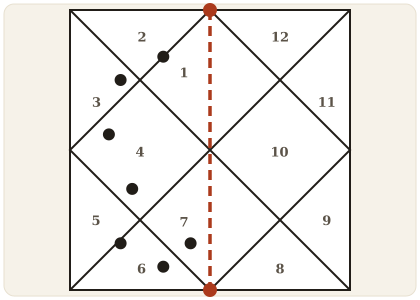
Kaal Sarp Dosh is today the most discussed, and most feared, dosha in popular astrology. The definition is simple: all seven planets of the birth chart lie on one side of the Rahu-Ketu axis. But around that definition a whole industry has grown up, and against it a whole tradition of criticism, because the concept does not appear in the classical texts. This article opens the full arithmetic from both sides: the definition and its subtleties, the twelve named types, where the idea came from, a random-chart frequency check, what to verify before accepting a diagnosis, and a balanced view of the remedies.
The definition: the axis and the hemmed planets
Rahu and Ketu, the two lunar nodes, always sit exactly opposite each other in a chart: if Rahu is in the first house, Ketu is in the seventh. This axis divides the chart into two halves. The tradition holds Kaal Sarp Dosh to form when all seven planets, Sun, Moon, Mars, Mercury, Jupiter, Venus and Saturn, sit in one half, hemmed between Rahu and Ketu. The image is the serpent of Kaal, time, whose head is Rahu and tail Ketu, coiled around the entire chart. Practitioners who accept the concept add refinements. First, full or partial: if even one planet lies outside the axis, the full dosha does not form; some count a "partial" version when a planet sits just outside, many do not count it at all. Second, direction: if the planets run from Rahu toward Ketu in zodiacal order, some call it the true Kaal Sarp; the reverse arrangement is sometimes called "Kaal Amrit Yoga" and treated as milder. Third, degrees: a planet in Rahu's own house but at a higher degree than Rahu may be counted as outside the axis. The consequence of these refinements is that whether you "have Kaal Sarp" depends on which method is applied.
The twelve types: named by Rahu's house
Because Rahu and Ketu are always seven houses apart, knowing Rahu's house fixes Ketu's automatically. The type's name follows Rahu's house, and each name belongs to a great Naga of the Puranas: Vasuki, who served as the churning rope of the cosmic ocean; Takshak, who struck down Parikshit; Sheshnag, on whom Vishnu rests. The names are memory keys, story-handles for each type's character. The full scheme:
| # | Type | Rahu house | Ketu house |
|---|---|---|---|
| 1 | Anant | 1 | 7 |
| 2 | Kulik | 2 | 8 |
| 3 | Vasuki | 3 | 9 |
| 4 | Shankhpal | 4 | 10 |
| 5 | Padma | 5 | 11 |
| 6 | Mahapadma | 6 | 12 |
| 7 | Takshak | 7 | 1 |
| 8 | Karkotak | 8 | 2 |
| 9 | Shankhchoor | 9 | 3 |
| 10 | Ghatak | 10 | 4 |
| 11 | Vishdhar | 11 | 5 |
| 12 | Sheshnag | 12 | 6 |
Some lists vary a few names, Shankhnaad for the ninth or Patak for the tenth, but the house-by-house scheme is the same. Those who accept the concept read each type from Rahu's house: Kulik, Rahu in the second, is tied to family wealth and speech; Shankhpal, fourth, to home and mother; Padma, fifth, to children and education; Takshak, seventh, to marriage. Takshak, Karkotak and Kulik are traditionally called the most worldly-disruptive, and Mahapadma and Sheshnag the most spiritually charged though materially demanding.
The Naga names as story keys
The twelve names are not decoration; the tradition treats them as mnemonic keys to each type's character. Vasuki is the serpent of shared, world-scale effort in the churning of the ocean, and so attaches to the third-ninth axis of initiative and fortune. Takshak is the serpent of the sudden, fatal strike on Parikshit, and so his name on the seventh-first axis of marriage and self is considered the gravest. Sheshnag is the serpent on whom Vishnu rests, which fits the twelfth house of expenditure, isolation and moksha. Read through the story keys, the table can be understood rather than memorised: the Naga's story tells you the imagined flavour of pressure on that axis.
Where the concept came from: a modern dosha
This is the most important point in the article: the modern sources we consulted for it report that Kaal Sarp Dosh does not appear in the foundational texts, neither Parashara's Brihat Parashara Hora Shastra, nor Varahamihira's Brihat Jataka, nor Kalyanavarma's Saravali. In their account, those texts do contain a "Sarpa Yoga", but it is a different combination formed by malefics in the angular houses, and Kaal Sarp became widespread in the twentieth century. We have not examined the root texts ourselves, so treat this as a source-based account, not a self-verified fact. This does not make the concept worthless; it makes it modern and contested. Many respected practitioners treat it cautiously or reject it; others say they genuinely see its pattern of delay and struggle in charts. Knowing both camps is essential, and once both are known there is no reason left for fear.
A randomness check: how "rare" is this dosha
A simple calculation puts the fear around this dosha into proportion. The model is this: relative to one fixed axis, say the Rahu-Ketu line of the first and seventh houses, let the seven planets fall anywhere independently with uniform probability. Then the probability that all seven land on one side, either side, is 2 times (1/2)^7 = 1/32, about three percent, counting both sides together. Note carefully: this is a statistical model, not a prevalence measured on real charts; actual planetary positions are correlated, so the real share will differ. The model's message is limited: even under its assumptions roughly three charts in a hundred will show a "full Kaal Sarp" by pure chance, so the share is not small. The conclusion: this is no rare curse-mark but a configuration the model makes common. A concept applying to that large a population is not a rational cause for one person's dread.
Two charts, one type: how intensity is said to vary
The type only says which two life domains are imagined as "compressed"; how hard the pressure is felt depends, say those who accept the concept, on the strength of the hemmed planets. Two charts can carry the same type, say Takshak: in one, a strong Jupiter and Venus sit inside the axis; in the other, afflicted planets; the tradition reads the first as mild and the second as hard. Similarly, if a benefic sits just outside the axis, some practitioners call it the "escaping planet" and treat its significations as a door of relief. The practical summary is always the same: the type name gives only the outline; the detail is chart-specific; and that is why two people told they have the same type can have entirely different experiences.
What is claimed about the effects
Those who accept the concept tie Kaal Sarp to a recognisable pattern: effort out of proportion to reward, delays in marriage, career or children, sudden reversals, and dreams of snakes. It is also claimed that the effect softens after the fortieth year, and that the same configuration can bring great success after struggle; the charts of several famous, successful people are said to carry it. Read all of this exactly as the tradition offers it: as claims, not as proof. Delay and reversal visit every chart configuration, and "effort without full reward" is so common an experience that it matches any broad diagnosis.
Checking for yourself: four steps
Whether this configuration is present in your chart can be seen in four steps, without any specialist or payment. Step one: cast a reliable chart from your birth date, time and place, and note the houses of Rahu and Ketu. Step two: mentally split the chart along the axis into two halves and mark the positions of all seven planets. Step three: check whether all seven lie on one side; if even one is outside, the full configuration is absent. Step four: if all seven are on one side, read the type from Rahu's house in the table. Keep in mind that if your birth time is uncertain, the house layout itself can change, and with it any diagnosis.
Before accepting a diagnosis: three checks
If you are ever told your chart has Kaal Sarp Dosh, run three checks yourself. First, look at the chart: are all seven planets genuinely between Rahu and Ketu? Surprisingly many "Kaal Sarp" diagnoses fail this simple test. Second, look at the whole chart: a strong ascendant, a well-placed Jupiter or a favourable dasha outweighs any single combination; reading one yoga in isolation is a methodological error. Third, beware fear-selling: if you are told that only an expensive puja can "remove" the dosha and otherwise something terrible will happen, take a second opinion from another scholar. The concept itself is contested; spending pressure on top of it demands double caution.
The traditional remedies: simple, doable yourself
The tradition's remedies are chiefly Shiva worship: Shiva wears serpents as ornaments and is himself the lord of Kaal. They can be done by yourself at almost no cost: daily or Monday water abhishek on a Shiva linga with the japa of Om Namah Shivaya; regular recitation of the Maha Mrityunjaya mantra; worship on Nag Panchami, Shravana Shukla Panchami, the most traditional day for Kaal Sarp remedies; Rudrabhishek on Pradosh; and the Hanuman Chalisa or Navagraha stotra. If a special shanti is wanted, Trimbakeshwar near Nashik and Srikalahasti are famous; in that case use the temple's own official arrangements, not middlemen. None of these remedies costs much, and all of them steady the mind; that steadiness is the most reliable answer to the anxiety the words "Kaal Sarp" produce.
How remedies are grouped by axis
The tradition that accepts the concept groups the twelve types by remedy focus. The identity-and-partnership group, Anant and Takshak, where the pressure falls on self and marriage, is paired with Venus-strengthening and marriage-specific practice. The wealth-and-transformation group, Kulik and Karkotak, is paired with intensified Maha Mrityunjaya japa and discipline in speech and money. The fortune-and-dharma group, Vasuki and Shankhchoor, is paired with Jupiter practice, Thursday observances and connection with a guru. The career-and-home group, Shankhpal and Ghatak, is paired with Moon strengthening and Monday fasting on one side and Shiva worship for career on the other. The children-and-network group, Padma and Vishdhar, draws on Jupiter and Venus together. The isolation-and-moksha group, Mahapadma and Sheshnag, is considered the most spiritual and is directed toward sustained seva and meditation. This grouping is also a claim of the tradition; read it as orientation.
A balanced view: a modern concept, an ancient worship
This article's position is plain. On one side, Kaal Sarp Dosh is a concept which the consulted sources describe as twentieth-century and absent from the root texts, which an idealised random model produces by pure chance in about one chart in 32, and in whose name fear-selling is documented. On the other side, a living tradition accepts it, whose remedies are Shiva worship and japa, wholesome in themselves, and which gives many people a frame for patience in seasons of struggle. Hold both facts together: do not fear the dosha, respect the simplicity of the remedies, and take a second opinion before any expensive "cure". The rule of this series holds here too: the arithmetic is open, the claims are presented as claims, and there is no prediction anywhere.
Why two people with Kaal Sarp can thrive
A configuration shared by roughly one chart in thirty-two cannot, on its own, decide one person's fate; that is the arithmetic heart of the matter. The tradition that accepts the concept says the same thing in its own language: the whole chart outweighs any single combination, and the type's outline is softened or hardened by the planets inside it. Both routes lead to one practical rule: never let a single named pattern outweigh everything else you know about your life. The people said to have this configuration include outstandingly successful lives; the people said to be free of it include lives of struggle. A label that fits both outcomes predicts neither, and anything that predicts neither success nor struggle deserves curiosity, not fear.
Common confusions
First confusion: Kaal Sarp is an ancient classical dosha. The root texts do not describe it; it is a modern concept with a supporter camp and a critic camp. Second: the dosha still holds in full when one planet is outside. By definition the full dosha needs all seven hemmed; many scholars do not count the partial state at all. Third: a practitioner chooses the type by judgement. The type is fixed mechanically by Rahu's house; the twelve names map one-to-one onto the twelve houses. Fourth: an expensive puja is required to remove it. The tradition's remedies are Shiva worship and japa, nearly free; spending pressure is itself the biggest warning sign.
Practical use
Use this article in three ways. First, as method literacy: the definition and the twelve-type table let you test the structure of any "Kaal Sarp" diagnosis yourself. Second, as decision safety: the model-based randomness check, about three percent, and the sourced account of its modern origin protect you from fear-based spending; adopt the second-opinion rule. Third, as affection for the tradition: if a remedy steadies your mind, adopt the simple Shiva worship of Nag Panchami and Mondays; it is free, it is safe, and it depends on no claim.
Sources and the honesty note
The definition, refinements, twelve types and their Naga names come from the Kaal Sarp articles at ishvaram.com and bhaktiarohan.com; the account of its modern origin, the difference from the classical "Sarpa Yoga", the partial-direction-degree refinements, the fear-selling warning and the remedy details come from Bhakti Arohan's balanced-view article; the claim of absence from the root texts is likewise these sources', we have not opened those texts ourselves. The random-probability calculation is our own: a model of seven independent, uniformly distributed points relative to a fixed axis, counting both sides; real planetary positions are correlated, so treat it as a proportion gauge, not a measurement. Everything about effects is presented as the tradition's claim. This article is educational; it makes no claim about any person's chart or future.


