Kantaka Shani and Dhaiya: Two Thorn-Names Audited, One Older Rule, and a Thirty-Year Map
When Saturn enters the 4th or the 8th from the Moon sign, the tradition calls it a dhaiya; the names are a later layer, the rule is older, and see by arithmetic where these states fall in the thirty-year cycle.
"A dhaiya is running" - after Sade Sati, this sentence creates the most fear in a household and is checked the least. Let the information begin with a tangle: the state one person calls Kantaka Shani, another calls Ashtama Shani, and janamkundlijyotish itself notes that the two names are frequently swapped in popular usage. This article does four things: it holds the names precisely; it audits their origin, where a surprising thing surfaces - these names are not found in the major classics; it shows by our own computation where these states fall in the thirty-year cycle; and it records a contradiction found inside one source. At the end are three steps by which you can check your own position.
The names first: two dhaiyas, held precisely
The word "dhaiya" itself means two and a half years, and that is its signature: in Sade Sati Saturn crosses three signs, in a dhaiya only one, so the span is about two and a half years. Two dhaiyas are counted. When transiting Saturn is in the 4th house from the natal Moon sign it is Kantaka Shani; "kantaka" means thorn, and in the textual tradition it has also been called ardha-ashtam. When Saturn is in the 8th from the Moon it is Ashtama Shani, also called Laghu Dhaiya. The count is always from the natal Moon sign, never from the Lagna; on this rule the sources speak in one voice. The fields differ too: the 4th house covers home, mother, property, vehicles and mental peace; the 8th covers health, sudden events, hidden matters and financial pressure. Alongside its caution list for the 4th, janamkundlijyotish also records the other side: the same description calls the period suitable for strengthening foundations, learning discipline and long-term investment in property.
The provenance audit: the names are a later layer
Here is the first real finding. According to vidhata.app's review, neither Kantaka Shani nor Ashtama Shani is named in the Brihat Parashara Hora Shastra, Phaladeepika or Saravali; both names, like Sade Sati, come from the later muhurta literature and regional commentary. We have not independently verified that conclusion through our own textual search; it is vidhata's recorded assessment. But the rule beneath it is older: transits are read from the Moon, and favourable-house lists for Saturn exist. vidhata cites Phaladeepika chapter 26, where Saturn is called favourable only from the 3rd and the 6th. Chapter 4 of the Muhurat Chintamani, which we read directly (translation at vedicpupil.in), calls Mars, Saturn and Rahu favourable in the 3rd, 6th and 11th, with vedha points 12, 9, 5. The difference over the 11th between the two lists stays on record; neither list includes the 4th or the 8th, and that absence is the entire foundation of the dhaiya reading. So "dhaiya" as a named dosha is a later layer, but the underlying rule - Saturn in the 4th or 8th from the Moon is not favourable - is old in the muhurta tradition.
The thirty-year map: our own computation
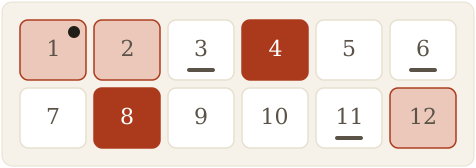
Saturn crosses one sign in about two and a half years, so the cycle through the twelve houses from the Moon sign is about thirty years. The figure above is that strip. Now look at the structure rather than dates; this computation is our own: houses 12, 1, 2 from the Moon are Sade Sati (seven and a half years); then a two-and-a-half-year release in the 3rd; then Kantaka Shani in the 4th (two and a half years); then a seven-and-a-half-year interval through the 5th, 6th and 7th; then Ashtama Shani in the 8th (two and a half years); then seven and a half years through the 9th, 10th and 11th, and the cycle returns to the 12th. In all, twelve and a half of every thirty years pass under some named Saturn state: seven and a half of Sade Sati, two and a half of Kantaka, two and a half of Ashtama. In cadence: Kantaka Shani begins about two and a half years after Sade Sati ends; Ashtama Shani about seven and a half years after Kantaka ends; the next Sade Sati about seven and a half years after Ashtama ends. In vidhata's wording Kantaka comes "seven to eight years before Sade Sati" and Ashtama "four to five years after"; its counting style does not match our structure, so we keep our own computation while recording the source's "roughly". The practical value: if you know when a Sade Sati ran, the dhaiya windows can be seen from this strip, not from guesswork.
A contradiction inside one source
One thing snagged during the audit, and instead of smoothing it over we record it. Point 4 at janamkundlijyotish says that if that 8th house "also happens to be the 12th, 1st or 2nd from the Moon", the transit falls within Sade Sati and the effect is counted double. Counted from one Moon sign, no house can be the 8th and the 12th at once; and that source's own FAQ says the opposite - for the same person a dhaiya and Sade Sati cannot run together, because Saturn is in one sign at a time. The line is probably a leftover of some other counting convention, such as a Lagna-relative count, but as written it is internally inconsistent. The lesson for the reader: when a dhaiya article offers a "double effect" sentence, first ask from which point the count runs; without that answer, hold the claim as suspended.
The Lal Kitab colour
There is a regional layer too. In janamkundlijyotish's compilation, the Lal Kitab calls Saturn in the 8th house "Andha Shani" and counts it among the most veiled placements in a chart; its verdict runs both ways, an indication of long life and also mid-life cautions over sudden financial loss, litigation and hidden ailments; on the family side it mentions the health of an elder brother or uncle. That tradition's remedies are object-based: after sunset, offering flour pellets to fish in running water, pouring mustard oil at a well, feeding roti to a black dog, keeping no empty iron vessel in the house, giving up meat and liquor; and here gemstones are refused, and walking barefoot on Saturday is advised against. Read these as claims of that tradition; none of them carries measured confirmation.
Remedies: the tradition's list, and two warnings
The remedies for a dhaiya are Saturn-centred, so the core list is shared with Sade Sati. The recorded set: Hanuman worship as the first remedy, daily Hanuman Chalisa and Bajrang Baan; japa of the Saturn mantra "Om Praam Preem Praum Sah Shanaishcharaya Namah"; the Dasharatha-krita Shani Stotra on Saturdays; sesame-oil abhishek at a Saturn temple on Saturday; donation of black sesame, mustard oil, urad dal, iron, black cloth and an umbrella, to the old or the poor; feeding crows and black dogs; the Saturday fast, one meal after sunset; and for Ashtama Shani specifically the Mahamrityunjaya japa, alongside regular medical advice. Two warnings from the sources. First, blue sapphire: only after specific examination; most powerful when right, most harmful when wrong; the safe alternative is an iron ring, and never on guesswork. Second, vidhata's explicit view: a dhaiya is a transit and cannot be cancelled; the mitigating factors are different - a strong natal Moon, Saturn well-placed in the chart, Jupiter aspecting the Moon, supportive dasha conditions; a strong 4th lord protects against Kantaka, a strong 8th lord against Ashtama. vidhata calls expensive commercially sold remedies over-reach, and that opinion is its own.
A map of the words: six names, two states
A reader entering this subject passes through six names, and clearing them once is useful. Dhaiya: the period-name, from "two and a half years". Kantaka Shani: the 4th-house state from the Moon, from "thorn"; the literature also spells it kantak. Ardha-ashtam: the second name of that same 4th house in the textual tradition, recorded by janamkundlijyotish; literally "half-ashtama". Ashtama Shani: the 8th-house state from the Moon. Laghu Dhaiya: a synonym of that same 8th state, the "small dhaiya"; the name records that the tradition placed the 8th house too in the dhaiya family. Andha Shani: the Lal Kitab's own name, for the 8th house alone. The unit of counting is one, the house from the Moon; the names belong to three layers: the muhurta-regional layer (Kantaka, Ashtama, ardha-ashtam, Laghu Dhaiya), the popular layer ("dhaiya" alone, which sometimes gets stuck on any Saturn difficulty), and the Lal Kitab layer (Andha Shani). When a reading or an article uses any of these names, the first question is the same: which house from the Moon? The moment that is answered, the naming tangle ends.
Common confusions
First confusion: a dhaiya is a small Sade Sati. No; different houses, different count, different field, different span. Second: Kantaka and Ashtama are names for the same thing. No; the 4th and the 8th hold different fields, and the naming muddle is a popular error. Third: my dhaiya comes from my Sun sign. The sources say Moon sign in one voice; a Sun-sign dhaiya usually turns out wrong. Fourth: Saturn is running, so every difficulty is a dhaiya. janamkundlijyotish itself writes that for most of a life none of the three states is running, and calling every hardship a dhaiya has become commonplace. Fifth: a dhaiya gets cancelled. In vidhata's assessment a transit is not cancelled, it is mitigated. Sixth: under Ashtama Shani japa replaces the doctor. The source itself pairs Mahamrityunjaya with regular medical advice; the remedies are part of the tradition, not an alternative to treatment.
Check it yourself: three steps
The source's method is simple. Step one: know your natal Moon sign, from a chart cast for the birth time, not the newspaper's Sun sign. Step two: see which sign transiting Saturn occupies now. Step three: count houses from the Moon sign to that sign; the 4th gives Kantaka Shani, the 8th Ashtama Shani, and the 12th, 1st or 2nd Sade Sati. Example, from the source's current table: according to janamkundlijyotish Saturn is in Pisces at this time and the next change falls on 2 June 2027; in that state a Sagittarius Moon is under Kantaka Shani, a Leo Moon under Ashtama Shani, and Aries, Pisces and Aquarius Moons under Sade Sati. That table is the source's and will shift with time; in the junction months a retrograde Saturn can return to the previous sign, so check your position from that day's chart. If none of the three applies, Saturn's transit is giving ordinary results - and that is the state that holds for most of a life.
One more check, on duration: "two and a half years" is an average. Saturn's actual stay in a sign lengthens and shortens with its retrograde motion, and in the junction months it can move back and forth across a boundary; that is why the source asks you to check your position from that day's chart in those months, not from a fixed table. The practical meaning: if a reading gives you an exact start and end date of a dhaiya, that date belongs to the chart computation and the ayanamsa it was made with; under a different ayanamsa the boundary can move by days. The caution looks small, but in the junction months it is the real question: whether "my dhaiya has begun" is answered not in a table but in that day's Moon-Saturn count.
Practical use
First, attend to the named fields: home, mother, property and vehicles under Kantaka; health, expenditure and contracts under Ashtama; not postponing matters in exactly those areas is, in the source's words, half the remedy. Second, regularity: every Saturn remedy carries the same recorded condition - daily, on time, sustained over the whole period; not one large ritual. Third, expectation: the 4th-house description also carries suitability for strengthening foundations and long-term investment; read the period in the language of structure, not only of fear. Fourth, financial protection: before any expensive package sold in the name of fear, read this article; the tradition's list is simple, and vidhata explicitly rejects costly remedies.
Sources and an honest note
The definitions, word meanings, field descriptions, current table, Lal Kitab section, remedy list, blue-sapphire warning and the three-step method are from janamkundlijyotish.com's dhaiya guide; the provenance assessment (the names absent from the major classics, later muhurta and regional literature), the Phaladeepika-26 citation, the no-cancellation view and the mitigating factors are from vidhata.app's review; the Muhurat Chintamani chapter 4 favourable list (Saturn in the 3rd, 6th, 11th; vedha 12, 9, 5) we read directly in the translation published at vedicpupil.in. The thirty-year cycle structure, the cadence computation and the catching of the "double effect" line's contradiction are our own. Everything tied to results, from the field descriptions to the remedies, is presented as a claim of the tradition; no measured connection between a dhaiya and an event is established. This article is educational; on health matters a doctor's advice prevails.


