Ketu in Vedic astrology: moksha and detachment
Ketu is the shadow planet of moksha, detachment and intuition. Learn what Ketu is said to take and to give, the Ketu mahadasha, and simple remedies.
In Vedic astrology Ketu is the other end of Rahu: the end of the axis that points not toward the world but beyond it. In the story of the churning of the ocean, where Rahu is the severed head, Ketu is the body: a trunk without a head, which is why Ketu is called "direction without a face". Astronomically Ketu is the south lunar node, the second point where the Moon's orbit crosses the ecliptic. In the tradition Ketu is the karaka of moksha, detachment, spiritual practice, past mastery and intuition. This article explains Ketu in that spirit: what it is said to take away, what it gives, and how its seven-year dasha is viewed.
What is Ketu the karaka of?
In the classical texts and commentaries Ketu is tied to these subjects:
- Moksha and detachment: disengagement from the world, practice, meditation and spiritual orientation.
- Past mastery: the skill that "comes already learned"; the tradition phrases this in the language of past-life impressions.
- Intuition: recognition without reasoning, dream-like understanding, the reading of subtle signs.
- Hidden knowledge: astrology, tantra, research, and the learning that hides behind the lines.
- Separation: in whichever house Ketu sits, a sense of indifference or "already-completeness" in that subject.
- The flag: Ketu is called the symbol of the banner: it shows a direction while itself going nowhere.
Compare with Rahu and the picture clears: Rahu inflates, Ketu reduces; Rahu grasps, Ketu releases. The line between them is the chart's "axis of learning".
The traditions disagree on exaltation
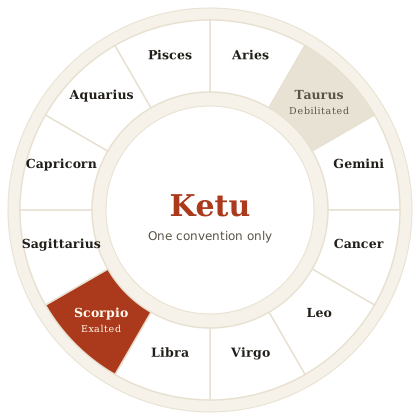
As with Rahu, Ketu's exaltation and debilitation signs are not settled across the traditions, for the same reason: Ketu too is a point of arithmetic, not a physical body. The main views:
| Tradition | Ketu's exaltation | Ketu's debilitation |
|---|---|---|
| One current view | Scorpio | Taurus |
| Another current view | Sagittarius | Gemini |
| On an own sign | Some teachers count Scorpio as Ketu's own home; some, like Rahu, call Ketu a "guest planet" | |
Notice that in both views Ketu's exaltation sign is the same one that view gives as Rahu's debilitation: the ends of the axis always run opposite. We declare neither opinion final. In practical reading Ketu's result, like Rahu's, comes from the house, the sign-lord, the conjunctions and aspects, and the dasha, so the disagreement has limited effect.
What does Ketu take away, and what does it give?
The commonest fear about Ketu is that it "snatches away". Listen to the tradition's language carefully: Ketu reduces craving for a subject, not the subject itself. In the house where Ketu sits, the native either feels the thing came already learned, so no attachment forms, or feels no urge to run in that direction at all. For example, Ketu in the seventh is discussed as indifference toward marriage or an unconventional partner; Ketu in the tenth, as inwardness away from the race for titles. Yet this same Ketu gives remarkable gifts on the other side: depth in research, steadiness in practice, and the ability to see into people. That is why the texts call Ketu the moksha-karaka: the planet that grows the inner direction by trimming the outer race.
Ketu through the twelve houses, in brief
- 1st: a simple, unshowy personality; spiritual leaning, a mild detachment from identity.
- 2nd: reduced greed for money; speech spare but deep, talk of distance from family.
- 3rd: counted a good seat for Ketu; courage and subtle skill, deep study.
- 4th: a bent toward leaving home or changing places often; the mind's peace lies in practice.
- 5th: talent in hidden knowledge; talk of delay or distance in children.
- 6th: a tendency to win while standing apart from the competition; a good seat for Ketu.
- 7th: talk of indifference in marriage or a spiritual partner; a need for freedom within the bond.
- 8th: depth in hidden research; Ketu's strength in a moksha house is discussed.
- 9th: one's own practice and one's own philosophy; talk of a path apart from the teacher's line.
- 10th: indifference to the race for fame; contribution in service or research.
- 11th: chosen friends, contentment in gains; distance from collective ambition.
- 12th: Ketu's famous moksha seat; a bent toward solitude, practice abroad, and pilgrimage.
As with every planet, Ketu's house result also changes with sign, sign-lord, aspects and dasha.
The moksha trikona and Ketu
The twelve houses divide into four trikonas: dharma (1, 5, 9), artha (2, 6, 10), kama (3, 7, 11) and moksha (4, 8, 12). Ketu's nature is held to match the moksha trikona most closely: in the fourth (liberation of the mind), the eighth (liberation of hidden knowledge) and the twelfth (liberation from worldly attachment), Ketu's deep beneficence is discussed. This does not make Ketu bad in other houses; it only means Ketu's essence is "the skill of letting go", and that skill joins naturally with the subjects of these three houses. From this comes the naming of the Ketu pairing as the seeker's combination: where Rahu multiplies worldly bonds, Ketu cuts them.
The Ketu mahadasha: 7 years
In the Vimshottari system the Ketu mahadasha runs 7 years, the same duration as Mars. The tradition views this period as a season of "inner cleaning": old attachments loosen, interest turns from outward to inward. In a strong Ketu's dasha, progress in practice, research and self-knowledge is discussed; in an afflicted Ketu's dasha, there is advice to guard against directionlessness. The lengths below use the schematic 360-day year: 7 × the sub-period lord's years ÷ 120. Calendar dates depend on the calculation settings. The interpretive labels are a symbolic reading, not a schedule of promised events:
| Sub-period | Length | Traditional character |
|---|---|---|
| Ketu-Ketu | 4 months 27 days | The rise of inwardness; old habits come into awareness |
| Ketu-Venus | 1 year 2 months | A test of detachment from ties and comforts; depth in art |
| Ketu-Sun | 4 months 6 days | The process of ego thinning; talk of distance from authority |
| Ketu-Moon | 7 months | The mind's energy turns inward; talk of distance from the mother, or caring for her |
| Ketu-Mars | 4 months 27 days | Sharp decisions, decisions of cutting away; advised caution with risk |
| Ketu-Rahu | 1 year 18 days | Both ends of the axis active; talk of major rises and falls |
| Ketu-Jupiter | 11 months 6 days | Meeting a teacher in practice; detachment balanced by wisdom |
| Ketu-Saturn | 1 year 1 month 9 days | Austerity and discipline; slow but deep change |
| Ketu-Mercury | 11 months 27 days | Hidden knowledge and writing; understanding beyond words |
The same truth once more: Ketu-Venus is talk of detachment from marriage in one chart and depth of artistic practice in another. Ketu's result melts into the shape of its sign-lord and conjunctions; context decides.
Ketu and practice: the practical side
The tradition calls Ketu the planet of meditation, mantra and solitude. In modern language the plain meaning is this: Ketu-strength is the capacity to go so deep into one subject that the world is forgotten. Scientific research, mathematics, linguistics, archaeology, or meditative practice: wherever "holding to one point" is needed, Ketu's symbol is at work. In the age of Rahu this quality is growing rare: the screen age breaks attention, and Ketu's lesson is to join it back. That is why in Ketu's dasha or transit the tradition prescribes simple conduct: a little daily silence, the study of old books, and the weeding of unnecessary possessions.
Ketu and the research-intellect
A less-spoken point: the tradition also calls Ketu the planet of "subtle mathematics", the capacity that sees patterns. Astrology's own computation, the analysis of a language's rules, or hunting down a subject's root text: these are counted as Ketu-natured work. In modern fields its mirror shows in data science, cryptography, research work and the professions where one must look below the surface. This is a tendency-indicator, not an employment guarantee; skill and training hold their own place.
Ketu's auspicious and afflicted indications
Like Rahu's, Ketu's result is read through its sign-lord: if the lord of the sign Ketu occupies is strong, Ketu's fruits are counted as good. In the traditional friendship list Ketu's friends are Venus and Saturn, its enemies the Sun, Moon and Mars, and Mercury and Jupiter are neutral. The traditional expression of an auspicious Ketu: deep concentration, subtle sight, progress in practice, and the ability to read people's intentions. Of an afflicted Ketu: directionlessness, scatter, sudden distance in relationships, and the feeling of not understanding oneself. The traditional health mentions cover nervous restlessness and sleeplessness; remember these are traditional indications, and for any symptom the doctor is the first address.
Story and symbol: what to learn from the trunk
In the churning of the ocean, Swarbhanu's trunk became Ketu. The head (Rahu) got the taste but not the digestion; the trunk (Ketu) has the stomach but not the taste, so Ketu became the symbol of "action without craving". In some depictions Ketu carries a banner: a flag does not move itself, yet it shows a direction. The reference consulted lists Ganesha among Ketu's deity correspondences. One reflective reading, offered here by the author rather than as a scriptural quotation, is: even in a strange form, the remover of obstacles; what looks incomplete may be the very thing that clears the way.
Ketu in transit and in the panchang
Rahu and Ketu always move together, so in transit Ketu stands exactly opposite Rahu. When reading Ketu's position from the birth sign, the tradition counts Ketu as Mars-like and treats its 3rd, 6th and 11th positions as relatively auspicious. Ketu has no separate daily period in the panchang; rahu kaal stands as the daily representative of the whole axis. But eclipse periods belong to both, since eclipses occur at those very node points, and practice during an eclipse is called especially fruitful in the tradition. Ritual practices vary by region and teacher. This article does not establish a universal rule for Ketu fasting, nor does it recommend fasting to alter a chart. A person with a medical condition should ask a clinician before changing food or medicine schedules.
The simple remedies
The tradition's remedies for Ketu's difficult influence:
- Charity: donating sesame, blankets, multi-coloured items, and feeding dogs, especially on Tuesdays or Saturdays.
- Mantra: chanting "Om Kem Ketave Namah"; Ganesha worship is counted as specially tied to Ketu.
- Conduct: the practice of silence, regular time in solitude, clearing old debts, and accepting without pursuit what has fallen away; the tradition calls Ketu's remedy "the practice of releasing".
- Gemstone: cat's eye (lehsunia) is considered Ketu's stone; its astrological effects are not established, and buying one is not necessary.
Keep in mind that remedies are a support within the tradition, not a guaranteed fix. If a mental burden persists, meeting a counsellor or doctor is the first step.
Ketu's lesson for our times
In an age that says "more" to everything, Ketu's symbol is the rare one: it teaches how to say "enough". In the tradition's language, Ketu-strength is the capacity to recognise what is now complete: an old job, an old relationship, an old identity. Its modern form: weeding both your room and your calendar once a year, and before starting anything new asking what you are setting down. Ketu's warning is just as modern: fleeing responsibility in the costume of detachment is not renunciation, it is escape. A balanced Ketu is the one that knows how to release but does not break, like a tree's branch that drops old leaves to make room for new. Recognising this difference is itself Ketu's discernment: carrying what was valuable with patience, and farewelling with gratitude what has finished. That discernment is, by the tradition, Ketu's greatest gift, and it arrives in conduct before any remedy, before any gemstone.
An honest note
Astrology is a traditional system, not laboratory science. The meanings attached to Ketu rest on centuries of symbolism, and as shown above the traditions themselves do not agree on this point's exaltation. Take decisions of mind, money and health with qualified specialists; treat astrology as context, never the only basis. Sources consulted for this article: NASA's explanation of lunar nodes; the correspondence table of day, colour, gemstone and dasha years from satyori.com/reference/grahas/ (which also shows both views on Ketu's exaltation); and the Vimshottari dasha year-table at panchangtime.com/methodology/vimshottari-dasha. Our aim is to explain the tradition in plain words, not to sell fear.
Questions on this article
What is Ketu the karaka of?
Ketu is the karaka of moksha, detachment, practice, intuition, hidden knowledge and past mastery. It is also called the symbol of the banner: showing a direction while going nowhere itself.
In which sign is Ketu exalted?
The traditions disagree: one view says Scorpio, another Sagittarius. In both views Ketu exaltation sign is the same one that view gives as Rahu debilitation sign.
How long does the Ketu mahadasha last?
In the Vimshottari system the Ketu mahadasha lasts 7 years, the same duration as Mars. The tradition views it as a season of inner cleaning and practice.
What are the remedies for a weak Ketu?
Traditional remedies include donating sesame and blankets, feeding dogs, Ganesha worship, the practice of silence, and chanting "Om Kem Ketave Namah". No reliable evidence is provided that wearing this stone changes life outcomes; do not buy it from fear.


