Lagna vs Rashi: Rising Sign and Moon Sign
The horizon and the Moon answer different questions. Learn the terms, reference shifts and limits without inventing a birth chart.
What is your sign? In an Indian astrology conversation, that short question may be asking for your Moon sign, while a chart report may be showing your ascendant. Both answers can be correct because they describe different things. Lagna is the rising reference at the eastern horizon for a time and place. Janma rashi is the sign occupied by the Moon at birth. Rashi by itself also means a zodiacal sign, so the word needs its context. The first step is not choosing which answer sounds more like you. It is naming the object or reference being measured.
This guide distinguishes those terms, explains how they work together in a chart, and shows a hypothetical example without inventing birth data. It also examines a source problem: a flat claim that every lagna lasts two hours versus sources explaining unequal rising times. Our purpose is cultural and technical literacy, not a promise of personality diagnosis or future events. The interpretation belongs to an astrological tradition; the calculation of positions and the scientific support for predictions are separate questions.
Three meanings that should not be compressed into one
In the general vocabulary of the zodiac, a rashi is one of twelve thirty-degree divisions. Mesha, Vrishabha, Mithuna, Karka, Simha, Kanya, Tula, Vrishchika, Dhanu, Makara, Kumbha and Meena correspond to Aries through Pisces. The word does not intrinsically mean Moon. A Sun rashi is the Sun's sign; a Moon rashi is the Moon's sign; a lagna rashi is the sign containing the rising point. The noun supplies the division, while the qualifier tells us what is located there.
In ordinary birth-sign usage, however, rashi often abbreviates janma rashi. Drik Panchang's Janmarashi calculator explicitly defines this as the Moon sign at birth. That is the sense used when this article contrasts lagna with rashi. If a form simply asks for rashi, read its instructions or ask which meaning it expects. Never silently replace a Moon sign with a Sun sign because the English word zodiac appeared nearby.
Lagna here means Udaya Lagna, the eastern rising reference. Drik Panchang's lagna table defines it as the sign rising on the eastern horizon. At greater precision, the ascendant is a point with a longitude, and the rising sign is the sign containing that point. A report may give both a sign and degrees. Keep them together. Knowing the sign does not mean you know the exact degree within it.
A horizon reference is not another moving planet
The Moon is an astronomical body whose zodiacal longitude can be calculated. The ascendant is the intersection of the zodiac's ecliptic with the observer's eastern horizon, not a tenth graha traveling through space. Rajeev Jhanji's The Vedic System of Calculating the Ascendant describes that intersection and the relation between Earth's rotation, the horizon and the zodiac. This distinction explains why a location belongs to the ascendant calculation rather than being an optional decoration on the birth record.
As Earth rotates, different parts of the zodiac reach the eastern horizon. Meanwhile the Moon moves through the zodiac on its own cycle. These are different motions and references. They need not produce the same sign at the same moment. A person having Cancer lagna and Taurus janma rashi is not an inconsistent result. It means Cancer supplies the rising sign while Taurus contains the natal Moon. No competition between the labels is required to explain the difference.
Why the two-hour rule is only a rough guide
The Wikipedia Lagna entry contains both a fixed two-hour description and, elsewhere, an average-of-two-hours description. That difference matters. Dividing a roughly daily circuit into twelve gives a useful rough scale, but it does not establish equal rising durations. Drik Panchang explicitly says that durations differ by location and that even at one location all lagnas do not have the same duration. We keep this disagreement visible rather than copying the convenient fixed rule.
Jhanji's account explains unequal ascension through the inclination of the ecliptic relative to the celestial equator and the observer's latitude. Its tables concern Sayana, or tropical, signs and identify their convention. The Ascendant encyclopedia entry likewise discusses long and short ascension and greater differences away from the equator. These sources support the practical warning, not a universal timetable: do not advance the ascendant by one sign for every exact two-hour block on an ordinary clock.
The Moon's movement is slower on this scale. The Lagna entry gives roughly two and a quarter to two and a half days for a rashi. That is a broad description, not permission to ignore birth time. If the Moon is near a sign boundary, even a much shorter uncertainty can matter. Conversely, a small uncertainty does not automatically change either sign. The actual boundary and the input interval must be checked rather than replaced by a slogan about speed.
Birth data: precision must come from evidence
For a personal chart, preserve the supplied date, local clock time and birthplace. Check how the calculator interprets time zones and any daylight-saving rule relevant to that place and historical date. Do not manually add a correction simply because another report looks different. First establish whether the program expects civil time or an already converted value. Applying the same adjustment twice can create a disagreement that looks astrological but began as a data-entry mistake.
If the recorded time is rounded or remembered, write that limitation. Do not infer an exact minute from someone's face, preferred career or self-description and present it as a documented fact. A practitioner may offer rectification as an interpretive method; that does not turn the resulting estimate into a hospital record. In a study worksheet, an uncertain interval and the possible signs within it are more honest than a precise-looking value whose source cannot be recovered.
Do not use this introduction to calculate your own lagna by mental arithmetic from sunrise. A rising-time table belongs to its stated location, date and settings. Drik Panchang's table also distinguishes local times and dates after midnight. A row crossing midnight must retain its next-day label. The example diagram in this article deliberately contains no clock axis, because a fictional sign comparison should not look like a dated ephemeris or a universal rising schedule.
One zodiac convention must be used for the comparison
The Hindu astrology source describes the primary Jyotisha use of the sidereal zodiac and distinguishes it from the tropical zodiac. Ayanamsa relates those reference systems. Before comparing a lagna from one report with a Moon sign from another, check their zodiac and ayanamsa settings. A sign label without its convention is incomplete information near a boundary. Two programs using different references need not print identical signs.
Nor should a tropical Sun-sign column be treated as though it answered a sidereal janma-rashi question. That mixes both the reference system and the celestial factor. Our next article treats Moon sign versus Sun sign in detail. Here the main lesson is simpler: comparison requires like settings and clearly named factors. It is possible to have three different sign labels without any calculation being inconsistent, because the Sun, Moon and horizon point are different references.
Worked example: Cancer lagna, Taurus Moon
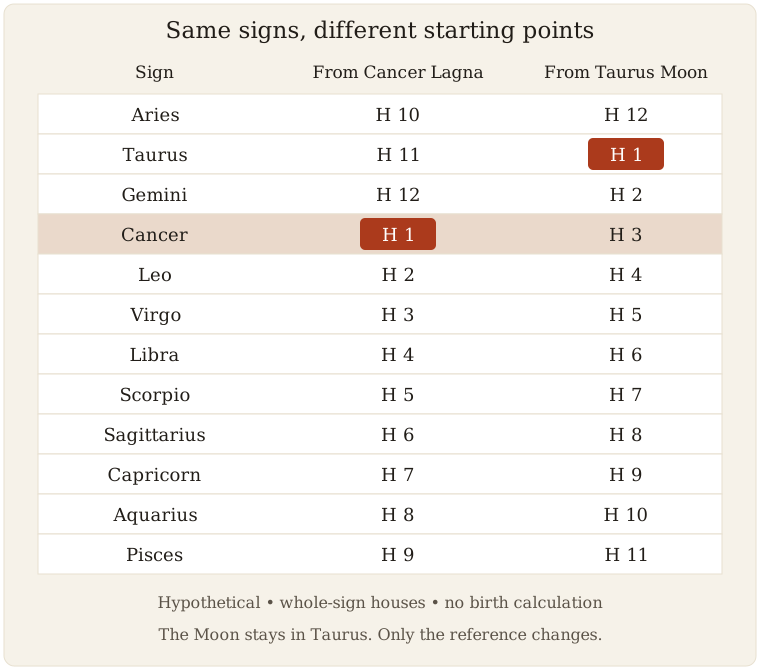
Take a hypothetical whole-sign chart with Cancer rising and the Moon in Taurus. This is a teaching arrangement, not a claim about an actual birth or a calculated sky. Cancer is the first house from lagna. The sequence continues Leo second, Virgo third, Libra fourth, Scorpio fifth, Sagittarius sixth, Capricorn seventh, Aquarius eighth, Pisces ninth, Aries tenth, Taurus eleventh and Gemini twelfth. Therefore the Moon is in the eleventh whole-sign house from lagna in this exercise.
The person's janma rashi in the same exercise is Taurus, because that is where the Moon is placed. It does not become Cancer merely because Cancer is the first house. Nor does Taurus become the first natal house simply because someone asks for the birth sign. The two labels answer different questions: which sign is rising, and which sign contains the Moon? Writing both as a pair prevents a single unqualified rashi field from swallowing that distinction.
Now make a Chandra Lagna view by using Taurus, the Moon's sign, as the reference house one. The Moon remains in Taurus. Cancer is third from Taurus, and Aries is twelfth. The planets have not jumped to new zodiacal longitudes; only the house count's starting point has changed. Our diagram shows the same twelve signs in two aligned columns of house numbers so the change can be checked rather than merely asserted.
Chandra Lagna is a reference shift, not a second birth
The Lagna entry describes Chandra Lagna as counting houses from the Moon's sign. It also attaches a traditional mental perspective to that reference. That symbolism should be attributed to the tradition, not announced as an experimentally established division between mind and body. The useful structural fact is the change of origin. If someone says seventh from the Moon, they are not necessarily describing the seventh from the rising sign.
Label every house claim with its reference when ambiguity is possible. In our exercise Taurus is eleventh from Cancer but first from the Moon; Cancer is first from lagna but third from the Moon. None of these statements contradicts another. A chart reading that moves between these references without announcing the switch can seem to make the numbers change arbitrarily. A careful transcript records the reference before discussing what a house is traditionally taken to signify.
Lagnesh and rashi lord can coincide without merging the terms
In the familiar seven-graha sign rulerships, Cancer's lord is the Moon and Taurus's lord is Venus. Thus the example has Moon as lagnesh, lord of the rising sign, and Venus as janma-rashi lord, lord of the Moon's sign. The Moon can be both the actual body defining janma rashi and the ruler of the ascendant sign. These are two roles. Its ownership of Cancer does not relocate it from Taurus into Cancer.
If lagna and Moon both occupy Cancer in another hypothetical exercise, the two sign labels match and the same sign ruler applies to both. The underlying definitions still differ. Agreement of labels does not create a more authentic sign, a superior person or a guarantee of stronger results. Likewise different labels do not mean internal conflict has been measured. The diagram's arithmetic is a teaching tool; personality stories attached to it remain traditional interpretation.
House systems and chart styles need their own labels
The Bhava source describes whole-sign practice but also Sripathi and Krishnamurti Paddhati's use of Placidus. Our house arithmetic is explicitly whole-sign. It should not be copied unchanged into a separate bhava or chalit chart whose divisions differ. A Moon sign can stay the same while a program assigns the Moon differently in a house display. Read the chart title and division before declaring that one report has moved the Moon incorrectly.
The drawing style is another separate choice. North Indian charts keep houses in fixed positions; South Indian charts keep signs fixed. Those arrangements do not redefine janma rashi or the eastern horizon. A beginner can avoid confusion by making a plain list of sign, longitude, house convention and reference point. Converting a diamond to a grid is a layout operation. Replacing the ascendant reference with the Moon reference is a different operation, and the notes should say which has occurred.
What each reference is traditionally used for
Jyotisha readings often build house discussions around lagna, while Moon-based rashi and nakshatra appear in timing and compatibility traditions. The Hindu astrology source describes the initial Vimshottari period through the natal Moon's nakshatra. That does not mean every dasha system is Moon-based or that knowing the Moon sign alone supplies a complete dasha calculation. A nakshatra and the position within it carry more information than the broad thirty-degree rashi label.
The Lagna entry makes several strong claims about personality and includes a numerical matchmaking split without establishing a universal standard. We do not turn those claims into facts about people or a scoring rule. A terminology guide does not need them to explain the difference between horizon and Moon. Similarly, a name-based rashi link on a calculator is not proof that an unknown astronomical Moon position has been recovered. Naming convention and a computed birth placement must retain their different provenance.
A short comparison checklist
First ask what rashi means in this conversation. Then record the rising sign and Moon sign separately, including degrees when available. Verify date, time, place and zodiac settings before comparing outputs. State the house system and whether a house count begins from lagna or the Moon. Keep unknown birth data unknown. Finally separate a placement statement from any personality or future claim. These steps are our editorial checklist for avoiding category mistakes, not a classical formula or a prediction technique.
For a discrepancy, collect the two original reports and their settings rather than combining their most attractive descriptions. If the missing input cannot be recovered, say what remains uncertain. Someone need not be assigned a single definitive astrological identity to be understood. The terms are tools within a tradition, not replacements for listening to the person and looking at the facts of their life.
The evidence boundary
Berkeley's Understanding Science explains that careful tests of specific astrological expectations did not support their validity, while vague expectations can be made to fit many outcomes. A correct ascendant calculation is not evidence that its sign determines character. A correctly identified Moon sign is not evidence that it forecasts a relationship. Respectful cultural study can preserve these definitions without endorsing predictive certainty. For health, money or marriage decisions, use qualified advice, real evidence and consent rather than treating either label as a verdict.
Questions on this article
Are lagna and rashi the same?
Not necessarily. Here lagna is the eastern rising reference and janma rashi is the natal Moon sign. Rashi alone also means a zodiacal sign, so context matters.
Does lagna change every exact two hours?
No. Two hours is a rough average, not a fixed duration. Rising times differ by location and sign. Use the relevant calculation and declared settings.
What changes in Chandra Lagna?
The Moon sign becomes house one for that reference. The Moon does not move to another zodiacal sign. House numbers change because the starting point changes.
Can a name-based sign replace a calculated Moon sign?
Do not treat them as identical evidence. A naming convention and a position calculated from birth data have different provenance. Keep unknown birth information uncertain.


