Leo (Simha): The Throne of the Zodiac
Simha is the fixed fire that does not flare and die but holds: the Sun’s own sign, and a radiance the world cannot stop, though it bows before its own root. From the classical verse to the modern sign profile, the art of sovereignty and the challenge of praise-hunger, with sources, and with an honest-limits note.
The tide has carried us to open ground, and there the light stands alone. The fifth sign of the zodiac, Simha, is that light: thirty degrees of fixed fire, the lion that does not hunt from desperation but from nature, and the sign Satyori’s Simha guide describes as the place where the soul says I am with full authority. This article audits that radiance in full: the sign’s structure, the classical verse on a Leo Moon, the ruling luminary and a telling absence of exaltation, the traditional tendencies in personality, career, relationships and health, and at the end an honest-limits note.
Everything below comes from sources fetched on 31 October 2026: Satyori’s Simha rashi guide, the seventeenth chapter of the Brihat Jataka available at VedicPupil (which we read directly, in that page’s English translation), Wikipedia’s Leo article for the tropical-sidereal difference and the lion’s mythology, and PanchangTime’s Vimshottari dasha guide for the Sun’s period. Where a tendency belongs to a source, the source is named; where a note is ours, it is marked. Sign description is the tradition’s framework; we give it as description, not as diagnosis.
The fifth cell: the structure
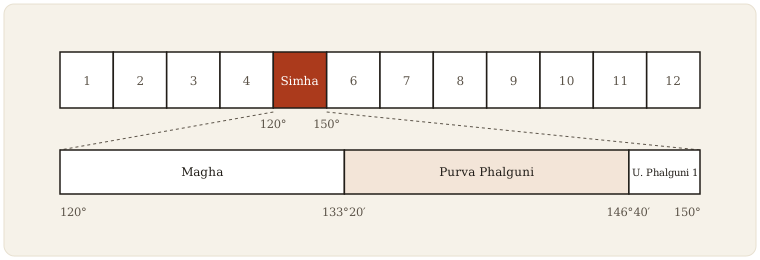
Per Satyori, Simha is the fifth sign of the zodiac, spanning 120 to 150 degrees. Its symbol is the lion, and that page reads the symbol precisely: the lion does not hunt out of desperation but out of its nature as king of the jungle, a regal quality that pervades everything Simha touches. Its element is fire, its character sthira, fixed, and it is classed in the masculine group. The ruling graha is the Sun, and the page marks what that means: Simha is the only rashi with a luminary as sole ruler. In the Vedic tradition of the Kalapurusha, the cosmic person of time across whose body the twelve signs are laid, Simha is the upper stomach and spine: the seat that digests experience and holds the body upright. Being a fixed fire sign means the fire does not spark and pass; it sustains, a steady radiance rather than a flame that leaps. Where Mesha’s cardinal fire begins, Simha’s fixed fire reigns.
Simha holds three nakshatra segments: all of Magha, all of Purva Phalguni, and the first pada of Uttara Phalguni. Each nakshatra in the zodiac spans 13 degrees 20 minutes, so Magha runs from 120 to 133:20, Purva Phalguni from there to 146:40, and Uttara Phalguni’s first quarter from 146:40 to 150; this follows the standard nakshatra division. Two Simha natives can therefore belong to different nakshatras within the same sign, and in Jyotish the nakshatra carries its own weight. This site carries a separate guide for each of the twenty-seven nakshatras, including Magha, Purva Phalguni and Uttara Phalguni; here it is enough that the sign sets the frame and the nakshatra paints the finer shade within it.
One more boundary line matters: in Indian usage ‘rashi’ usually means the Moon sign, the sign the Moon occupied at the moment of birth. The classical chapter we quote below is titled exactly that, Chandra-rashi-sheel, the characters of the Moon signs. For Simha this carries a pleasant irony: the chapter belongs to the Moon, and this verse describes what the Moon becomes in the Sun’s house. A chart also has a lagna, the sign on the rising horizon, and a Sun sign; the three signify different things. And Satyori adds in one line that the condition of the Sun in the chart strongly influences how Simha expresses in a life. The sign, in other words, is one axis, not the whole picture.
Simha and Leo: two scales, one sky
In Western astrology Leo is the same fifth sign: the lion, the fire element, the fixed quality, the Sun as ruler; per Wikipedia’s table, in the tropical system the Sun transits it from 22 July to 23 August in 2026. But the tropical zodiac is bound to the equinox point, while the Vedic sidereal zodiac is bound to the stars. Satyori states the gap between them as an ayanamsha of about 24 degrees. The practical result: a person whose Western sun sign is Leo may have Simha as the Vedic rashi, or may have Karka; it is not the date that changes but the scale. This article speaks of Vedic Simha, and for date boundaries rely on your own panchang or chart calculation.
The lion’s mythology is a king’s mythology. Per Wikipedia, in the Greek telling Zeus placed this constellation in the sky to commemorate his son Heracles’ first labour, the defeat of the Nemean lion, the beast whose hide no weapon could pierce. The pattern repeats what we have seen in this series: the ram carried a golden fleece, the bull ruled heaven in the Bronze Age, the twins split immortality, the crab apologized for existing, and now the lion arrives as the enemy worthy of a hero’s first labour. The sky’s fifth station has always been a throne, contested or not. Satyori’s reading of the same figure stays closer to temperament: sovereignty, creative power, self-expression, and the fifth house’s association with children, intelligence and the fruits of past merit.
What the classical text says: the Brihat Jataka’s Leo Moon
Varahamihira’s Brihat Jataka is among the root texts of Jyotish, and we read its seventeenth chapter, Chandra-rashi-sheel, directly on VedicPupil’s page, in that page’s own English translation of the Sanskrit. The chapter gives each sign’s result when the Moon stands in it. The Leo verse, 17.5, in that translation: sharp, with a heavy jaw, a broad face and tawny eyes, few children, averse to women, fond of meat, forests and hills, angry for a long time over a trifle; troubled by hunger, thirst and ailments of the belly, teeth and mind; generous, valiant, steady-minded, very proud, obedient to his mother. The page’s own simple meaning: strong-willed, proud, brave and generous; anger can linger; health needs care.
This verse carries two of the translator’s honest flags, and we keep both flying. Where the translation says ‘over a trifle’, the page notes an alternative reading, over a wrong. And where it says ‘thirst’, the translator records that the text reads trina while trit, thirst, is the expected reading, another doubtful syllable marked rather than smoothed over. The verse’s closing note deserves its own sentence: after the pride, the valour and the long anger, the last word is obedience to the mother. The classical style mixes body, temper and fortune without sorting them, and we have kept them unsorted.
The seventeenth chapter’s thirteenth verse sets the condition that applies to every sign: the stated qualities come fully only when the Moon is strong and the sign’s lord is strong; otherwise the indications require further consideration. In plain words, the text itself says a sign reading is a general sketch, not a verdict on any one birth chart. The tradition’s own caution remains as precise today.
One more detail from the page gives context: the Brihat Jataka is a work of 409 verses in 28 chapters, and the seventeenth chapter gives the Moon-sign results for all twelve signs, one verse each; the English we read is VedicPupil’s own translation. It is useful to know how compressed the classical description is: some twenty traits in a single verse, without commentary. A modern sign guide, such as Satyori’s, unfolds those same seeds into the context of present-day life; the two are best read with one eye, the seed from the text, the growth from today’s commentary.
The ruling luminary: the Sun on its own throne
The Sun is Simha’s lord, and per Satyori the sign embodies what the Sun stands for here: self-expression, sovereignty and creative power. The page’s psychology of rulership is unusually direct: the need for recognition is real and should not be dismissed as mere vanity, because the Sun needs to be seen to fulfill its function. If Karka’s Moon rules by reflecting, Simha’s Sun rules by radiating; the two luminaries divide the sky between them, each with exactly one sign to govern. The Sun has its place in the timing tradition too. Per PanchangTime’s Vimshottari dasha guide, the Sun mahadasha runs 6 years within the 120-year Vimshottari cycle, the shortest planetary period in that cycle; when a Simha native’s Sun period runs, the sign’s own light governs that stretch. This too is description, not prediction.
On exaltation and debilitation, Simha’s entry in Satyori’s quick facts is the quietest in the zodiac: no planet is recorded as traditionally exalted here, and none as traditionally debilitated here. After the crowded ledgers of the earlier signs, the empty throne-room is itself information: the tradition leaves the Sun’s own house to the Sun alone. We record the absence as the source states it, scoped to that page’s tables; whether other traditions assign shadow points here is a question for their own texts, not one this article settles.
Personality, career, relationships: the traditional tendencies
The traditional personality description, per Satyori’s Simha profile: a natural magnetism that draws others into their orbit; generous, warm-hearted, genuinely enjoying uplifting those around them. Loyalty is named paramount, and lavishly rewarded. The same page names the shadow without flinching: arrogance, an inability to accept criticism, or demanding special treatment, and it frames the fork honestly, that healthy confidence inspires others while distorted confidence becomes ego-driven pride. The classical verse’s ‘very proud, generous, valiant’ becomes, here, the same metal in a modern forge: what the tradition praised as sovereignty it also warned could curdle, fourteen centuries before the profile said so.
For career, Satyori’s list follows the visibility pathway: politics, entertainment, executive management, education and creative direction; government service, performing arts, luxury branding and high-level consulting. The reasoning matters more than the list: Simha thrives in positions of authority where it can set vision and inspire, and struggles in subordinate roles unless it respects the superior, for, in that page’s words, Simha cannot perform for a leader it does not believe in. The same page adds the tradition’s own hedge, that career outcomes depend on the tenth-house lord, planetary periods and overall chart strength; a sign preference is not an employment forecast.
In relationships, per the same profile, Simha natives are romantic, loyal and generous, courting with grand gestures, and they need admiration and appreciation expressed regularly. The profile names the weak joint plainly: pride can make this sign slow to apologize even when it knows it is wrong. It also names the keys both ways: genuine respect and appreciation unlock Simha’s extraordinary warmth and protectiveness, while public humiliation or undermining loses the Simha partner permanently. The classical ‘obedient to his mother’ becomes, here, the same truth domesticated: this sign’s loyalty is real, but it is given upward to what it respects. We give that reading in the source’s name; whether it fits any one person is that person’s own testimony.
Health: the traditional reading
Per Satyori, Simha’s primary areas are the heart, spine, upper back and circulatory system, with susceptibility toward heart conditions, blood-pressure issues and spinal problems; the page notes that this sign’s strong constitution can mask developing conditions because it pushes through discomfort out of pride, and that it tends to run hot, with pitta imbalances, inflammation and overheating common, so regular cardiovascular care and stress management protect its greatest vulnerability, the heart. Its dosha note ties the sign to pitta affinity through the fire element and the Sun’s hot, penetrating nature, and suggests sweet and bitter foods that cool without depleting, moderate exercise in cool environments, and practices that soften intensity without extinguishing the essential fire. All of this is that source’s Ayurvedic framing, which we have given in its name; this article offers no medical advice, and for any symptom the doctor is the authority. If you are pregnant, ill, elderly or on medication, any regimen the tradition mentions is not for you without a doctor’s word.
The honest limits
Sign description is the tradition’s framework, not measured psychology. Everything above is what the texts and one modern guide say about Simha, recorded with their names and their dates; it is not what we measured in any person. The Brihat Jataka itself conditions every result on the strength of the Moon and the sign lord; Satyori itself conditions career on the rest of the chart. A rashi is one thread of a chart and no thread of your worth. Do not measure anyone else by their sign, and do not pour yourself into one either; being Simha is not being only this.
Keep one practical test as well: if some description in this article does not fit you at all, that is no fault of yours and none of the tradition’s; the text laid down beforehand that these portraits are general. And if a description does fit, do not make it your ceiling; the most important part of the lion’s story is that sovereignty over oneself is trained, not inherited, and training, like every skill, comes by practice, not by sign.
Questions on this article
What is the difference between Simha and Leo?
They are two names for the zodiac’s fifth 30 degrees: Simha in the Vedic (sidereal) tradition and Leo in the Western (tropical) one. The difference is that the tropical zodiac is tied to the equinox point and the sidereal to the stars; an ayanamsha gap of about 24 degrees separates them, so your Western sun sign and your Vedic rashi can differ. Per Wikipedia, the Sun transits tropical Leo from 22 July to 23 August in 2026; Vedic Simha is computed from the panchang.
Why does Simha have no exalted or debilitated planet?
Satyori’s exaltation-debilitation table carries no entry for Simha: no planet is exalted here and none debilitated. One reading within the tradition is that where the householder is itself the sole luminary, the question of any guest planet’s exaltation does not arise; the Sun’s own house is complete in itself. This absence too is a statement of the tradition, not an error in the table.
Are Leo people really arrogant?
The tradition names arrogance as this sign’s test, not its identity. The Brihat Jataka’s Leo-Moon verse calls the same native generous, heroic and free of delusion as well as fond of flatterers, angry and obedient to his mother; the text does not spare its own hero. And the text itself (17.13) says these marks hold fully only when no other planet in the chart affects that sign. Do not mould or measure any person by their sign.
Is reading personality from a sign scientifically established?
No, and this article makes no such claim. Sign description is the framework of the Jyotish tradition, carried through texts and practising astrologers over centuries; we present it as exactly that, with sources. Do not treat it as a substitute for psychology or medicine; as a way of reflecting on oneself it can be a cultural mirror, not a measuring instrument.


