Libra (Tula): The Scales of the Zodiac
Tula is the cardinal air that starts by asking: Venus’s sign, where the judge rises exalted and the king steps down. From the classical verse to the modern sign profile, the art of harmony and the challenge of indecision, with sources, and with an honest-limits note.
After the throne and the workbench comes the marketplace, where two people must agree. The seventh sign, Tula, is thirty degrees of cardinal air, the scales of the zodiac, and the sign that sits directly opposite Mesha, marking the transition from self to other. Satyori's Tula guide draws the arc plainly: if the first six rashis develop the individual, Tula begins the journey of relationship, partnership and social harmony. This article audits those scales in full: the sign's structure, the classical verse on a Libra Moon, a ruler with an exaltation and a fall that argue the sign's whole thesis, the traditional tendencies in personality, career, relationships and health, and at the end an honest-limits note.
Everything below comes from sources fetched on 31 October 2026: Satyori's Tula rashi guide, the seventeenth chapter of the Brihat Jataka as published at VedicPupil, which we read directly in that page's English translation, Wikipedia's Libra article for the tropical-sidereal gap and the scales' long history, and Panchangtime's Vimshottari dasha guide for Venus's period. Where a claim belongs to one of them, we say so; where a note is ours, we mark it. Sign description is the tradition's framework; we give it as description, not diagnosis.
The seventh cell: the structure
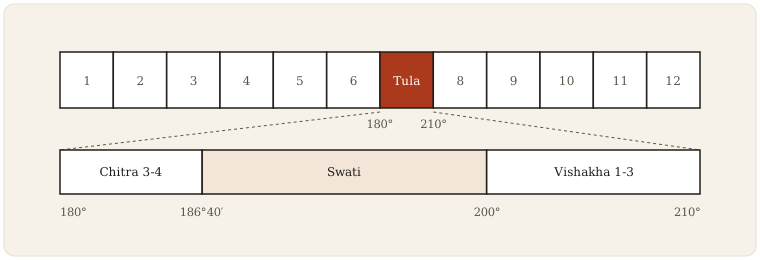
Tula is the seventh sign of the zodiac, from 180 to 210 degrees. Its symbol is the scales, and the Satyori page reads the symbol precisely: the scales represent the constant weighing of perspectives, the desire to find the equilibrium point in every situation, which makes Tula the natural sign of justice, partnership and social grace. Its element is air, its character Chara, cardinal, and its ruler is Venus; a cardinal air sign initiates through connection and negotiation. In the Vedic mapping of the Kalapurusha, the cosmic person of time across whose body the twelve signs lie, Tula is the lower abdomen and the reproductive organs: the part made for joining. Where Mesha's cardinal fire starts by striking, Tula's cardinal air starts by asking.
Three nakshatra segments fall within Tula: the third and fourth padas of Chitra, all of Swati, and the first three padas of Vishakha. Each nakshatra spans 13 degrees 20 minutes of the zodiac, so Chitra's closing half runs from 180 to 186 degrees 40 minutes, Swati from there to 200, and Vishakha's first three quarters to 210; the arithmetic is ours from the standard nakshatra division. So two people both called Tula may carry different nakshatras inside the same rashi, and the nakshatra has its own weight in a reading. This collection carries detailed introductions to all twenty-seven nakshatras, including Chitra, Swati and Vishakha; here it is enough that the rashi sets the frame and the nakshatra the finer shading within it.
One more boundary line matters. In Indian usage the word rashi usually means the Moon sign, the sign the Moon occupied at the birth moment. The classical chapter we quote below is titled exactly that, Chandrarashishila, the natures of the Moon signs. For Tula there is a particular charge in this: the sign of the other, read through the planet of the inner life. A chart also holds the lagna, the sign rising on the horizon, and the Sun's sign; the three carry different significations. And Satyori adds in its own line that the condition of Venus in your chart strongly influences how Tula expresses in your life. A rashi is one axis, not the whole picture.
Tula and Libra: two scales, one sky
In Western astrology Libra is the same seventh sign: the scales, the air element, the cardinal quality, Venus as ruler; per Wikipedia's table, the Sun transits tropical Libra from 23 September to 23 October in 2026, and between 24 September and 23 October on average. But the tropical zodiac is tied to the equinox point, while the Vedic sidereal zodiac is tied to the stars. Satyori puts the ayanamsha gap between them at about 24 degrees. The practical result: a person whose Western sun sign is Libra may have Tula as their Vedic rashi, or Kanya; it is not the date that changes but the scale. This article speaks of the Vedic Tula, and for date boundaries rely on your own panchang or chart calculation.
The scales are the zodiac's only inanimate symbol; per Wikipedia, the other eleven signs are all animals or mythological figures. Yet this object carries a crowded history. The symbol is based on the Scales of Justice held by Themis, the Greek personification of divine law, who became the inspiration for modern Lady Justice; Roman tradition tied the sign to Iustitia, and the writer Manilius declared that judges are born under Libra, calling it the sign in which the seasons are balanced, for the September equinox makes the hours of day and night equal. The Romans even held that the Moon was in Libra when Rome was founded. And the Greeks had an older name for these stars: chelae, the claws, because the constellation was once counted as the scorpion's own claws before it was weighed free. An object among animals, then, but an object with a past: first a predator's grip, then a goddess's measure, then an empire's horoscope.
The classical Libra Moon: Brihat Jataka
Varahamihira's Brihat Jataka, a mid-first-millennium Jyotish text, devotes its seventeenth chapter to the natures of the Moon signs, and its line for the seventh sign reads: devoted to the worship of gods, Brahmins and holy people, wise, pure, ruled by women, tall, with a high nose, a lean and restless body, a wanderer, wealthy; with a defective limb, skilled in buying and selling, having two names, prone to illness, a helper of his relatives, yet made angry and left by them.
In plain terms: this is the merchant-devotee, and the verse gives the sign of harmony a discordant spine. It opens in temple and ends in exile: the native who helps his relatives is in the last breath angered and abandoned by them. Between those poles the marks keep pairing opposites: pure and devout, yet ruled by women, strijita, a word the tradition reads both as henpecked and as devoted to women; wealthy, yet a wanderer; skilled in trade, yet carrying a defective limb and a prone-to-illness body. One phrase the translation itself flags as an unclear reading, rendered "having two names"; as with the textual notes this series has kept visible in earlier signs, we keep the flag flying rather than smooth it. What holds the verse together is its fit with the scales: a nature made of weighed opposites, devotion against dependence, giving against abandonment.
The same chapter already holds the most useful hedge inside itself, the one we have quoted before in this series: verse 17.13, which says these twelve Moon-sign natures hold when no other planet or condition in the chart affects that sign; otherwise the marks change. The tradition said first that its portraits are not verdicts. The twelve Moon-sign verses are twenty-eight lines among the chapter's four hundred and nine; that says how old these figures are, and also how much else the book contains.
The ruler, the judge and the fallen king
Tula's ruler is Venus, and the exaltation table argues the sign's thesis twice over. Per Satyori's Tula guide, Saturn is exalted here at 20 degrees, because justice, impartiality and the patient weighing of evidence are Saturn's highest expression: the planet of slow consequence finds its best seat in the sign of the scales. And the Sun is debilitated here at 10 degrees, with the reason given in temperament: Tula requires compromise and consideration of others, and the Sun's self-centered radiance is dampened when it must share the stage and subordinate individual will to the needs of partnership. Read the two together and the sign declares itself: here the judge rises and the king steps down. Per Panchangtime's Vimshottari table, Venus's mahadasha runs 20 years, the longest of all, set against the Sun's 6, the Moon's 10, Mars's 7, Mercury's 17 and Jupiter's 16: the sign of patience gets the longest period.
One more contrast belongs to the ruler himself. Venus rules two signs, Tula and Vrishabha, and the two show his two faces: in the earlier article of this series we met the fixed-earth Venus of Taurus, the pleasure that holds and accumulates; here the cardinal-air Venus of Libra is the pleasure that relates and refines. The same planet, the same love of beauty, turned in one sign toward the body and in the other toward the bond. The tradition keeps both under one lord, and the exaltation table marks the difference: in Taurus it was the Moon who rose to exaltation, a guest of feeling; in Tula it is Saturn, a guest of judgement.
Temperament, work and relationships: the tradition's map
The descriptive tradition seats Tula at the negotiating table, and names the price of sitting there. Satyori's traits: charming, fair-minded and socially aware, with a genuine desire to create harmony; skilled negotiators who instinctively understand how to make different people feel heard and valued. Their challenge is decisiveness: seeing all sides of every issue can lead to chronic indecision and people-pleasing, and they may sacrifice their own needs to maintain peace, building resentment beneath a pleasant exterior. In careers the descriptive tradition places them in law, diplomacy, fashion, interior design, counseling, mediation and the arts; they make outstanding judges, designers, art directors and relationship therapists, and perform best in collaborative environments, struggling in cutthroat, winner-take-all cultures that violate their sense of fairness. Satyori's own hedge stands here too: career outcomes depend on the tenth-house lord, planetary periods and overall chart strength.
Relationships are this sign's central theme. Satyori's account: Tula natives genuinely flourish in partnership and often feel incomplete when single; they are attentive, romantic and skilled at creating beautiful shared experiences. Their tendency to avoid conflict can be destructive if important issues go unaddressed for the sake of surface harmony, and they need partners who can engage in honest, respectful disagreement and who value the partnership as much as Tula does. The classical verse had already given this sign its sharpest sketch from the far end: the native who helps his relatives, made angry and left by them. Harmony purchased by silence, the tradition says from both directions, is a debt that comes due.
On health the descriptive tradition ties Tula to the kidneys, the lower back and the skin, with tendencies toward kidney and urinary conditions, lower back pain and skin sensitivities; Satyori adds that suppressed conflict can manifest as physical tension in the lower back and hips, and recommends adequate water intake and practices that support honest self-expression. Its dosha note gives Tula a vata affinity through the air element, combined with Venus's tendency toward sweetness and comfort that can tip toward kapha, a constitution that can swing between vata dryness and kapha congestion, and suggests warm, moderately spiced foods, consistent daily routines and creative outlets. All of this is that source's Ayurvedic framing, given in its name; this article offers no medical advice, and for any symptom the doctor is the authority. If you are pregnant, ill, elderly or on medication, any regimen the tradition mentions is not for you without a doctor's word.
The honest limits
Sign description is the tradition's framework, not measured psychology. Everything above is what the texts and one modern guide say about Tula, recorded with their names and their dates; it is not what we measured in any person. The Brihat Jataka itself conditions every mark on the rest of the chart not disturbing the sign, and Satyori itself conditions career on the tenth lord and the dashas. A rashi is one thread of a chart and no thread of your worth. Do not measure anyone else by their sign, and do not pour yourself into one either; being Tula is not being only this.
Keep one practical test as well: if some description here does not fit you at all, that is no fault of yours and none of the tradition's; the text laid down beforehand that these portraits are general. And if a description does fit, do not make it your ceiling; the most important thing about scales is that they move, and balance is something a person does, not something a sign is, achieved by practice, not by birth.
Short answers
What is the difference between Tula and Libra? A matter of scale: Vedic sidereal Tula is tied to the stars, tropical Libra to the equinox, and a gap of about 24 degrees separates them; one birth date can therefore fall in different signs in the two systems. Why is Saturn exalted and the Sun debilitated here? Per Satyori's reasoning, the patient weighing of evidence is Saturn's highest expression, while the Sun's individual radiance is dampened when it must share the stage; the tradition's internal logic, not a physical measurement. Are Libra people really indecisive? The tradition frames indecision as the cost of seeing all sides, and the classical verse gives the same native decisiveness of another kind: skilled in buying and selling. Is reading personality from a sign scientific? No; it is the tradition's descriptive framework, presented here as exactly that, with sources.
Questions on this article
What is the difference between Tula and Libra?
They are two names for the zodiac’s seventh 30 degrees: Tula in the Vedic (sidereal) tradition and Libra in the Western (tropical) one. The difference is that the tropical zodiac is tied to the equinox point and the sidereal to the stars; an ayanamsha gap of about 24 degrees separates them, so your Western sun sign and your Vedic rashi can differ. Per Wikipedia, the Sun transits tropical Libra from 23 September to 23 October in 2026; Vedic Tula is computed from the panchang.
Why is Saturn exalted and the Sun debilitated in Tula?
Per Satyori’s Tula guide, the reasoning is temperamental: justice, impartiality and the patient weighing of evidence are Saturn’s highest expression, so Saturn is exalted here at 20 degrees; and Tula requires compromise and consideration of others, while the Sun’s self-centered radiance is dampened when it must share the stage, so it is debilitated here at 10 degrees. This is the tradition’s internal logic, not a physical measurement.
Are Libra people really indecisive?
The tradition frames indecision as the cost of seeing all sides: per Satyori, the same gift makes the negotiator, and its shadow is people-pleasing. The Brihat Jataka’s Libra-Moon verse calls the same native skilled in buying and selling, wise and a helper of relatives. And the text itself (17.13) says these marks change with the rest of the chart. Do not mould or measure any person by their sign.
Is reading personality from a sign scientifically established?
No, and this article makes no such claim. Sign description is the framework of the Jyotish tradition, carried through texts and practising astrologers over centuries; we present it as exactly that, with sources. Do not treat it as a substitute for psychology or medicine; as a way of reflecting on oneself it can be a cultural mirror, not a measuring instrument.