Love Marriage Yogas: Fifth and Seventh Links, With Limits
A chart connection is not a partner’s decision. Understand the rules, the disagreements and what they cannot establish.
A love-marriage yoga is a name used by astrologers for a chart pattern they associate with a self-chosen relationship becoming marriage. It is not an independently established prediction of whom you will love, whether a family will agree or what your partner will decide. Read the pattern as a traditional interpretation, with its method and uncertainty visible. A person's wishes and actual conduct remain more important than a label on a chart.
This guide explains a frequently repeated fifth-house and seventh-house connection, then examines disagreements between modern practitioner pages. It does not read a real person's birth data. Its examples are deliberately synthetic. We consulted the linked modern pages themselves, not a Sanskrit edition proving the historical origin of every rule. A website calling something classical does not by itself establish which text first stated it or whether the rule has been tested.
First separate the questions people put into one label
Who introduces a couple, whether affection develops, whether they choose to marry and whether the relationship remains safe are different questions. A family introduction can lead to a freely chosen relationship. Two people can meet independently and later welcome their families' participation. Some people do not want marriage at all. Neither a chart nor the phrases love marriage and arranged marriage should erase those possibilities or rank one route as automatically superior.
The practitioner pages use these labels differently. One discusses the route into marriage; another allows a family-arranged marriage to count as personal love because of an asserted past-life tie. Those are not identical definitions of an outcome. Before comparing predictions, ask what the author means by the category. If a definition can be changed after the wedding to fit either story, it is harder to test than a clearly recorded expectation.
Why the fifth and seventh are discussed together
The JagannathHora website article uses the fifth for romance and the seventh for the marital bond. It names whole-sign houses, Parashari interpretation, Lahiri ayanamsa and Vimshottari dasha as its conventions. We identify this as a website source; sharing a familiar software name does not establish an affiliation with a desktop program. Its descriptions of what different placements produce remain the author's claims.
Astromitra's page also centers the fifth and seventh lords, meaning the planets assigned rulership of the signs occupying those houses. This is different from asking which planets happen to sit inside the houses. A house can be empty and still have a ruler under the chosen system. Keeping sign, house, lord and occupant in separate columns prevents several ordinary reading mistakes before any interpretation begins.
Four connections, not four measured success rates
The consulted explanations commonly discuss exchange, one lord occupying the other house, conjunction and aspect. An exchange means the fifth lord is in the seventh and the seventh lord is in the fifth. One-way occupation does not become an exchange just because the paragraph sounds emphatic. A conjunction places the two planets together under a stated convention. An aspect is a relationship defined by the aspect system, not simply any line someone can draw between symbols.
Record exactly which connection is being claimed. If a report says mutual aspect, check both directions rather than assuming a one-way special aspect is reciprocal. If it says conjunction, ask whether it means the same sign or a specified angular distance. Different definitions may produce different lists. Terms such as strongest and mildest on the practitioner pages are interpretive rankings. They are not measured probabilities and should not be turned into percentages of marriage success.
A small whole-sign example you can check
Take a fictional Aries ascendant in the ordinary seven-planet sign-rulership scheme. Counting Aries as the first house makes Leo the fifth and Libra the seventh. Their lords are the Sun and Venus. If we stipulate the Sun in Libra and Venus in Leo, the fifth lord occupies the seventh and the seventh lord occupies the fifth. That is the exchange structure. No birth date, planetary ephemeris or real person's relationship is being calculated here.
The example deliberately says stipulate. It is a diagram of a rule, not a claim that a physically possible full sky has been found for a named moment. A schematic arrangement must not silently become a real natal chart; physical realizability and a full ephemeris have not been checked for this teaching example. The only result established here is how the stated house labels and rulers connect. It establishes neither a future wedding nor an existing partner's consent.
Check a source's same-lord claim instead of copying it
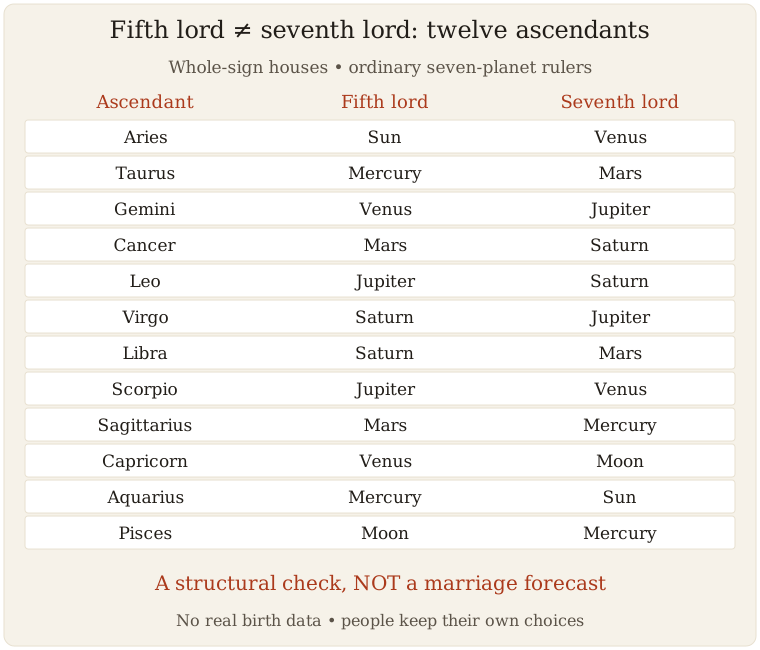
Astromitra's exchange row adds the possibility that one planet rules both houses. The JagannathHora page explicitly says this does not happen for fifth and seventh in its whole-sign scheme. We checked the ordinary rulership mapping for all twelve ascendants: the fifth and seventh lords are different in every case. The relevant signs are two signs apart, while the two signs assigned to any dual-sign ruler do not form that pair in this scheme.
This is a narrow arithmetic correction, not a verdict on everything either site says. A source could be using another reference or an unstated convention, but the consulted row does not explain one. We therefore retain the discrepancy rather than inventing a reconciliation. The diagram lists the twelve pairs so the claim is inspectable. A clear error in a structural explanation is a reason to check the method before relying on its confident outcome language.
Venus alone: the consulted pages do not say the same thing
The JagannathHora page calls Venus in the fifth or seventh a love-marriage indicator on its own. Turia's calculator explanation says Venus alone is not sufficient and requires support from house-lord connections. These positions are materially different. Do not smooth them into a universal rule saying all practitioners agree. A reader should be able to see whether the report follows a single-placement rule or requires a structural connection.
Both pages also use words such as reliable and strong without supplying, in the consulted explanation, a separately checked outcome study establishing that level of predictive performance. We do not convert those descriptions into evidence. Nor do we adopt a promise that a strong Venus proves a person's feelings. Interest, affection and willingness to commit need communication with the person concerned, not an inference that lets someone speak for them.
Rahu is not a certificate of a partner's identity
The sources associate Rahu with departure from expected social patterns, sometimes mentioning caste, religion, nationality or family expectations. These are their interpretive associations, not a reliable method of identifying a stranger's background. We do not classify people as unsuitable because of community or religion, and we do not claim that a lunar node reveals a future spouse's identity. A relationship across social boundaries is not itself evidence of danger, deception or a defect.
One practical distinction matters: a family may have expectations, while the couple may have different wishes. That disagreement is a real conversation, not proof that a chart is good or bad. Do not use an alleged Rahu signature to accuse someone of secrecy or obsession. If there is controlling behavior, describe the behavior itself. If there is uncertainty about a relationship, ask respectful questions rather than treating a placement as surveillance information.
D9 adds a traditional layer, not an independent witness
Astromitra describes a D1 connection without a D9 connection as a relationship that may not become marriage. The JagannathHora page instead describes it as a love marriage that happens but does not settle. These are different asserted outcomes. The disagreement stays visible here. A reader cannot honestly report that the consulted sources give one shared verdict merely because both give the Navamsa an important role.
D9 is derived from natal longitudes and is not a second person's observation of the relationship. Repeating a claim in a derived chart does not independently validate it. Turia also says its initial calculator excludes divisional charts, dasha, planetary dignity and ascendant-lord strength. That is a useful scope disclosure. A longer paid reading may contain more traditional detail, but length alone does not establish scientific accuracy or justify stronger instructions about someone's life.
Unknown birth time should stay unknown
Astromitra offers a noon substitute when the birth time is not known and notes that lagna and houses may change. Its broad statement that planetary signs stay accurate should not be read as a universal guarantee for every birth date: a body near a sign boundary needs its actual position checked across the possible interval. We have not computed a particular birth here, so we do not claim any named person's sign is stable.
Likewise, an average statement that the ascendant changes about every two hours is not a universal safe tolerance for house-lord inference. The relevant question is whether the plausible time range crosses a boundary in the calculation being used. Record the missing time, the assumed substitute and which conclusions depend on it. An approximate chart should not be dressed up as an exact answer by choosing a convenient minute after hearing the relationship story.
Timing claims are not a deadline for either partner
The JagannathHora article links marriage to periods involving the fifth and seventh lords and to transit claims. Those are traditional timing proposals, not a verified calendar commitment from the people involved. This article does not announce a current transit or name an auspicious year for a reader. Astromitra explicitly separates the type-of-marriage page from its other timing service. Preserve that scope rather than adding a wedding date the source did not supply here.
If a report suggests a window, keep actual plans separate: work, education, travel, finances, legal requirements and readiness need their own current information. A favorable period does not oblige a person to marry. An unfavorable label does not prove the relationship must end. Do not rush an engagement, spend money or pressure a partner because a symbolic interval is supposedly closing. Time requested by either person is meaningful without astrological permission.
Family agreement is something people say, not a chart result
The consulted practitioners attach family themes to the fourth, ninth and sometimes second houses. Those associations describe their reading framework. They cannot stand in for an actual conversation with a parent, and a prediction of eventual agreement does not authorize revealing a private relationship now. Ask the couple what family participation they want. Sharing birth details or relationship concerns with one person does not give permission to post them in a group.
Family involvement can be welcomed without giving relatives control over every decision. The important distinction is voluntary participation versus pressure. Do not advise waiting through threats simply because a source expects resistance to soften. Where coercion or safety concerns exist, seek suitable trusted support in the actual location rather than another chart score. The relationship resources linked here are US-based; their published contact routes are not presented as local services for every reader.
Observe the relationship separately from the yoga
Love is respect's green-flags guide discusses communication, respect, honesty, trust, equality, boundaries and consent. These are behaviors people can discuss and observe. Does each person have a say in major decisions? Can disagreement be expressed without fear? Is time apart respected? A label promising love marriage answers none of these questions. A self-chosen relationship is not automatically healthy, and a family introduction is not automatically unhealthy.
The organization's consent guidance stresses communication, no assumptions and the ability to stop after an earlier agreement. Agreeing to meet is not agreeing to marriage. Agreeing to marriage is not consent to every disclosure or intimate activity. A positive chart cannot turn silence or fear into a yes. Neither families nor astrologers can supply a partner's permission, and a person's answer can change.
What a careful reading can and cannot offer
Ask a reader to show the reference point, house system, rulers, exact connection and exceptions before presenting the conclusion. Keep the original result and later changes distinguishable. For any proposed score, ask whether it is an internal weighting or an outcome-tested probability. A visible rule can make a report easier to inspect without making it true. The useful gain is clarity about what the tradition is claiming, not authority over another person's choices.
Berkeley's Understanding Science explains that careful studies of specific astrological expectations did not support validity. A familiar anecdote or a calculator's large chart count is not the same as an independently checked prediction record. Read cultural interpretations if they interest you, while keeping that evidence boundary intact. Whether you marry, whom you choose and how you treat one another must remain decisions made by the people living the relationship.
Questions on this article
Does a love-marriage yoga guarantee a wedding?
No. These are attributed traditional interpretations, not independently established predictions or a partner’s consent.
Can one planet rule the fifth and seventh here?
Not in the ordinary seven-planet whole-sign rulership map checked for all twelve ascendants. One consulted source prints a conflicting suggestion.
Do the sources agree about Venus alone?
No. One treats Venus in the fifth or seventh as an indicator on its own; another says house-lord support is required.
Does D9 independently prove the prediction?
No. It is derived from natal coordinates, and the consulted practitioners disagree about some D1/D9 outcomes.


