Marriage Timing in Astrology: Windows, Rules and Honest Limits
A forecast window is not an appointment a partner has agreed to keep. Read the method, its disagreements and its evidence limits.
When will I get married is a human question before it is an astrological one. Someone may be waiting for a partner, facing family pressure, comparing a prediction with an existing relationship, or simply trying to understand a traditional method. Those are different situations. This guide explains how consulted modern pages combine birth-chart interpretation, dasha periods and transits, while keeping their disagreements and evidence limits visible. It does not calculate your future, identify a partner, or declare that you must marry. A predicted window is not an appointment another person has agreed to keep.
Three questions that should not be merged
Whether someone wants to marry, when a practitioner considers a period supportive, and which day a couple chooses for a ceremony are separate questions. Astrolal's timing page separates its month-range predictions from a next step for choosing a Vivah Muhurat. Tempora's explainer likewise distinguishes its structural windows from electional timing and social circumstances. We describe these distinctions without adopting either service's predictive claims. A wedding day still requires actual people, practical arrangements and a decision.
Start by naming the question you want answered. If a couple has already agreed to marry and wants to compare possible ceremony dates, an open-ended prediction about eventual marriage may not help. If someone is single and unsure whether marriage is wanted, a calendar window should not be treated as a command to find a spouse quickly.
What the consulted pages call promise
Kaalveda's seventh-house guide describes a sequence: the seventh house, its lord, significators, Navamsa and then dasha and transit. The word promise in this setting is practitioner vocabulary for an interpretation of those chart factors. It is not a promise made by a future partner or a demonstrated fact about the person's life. Reading that word literally can make a traditional assessment sound like an obligation written into the sky.
Astrolal describes a marriage-promise score produced by adding or subtracting chart factors from a base of sixty. That is a disclosed scoring design, not a measurement of how much a person deserves marriage. It also should not be relabelled as a percentage chance of marrying. A score on a hundred-point display and an empirically calibrated probability are different things; this article has not established a conversion between them.
Dasha and antardasha are a period framework
The consulted pages describe Vimshottari dasha as a sequence of planetary periods keyed to the Moon's birth nakshatra, with antardasha subdivisions inside a major period. They look for period lords connected with the seventh house or with their selected marriage significators. The exact list matters. A statement that the current dasha is favourable is incomplete unless the report explains which connection made it favourable under that method.
Vedicmarga includes the seventh lord, occupants of the seventh, Venus, Darakaraka, Upapada lord, supporting house lords and selected nakshatra lords in its stated approach. Astrolal describes a partly different factor list including the seventh lord's dispositor and the D9 seventh lord. We do not combine every candidate into one supposedly universal rule. Adding more candidates changes how often a period qualifies.
Transits narrow a selected period, according to the method
The practitioner pages use transit for a moving planet's relation to natal positions. They do not all require the same condition. Kaalveda describes Jupiter as a common trigger and says double-transit schools additionally require Saturn's simultaneous involvement. Astrolal gives the joint Jupiter-Saturn condition the greatest weight in its described monthly scoring. Vedicmarga also scores the double transit and describes narrowing a period to the overlap. These are related approaches, not identical instructions.
Ask which reference is being used: Lagna, Moon, the seventh house, its lord's natal position, or another selected point. Also ask whether occupying a sign and aspecting it count in the same way. A report that changes these conditions between examples may seem flexible while actually changing the test. A clear written rule is more useful than the vague claim that several planets agree.
Our diagram teaches overlap, not an actual forecast
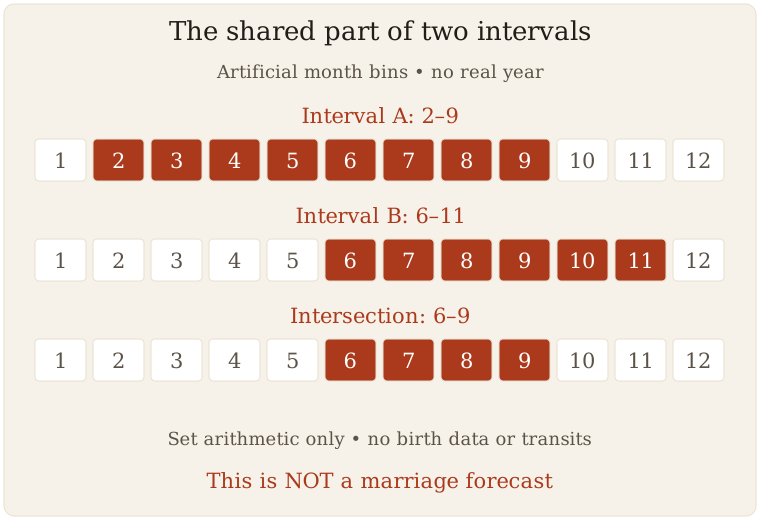
The diagram uses twelve artificial numbered month bins. We stipulate one selected period from bin two through bin nine and a second selected period from bin six through bin eleven. Their intersection is bins six, seven, eight and nine. No year, birth data, ephemeris or planet positions are attached. The bins illustrate set intersection only. They are not equal-duration promises about a real dasha or a real Jupiter transit, and no ceremony date is implied.
The example helps explain why an overlap can be narrower than either input interval. It cannot show that the selected inputs predict marriage. Even a perfectly correct intersection can join two rules with no established outcome validity. Keep that distinction beside the drawing: arithmetic checks the relationship between intervals, while evidence would have to test whether those intervals identify real events better than an appropriate comparison.
Several signals are not several independent witnesses
Navamsa, house lordship, dasha selection and transit comparison can share birth coordinates or a common interpretive rule. Counting four displayed signals does not automatically create four independent confirmations. D9 is derived from the same natal longitudes; it is not a separate person's observation that a wedding is happening. A second view of an input may be meaningful within a tradition without becoming independent scientific evidence.
This matters when a report uses the language of confirmation. Ask what is being confirmed: consistency within the chosen method, agreement between selected chart indicators, or measured prediction of an event? These are different claims. A tidy chart and a detailed explanation can improve transparency, but neither replaces a test of outcomes that includes misses as well as apparent successes.
The sources disagree about missing birth time
Astrolal offers a no-birth-time mode. Its page says it uses noon, hides time-dependent features, flags possible nakshatra changes, and describes a Moon-sign fallback that skips Navamsa. Vedicmarga answers its exact-time question with yes, citing Lagna-dependent factors and the Moon-dependent dasha balance. Kaalveda also warns that an uncertain birth time undermines its house framework. Those positions should not be flattened into one reassuring answer that date alone is always enough.
A noon substitution is a computational convention, not recovered birth evidence. If the time is unknown, write unknown, state which outputs were suppressed, and keep any remaining boundary uncertainty visible. Do not replace that uncertainty with a plausible-looking clock time. Nor should a generic statement about minutes be used to claim that every person's Lagna changes within the same fixed interval; actual boundary sensitivity needs the particular calculation.
Gender conventions and modern defaults differ
Tempora foregrounds Venus for male charts and Jupiter for female charts, while also saying both should be assessed. Kaalveda explicitly presents the gendered scheme as a convention with social assumptions and notes that modern practitioners may read Venus for partnership across genders. Vedicmarga says it reads Venus and Jupiter for everyone by default, with the husband-significator convention switched off unless selected. Astrolal says it weighs both equally when the user prefers not to state gender.
These choices can change a factor score or the periods selected. They also show why a calculator's questions are not neutral facts about all relationships. Ask which setting was used instead of forcing someone's identity or partnership into a model they did not choose. Our article reports the conventions, not a rule about what any gender must want, whom they may marry or which planet represents their partner.
Even one page can use different thresholds
Tempora initially describes a window as the intersection of four structural conditions. Later it says at least three of four layers can open a window, and its later summary changes how some conditions are expressed. We preserve that internal difference rather than silently choose one threshold. A reader trying to reproduce the method needs to know which formulation controls the result. Without that answer, the threshold remains unresolved.
This is a useful general reading habit. Compare a page's opening claim, worked example, rule summary and frequently asked questions. If they describe different tests, do not turn your own reconciliation into the source's rule. You can still learn the terms from the page while withholding reliance on an operational conclusion. A clear explanation should make the threshold easier to inspect, not require the reader to guess it.
No window is not a verdict of no marriage
Vedicmarga explicitly says its reading never denies marriage. Tempora says some charts are not structurally favourable and does not predict marriage for everyone. These are different scopes for their reported frameworks. Neither is evidence that a particular reader is destined to marry or destined not to marry. A tool may also search only a specified age range, return a limited number of results, or omit periods that fail its score threshold.
Therefore ask what was searched before interpreting an empty result. No window returned can mean no interval met that tool's current settings within that search range. It does not establish that no future relationship is possible. Equally, a displayed window does not establish that another willing person will appear. The boundary between an algorithm's output and a person's life needs to stay visible in both directions.
Do not borrow precision from a calendar display
Astrolal describes grouping months into up to three windows of at most eighteen months. Vedicmarga explains why it returns month ranges rather than a day. Tempora also rejects exact wedding dates in its framework. A calendar can display a precise beginning and end because software requires boundaries; that does not show that the underlying prediction is accurate to those boundaries. Read the granularity as part of the model design.
We do not publish current transit dates from the consulted pages here or calculate a personal age of marriage. Such dates would require a separately checked ephemeris, conventions and birth inputs. General phrases about a planet's approximate sign duration are not an exact transit schedule. A personalised-looking date copied from a general article would add false certainty rather than useful detail.
What would make a prediction testable?
Berkeley's Understanding Science distinguishes scientific-looking tools from a practice that tests and changes ideas against evidence. For marriage timing, a meaningful test would have to define the event, the forecast window and the comparison in advance. Does marriage mean a legal registration, a ceremony, an engagement or beginning to live together? Choosing whichever event fits after the fact changes the claim.
It would also need to count people whose predicted windows passed without the defined event, and events outside predicted windows. A collection of satisfying anecdotes cannot supply those missing cases. This article does not conduct such a study or independently validate any provider's accuracy claims. We explain published methods, not a demonstrated ability to forecast a reader's wedding.
A practical planning window is a different thing
A couple may have a real planning interval because of work, study, travel, caregiving or a venue's availability. Those constraints can be discussed directly and checked with the people involved. A traditional preference can be included if both want it, but it should not erase the practical window or create an obligation that no one agreed to. A forecast is not grounds to pay a deposit before the couple has made a plan.
If a predicted window is approaching while one person is unsure, the useful next step is a conversation about readiness, not pressure to beat the end date. Likewise, missing a forecast window is not a personal failure. People can change plans, decide against marriage, or choose a later time without needing to explain themselves as an exception to a chart.
Read relationship readiness through actual behavior
Loveisrespect's green-flags guide names communication, respect, trust, honesty, equality, boundaries and consent. Those questions remain relevant in every predicted period. Can both discuss money honestly? Does either feel afraid to disagree? Do both have a say in major choices? A supposedly favourable transit should not outweigh observed control, dishonesty or disrespect.
Loveisrespect is a US resource; its contact details are not offered here as local Indian services. We use its principles to keep the human part of the discussion visible. Astrology is not relationship counselling, and a score cannot diagnose a relationship. If there is threatening behavior, take the behavior seriously rather than translating it into a planetary explanation that excuses the person doing it.
Consent does not have an expiry set by a transit
Loveisrespect's consent guide stresses communication, respected boundaries and the absence of pressure or guilt. Applying that principle here, no predicted end date turns hesitation into yes. Nor does agreeing to discuss marriage commit someone to a ceremony, an intimate relationship, a paid ritual or sharing private birth details with a wider audience. Ask about those choices separately.
This article recommends no remedy purchase and no paid prediction. Anyone offering certainty should be asked what evidence supports it and what the limits are. A respectful timing discussion can end with uncertainty. Its purpose should be understanding a chosen tradition while preserving people's choices, not making them race a calendar or fear that their only chance has passed.


