Mercury in Vedic astrology: karaka of intellect, speech and trade
Mercury signifies intellect, speech, education and trade. Learn the signs of a strong or weak Mercury, the budhaditya yoga, and simple remedies.
Mercury is called the kumara in the tradition: the youthful, quick-witted, humour-loving prince who grasps every subject fast. It stands for the faculty by which we learn, speak, write, count and bargain. The Sun is the ego, the Moon the mind; Mercury is the intellect, the instrument that turns experience into language and decisions. This article explains Mercury's classical placements, signs, dasha and remedies in detail.
What is Mercury karaka of?
- Intellect and reasoning: the capacity to understand, analyse and decide.
- Speech and writing: the art of speaking, humour, presentation, translation.
- Education: student life, examinations, certificates.
- Trade and mathematics: accounts, ledgers, markets, brokerage.
- Aunts, uncles and young relatives: the classical significations.
- Skin and nerves: in the ayurvedic view, the nervous system and the skin.
Own, exalted and debilitated signs
| State | Sign | Traditional meaning |
|---|---|---|
| Own signs | Gemini, Virgo | Curiosity and communication in Gemini, analysis and practicality in Virgo |
| Exalted | Virgo (15 degrees) | The highest state of fine intellect; the formula of the writer-analyst |
| Debilitated | Pisces (15 degrees) | An intellect drowned in imagination; must practise fact-checking |
| Moola trikona | Virgo 15-20 degrees | A zone of special strength |
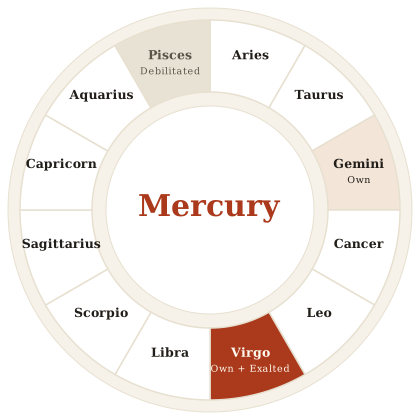
Exalted Mercury in Virgo shows that the highest form of intellect is not information but the ability to see fine distinctions. Debilitated Mercury in Pisces produces imaginative writers and artists; such people benefit especially from the habit of putting their thoughts on paper and testing them.
Friends, enemies and neutrals
- Friends: Sun, Venus
- Enemy: Moon
- Neutral: Mars, Jupiter, Saturn
The Mercury-Moon enmity pictures the clash of reason and feeling: Mercury says "think", the Moon says "feel". Mercury's neutrality toward Jupiter is interesting too; both are planets of knowledge, but Mercury trusts detail while Jupiter trusts principle. Their benevolent conjunction counts as a major yoga of scholarship.
Signs of a strong Mercury
- placed in its own or exaltation sign,
- in a kendra or trikona house,
- not too close to the Sun (not deeply combust),
- linked to Venus or Jupiter,
- classical mention of birth on a Wednesday or in Mercury's hora.
A person with a strong Mercury is quick-witted, a fine speaker and deft with figures. Such natives advance fast in teaching, writing, law, accountancy, trade, journalism and the technical fields.
Signs of a weak Mercury
- difficulty focusing, interruptions in studies,
- classical mention of unclear speech or a stammering tendency,
- errors in arithmetic and paperwork,
- instability in decisions; today's decision changed tomorrow,
- a tendency toward nerve or skin complaints.
Most of these connect directly to practice: regular reading, writing and speaking is Mercury's most authentic remedy.
The budhaditya yoga
The Sun-Mercury conjunction is called budhaditya yoga. Mercury stays near the Sun by nature, so this yoga appears in charts often; its benevolent result is expected when Mercury is not deeply combust and both sit in good houses. The tradition reads it as a combination of intelligence, administrative skill and honour through learning. In the opposite case, when Mercury is fully combust, interpretations like "one's own voice lost in the father's influence" appear, whose modern meaning is simple: learn to trust your own intellect.
Mercury through the twelve houses, briefly
- 1st: a youthful personality, eloquence, a curious nature.
- 2nd: earnings through speech, mathematical knowledge, commercial speech.
- 3rd: writing, communication, bonds with younger siblings.
- 4th: happiness of education, books at home, mention of vehicle-yogas.
- 5th: sharp intellect, success in studies, a poet's heart.
- 6th: victory over rivals through argument; skill in disputes, caution for nerves.
- 7th: an intelligent spouse, gains through partnership.
- 8th: a research mind, interest in hidden subjects, discussion of longevity.
- 9th: higher education, philosophical thought, knowledge through travel.
- 10th: an intellect-based career: accountancy, law, media, teaching.
- 11th: income through intellect, a circle of learned friends.
- 12th: private study, a combination for education abroad; keep track of expenses.
Mercury mahadasha and sub-periods
In Vimshottari the Mercury mahadasha is the longest: 17 years. This period centres on education, skill-building and commercial expansion, the long stretch of life in which a person deposits their "capital of intellect". A strong Mercury dasha carries combinations for completing education, establishing a job or business, and writing work. The sub-periods in brief:
| Sub-period | Length | Traditional character |
|---|---|---|
| Mercury-Mercury | 2 years 4 months 27 days | Laying the foundation of study and skill |
| Mercury-Ketu | 11 months 27 days | Esoteric study, research in solitude |
| Mercury-Venus | 2 years 10 months | Art, composition and sweetness in income |
| Mercury-Sun | 10 months 6 days | Recognition and administrative work |
| Mercury-Moon | 1 year 5 months | Writing, publishing, public contact |
| Mercury-Mars | 11 months 27 days | Technical work; avoid haste |
| Mercury-Rahu | 2 years 6 months 18 days | Unusual experiments; guard against confusion |
| Mercury-Jupiter | 2 years 3 months 6 days | Higher education, scholarship, guidance |
| Mercury-Saturn | 2 years 8 months 9 days | Disciplined study; slow but solid results |
Mercury through the twelve signs: quick reference
| Sign | Traditional temperament |
|---|---|
| Aries | Fast thinking, quick decisions, plain speech |
| Taurus | Slow, solid thought; practical arithmetic |
| Gemini (own sign) | Natural curiosity, verbal art, multi-tasking |
| Cancer | Memory and speech blended with feeling |
| Leo | Impressive oratory, the voice of a leader |
| Virgo (exalted/own) | The peak of analysis, an eye for detail |
| Libra | Balanced reasoning, the art of negotiation |
| Scorpio | An investigating intellect, a taste for mystery |
| Sagittarius | Philosophical thought; principle over detail |
| Capricorn | Orderly planning, practical intellect |
| Aquarius | Original experiment, technical interest |
| Pisces (debilitated) | An imaginative mind; poetry, music, writing |
Career and Mercury
The fields the tradition assigns to Mercury: accountancy and banking, law, teaching, writing and journalism, translation, market analysis, software and data, commerce and brokerage. When Mercury ties to the fifth or tenth house, the formula "livelihood through intellect" forms. Bhadra yoga, Mercury in own or exalted sign in a kendra, is one of the pancha mahapurusha yogas and is linked to the charts of celebrated writers, lawyers and merchants.
The traditional view on health
In the classical body-correspondence scheme, Mercury is linked to the nervous system, the skin and the organs of speech. An afflicted Mercury is said to incline toward restlessness, insomnia and skin complaints. For nervous strain, tradition and medicine say the same thing: adequate sleep, breaks from screens, and practices that steady the mind. For any symptom, the doctor is the first address.
The nakshatras of Mercury
Mercury owns Ashlesha, Jyeshtha and Revati. Natives born in these begin life with the Mercury dasha. Ashlesha carries a deep understanding of diplomacy and psychology, Jyeshtha a sense of seniority and responsibility, and Revati compassion and a love of travel in the classical descriptions. In these three stars the intellect works in different colours: strategy in Ashlesha, organisation in Jyeshtha, guidance in Revati.
Wednesday and the hora
Wednesday is Mercury's day, classically excellent for beginning new study, writing, contracts and commercial talks. In the panchang's hora system every hour of the day belongs to a planet; in Mercury's hora, accounts, correspondence and purchases are considered auspicious. Our panchang page carries such everyday guidance along with the day's tithi and nakshatra.
Retrograde Mercury: what it actually means
Mercury turns retrograde about three times a year, for three weeks each time. Astronomically this is the apparent reversal of motion seen from the earth; the planet never truly moves backward. The tradition calls this a period for reviewing written work: rereading old contracts, clearing pending correspondence, and reconnecting with lost acquaintances. For natives born under a retrograde Mercury, the classical tradition describes an inward but deep intellect; such people are said to think before they answer. Retrogression is thus no calamity, only a sign of changing gears.
Mercury and education: the practical lesson
Calling Mercury the planet of student life has a useful side: its classical remedies are the very habits the science of learning recommends. Read a little daily, write what you read in your own words, test yourself by explaining it to someone, and revise old notes before an exam. For children whose charts show a pressed Mercury, the tradition advises short study sessions over deep dives into one subject. This advice matches modern study science exactly; therein lies the practical beauty of the tradition.
Classical correspondences
| Subject | Mercury |
|---|---|
| Day | Wednesday |
| Direction | North |
| Colour | Green |
| Metal | Brass, bronze |
| Gemstone | Emerald (wear only on advice) |
| Deity | Vishnu |
| Dasha length | 17 years (Vimshottari) |
| Element | Earth |
| Greatest distance from the Sun | About 28 degrees |
Mercury in relationships and at work
Mercury is the planet of speech, so in relationships it means conversation. People with a strong Mercury can both explain themselves and hear others; the tradition counts both as auspicious for partnership and marriage. At the workplace, Mercury-dominant people anchor documents, emails and meetings. For a weak Mercury the tradition advises "taking it in writing": put important matters in written words instead of leaving them verbal. This advice is as useful in modern work life as it ever was.
Daily practices for a strong Mercury
The core of Mercury sadhana is the threefold process of shravana, manana, nididhyasana: listening, reflecting, and casting into your own words. Fifteen minutes of reading daily, writing by hand once a week, and aiming at understanding rather than victory in a debate, these three practices are said to strengthen Mercury. Arithmetic, puzzles and games like chess belong to the same family. Telling children stories and having them retell them is the simplest household tradition for building Mercury's strength.
Mercury in the digital age
Today's information economy is an expansion of the fields Mercury rules: writing, data, software, markets and communication. In the language of the tradition, an age in which the capital of intellect has overtaken physical capital is the age of Mercury. The tradition also carries a ready warning: Mercury's restlessness can become the habit of multi-tasking. Just as the panchang divides the day into horas, modern time-management asks for work in blocks; in a notification-filled day, one hour of uninterrupted work is the most modern remedy for Mercury. Alongside, verifying online information, that is, not swallowing every auspicious or ominous tip with closed eyes, is itself a benevolent use of Mercury.
Mercury's significations in the family
In the classical list Mercury also signifies maternal uncles, aunts and younger siblings. A strong Mercury is said to bring support and learning through these bonds; an afflicted one, gaps in communication with them. For questions about a child's education, Mercury is examined alongside the fifth house, since it is the planet of the capacity to learn. The simplest way to raise Mercury's strength at home is books, shared reading and an atmosphere of conversation, where asking a question earns appreciation rather than scolding. In such homes children move toward reading and understanding on their own, and that is Mercury's most durable blessing.
Traditional remedies
- Vrat and worship: the Wednesday fast; reciting the Vishnu Sahasranama or the Ganapati Atharvashirsha.
- Mantra: "Om Bum Budhaya Namah" or "Om Bram Breem Braum Sah Budhaya Namah".
- Donation: green items, books, pens, spinach or green moong on Wednesdays.
- Conduct: read and write something daily; help younger ones study; take a moment's pause before speaking.
- Gemstone: emerald is Mercury's gem; wear it only on competent advice.
A few myths
- "Things go wrong when Mercury is retrograde." Retrogression is a mathematical state; the tradition calls it a period of review, not of ruin. People born with a retrograde Mercury are often deep thinkers.
- "A combust Mercury makes one dull." Entirely wrong; many celebrated scholars have a combust Mercury. The difference is only in the style of expression.
- "Wear an emerald and the exam is passed." Gemstones are considered aids, not substitutes for an examination.
How to check Mercury in your chart
Build your chart with the free kundli tool and note the sign, house and solar distance of "Me". If Mercury sits very close to the Sun, consider combustion; then compare with the indicators above.
An honest note
The lore of Mercury is a tradition of symbols, not measured science. The real strength of intellect is built by practice, curiosity and honesty; astrology is an old vocabulary-map for understanding it. Sources consulted for the traditional placements and correspondences here: the dignity table of own sign, exaltation and debilitation with degrees, from the Saravali translation at saravali.github.io/astrology/dignities.html; the graha correspondence reference (day, direction, colour, gemstone, deity, dasha years) at satyori.com/reference/grahas/, and the Vimshottari dasha year-table at panchangtime.com/methodology/vimshottari-dasha. These present the classical Parashari framework; where traditions disagree, the text above says so. Our effort is to hand you that map in plain words, not to issue a decree of fate.
Questions on this article
In which sign is Mercury exalted?
Mercury is exalted in Virgo (deepest at 15 degrees) and debilitated in Pisces. Gemini and Virgo are its own signs.
What is a combust Mercury?
Mercury by nature stays close to the Sun, so combustion is common for it. The tradition discusses the intellect being scorched when too close, but most scholars do not treat a combust Mercury as harshly as other combust planets; the budhaditya yoga itself forms from this closeness.
How long is the Mercury mahadasha?
In the Vimshottari system the Mercury mahadasha lasts 17 years.
What are the remedies for a weak Mercury?
Traditional remedies: a Wednesday fast, worship of Vishnu or Ganesha, the mantra "Om Bum Budhaya Namah", donating green items and books, and regular study and writing. Show your full kundli before wearing an emerald.


