The Moon in Vedic astrology: karaka of mind, mother and emotions
The Moon signifies the mind, the mother and emotions. Learn the traditional signs of a strong or weak Moon, why the Moon sign matters, and simple remedies.
If the Sun is the soul, the Moon is the mind. In Vedic astrology your birth sign is fixed by the Moon, the panchang's tithi is built from the Sun-Moon distance, and the dasha sequence begins from the birth nakshatra, the Moon's own mansion. This is why people say Indian astrology stands on the Moon. This article explains the Moon's traditional meanings, the signs of its strength and weakness, and the remedies of the parampara.
What is the Moon karaka of?
- Mind and emotions: how we feel inside, how quickly moods move, the tendency toward calm or restlessness.
- Mother: the bond with the mother, her blessing and indications about her situation.
- The public: collective feeling, connection with crowds, popularity.
- The water element in the body: blood, bodily fluids and, in the ayurvedic view, kapha.
- Home and comfort: material ease, food, sleep and daily routine.
The Moon is the fastest graha, changing sign every two and a half days. That speed is itself linked to the restless nature of the mind.
Own, exalted and debilitated signs
| State | Sign | Traditional meaning |
|---|---|---|
| Own sign | Cancer | The mind at home; emotional security comes naturally |
| Exalted | Taurus (3 degrees) | The strongest placement: a steady, balanced, contented mind |
| Debilitated | Scorpio (3 degrees) | Emotions run deep and intense; the mind must practise balance |
| Moola trikona | Taurus 3-30 degrees | A zone of special strength |
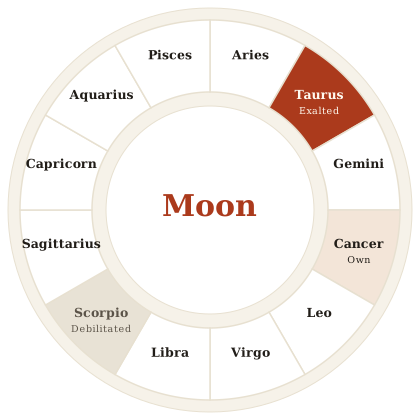
A Scorpio Moon often brings deep sensitivity; such people read the feelings of others quickly. That very depth serves well in art, psychology and healing. Cancellation combinations and friendly aspects balance it further.
Paksha bala: the waxing and waning Moon
The Moon alone carries paksha bala, phase strength. The waxing Moon (new to full) is considered strong and the waning Moon relatively quiet. A birth near the full moon is read as an open, expressive mind; a birth near the new moon as an inward, deep nature. So not just the sign but the lunar phase shapes the result.
Friends, enemies and neutrals
- Friends: Sun, Mercury
- Enemies: none (the Moon treats no one as an enemy)
- Neutral: Mars, Jupiter, Venus, Saturn
Note the asymmetry: the Moon holds no grudge, but Saturn counts the Moon as an enemy. So Saturn's aspect or conjunction with the Moon indicates pressure on the mind, and sade sati itself is computed from the Moon sign. A Moon-Rahu conjunction is discussed as a chandala-tainted mind, with a tendency toward anxiety and overthinking.
Signs of a strong Moon
- birth near the full moon,
- placed in its own or exaltation sign,
- in a kendra or trikona house,
- aspected by Jupiter or Venus,
- away from Saturn, Rahu and Ketu.
A person with a strong Moon is considered emotionally steady, compassionate and well liked. The texts speak of patience in decisions and the blessing of the mother.
Signs of a weak Moon
- moods that swing often, small events affecting the mind deeply,
- a tendency toward poor or broken sleep,
- concern about the mother's health or relationship,
- traditional mentions of water-related complaints and allergies,
- leaning too heavily on others for peace of mind.
The same caution applies: these are general formulas, and no single placement decides a whole life. If stress or anxiety is genuinely rising, speaking to a qualified mental-health professional is the right step.
The Moon through the twelve houses, briefly
- 1st: an emotional, attractive personality; health tied to mood.
- 2nd: sweet speech; money flows in with fluctuation.
- 3rd: a restless mind, interest in writing and travel, attachment to sisters.
- 4th: the seat of comfort: home, vehicles, the mother's affection.
- 5th: a creative mind, love of children, interest in learning.
- 6th: a tendency toward mental stress; the ability to win in competition.
- 7th: an affectionate spouse; success in partnerships.
- 8th: a deep mind, interest in hidden knowledge; emotional ups and downs.
- 9th: rising fortune, a religious mind, happiness from the mother's side.
- 10th: a public-facing career; a tendency toward changes of position.
- 11th: the company of friends and desired income.
- 12th: an imaginative, private mind; a foreign connection.
Moon mahadasha and transits
In Vimshottari the Moon dasha runs ten years. It is read as a period when mind, mother, home and emotional life come to the centre. A strong Moon's dasha is said to bring comfort, happiness through children and popularity; for an afflicted Moon's dasha the tradition advises sadhana and a steady routine for peace of mind.
In transit the Moon changes sign every two and a half days, and the daily horoscope is built on this. Sade sati, kantaka shani and ashtama shani are also counted from the Moon sign, so knowing your Moon sign is the first lesson of Vedic astrology.
The Moon through the twelve signs: quick reference
| Sign | The mind's traditional temperament |
|---|---|
| Aries | Quick to react, enthusiastic, quick to anger |
| Taurus (exalted) | Steady, patient, beauty-loving |
| Gemini | Curious, multi-tasking, restless |
| Cancer (own sign) | Deep affection, a need for security, strong memory |
| Leo | Proud, generous, fond of appreciation |
| Virgo | Analytical, practical, worry-prone |
| Libra | Seeks balance, sociable, entangled in indecision |
| Scorpio (debilitated) | Intense feeling, private, emotionally deep |
| Sagittarius | Optimistic, freedom-loving, philosophical |
| Capricorn | Restrained, responsible, tends to suppress feeling |
| Aquarius | Reflective, social, stands a little apart from emotion |
| Pisces | Imaginative, compassionate, dreamy |
The Moon and the twenty-seven nakshatras
In the puranic telling the twenty-seven nakshatras are the Moon's wives; favoured Rohini drew Daksha's curse, the Moon waned away, and Shiva's grace gave it the cycle of waxing and waning. Behind the story sits a fact of the sky: in its 27.3-day circuit the Moon passes through about one nakshatra a day. The nakshatra the Moon occupies at your birth is your janma nakshatra; from it come the first letter of the name, the starting dasha of Vimshottari, and considerations like moola and gandmoola. Our nakshatra-finder tool shows your birth star and its pada instantly.
Sub-periods within the Moon mahadasha
The ten-year Moon mahadasha divides into nine antardashas. Their classical character in brief:
| Sub-period | Length | Traditional character |
|---|---|---|
| Moon-Moon | 10 months | Emotions to the fore; happiness through the mother |
| Moon-Mars | 7 months | Rising energy; keep emotional impulse in check |
| Moon-Rahu | 18 months | A mentally tangled phase; patience needed |
| Moon-Jupiter | 16 months | Auspicious; combinations for marriage and children, guidance |
| Moon-Saturn | 19 months | Mental weight; a period of patience and service |
| Moon-Mercury | 17 months | Gains in study, writing and intellectual work |
| Moon-Ketu | 7 months | A sense of detachment; the mind turns inward |
| Moon-Venus | 20 months | Comforts, art and sweetness in relationships |
| Moon-Sun | 6 months | Confidence rises; matters tied to father and government |
The lengths follow the Vimshottari proportions; outcomes depend on both planets in the chart.
The traditional view on health
Ayurvedic astrology links the Moon to kapha, blood and the coolness of the brain. An afflicted Moon is said to incline toward sleeplessness, sluggish digestion and mental fatigue. A few simple habits are common to both the tradition and modern medicine: regular meals, enough water, a fixed bedtime and slow evening walks. For any symptom, a doctor's advice comes first; astrological remedies can accompany treatment, never replace it.
The Moon in relationships
Signifying the mother, the wife and the women of the house, the Moon is tied to the atmosphere of home. A strong Moon is said to give a home where emotional support comes naturally; for a weak Moon the tradition speaks of a "hunger of the mind", whose remedy is not attachment but conversation and service. In matching too, the Moon sign and nakshatra are the base: most of the guna-milan kutas are computed from the two Moons.
The Moon, career and public contact
As the karaka of the public, the Moon connects to careers with regular contact with people: healthcare, food and nutrition, water-related trades, hospitality and tourism, teaching, psychology, social work and media. When the Moon ties to the tenth house or its lord, the tradition speaks of positions in public service. The ability to pour emotional energy into art and writing is also counted among the Moon's gifts.
Classical correspondences
| Subject | Moon |
|---|---|
| Day | Monday |
| Direction | North-west |
| Colour | White, milky |
| Metal | Silver |
| Gemstone | Pearl (wear only on advice) |
| Deity | Soma; Parvati and Durga in correspondence lists |
| Dasha length | 10 years (Vimshottari) |
| Element | Water |
| Zodiac circuit | About 27.3 days |
Conjunctions with Rahu-Ketu and eclipses
The Moon with Rahu is said to cast a shadow of confusion and overthinking on the mind; with Ketu, a tendency toward detachment and solitude. A birth chart with the Sun or Moon near the nodes counts as a birth close to an eclipse. The tradition advises shanti rituals for such births, but no such combination is a curse; it only says that the tools of a steady mind, such as meditation, regular sleep and good company, help these natives even more.
The Moon's role in the panchang
Three of the panchang's five limbs come straight from the Moon. The tithi is built from the Sun-Moon angular distance, the nakshatra is the Moon's own position, and the yoga emerges from the sum of both their motions. In choosing a muhurat, checking chandra bala is treated as essential: an auspicious moment is one where the transiting Moon stands well from the native's birth sign. Tara bala too is counted from the birth nakshatra to the Moon's nakshatra of the day. The Moon is thus the centre not only of the birth chart but of electional timing itself.
Moon-linked fasts and festivals
A large part of the Indian vrat tradition rests on the Moon. Karva Chauth breaks only after moonrise; on Sharad Purnima, kheer is kept in the moonlight under the belief that the full moon showers nectar; Sankashti Chaturthi too ends at moonrise. Holi and Guru Purnima belong to the full moon, and amavasya observances honour the ancestors. These occasions make clear that the Moon is not merely a body in the sky but part of the emotional memory of Indian homes, and that is why astrology made it the karaka of the mind.
Daily practices to steady the mind
The first remedy for the Moon in the tradition is routine: sleep and rise at fixed times, keep mealtimes steady, and spend a few hours a week near nature or water. Mantra japa belongs to the same family, because japa teaches the mind to rest on a single point. For those with an afflicted Moon, the parampara also suggests touching the mother's feet, taking the blessing of elders, and feeding someone to their fill. Every one of these practices carries the same essence: bring the mind back from wandering and connect it to support.
Monday: the Moon's day
Each weekday belongs to a graha, and Monday is the Moon's day. Shiva worship is customary on this day, since Shiva wears the crescent on his head. The sixteen-Monday vrat, the Mondays of Shravana and Somvati Amavasya all belong to this family. The tradition says that on Monday, white clothing, cooling food and the practices of a quiet mind, such as japa and satsang, strengthen the Moon. If you wish to begin a remedy, Monday morning is the classically favoured time.
Traditional remedies
- Vrat and worship: the Monday fast and the worship of Shiva, who wears the Moon on his head.
- Mantra: "Om Som Somaya Namah" or the Moon beej mantra.
- Donation: milk, rice, silver or white cloth on Mondays.
- Conduct: serve your mother and motherly women; take proper sleep; keep away from screens late at night.
- Gemstone: pearl is the Moon's gem, but wear it only on competent advice.
A few myths
- "Birth on amavasya is inauspicious." It is not. A new-moon birth gives an inward, spiritual mind; countless calm, successful people were born that day.
- "A weak Moon means mental illness is certain." Never. Astrology indicates temperament; mental health is cared for through modern medicine and relationships.
How to find your Moon sign
Enter your birth date, time and city in our free moon-sign tool to see your Moon sign and nakshatra instantly. This is the sign your "rashifal" should be read for, by classical convention, in the daily and weekly forecasts.
An honest note
Moon astrology is a centuries-old symbolic tradition, not clinical science. If the mind is troubled, see a professional; remedies are support, not treatment. Sources consulted for the traditional placements and correspondences here: the dignity table of own sign, exaltation and debilitation with degrees, from the Saravali translation at saravali.github.io/astrology/dignities.html; the graha correspondence reference (day, direction, colour, gemstone, deity, dasha years) at satyori.com/reference/grahas/, and the Vimshottari dasha year-table at panchangtime.com/methodology/vimshottari-dasha. These present the classical Parashari framework; where traditions disagree, the text above says so. Our work is to explain the tradition in plain words, not to create fear.
Questions on this article
In which sign is the Moon exalted?
The Moon is exalted in Taurus (deepest at 3 degrees) and debilitated in Scorpio. Cancer is its own sign.
What is the difference between the Moon sign and the Sun sign?
Your Moon sign (janma rashi) is the sign the Moon occupied at birth, and it is the primary sign in Vedic astrology. The Sun sign, which Western astrology uses, is the sign the Sun occupied.
What are the remedies for a weak Moon?
Traditional remedies: a Monday fast, worship of Shiva, the mantra "Om Som Somaya Namah", serving one's mother, donating milk and rice, and getting proper sleep. Show your full kundli before wearing a pearl.
How long is the Moon mahadasha?
In the Vimshottari system the Moon mahadasha lasts 10 years.


