Moon Sign vs Sun Sign: Two Bodies, Two Questions
Your Sun sign and Moon sign need not match. Name the body and zodiac frame before comparing the results.
Your Moon sign and Sun sign answer different questions about the same birth moment. The Moon sign names the zodiacal sign occupied by the Moon; the Sun sign names the sign occupied by the Sun. They may match or differ. Neither result cancels the other. In an Indian astrology conversation, my rashi often means the natal Moon sign, while a Western newspaper's star sign usually means the Sun sign. Confusion begins when these different questions are compressed into the single word sign, or when a tropical result is compared with a sidereal result without naming the difference.
This guide separates the celestial factor from the zodiac convention, explains why a birthday list cannot supply every placement, and uses deliberately fictional longitudes to show the arithmetic. It describes traditional interpretation without treating it as established psychology. A correctly calculated coordinate is different from proof that a coordinate determines someone's personality, marriage or future. You can understand the language of a horoscope without making that further claim.
The definitions: one moment, two bodies
Drik Panchang's Janmarashi calculator defines janma rashi as the Moon sign at birth. Its separate Surya Rashi calculator defines Surya Rashi as the sign in which the Sun was located at birth. These paired definitions are a useful starting point because they do not ask which sign is more authentic. Each identifies a different body's placement within the zodiac.
Rashi itself means a sign. Chandra rashi specifies the Moon; Surya rashi specifies the Sun. The familiar twelve names run from Mesha or Aries through Meena or Pisces. If a report prints both names, it has not given you two incompatible identities. It has supplied two fields in a larger chart. Likewise the ascendant, covered in the previous article, is a horizon reference rather than a third body. Keep Sun, Moon and rising reference in separate labeled spaces.
At birth is also part of the definition. Today's Moon sign is not your natal Moon sign, and the Sun's current sign is not necessarily your birth Sun sign. A page may display today's sky beside a birth calculator. Read the heading and inputs before copying a result. The word horoscope can refer to a birth chart or a forecast column, so the page's purpose needs checking as well as its sign labels.
There are two independent choices to name
The first choice is the body: Sun or Moon. The second is the zodiac reference: tropical or sidereal. These are independent axes, not synonyms for one another. A tropical Moon sign is possible, and a sidereal Sun sign is possible. Indian astrology includes the Sun; Western natal charts include the Moon. The shortcut India equals Moon and West equals Sun describes some popular emphasis, not the full contents of either chart tradition.
The Hindu astrology entry explains the main Jyotisha use of a sidereal zodiac and the distinction from a tropical zodiac. The latter is measured from the seasonal equinox reference; sidereal conventions relate their origin to a stellar reference through an ayanamsa. To compare two results, write both the factor and convention: sidereal Moon, tropical Sun, or whichever was actually calculated. If the calculator offers an ayanamsa choice, preserve that setting too.
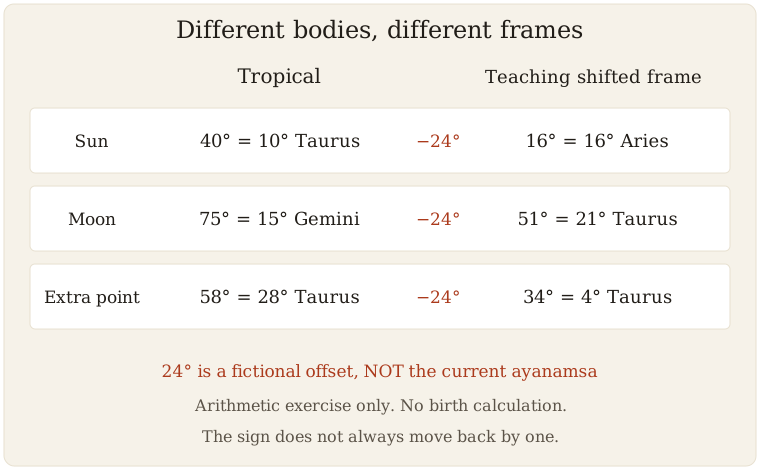
Do not repair an unexplained disagreement by simply moving every sign back one. The angular relationship between reference systems is not the same as a universal one-sign substitution. A point well inside a sign and a point near its beginning can respond differently to the same angular offset. The diagram below uses a fixed fictional offset to demonstrate this logic. It is not a statement of the present ayanamsa, an ephemeris or a recommendation of one school.
Our arithmetic example: separate factor from frame
Imagine a tropical Sun longitude of forty degrees and a tropical Moon longitude of seventy-five degrees. These are classroom numbers, not measured birth positions. With Aries beginning at zero degrees, Taurus begins at thirty and Gemini at sixty. The Sun is therefore ten degrees Taurus, and the Moon fifteen degrees Gemini. The body difference alone gives two sign labels within the same reference system. No tropical-to-sidereal conversion is needed to explain that difference.
For a second exercise, choose an illustrative offset of twenty-four degrees and subtract it from both longitudes. The results are sixteen degrees for the Sun and fifty-one for the Moon. Those lie in Aries and Taurus respectively: sixteen degrees Aries and twenty-one degrees Taurus. The bodies did not physically jump. The coordinate reference changed. The diagram labels the offset as hypothetical so its round value cannot be mistaken for a current astronomical constant.
A second pair shows why subtract one sign is not the rule. A hypothetical tropical point at fifty-eight degrees lies at twenty-eight Taurus. Subtracting the same twenty-four-degree teaching offset gives thirty-four degrees, or four Taurus: the sign name stays Taurus. A point at forty degrees changes sign under that same offset. Angular conversion must be done on the longitude, not on the name alone. This example is arithmetic, not a birth chart or a prediction.
Signs and constellations are related names, not identical boundaries
OpenStax Astronomy 2e explains the division of the zodiac into twelve thirty-degree signs and their historical constellation names. NASA's Constellations and the Calendar post explains that constellations have different sizes and shapes. Equal thirty-degree sign divisions are therefore not a tracing of the unequal areas occupied by named constellations. Saying sidereal does not turn twelve equal signs into the actual irregular constellation boundaries.
NASA's post also rejects the recurring claim that NASA changed everyone's zodiac signs. It distinguishes astronomy from astrology and explains precession. This is useful when a viral picture offers a new sign list: first ask whether it refers to constellation areas, tropical signs or sidereal signs. Do not apply a constellation calendar to an astrological report as though they were automatically the same system. Naming conventions and physical sky boundaries must not be silently substituted.
OpenStax's discussion is framed around familiar Western Sun-sign usage. Its statement about what people mean by your sign should not erase Drik Panchang's explicitly Moon-based janma-rashi definition. The sources are describing different contexts. We retain that distinction rather than presenting one cultural shorthand as universal. Neither source justifies treating a broad sign label as a complete personal description.
Why fixed birthday lists have limits
The Sun sign astrology entry says the familiar start and end dates are approximate and can vary between years. Exact ingress, the crossing into a sign, requires an ephemeris or appropriate calculation. A birthday comfortably away from a boundary may be straightforward within a declared system, but a boundary date without the birth time cannot be converted into certainty by reading a generic date range more forcefully.
There is another limit: a Sun-sign date list is not a Moon-sign table. The Moon moves through the signs on a much shorter cycle, so a month-and-day birthday label cannot supply its placement. To determine a natal Moon sign, use a calculation for the actual birth information and stated reference. Do not assume the Moon shares the Sun's sign throughout a month or use today's Moon to fill a missing historical value.
Near a boundary, preserve uncertainty rather than inventing an exact time. If a date-only tool uses a reference hour, that convention does not establish the hour of birth. Ask what the tool calculated. A whole-day range may include more than one possible result. The same principle applies to the Sun and Moon, although their rates of motion differ. A person should not be told a placement is certain simply because a form returned only one answer.
Input quality matters before interpretation
Start with the original birth record or the family's actual account. Keep the date, local time and place together. The place helps a calculator interpret the local time and matters directly for the ascendant. Do not confuse a change in wall-clock representation of the same instant with a different instant. An unexplained timezone conversion can create a different result even when the astronomical calculation itself is working as designed.
Check the requested settings and whether the report is geocentric or uses another convention before comparing highly precise positions. This introductory guide does not provide a universal software-error threshold. Its advice is methodological: compare like inputs and like settings first. If an input remains unknown, show the gap. Precision in a printed longitude cannot repair an undocumented birth time or prove that an interpretive claim is true.
What the traditions do with the two signs
Sun-sign astrology is a simplified form of Western astrology centered on the Sun at birth, according to the Sun sign entry. OpenStax describes newspaper Sun-sign columns as a limited variant of a fuller natal horoscope. A full chart contains other factors, including the Moon and planets. It is inaccurate to treat a newspaper paragraph as the whole of Western chart practice, just as a one-line Moon-rashi forecast is not the whole of Jyotisha.
In Jyotisha, the Hindu astrology source places the Moon's nakshatra in the initial Vimshottari dasha calculation. That role needs more detail than the Moon's rashi alone. It does not mean every timing method uses the same basis. The Sun and Moon are both included among the navagraha. Their traditional roles can be described without assigning a scientifically established mental faculty or life destiny to either sign.
Popular explanations often turn the Sun into an outer self and the Moon into an inner self. Treat such phrases as interpretive metaphors, not as validated psychological compartments. A reader recognizing themselves in one description has not thereby confirmed the calculation or tested astrology. If a metaphor helps reflection, keep its status clear. For understanding a person's feelings, their own account and circumstances are stronger grounds than an assigned Moon-sign story.
Nakshatra, house and phase are different fields
The Hindu astrology source describes the usual twenty-seven nakshatras as divisions of thirteen degrees twenty minutes, each split into four padas. A Moon sign is a broader thirty-degree label. It does not uniquely identify every nakshatra or pada detail. A calculator can report all of these for one longitude, but they are not interchangeable names. Record the actual fields rather than guessing a birth syllable or dasha from a sign name alone.
A Moon sign is also not a lunar phase. Full Moon and new Moon describe a Sun-Moon relationship; Taurus or Gemini describes a zodiacal position. Likewise a house describes a chart division relative to a stated reference and house system. Someone can say Moon in Taurus and Moon in the eleventh house without giving two different Moon signs. The previous lagna article demonstrates such a whole-sign example. Keep the coordinate label distinct from the house count.
When the signs match, and when they do not
Sun and Moon can occupy the same sign within one system. They can also occupy different signs. Neither case proves an easy personality, an internal conflict or a relationship outcome. Even a shared sign does not mean the bodies have the same degree. The broad label discards information. The guide's fictional examples should make that visible: a sign is a thirty-degree interval, not one exact point and not a measurement of human character.
Two people sharing a Sun sign may have different Moon signs; sharing both still does not make their lives identical. Astrology cannot replace information about upbringing, choices, health, work or relationships. Avoid using either label to rank applicants, select a partner or dismiss someone's feelings. A cultural vocabulary is not a license to make consequential claims about a person who has not supplied the relevant real-world evidence.
A practical comparison sheet
Use separate lines for natal Sun, natal Moon and ascendant. Beside each, write the zodiac convention and any ayanamsa setting. Add the sign and longitude exactly as supplied, then record the birth inputs and their uncertainty. If two reports differ, compare their factor names before comparing their arithmetic. Check whether one report shows current transits, a divisional chart or a forecast instead of natal positions. These are our editorial error-checking steps, not a classical procedure for divination.
For an unknown birth time, do not promise that a single sign is recoverable from a name or a broad personality description. Ask what can actually be established from the available record and calculation interval. If a boundary cannot be excluded, keep more than one possibility. The outcome of a careful comparison can be unresolved. That is better than silently choosing the label with the most appealing adjectives.
Where calculation stops and evidence begins
Berkeley's Understanding Science explains that careful tests of specific astrological expectations did not support their validity, while vague expectations can fit many outcomes. OpenStax likewise reports no evidence that natal astrology predicts personality or future events. These sources address the further claims, not the ability to calculate a longitude. We can learn what Sun sign and Moon sign mean while retaining that boundary. Use the terms for informed cultural discussion, not as substitutes for medical care, financial evidence, consent or direct conversation.
Questions on this article
What is the difference between Moon and Sun signs?
Moon sign locates the natal Moon; Sun sign locates the natal Sun. They can differ within the same zodiac system.
Is every Indian sign a Moon sign?
No. Rashi means sign; janma rashi usually means natal Moon sign. Surya Rashi is the Sun sign. Name the factor.
Can a fixed birthday list settle a boundary birth?
Not reliably. Exact ingress depends on the year and moment. Keep unknown time uncertain and use the appropriate calculation.
Do scientific tests support sign-based personality claims?
The scientific sources consulted report no support for natal astrology predicting personality or future events. Coordinate calculation is a different claim.


