Mulank and Bhagyank: Two Birth Numbers Explained
The Mulank uses your birth day, the Bhagyank your full birth date. Both are fixed. Trait lists are tradition, and the one direct test found no predictive power.
Two numbers from one date
Ask an Indian numerologist about your numbers and you will usually get two: the Mulank and the Bhagyank. Both come from your date of birth, both reduce to a single digit from 1 to 9, and each is linked to one of the nine grahas. Yet they answer different questions. The Mulank, also called the birth, root or psychic number, is said to describe your basic nature: how you instinctively think, react and behave. The Bhagyank, the destiny or life path number, is said to describe the direction your life tends to take: the opportunities, obstacles and lessons along the way. ZingAstro's framing is tidy: when the two harmonise, inner nature and life direction pull together; when they clash, tradition reads an inner tension between who you feel you are and where life leads you.
This guide shows how to calculate both, what tradition says each number means, where the sources disagree, and what the one direct empirical test of birth numbers found. It does not claim the numbers determine anything about you. The trait lists below are tradition, not measurement; people read them as culture, reflection or entertainment, and the skeptical evidence gets its own section rather than a footnote.
Calculating the Mulank: the day alone
The Mulank uses only the day of the month you were born. Add its digits until one digit remains. Born on the 7th: Mulank 7. Born on the 14th: 1 + 4 = 5. Born on the 29th: 2 + 9 = 11, then 1 + 1 = 2. The month and year play no part. The result never changes; it is fixed at birth. The dates map cleanly: the 1st, 10th, 19th and 28th all give Mulank 1; the 2nd, 11th, 20th and 29th give Mulank 2; and so on, with the 5th, 14th and 23rd giving 5, and the 9th, 18th and 27th giving 9.
Calculating the Bhagyank: the full date
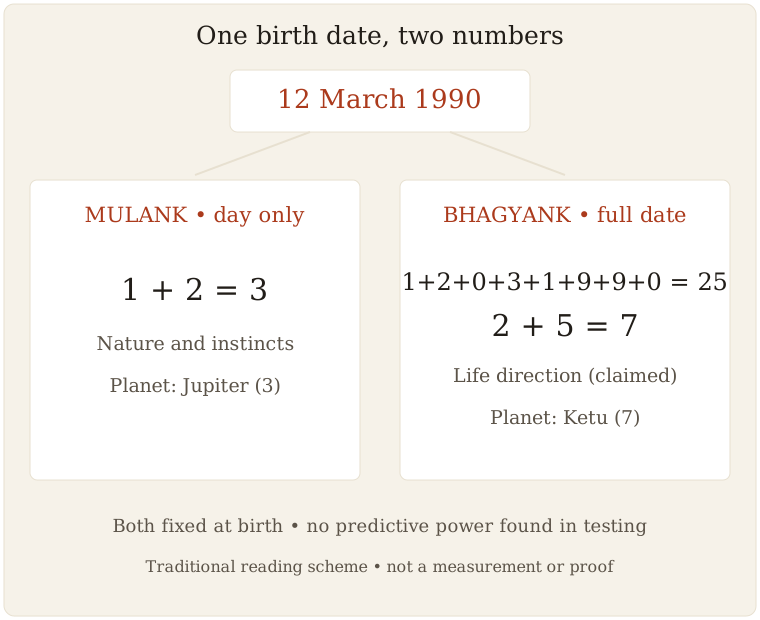
The Bhagyank uses every digit of the full date of birth: day, month and the four-digit year. Add them all, then reduce the total the same way until one digit remains. Arun Pandit's example: born 12 March 1990, add 1 + 2 + 0 + 3 + 1 + 9 + 9 + 0 = 25, then 2 + 5 = 7, so the Bhagyank is 7. News18 Hindi's example: born 29 August 1998, the digits total 45, and 4 + 5 = 9. Note that leading zeros change nothing, and you will sometimes see the same total computed by adding day, month-number and year first and then reducing; the digit-sum comes out identical either way.
One date, both numbers, worked once
Take 12 March 1990. The Mulank looks only at the 12: 1 + 2 = 3, a Jupiter number in the traditional mapping. The Bhagyank takes the whole string: 25, then 7, a Ketu number. Two people born on the 12th of different months share a Mulank but usually not a Bhagyank, which is why practitioners say a full reading needs both. The Mulank is read as the person; the Bhagyank as the path.
The nine numbers and their planets
The practitioner sources agree on the planetary mapping, and it is what ties numerology to astrology: 1 to the Sun, 2 to the Moon, 3 to Jupiter, 4 to Rahu, 5 to Mercury, 6 to Venus, 7 to Ketu, 8 to Saturn and 9 to Mars. Reading a number means reading its planet's traditional qualities. The widely published trait list runs as follows, all of it tradition rather than measured fact: Mulank 1 (Sun) leadership, independence, ambition, self-confidence. Mulank 2 (Moon) sensitivity, imagination, diplomacy, changeable moods. Mulank 3 (Jupiter) wisdom, discipline, love of learning and teaching, optimism. Mulank 4 (Rahu) unconventional thinking, hard work, sudden ups and downs, independent views. Mulank 5 (Mercury) quick wit, communication, business sense, restlessness. Mulank 6 (Venus) charm, love of beauty and comfort, artistic taste, devotion to family. Mulank 7 (Ketu) intuition, introspection, interest in spirituality, a reserved nature. Mulank 8 (Saturn) patience, discipline, perseverance, success said to come later in life. Mulank 9 (Mars) courage, energy, a protective nature, a quick temper.
Where the sources disagree: master numbers
The first real fork in the tradition is what to do when a reduction lands on 11, 22 or 33. The Indian convention followed by Arun Pandit reduces everything to a single digit from 1 to 9, because each number must map to one of the nine grahas. CheckMyNumerology notes that many modern numerologists write the master number first: a person born on the 11th or 29th is recorded as 11/2, a Mulank 2 "with extra intuition", and one born on the 22nd as 22/4. Western Pythagorean numerology goes further and treats 11, 22 and 33 as master numbers that are never reduced.
The skeptical literature adds a sharper problem: the master-number rule is not even internally stable. Genovese's test paper shows that 1 May 1999 yields 11 if you add all digits in one string (38, then 3 + 8), but 2 if you group day, month and year separately first (10 + 10, then 1 + 1). A system whose answer depends on the order of addition is telling you about arithmetic, not about a person. We record all three conventions and make no ruling; just know which one a reading is using before comparing two readings.
Which number matters more?
Practitioners do not fully agree here either, and we keep both views. CheckMyNumerology's position is that neither is more important: they are two halves of one reading, the Mulank naming the character, the Bhagyank the path. Arun Pandit's FAQ adds a common practitioner refinement: the Mulank dominates the reading of early life and everyday behaviour, while many give the Bhagyank more weight from middle age onward, when the "direction of life" has had time to show. What practitioners on both sides emphasise is the relationship between the two: whether the numbers are traditionally "friendly" or "in conflict" is read as more significant than either number alone. News18 Hindi's example pairs Mulank 1 (Sun) as friendly with Bhagyank 9 (Mars) or 3 (Jupiter), and difficult with 8 (Saturn) or 7 (Ketu). These compatibility tables are convention, not evidence, and different numerology books do not always print the same friendships.
The third number you will hear about: Namank
Many readings add a Namank, the name number, computed by assigning each letter of your name a value and reducing the sum. News18 Hindi's account, quoting a Bhopal numerologist, says the Namank shows fame and social image, that the name's first part (what people actually call you) matters most, and crucially that unlike the Mulank and Bhagyank the Namank can be changed, which is why some practitioners advise spelling changes for better fortune. Record this as what it is: a claim made by practitioners, and also the point where the tradition becomes a commercial service. If a reading ends with a paid name correction, a lucky spelling or a purchased remedy, you are no longer reading a tradition; you are in a sales conversation. There is no evidence that respelling a name changes outcomes, and both of your birth numbers stay exactly what they were.
What the one empirical test found
Numerology's central claim is testable: if birth numbers carry real information, then groups of exceptional people should show non-random distributions. Jeremy Genovese ran exactly that test in 2017, computing birth numbers for 806 Nobel Prize winners from 1901 to 2010. If the tradition were right, laureates should cluster on certain numbers, and different prize categories, calling on different abilities, should cluster differently. Neither happened. The distribution matched chance (chi-squared 4.92, p = 0.77), and the differences between categories also matched chance (p = 0.90). To our knowledge this is the only published direct test of the birth-number claim, and it found no support for it.
Why readings feel accurate anyway
The Skeptic's Dictionary entry on numerology explains the mechanism without needing the claim to be true. Trait lists are written broadly enough that most people can find themselves in most numbers; readers ignore the parts that do not fit and remember the parts that do; and being told you have hidden strengths is pleasant, so the reading feels personal. The entry also undercuts the usual pedigree: modern numerology's origins are obscure, with L. Dow Balliett's early twentieth-century books a plausible starting point; the Pythagoreans assigned mystical qualities to numbers but there is no evidence they analysed personalities from names and birth dates; and Cheiro's claim of learning numerology in India is unverified. Different languages have different alphabets and different cultures use different calendars, so a universal "correct reading" is not even well-defined.
None of this makes the tradition worthless as culture. Ank Jyotish is how many families frame temperament and talk about life direction, and a Mulank-Bhagyank conversation can be a harmless, even warm, way to reflect on yourself. What it cannot honestly do is predict, diagnose or decide. Use it the way you would a festival custom: enjoyed, attributed, and never in charge of a career move, a marriage decision or a purchase.
Common calculation mistakes
Three errors account for most wrong numbers. First, using the full date for the Mulank: the Mulank never touches the month or year, so if your Mulank calculation involved 1990 anywhere, start over. Second, stopping one step early: a total like 28 is not a result, it still reduces, 2 + 8 = 10 and then 1 + 0 = 1, and practitioners write that final digit only. Third, mixing conventions: if one site reports 11/2 and another says 2, they may agree with each other under different rules. The arithmetic itself has a useful check: a digit-sum never changes when you add the digits in any order or drop zeros, so day-plus-month-plus-year reduced once equals the full string reduced digit by digit. What does change the answer is switching calendars; the tradition assumes the Gregorian civil calendar, and converting a birth date recorded in another calendar is a separate step people routinely forget.
A short, honest history
The practice is younger than its marketing. The Skeptic's Dictionary, following the mathematics writer Underwood Dudley, traces the modern system plausibly to L. Dow Balliett's books in the early twentieth century, with the famous palmist Cheiro claiming soon after to have learned it in India, a claim no one has verified. The habit of citing Pythagoras as the founder appears in the earliest advertisements and persists today; the historical Pythagoreans did treat numbers mystically, odd as male and even as female, but nothing surviving shows them reducing names and birth dates to personality readings. The Indian grafting of the nine numbers onto the nine grahas is what produced the Mulank-Bhagyank pair this article describes, and that synthesis is genuinely distinctive: it lets a numerologist and an astrologer speak the same planetary language, which is a large part of why the system thrives in India specifically.
Guardrails for using your numbers
Calculate them yourself; the arithmetic takes a minute and no app or consultant is needed. Read trait lists as tradition, and notice how easily neighbouring numbers also fit. Never pay to fix a "bad" Bhagyank; the number is fixed, and so is the fact that no payment changes a birth date. Do not let any number rule out a partner, a job or a medical decision. And if someone presents your numbers with certainty, fear and a fee, the useful information in that room is about the seller, not about you. One more habit is worth building: if you enjoy comparing numbers with family and friends, compare the calculations, not the judgments. Two people who compute their own Mulank and Bhagyank learn the same arithmetic and can talk about the tradition on equal terms, without anyone needing to be the expert who interprets, and charges, at the end.
Sources consulted
- Astro Arun Pandit: Mulank vs Bhagyank guide and trait table
- ZingAstro: Mulank and Bhagyank explained
- News18 Hindi: Namank, Mulank and Bhagyank (Hindi)
- CheckMyNumerology: calculator and master-number conventions
- Genovese 2017: birth numbers of Nobel laureates match chance (PDF)
- The Skeptic's Dictionary: numerology