Mundan Muhurat: Tradition and Haircut Safety
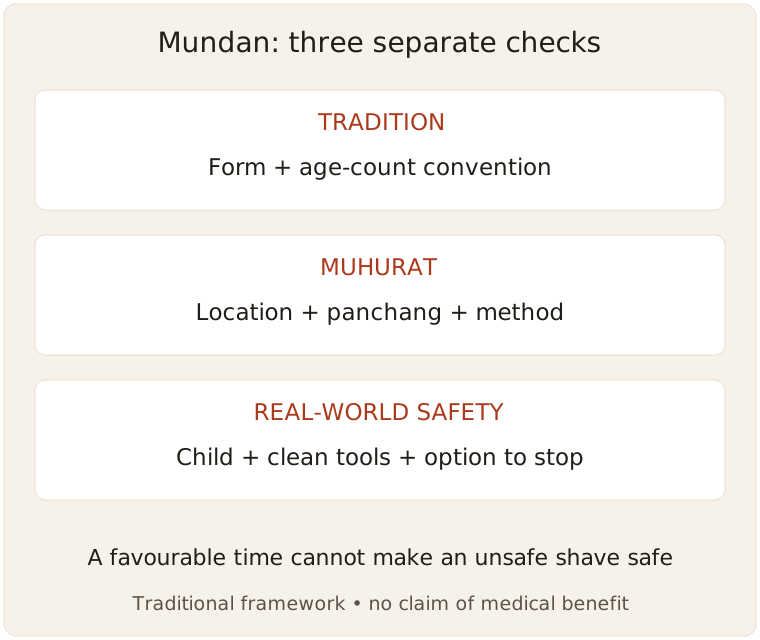
Keep family tradition, calendar rules and actual haircut safety separate. A favourable time cannot make an unsafe shave safe.
A first haircut can carry meaning without medical promises
Mundan, also called chudakarana or chudakarma, is a child's ceremonial first haircut or head-shaving in many Hindu families. Its meaning can include a welcome into family tradition, prayer, gratitude, or a shared memory. The form varies: one household expects a full shave, another keeps a tuft, and another marks the occasion with a small cut. A muhurat is a traditionally preferred time for the rite. It is not a medical prescription, proof that shaving improves hair, or permission to ignore a child's discomfort.
This guide separates three decisions that are often bundled together: whether and how the family wants to observe the rite, which timing convention it follows, and whether the actual haircut can be done safely. The first two are cultural choices. The third needs practical attention regardless of the calendar. No personal date is calculated here, and no temple, barber, paid remedy, or product is being recommended.
What the traditional texts actually disagree about
Manusmriti 2.35, in the translation and commentary hosted by Wisdom Library, places tonsure in the first or third year. The comparative notes on that page quote other authorities favouring the third year, allowing a family custom, or mentioning other ages. These are records of historical prescriptions, not a single contemporary rule for every child. The page's social classifications belong to its historical setting; they are not a standard for deciding which children deserve a ceremony or care.
Muhurta Chintamani 5.29, as translated on VedicPupil, begins with the third year and an odd-year convention. PujaDeep's cited summary of the same verse likewise describes the third or a later odd year, while its commentary note includes family practice and counting from conception or birth. A first-year family custom and a third-year textual rule should not be quietly rewritten as if they are identical. Identify the tradition before trying to choose a date.
The third year is not automatically the third birthday
Age language needs checking. In ordinary birthday counting, a child enters the third year after completing two years. A family saying after the third birthday means something else. Some traditional discussions also distinguish counting from birth and from conception. Do not assume that a calendar label settles the age question. Ask the person applying the rule what they mean, then record the agreed date range in civil dates.
This matters because confusion can create unnecessary urgency. Parents may be told that a preferred year is about to be lost when the speaker and parents are counting differently. A clear conversation should resolve the convention, not manufacture a deadline. If the child has a health issue or the family cannot manage the event, practical care comes first. There is no medical need to shave a head to satisfy an age label.
The calendar filters in one named method
The VedicPupil rendering of MC 5.29 describes Uttarayana, excludes Chaitra, and names Monday, Wednesday, Thursday, and Friday. It excludes several tithis, including the first, sixth, eighth, twelfth, rikta tithis, and parva days. PujaDeep's summary broadly follows this structure and expressly includes sankranti in its description of parva exclusions. These are rules of a particular ritual method, not evidence that another weekday causes harm.
Rikta commonly labels the fourth, ninth, and fourteenth tithis in these summaries. A tithi is a lunar interval, not the number printed on a civil calendar date. A date can contain a transition from one tithi to another. If a guide gives a suitable day but not the usable interval, ask whether it means the whole day or a shorter window. Never infer a personal muhurat just from a month name and weekday.
Nakshatras, exceptions, and the limits of a short list
The same MC verse uses soft, movable, and light nakshatra groups, adds Jyeshtha, and excludes Anuradha. That last exception is worth preserving because a reader may have seen Anuradha included for another ceremony, such as naming. Rules for one samskara are not interchangeable with rules for another. Copying a general auspicious-star list into a haircut guide can therefore misstate the source.
The verse also contains ascendant, navamsha, and house conditions. A simple date list that checks only tithi, weekday, and nakshatra is not necessarily checking all of them. Ask what the chosen service actually computes and what still needs interpretation. More detailed astrology is still traditional interpretation, not a safety inspection of the venue or tools. A chart cannot tell you whether a blade is clean or whether a child is moving too much for a close shave.
Why the ceremony city and time zone matter
PujaDeep describes its windows as city-specific, using local sunrise, panchang factors, and the times at which those factors change. Even two cities sharing a civil time zone do not necessarily have the same sunrise-based ritual day. A window copied from a relative's city should therefore be rechecked for the ceremony location. For a family abroad, use that venue's local date and time zone, including any seasonal clock change.
For planning, write a window's start and end, not merely an auspicious date. Record the method and the location beside it. If relatives join remotely, convert the ceremony's time into their time zones separately. This article does not publish annual dates because no individual venue or date range has been supplied. A responsible explanation of method is more useful than an invented timetable that looks precise.
Do not repeat frightening predictions as health facts
The traditional chapter contains claims about illness, longevity, planetary positions, and restrictions related to family circumstances. They belong to the source's historical astrological framework. Their presence in an old text does not establish a medical mechanism or a demonstrated risk to a particular child. This guide does not present those predictions as facts, diagnose anyone from them, or use them to pressure a parent into an urgent rite.
If a relative raises such a rule, ask which tradition they mean and whether a less burdensome option is acceptable within the family. Separate that conversation from actual medical care. A child's condition is assessed by an appropriate clinician, not by an ominous calendar label. No parent should be blamed for a child's illness because a haircut was postponed, simplified, or not performed.
Shaving does not make the hair grow thicker
University of Utah Health's pediatrician-led explanation directly rejects the claim that shaving a baby's head makes hair grow thicker. It also rejects the idea that a first haircut before the first birthday causes bad hair. Hair characteristics are not improved by choosing a lucky shave date. This lets a family decide about mundan for its cultural meaning instead of expecting a biological benefit that the procedure does not provide.
The dermatology article Tonsuring: Myths and Facts, published in the International Journal of Trichology, discusses a small study in which five adult men shaved one leg repeatedly and left the other as a comparison. No significant difference in hair weight, width, or growth rate was attributed to shaving. That is not an infant trial, and it should not be described as one. It is supporting context for the broader hair-growth myth, alongside the pediatric guidance.
Why regrowth may look different
The trichology article explains that short shaved shafts can look and feel coarser and that growth is easier to notice on a recently shaved area. Babynama's first-haircut guide likewise notes that blunt regrowing ends can appear different without changing the actual amount or thickness of hair. Appearance after a shave is not the same as creating more follicles or improving future hair quality.
Do not promise a specific texture, colour, density, or growth schedule after mundan. If parents are worried about unusual hair loss, scalp changes, or absent growth, they should discuss the concern with the child's clinician. Repeating a shave to correct a perceived failure can add irritation without addressing its cause. A cultural ceremony need not be defended with a medical claim to remain meaningful.
Clean equipment is a real requirement
The trichology review warns that unclean blades can lead to secondary bacterial infection and that reused, inadequately sterilised blades can transmit infections. Babynama also stresses clean equipment, an experienced person, and avoiding unsterile shared blades. These are practical risks attached to a procedure near skin. They are not predictions attached to a tithi. A favourable muhurat never compensates for poor hygiene.
Before agreeing to a close shave, ask how the person handles tools, whether a fresh single-use blade is opened for this child, and how reusable equipment is cleaned appropriately. A fresh blade does not make dirty hands, surfaces, or other equipment safe. Do not accept a quick wipe or a reassuring religious explanation as proof of proper practice. If the answers are unclear, decline or postpone the shave rather than treating the calendar as a reason to proceed.
A trim and a razor shave are different choices
A close razor shave can nick delicate skin, especially when a child turns suddenly. Babynama describes a simple trim with suitable scissors or clippers as a gentler option for very young babies than a close shave. That does not make any tool risk-free, and parents should choose someone experienced with children rather than try a new technique because a ceremony is approaching. This article is not a home shaving tutorial.
A family can ask whether a symbolic lock or a trim preserves what matters to them. Not every officiant or household will regard it as the same ritual, so confirm rather than claiming universal religious permission. The practical choice to avoid a blade remains valid even if a family decides to mark the cultural occasion differently. A child's comfort and safety are not bargaining chips in a disagreement about symbolism.
Prepare for the child who is actually present
Babynama recommends a fed, rested child, slow handling, and another adult to soothe and support. The important principle is responsiveness. A booking is not a promise that the child will stay still on demand. Arrange a quiet space, an unhurried appointment, and a way to pause. Tell the person doing the haircut that the parents may stop it at any time.
If a child is distressed, struggling, or unable to cooperate safely, stop rather than using force to finish before the window ends. Do not sedate a child or give medicine simply to make a ceremonial haircut easier without medical direction. Do not let photographs or guests' expectations make adults ignore distress. The memory worth keeping is a respectful family welcome, not proof that every last hair was removed on schedule.
A scalp problem is not something to shave away casually
If the scalp is sore, inflamed, injured, or affected by a condition the parents do not understand, ask the child's clinician before planning a close shave. This is a precaution, not a diagnosis. The review's discussion of hair removal in some medical conditions should not be converted into instructions to treat a child's skin problem at a ceremony. Medical uses depend on the condition and professional judgement.
Do not scrape scales, apply unproven pastes, or rub ritual substances into freshly shaved skin. Babynama specifically advises against unproven substances before or after the haircut. If the family wants a symbolic offering, keep it separate from the child's skin unless an appropriate health professional has advised otherwise. Tradition can be represented without turning a new cut or irritated scalp into a surface for experiments.
What to do if there is a cut
Babynama's guidance for a minor nick is to keep the area clean and use gentle, steady pressure with a clean cloth for bleeding. Stop the haircut. A deep wound, bleeding that does not stop, or an injury that worries the parent needs medical assessment. This article cannot assess the wound or give a personalised treatment plan, and a ceremony should never delay that assessment.
Seek medical advice for increasing redness, swelling, warmth, pus, feverishness, or a child who seems unwell. If an unclean or shared blade was used, explain exactly what happened to the clinician rather than guessing whether an infection occurred. Do not self-prescribe antibiotics, use ash as a dressing, or rely on a ritual remedy for a skin injury. Appropriate care is compatible with respect for the ceremony.
Aftercare, travel, and a manageable event
Babynama advises gentle washing and drying and watching the skin over the following days. It also recommends shade or a soft cap outdoors and keeping babies under six months out of direct sun. Follow the child's own care advice if there is a skin condition or injury. Do not assume a newly shaved scalp needs a strong oil, antiseptic, or cosmetic product; ask before adding treatments.
Keep the wider event manageable. Travel, queues, heat, noise, and smoke are practical considerations even if a temple appointment fits a calendar. Ask about clean facilities and a quiet place to feed or rest. Hair collection and disposal are family or venue matters; do not leave loose hair or sharp blades where children can reach them, and follow the venue's and local rules rather than assuming a river or public place accepts offerings.
A planning checklist that keeps the decisions separate
First agree on the family's meaning and preferred form: full shave, tuft, symbolic cut, or another observance. Next resolve the age-count convention, date range, city, and any traditional calendar checks. Then independently assess the child's condition, the person's experience, tool hygiene, a calm setting, and the ability to stop. Confirm costs only if a service is actually wanted; no purchase is required by this guide.
Keep a fallback such as a later appointment or a blessing without a haircut. Tell guests that the child's needs can change the plan. Do not publish a child's full birth details or photographs without parental agreement. A sound plan allows a cultural practice to remain meaningful while refusing unsupported promises about hair, health, or destiny. The muhurat can guide a family's ritual preference; it cannot replace clean tools, gentle handling, or care.
Sources consulted
- Manusmriti 2.35: tonsure ages and comparative notes
- Muhurta Chintamani chapter 5: translated verses 5.29 onward
- PujaDeep: cited chudakarana rules and city windows
- University of Utah Health: pediatric hair myths
- International Journal of Trichology: Tonsuring, Myths and Facts
- Babynama: first haircut, safety, aftercare, and warning signs


