Nadi Dosh: How 8 Points Go to Zero, and Which Rules Give Them Back
The heaviest koota in kundli matching: a good total of 28 with "Nadi 0/8" underneath — when this zero matters and when it does not.
A situation recurs constantly in kundli matching: the families exchange birth details, run the score, 28 out of 36, happiness on the phone; then someone opens the breakdown and there at the bottom sits "Nadi 0/8", and the mood changes. This article is the complete arithmetic of that zero: what a nadi is, how the 27 nakshatras divide into nadis, why 8 points go to zero, how many couples land in this position, which cancellation rules are widely accepted and which are disputed, and finally the caution that should come first of all, the birth time. Every rule with its source, and every effect statement as a claim.
What a nadi is: three groups of nine stars each
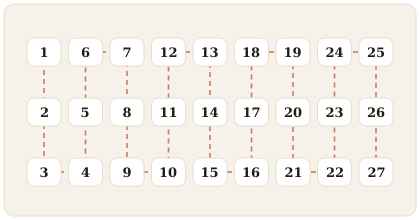
In the ashtakoota method the 27 nakshatras divide into three nadis: Aadi, Madhya and Antya. The names are tied to Ayurveda's three doshas, Vata, Pitta and Kapha, which is part of why the tradition reads Nadi for health, progeny and constitution; that is a reading tradition, not medicine. The stars do not fill the three groups in blocks: the pattern zigzags. Ashwini is Aadi, Bharani Madhya, Krittika Antya, then the order runs back: Rohini Antya, Mrigashira Madhya, Ardra Aadi. This six-star cycle repeats around the zodiac, and each nadi ends up with nine stars. The figure above shows this zigzag. The full list:
| Nadi | Ayurvedic tie | The nine nakshatras |
|---|---|---|
| Aadi | Vata | Ashwini, Ardra, Punarvasu, Uttara Phalguni, Hasta, Jyeshtha, Mula, Shatabhisha, Purva Bhadrapada |
| Madhya | Pitta | Bharani, Mrigashira, Pushya, Purva Phalguni, Chitra, Anuradha, Purva Ashadha, Dhanishtha, Uttara Bhadrapada |
| Antya | Kapha | Krittika, Rohini, Ashlesha, Magha, Swati, Vishakha, Uttara Ashadha, Shravana, Revati |
Note that only the birth star counts in this koota: the Moon's sign, the Lagna and the rest of the chart play no part in Nadi. ePandit's source page cites Muhurta Chintamani, Vivaha-prakarana verse 34, for this division; we have not opened that text ourselves, but the division was identical across every source we studied.
How 8 points go to zero
Nadi is the heaviest koota in ashtakoota: 8 of 36 points. And its scoring is all or nothing: different nadis take the full 8, the same nadi takes 0; there is nothing in between. So a shared nadi caps the total at 28, and families find a good total above a flagged dosha below. Now the proportion check. The model is this: each nadi holds 9 of the 27 stars, and over years of births the Moon spends about equal time in every star. Then the probability that two random people share a nadi is 3 times (9/27) times (9/27), that is 1/3: about one couple in three will share a nadi. The drishtiapp.in source article gives the same estimate. The meaning: a Nadi zero is no extraordinary event; it is an ordinary position for one couple in three, and reading a condition with that large a share as a "marriage-breaking curse" runs against the arithmetic itself.
Nadi's place within the ashtakoota
To understand Nadi, keep the whole ashtakoota table in view, because "8 points" makes sense only next to the other seven kootas. The method's eight kootas and their maximum points are: Varna 1, Vashya 2, Tara 3, Yoni 4, Graha Maitri 5, Gana 6, Bhakoot 7 and Nadi 8; the total is 36. The table shows two things. First, Nadi alone is about 22 percent of the total, so its zero is the largest single blow the score can take. Second, the remaining seven kootas add to 28 and measure distinct subjects: social classification, influence balance, star auspiciousness, physical compatibility, mental friendship, temperament class and sign relationship; a "match" is not one question but the sum of eight different ones. This is why one common piece of source advice is worthwhile: read the breakdown more than the total, because a total of 28 can mean "Nadi 0, everything else full" or "every koota slightly reduced", and the two situations raise different questions.
| Koota | Max points | Subject |
|---|---|---|
| Varna | 1 | Social classification |
| Vashya | 2 | Influence balance |
| Tara | 3 | Star auspiciousness |
| Yoni | 4 | Physical compatibility |
| Graha Maitri | 5 | Mental friendship |
| Gana | 6 | Temperament class |
| Bhakoot | 7 | Sign relationship |
| Nadi | 8 | Constitution, vitality, progeny |
The table allows one more proportion check: if a couple's Nadi is zero and every other koota is full, the total is 28, well above the commonly quoted "18 and above is acceptable" line. This is why the real families' dilemma is understandable: the number is good, the label is bad. The method's own answer is to settle the label by rule-checking, not by the number.
What the subject is: the idiom of progeny and constitution
Why are Nadi's points this heavy? The answer from paramarsh.app's ashtakoota page: the subject matter. Nadi is tied to vitality, constitution and progeny, so the classical language speaks in the idiom of lineage. The tradition's stated concern is that a same-nadi marriage may bring difficulty in the matter of children or constitutional mismatch in the couple's health. We repeat this as a claim: it is the tradition's reading, with no measured medical or biological basis; the Ayurvedic naming expresses an affinity, not a diagnosis. Know also that in modern counselling practice the working translation of this subject is "open conversation about family planning and health", not fear.
The cancellation rules, sorted from accepted to disputed
Ask three jyotishis for the Nadi cancellation list and you will get three lists that overlap without matching. drishtiapp.in has sorted them by acceptance, and we follow that order. The two most widely accepted rules first. One: same Moon sign, different nakshatras; say both Moons in Vrishabha, one in Krittika and one in Rohini. Two: same nakshatra, different Moon signs; nine stars straddle two signs, Krittika, Mrigashira, Punarvasu, Uttara Phalguni, Chitra, Vishakha, Uttara Ashadha, Dhanishta and Purva Bhadrapada, so two people born in one star can stand on opposite sides of the sign line. Beyond this the disputed zone begins. Three: same star, same sign, different padas; many lists cancel, while others treat a shared star as the heavier case, not the lighter, and when the pada is also shared almost no list cancels. Four: the Moon-sign lords being the same planet or mutual friends; some traditions apply this to Nadi, some only to Bhakoot. Five: exempt-star lists; the traditions do not agree on these lists, so we reproduce none. ePandit, citing Muhurta Chintamani, Vivaha-prakarana verse 36, lists three situations, same sign different nakshatras, same nakshatra different signs, same nakshatra different padas, with the text's own examples: Shatabhisha and Purva Bhadrapada (first three padas), both in Kumbha; Purva Bhadrapada's first three padas (Kumbha) against its fourth pada (Meena); Bharani's first and second padas. We have not opened that text ourselves; the account rests on ePandit's citation. And one negative rule that belongs in every honest list: a high total does not cancel Nadi Dosh; a 28 with Nadi at zero still leaves the Nadi question open.
Five example couples
drishtiapp.in built five made-up couples to show how differently the situation plays out even when the nadi is shared; here is the summary. Couple one: both Moons in Vrishabha, one Krittika one Rohini; rule one applies, the dosha is not counted. Couple two: both Punarvasu, one Karka one Mithuna; rule two applies, but their Bhakoot score was zero, so the question moved from Nadi to Bhakoot. Couple three: both Vrishabha-Rohini with different padas; the third, disputed rule applies, and the source honestly says the traditions are split here. Couples four and five: Ardra-Hasta and Mula-Shatabhisha, different stars in different signs; no star-sign rule applies, and the source's advice is that such cases go to a jyotishi with both full charts, not to a verdict on the score. The lesson is plain: "Nadi 0/8" is one label, but it covers at least five different situations, and each situation has a different answer.
The birth-time caution
The most important check before any matching reading is not about the nadi but about the clock. The Moon stays in a nakshatra for about a day, and the star can change within a few hours; a two-to-three-hour uncertainty in birth time can change the nakshatra, and with it the nadi. If either person's birth time is approximate, the Nadi result is exactly that approximate. In that position the first step is settling the birth time, and only then the matching. This order applies to every dosha reading: first fix the datum, then the interpretation.
One more practical subtlety: do not read a matching report in reverse order. First verify both birth details, date, time, place; then match the nakshatras and signs against the table; then read the eight-koota breakdown; then, if a Nadi zero appears, apply the two widely accepted rules; and only at the end, if the question remains open, place both full charts before a qualified jyotishi. Every step of this order is free and can be done at home; even the last step should stay within a one-time consultation fee. A process that starts at the last step and immediately advises an expensive cure is not method but sales.
The balanced view
This article's position is plain. Treating a Nadi zero as, by itself, a bar to marriage goes against both the arithmetic and the method: the position arrives for one couple in three, and the widely accepted cancellation rules cover a large share of them. At the same time, waving the scoring system away entirely is unfair to the families who have practised it for centuries: the useful path for them is to check the rules in order, to call the disputed ones disputed, and to rest the final decision not on the score but on conversation, a full chart review and both families' informed consent. The summary line of ePandit's source page carries the same spirit: "talk it over, then go ahead", not "stop".
Common confusions
First confusion: Nadi Dosh means there will be no children. That is the tradition's subject of concern, not a diagnosis; it has no measured basis, and the cancellation rules already settle a large number of cases. Second: a good total of 28 has erased the dosha. No list says so; the Nadi question stays open until a named rule settles it. Third: sharing one nakshatra is the most dangerous case. The traditions are split: many treat same-star-different-sign as full cancellation; same star and same pada is where the disagreement runs deep, and the honest answer is to report the disagreement, not to hide a side. Fourth: an expensive puja is mandatory for Nadi Dosh. Within the matching method the answer is not a ritual but rule-checking and a full chart review; pressure to spend is a warning sign.
Practical use
Use this article in three ways. First, as method literacy: with the nadi table you can check the Nadi line of any matching report yourself, look up both stars in the table, and if a zero appears, apply the two widely accepted rules immediately. Second, as decision safety: on hearing "there is Nadi Dosh, stop the marriage", ask which cancellation rules were checked and which were not, and how certain the birth time is. Third, for family conversation: raise the level of the debate by calling the disputed rules disputed; where traditions are split, declaring one jyotishi's list the final truth is not honesty but partisanship.
Sources and the honesty note
The nadi division table, the 8-points-to-zero rule, and the citations of Muhurta Chintamani Vivaha-prakarana verses 34 and 36, including the text's examples, come from ePandit's Nadi Dosha page (epandit.in); we have not opened that text ourselves, the citations are the source's. The description of the zigzag order, the one-in-three couples estimate, the acceptance-sorted cancellation list, the five example couples, the "no high total cancels" rule and the birth-time caution come from the drishtiapp.in article; we independently verified the one-in-three figure from the table (each nadi holds 9 of 27 stars, uniform-distribution model). The subject matter, vitality, constitution, progeny, is from paramarsh.app's ashtakoota page. The Ayurvedic correspondence of the nadi names was checked against saravali.github.io's koota page. Everything about effects is presented as the tradition's claim; there is no established measured link between kundli matching and marriage outcomes. This article is educational; it makes no claim about any couple's marriage or future.