Nakshatra lords and the Vimshottari dasha: the 120-year clock
Which nakshatra belongs to which lord, how the dasha balance is derived, and what the traditional method of dasha reading is.
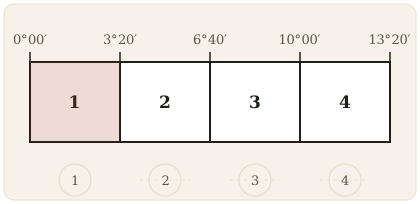
The Vimshottari dasha is the most widely used timing cycle of Jyotish, and its foundation is the lords of the nakshatras. Each of the twenty-seven nakshatras has a planetary lord: nine lords running from Ketu to Mercury, each holding three nakshatras. The fixed years of these lords add up to the 120-year cycle, and the nakshatra the Moon occupies at birth decides which lord starts the clock of a life's dashas. In this article we open the whole system: which nakshatra belongs to which lord, what the year table says, how the balance of the first dasha is derived, what the antardasha arithmetic is, and what the interpretive tradition says - along with the boundary where dasha interpretation must stop.
Who is a nakshatra lord
In Jyotish the word "lord" appears in two different senses: sign lords, who rule the twelve rashis, and nakshatra lords, who rule the twenty-seven nakshatras. The nakshatra-lord arrangement is among the oldest layers: the seven planets plus the two shadow points, Rahu and Ketu, make nine lords, and each is assigned three nakshatras. The assignment is even: 27 nakshatras, 9 lords, 3 nakshatras per lord, and the three nakshatras of a lord sit exactly 120 degrees - a trine - apart. Ashwini, Magha and Mula belong to Ketu; these are the opening 13 degrees 20 minutes of Aries, Leo and Sagittarius respectively. The meaning of this trinal symmetry is that the lord assignment is no arbitrary list but a symmetric structure of the ecliptic.
The table of the nine lords
Verified against two independent sources, one modern methodology page and one classical-reference site, this table is the backbone of the whole system:
| Lord | Nakshatras | Years |
|---|---|---|
| Ketu | Ashwini, Magha, Mula | 7 |
| Venus | Bharani, Purva Phalguni, Purva Ashadha | 20 |
| Sun | Krittika, Uttara Phalguni, Uttara Ashadha | 6 |
| Moon | Rohini, Hasta, Shravana | 10 |
| Mars | Mrigashira, Chitra, Dhanishta | 7 |
| Rahu | Ardra, Swati, Shatabhisha | 18 |
| Jupiter | Punarvasu, Vishakha, Purva Bhadrapada | 16 |
| Saturn | Pushya, Anuradha, Uttara Bhadrapada | 19 |
| Mercury | Ashlesha, Jyeshtha, Revati | 17 |
| Total | 27 nakshatras | 120 |
Note that the order of years is bound to the order of lords: after Ketu come Venus, then Sun, Moon, Mars, Rahu, Jupiter, Saturn and Mercury, and then back to Ketu. This same order runs in both mahadashas and antardashas.
The trinal symmetry: nakshatras tiled across three element cycles
Read the table closely and a beautiful pattern emerges: each lord's three nakshatras sit at the same degree-position within signs of one element. Ketu's nakshatras, Ashwini, Magha and Mula, stand at the start of the fire signs Aries, Leo and Sagittarius; Venus's nakshatras stand in their middle; the Sun's nakshatras at their end. Then the nakshatras of the Moon and Mars continue the same march through the earth signs Taurus, Virgo and Capricorn, those of Rahu and Jupiter through the air signs Gemini, Libra and Aquarius, and those of Saturn and Mercury through the water signs Cancer, Scorpio and Pisces. In other words, the nine lords tile the ecliptic across the three element cycles, keeping the Ketu-to-Mercury order intact through every cycle. The practical benefit of this structure is memorability: if you know the lord of one nakshatra, the lords of the other two nakshatras at the same degree-position come free. And its mathematical essence is that the lord assignment stands on the ecliptic's 120-degree trinal symmetry.
The logic of the sequence: Ketu to Mercury
This order - Ketu, Venus, Sun, Moon, Mars, Rahu, Jupiter, Saturn, Mercury - matches no common sequence of the Vedic week or of planetary distances, and the texts do not explain it. The tradition has offered several symbolic explanations, but the honest answer is that the sequence is ancient and its original reasoning is not preserved in translated texts. What is stable is the usage: this same order, these same years and this same trinal assignment appear identically in every traditional calculation. Even after verification from two independent sources, we present it in the form the tradition gave it: as a received system, not as a derived theorem.
The 120-year cycle: the year table
The word "Vimshottari" means "related to one hundred and twenty": the years of the nine lords total 120, which the tradition counted as the full span of a human life. The distribution of years is uneven: Venus holds the most at 20 years, the Sun the least at 6. This unevenness is part of the interpretation: in the tradition, a long dasha gives that planet's subjects a long stage in life, a short dasha a brief but focused chapter. One arithmetic detail is worth knowing: traditional calculation runs on the 365.25-day year, so dasha boundaries land on exact dates, not rounded to whole years. This detail matters because many popular tables round dasha boundaries to the year; the traditional method is more precise than that.
The balance of the birth dasha: why the first mahadasha is partial
Birth almost never falls at the start of a nakshatra, so the first mahadasha is not full but partial. The rule is simple: whatever fraction of the nakshatra the Moon has already crossed, that fraction of the lord's dasha is counted as elapsed; multiplying the remaining fraction by the lord's full years gives the dasha balance at birth. Example: the Moon stands at 20 degrees of Aries, the exact middle of Bharani nakshatra. Bharani's lord is Venus, with 20 years in all. Half the nakshatra has elapsed, so the Venus balance at birth is 10 years. After that, the Sun's 6, the Moon's 10, Mars's 7 and the following dashas attach in order. This is why the position within the nakshatra, the same figure from which the pada is derived, is the input of dasha calculation - and why a dasha table becomes guesswork without an accurate birth time.
From birth nakshatra to starting lord: step by step
The full procedure for knowing your own dasha sequence has five steps. Step one: find the Moon's sidereal longitude at birth from a reliable panchang or chart software, and note which ayanamsa it uses. Step two: divide the longitude by 13 degrees 20 minutes to get the nakshatra, as the pada article in this series explains. Step three: read that nakshatra's lord from the table above; that is the first mahadasha. Step four: derive the remaining fraction from the Moon's position within the nakshatra and multiply it by the lord's years; this is the balance of the first dasha. Step five: then keep attaching the following dashas in the fixed order, each for its full years. This entire arithmetic can be done by hand, and it is the reliable way to check any software's output.
The antardasha arithmetic: the rule of proportion
Every mahadasha divides into nine antardashas, and the rule of division is proportion: multiply the mahadasha years by that antardasha lord's years and divide by 120. Antardashas begin with the mahadasha's own lord and run in the same fixed order. The source's worked example: the Moon's mahadasha is 10 years, so the Moon-Moon antardasha is 10 times 10 divided by 120, equal to 10 months, and the Moon-Mars antardasha is 10 times 7 divided by 120, about 7 months. Pratyantardashas and still finer levels follow from the same proportion. The arithmetic is entirely rule-bound: if the birth-dasha balance is right, the whole tree builds itself; and if the birth time is doubtful, the lower levels are just as uncertain.
Dasha lord and nakshatra lord: two different roles
A subtle but useful distinction: every planet in a chart carries two identities - what it is, and which nakshatra it sits in. The dasha is run by the nakshatra lord, but the results are delivered by the occupying planet from its chart position. The tradition has also read a planet as the "messenger" of its nakshatra lord: whatever nakshatra a planet sits in, it is held to carry forward that lord's subjects during its own dasha and antardasha. This makes interpretation two-layered: the lord of the running dasha, its chart position, and the lord of the nakshatra it occupies - all three together make the traditional reading. This structure shows that in the tradition, dasha interpretation is not a key-table but a layered analysis, and drawing conclusions from a single indication violates that very method.
The mahadasha lord as lagna
One central technique of the interpretive tradition is to read the chart with the running mahadasha's lord as a temporary lagna for that period. That lord's sign, house, strength and aspects are held to set the shape of the period's subjects, and the antardashas are evaluated relative to that same temporary lagna. The source texts add several more elements: the mutual friendship and enmity of the dasha and antardasha lords, their positions in the navamsa, and according to one school, giving the lords' "natural" character only about fifteen percent of the total weight, the rest to chart placement. The shared essence of all this is: dasha reading is not a game separate from the chart. General sentences like "Saturn's dasha is hard for everyone" run exactly against this method.
A scholarly fact: Saravali and Brihat Jataka do not mention Vimshottari
A little-known fact is recorded in scholarly sources: some major classical texts, such as the Saravali and the Brihat Jataka, do not mention the Vimshottari dasha at all, while the Brihat Parashara Hora Shastra is counted as its principal source. This does not mean the system is invalid; it means that the tradition of Jyotish was built and changed over time, and what looks "eternal" today is also the gift of a specific textual lineage. We state this because dasha systems are often presented as unalterable astronomical laws; they are time-organising systems constructed by the tradition. Their use is coherent within the tradition, but knowing this history automatically moderates the language of claims made upon them.
Other dasha systems: Yogini and Kalachakra
Vimshottari is not the only dasha system. The tradition holds Yogini, Kalachakra, Narayani and many other dashas, some nakshatra-based, some sign-based. The source texts also give a traditional rule: when more than one dasha system times the same subject together, the tradition counts that as stronger. The balanced meaning of this rule is that the tradition itself does not treat a single system's conclusion as final and wants cross-verification. The lesson to draw is that acting on a single dasha indication goes against the tradition's own method - not that the agreement of several systems makes an event certain.
Arithmetic cautions
The three cautions of dasha calculation are like those of pada calculation, but heavier, because the error spreads over years. First, birth time: the Moon changes nakshatra roughly every day, so a difference of hours in birth time brings a difference of months in the dasha balance; do not build detailed conclusions on a dasha table made from an estimated birth time. Second, ayanamsa: the sidereal longitude depends on the ayanamsa chosen; the dasha dates of two different panchang traditions can come out different. Third, the year-value: a 365.25-day year versus a plain 365-day year shifts boundaries by weeks over long dashas; know which value your table is built on. Even after all three, a dasha table is the arithmetic of time, not the announcement of events.
Common confusions
First confusion: a dasha is a decree of fate. In the tradition a dasha is a schedule of which subjects' stage is active; what happens on that stage is made by chart placement, circumstance and effort. Second confusion: a given planet's dasha is the same for everyone. The tradition's own rule says the opposite: the lord's chart placement and its position relative to the lagna decide the results, not the planet's name. Third confusion: dasha dates print the date of events. The arithmetic gives dates, not events; reading a date as an event is the language of prediction-sellers. Fourth confusion: a "bad" dasha can be escaped by buying a remedy. In the tradition the answer to a dasha is a balanced life in that planet's own subjects, not fear-based purchases.
Practical use: reading your own dasha sequence
The balanced way to read your dasha: first know which mahadasha and antardasha are running now. Then look at those lords in your chart: which house they sit in, which sign, which planets they join. Third step: look at which subjects they rule from your lagna - those subjects are counted as the stage of that period. After that, take the period as an invitation to pay attention to those same areas of your life, not as an order for decisions. And at the end, the same limit this series holds: the dasha table is a beautiful framework of time-conception; making it the sole criterion of life decisions is neither the tradition's intent nor responsible behaviour.
A note on sources and honesty
The facts in this article come from sources actually opened and read: for the year table, the balance method, the antardasha proportion and the 365.25-day year, panchangtime.com's Vimshottari methodology page; for the lord-nakshatra mapping, the worked antardasha example, the interpretive principles and the scholarly fact of absence from the Saravali and Brihat Jataka, saravali.github.io's Vimshottari page; and for an independent check of the nakshatra-lord mapping, satyori.com's 27-nakshatra reference table. Both lists were found to match completely. Where texts are named, they rest on the references in these secondary sources; we have not consulted the original Sanskrit texts directly. This article is educational; it offers no guarantee about any person's future, any event or its date.
Questions on this article
Who are the nakshatra lords?
Nine: Ketu, Venus, Sun, Moon, Mars, Rahu, Jupiter, Saturn and Mercury. Each lord holds three nakshatras, sitting 120 degrees - a trine - apart. This fixed order runs the Vimshottari dasha.
How is the first dasha at birth determined?
The lord of the nakshatra the Moon occupies at birth runs the first mahadasha. Whatever fraction of the nakshatra the Moon has crossed is counted as elapsed; the remaining fraction times the lord's full years gives the dasha balance.
How is an antardasha calculated?
By proportion: mahadasha years times the antardasha lord's years, divided by 120. In the Moon mahadasha of 10 years, Moon-Moon is 10 times 10 divided by 120, equal to 10 months. Antardashas start from the mahadasha lord and run in the same fixed order.
Is a dasha a declaration of the future?
No. In the tradition a dasha is a schedule of which subjects' stage is active; results are made by the lord's chart placement, circumstance and effort. Dasha dates do not print event dates, and acting on a single dasha indication goes against the tradition's own method.


