Nakshatra padas explained: the arithmetic of the 108 quarters
The full arithmetic of the pada system: the quarter of a nakshatra, its link to the navamsa, and how to read the pada in your own chart.
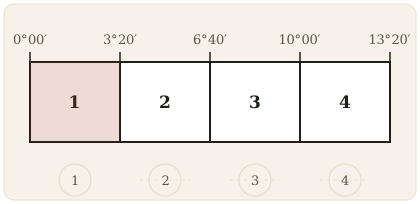
The nakshatras are the oldest layer of Jyotish: before the twelve signs, the sky was divided into twenty-seven star-segments. But knowing a nakshatra's name is only half the information. Every nakshatra has four equal parts called padas, or charanas, and in the tradition the real precision lives at this level. Saying "the Moon is in Rohini" and saying "the Moon is in the third pada of Rohini" are two different pieces of information in a traditional reading. In this article we work through the full mathematics of the pada system: how many degrees one pada spans, where the number 108 comes from, how a pada yields its navamsa sign, and how to read the pada in your own chart. We will also be explicit about what this system shows and what it does not.
What a pada is: the quarter of a nakshatra
The full ecliptic spans 360 degrees, and divided among twenty-seven nakshatras, each nakshatra covers 13 degrees 20 minutes. Split that into four equal parts and one pada is exactly 3 degrees 20 minutes. For example, Ashwini nakshatra runs from 0 to 13°20' of Aries; its first pada covers 0 to 3°20', the second 3°20' to 6°40', the third 6°40' to 10°, and the fourth 10° to 13°20'. The word "pada" means foot or step: the nakshatra is a path and the padas are four steps placed upon it. That is why several texts also call them charanas. The division is equal: no pada is larger or smaller than another, which is evidence that the nakshatra system is astronomically grounded. These are not imaginary lines drawn in the sky; they are an ancient mathematical grid for measuring the Moon's motion.
The number 108: astronomical arithmetic and cultural weight
Twenty-seven nakshatras times four padas equals 108 padas: 108 equal divisions of the entire ecliptic. This number is counted as extraordinarily sacred in Indian traditions: the 108 beads of a japa mala, the 108 names of deities, the 108 Upanishads of the Muktika canon, the 108 steps of temples. From the Jyotish angle, the interesting fact is that the astronomical basis of 108 is precisely this nakshatra-pada structure: the number of distinct celestial positions the Moon can occupy is 108. The sources also note a coincidence: the average distance from the Earth to the Sun is roughly 108 times the Sun's diameter, and the distance to the Moon roughly 108 times the Moon's diameter. We leave that as a coincidence: whether ancient astronomers observed it is not proven, and it changes nothing about the pada system's arithmetic. What matters is that the 108 padas are a real, computable astronomical grid.
Pada and navamsa: two names for one grid
The pada system's most elegant property is that the 108 padas sit exactly on the 108 cells of the navamsa chart. The navamsa, the D-9 chart, is held to be the most important divisional chart in Jyotish after the rashi chart. The method of building it is this: divide each sign's 30 degrees into nine parts of 3 degrees 20 minutes, and assign each part a navamsa sign. Since a nakshatra pada is also 3 degrees 20 minutes, every pada equals one navamsa cell. The practical consequence: the moment you know a planet's pada in the birth chart, its navamsa sign is known automatically, and a planet's position in the navamsa chart is impossible without the pada calculation. This is the mathematical bridge that joins the nakshatra system to the sign-based varga system.
How the navamsa sign is derived: starting from the element
Which navamsa sign a pada receives is ruled by the element of the sign the nakshatra falls in. For the fire signs, Aries, Leo and Sagittarius, the navamsa count begins from Aries. For the earth signs, Taurus, Virgo and Capricorn, from Capricorn. For the air signs, Gemini, Libra and Aquarius, from Libra. And for the water signs, Cancer, Scorpio and Pisces, from Cancer. Then you count forward by the number of padas elapsed within that sign. Example: Ashwini is in Aries, a fire sign, so its four padas are, in order, Aries, Taurus, Gemini and Cancer navamsas. Rohini begins at 10 degrees of Taurus, that is, at the fourth navamsa of Taurus; counting forward from the earth-sign start of Capricorn, Rohini's four padas come out as Aries, Taurus, Gemini and Cancer navamsas. This is why a nakshatra's navamsa sign is usually different from the sign the nakshatra occupies, and that difference is exactly what makes pada analysis meaningful.
Finding the pada: step-by-step arithmetic
If you have the sidereal longitude of the Moon or any planet, the nakshatra and pada fall out in four steps. Step one: divide the longitude by 13 degrees 20 minutes, 13.333 in decimal, and take the floor; that is one less than the nakshatra number. Step two: add one; that is the nakshatra's serial number. Step three: subtract the nakshatra's start to get the position within the nakshatra. Step four: divide that position by 3 degrees 20 minutes, take the floor, add one; that is the pada, from one to four. Remember that this computation runs on the sidereal longitude: from a tropical, Western, longitude you first subtract the ayanamsa, and the choice of ayanamsa can shift the pada of a planet sitting near a boundary. Modern chart software does this calculation itself, but knowing the method matters so that any output can be checked.
A worked example: Hasta nakshatra, pada 3
Suppose the Moon's sidereal longitude is 167.3 degrees. Step one: 167.3 divided by 13.333 gives 12.548; the floor is 12. Step two: the nakshatra number is 13, Hasta, which spans 160 to 173.33 degrees. Step three: 167.3 minus 160 equals 7.3 degrees, the position within the nakshatra. Step four: 7.3 divided by 3.333 gives 2.19, floor 2, plus one gives pada 3. Now the navamsa sign: Hasta is in Virgo, an earth sign, so the count begins from Capricorn. Hasta's first pada, 160 to 163 degrees 20 minutes, is Virgo's fourth navamsa, so pada 3 is Virgo's sixth navamsa. Count from Capricorn: Capricorn one, Aquarius two, Pisces three, Aries four, Taurus five, Gemini six. The navamsa sign of Hasta pada 3 is Gemini. The same arithmetic can be repeated for any planet, and it matches the standard navamsa tables: Hasta's four padas are, in order, the Aries, Taurus, Gemini and Cancer navamsas.
One nakshatra, four shades: how the pada changes expression
In the tradition the nakshatra supplies the base energy and the pada, through its navamsa sign, gives it direction and colour. The traditional illustration given in the sources is Ashwini: in the first pada, whose navamsa sign is Aries, Ashwini's healing swiftness is held to take a pioneering, action-oriented form; in the second pada, Taurus navamsa, the same energy in a settled, material form; in the third pada, Gemini navamsa, with intellectual curiosity; and in the fourth pada, Cancer navamsa, with nurturing and emotional care. Likewise two people whose Moon sits in the same nakshatra Bharani, one in the first pada and one in the fourth, are read in the tradition as very different expressions of the same energy. Read these examples within limits: they are the tradition's illustrations of symbolic style-differences, not proof of any person's character. A small difference in birth time can change the pada, so person-specific claims on this basis demand even more restraint.
Pushkara navamsas: twenty-four special padas
Of the 108 padas, the tradition has designated twenty-four as Pushkara navamsas: specially auspicious positions where planets are held to gain extra benefic strength. These fall in the navamsa signs of Cancer, Taurus, Pisces and Sagittarius, signs tied to the natural benefics Moon, Venus and Jupiter. The traditional uses are two: a planet placed in a Pushkara navamsa in the birth chart is held to carry a special strength that reduces other weaknesses, and in muhurta, electional astrology, placing the lagna or the Moon in a Pushkara navamsa is said to increase the auspiciousness of the chosen moment. The same limit applies here too: Pushkara navamsa is part of the tradition's auspiciousness list, not a guarantee of any event, and using it to escape a bad time or to secure a certain outcome would go beyond the texts' method.
Naming syllables: the pada and the naming tradition
The most living folk-use of the pada system is name-giving. In the tradition, each pada carries one or more syllables, and the custom is to name a child with the syllable of the pada in which the Moon stood at birth. The four padas of Ashwini are held to carry the syllables chu, che, cho and la; every pada has its own syllables in the same way. The arithmetic of this custom is the same as described above: the birth-time Moon, its sidereal longitude, the nakshatra, and then the pada. One practical caution is needed here: syllable lists differ by tradition and region, so for naming, the list of your own family or community tradition is the right one to use. Naming syllables are a cultural practice; treating them as an instrument that changes destiny is not the method of this series.
Dasha and pada: the starting point of Vimshottari
The pada's position is also the basis of dasha calculation at birth. In the Vimshottari dasha system, life's first mahadasha belongs to the lord of the Moon's birth nakshatra, but how much of that dasha remains at birth depends on how much of the nakshatra the Moon had already crossed. The Moon's position within the nakshatra, the very figure from which the pada is derived, is the input of this balance calculation. That is why two infants born on the same day in the same nakshatra, one in the first pada and one in the fourth, can have dasha starting points years apart. This is also why an accurate birth time and the correct ayanamsa are decisive for dasha calculation, and why Vimshottari interpretation without pada-level information remains guesswork.
Arithmetic cautions: near the boundary
Three error sources recur in pada calculation. First, a planet near a boundary: if the Moon lies within a few arc-minutes of a pada boundary, a one-minute difference in birth time or a difference of ayanamsa will change the pada, and with it the navamsa sign. Second, the ayanamsa itself: the choice of Lahiri, Raman or another ayanamsa changes the sidereal longitude; for boundary-sitting planets this difference becomes decisive. Third, rounding: cutting decimals in intermediate steps can corrupt the final pada; compute at full precision and take the floor only at the end. All three carry one teaching: pada arithmetic is small but sensitive, and in boundary cases two different pieces of software can show different padas; in such cases verify the inputs before settling on any conclusion.
Common confusions
First confusion: the pada is only a fine decoration; the nakshatra alone is enough. The tradition disagrees: the pada alone fixes the navamsa position, and the navamsa is counted the most important varga after the rashi chart; navamsa reading without the pada is simply impossible. Second confusion: a pada's navamsa sign is the same sign the nakshatra falls in. The arithmetic above has shown that the navamsa sign runs by the element sequence and differs from the nakshatra's sign for most padas. Third confusion: some padas are "bad." Padas are names of divisions, not columns of defects; declaring a pada inauspicious to sell fear is not the texts' method. Fourth confusion: a pada can announce events. The pada system is a measuring grid; the interpretation built on it is the tradition's symbolic reading, not an announcement-machine for the future.
Practical use: reading the pada in your own chart
A simple method for reading padas in your own chart: first find the nakshatra and pada of your Moon and your lagna, because the tradition gives these two points the most weight. Then look at the navamsa signs of those padas and see where these planets land in the navamsa chart. If you are interested in traditional practices like naming or muhurta, pada arithmetic is their key. And if you follow the Vimshottari dasha, remember that the pada position fixes the balance of the birth dasha. Through all of this, one restraint: pada information makes a chart more precise, not its claims. However fine the grid, the interpretation stays just as symbolic.
A note on sources and honesty
The facts in this article come from sources actually opened and read: for the pada system, the arithmetic of 108, the element-based navamsa derivation, the worked examples and Pushkara navamsas, dekhopanchang.com's lesson "Padas and Navamsha"; for the spans, rulers and deities of the twenty-seven nakshatras, satyori.com's "27 Nakshatras Reference"; and for checking the pada-by-pada degree boundaries, epandit.in's pada page. One secondary source's worked example contained a navamsa-counting error; this article verified the example's arithmetic independently against the standard navamsa table and corrected it. Where texts are named, such as the Brihat Parashara Hora Shastra or the Brihat Jataka, they rest on the references in these secondary sources; we have not consulted the original Sanskrit texts directly and do not present it otherwise. The connection between the Sun-Moon distances and 108 is presented as a coincidence, not as a proven ancient observation. This article is educational; it offers no guarantee about any person's nature, future or any event.
Questions on this article
What is a nakshatra pada?
The four equal parts of each nakshatra are called padas; one pada spans exactly 3 degrees 20 minutes. The twenty-seven nakshatras have 108 padas in all, and each pada equals one navamsa cell.
How is the navamsa sign derived from a pada?
The count starts from the sign's element: fire signs from Aries, earth from Capricorn, air from Libra, water from Cancer. Then the number of padas elapsed within that sign is counted forward. A pada's navamsa sign usually differs from the nakshatra's sign.
Where does the number 108 come from?
27 nakshatras times 4 padas equals 108: 108 equal divisions of the ecliptic, sitting exactly on the 108 cells of the navamsa chart. The 108 in the Sun and Moon distances is presented as a coincidence, not as a proven ancient observation.
Are some padas bad?
No. Padas are names of divisions in a measuring grid, not columns of defects. The tradition names 24 padas as Pushkara navamsas, but that is part of an auspiciousness list, not a guarantee of events. Declaring a pada inauspicious to sell fear is not the texts' method.


