Nakshatra yoni compatibility: the full arithmetic of the 14 yonis and the scoring table
Which nakshatra has which yoni, how the points are distributed, and why a yoni score must be read together with its table.
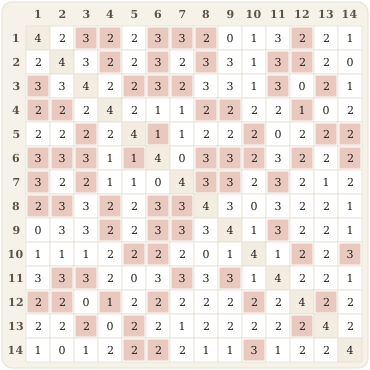
Yoni kuta is the fourth of the eight kuta checks in traditional kundali matching, worth 4 of the total 36 points. Every nakshatra carries an animal symbol: 14 yonis across 27 nakshatras. In match-making, the two birth nakshatras' yonis are looked up in a table that awards 0 to 4 points. This article opens out the full arithmetic of the method: which nakshatra has which yoni, how the points are distributed, and what our own check found - that while the nakshatra-to-yoni list is stable across sources, the scoring table is not: two prominent sources' 196-cell tables differ in 72 cells. That is why the right way to read a yoni score is to understand its structure, not to treat any single number as a verdict.
What yoni kuta is and where it sits in the ashtakoota
Ashtakoota matching is a method of eight checks: varna, vashya, tara, yoni, graha maitri, gana, bhakoot and nadi, totalling 36 points. Nadi carries the most at 8, bhakoot 7, and yoni 4. So yoni kuta is a mid-weight check, not a decisive one. In the tradition it symbolises the couple's physical and temperamental affinity: the word "yoni" originally refers to the reproductive organ, and the method gave each nakshatra an animal form to imagine its "nature". The entire structure is one of symbols: the animal symbols are poetry, not biology. This article's method is to understand the system within its own rules, not to treat its verdicts as facts.
The 14 yonis and 27 nakshatras: the full list
Cross-checking both sources, the nakshatra-yoni list proved stable. Ashwini and Shatabhisha: ashwa, the horse; Bharani and Revati: gaja, the elephant; Krittika and Pushya: mesha, the sheep; Rohini and Mrigashira: sarpa, the serpent; Ardra and Mula: shwana, the dog; Punarvasu and Ashlesha: marjara, the cat; Magha and Purva Phalguni: mushaka, the rat; Uttara Phalguni and Uttara Bhadrapada: gau, the cow; Hasta and Swati: mahisha, the buffalo; Chitra and Vishakha: vyaghra, the tiger; Anuradha and Jyeshtha: mriga, the deer; Purva Ashadha and Shravana: vanara, the monkey; Uttara Ashadha: nakula, the mongoose; and Dhanishta and Purva Bhadrapada: simha, the lion. Note that the mongoose gets only one nakshatra; one tradition counts the Abhijit nakshatra as the twenty-eighth and pairs it with the mongoose, distributing the yonis over 28 nakshatras. The Sanskrit names are worth keeping alongside the English ones, because different tables translate the animals unevenly: mriga appears as deer or hare, mesha as sheep, goat or ram, and shwana once even surfaces mistyped as swan in a software table. The Abhijit question comes later. Notice also that the yoni assignment does not follow the nakshatra order: adjacent nakshatras have different yonis. This is not a continuous mathematical sequence like the pada or element cycles but a received list, preserved as given; both sources match it exactly.
How the points are distributed: the ladder from 0 to 4
The matching rule is simple: same yoni, 4 points; friendly yonis, 3; neutral, 2; inimical, 1; and sworn-enemy yonis, 0. The sworn-enemy pairs are seven, and both sources agree on them completely: horse-buffalo, elephant-lion, sheep-monkey, serpent-mongoose, dog-deer, cat-rat and cow-tiger. Each pair rests on a well-known natural enmity: the mongoose is the serpent's enemy, the cat the rat's, the tiger the cow's. The tradition calls a zero-point match "yoni dosha". But the table is not limited to these seven pairs: every one of the 196 combinations of the 14 yonis carries a fixed score from 0 to 4, and that is where the story turns interesting.
Our check: the two source tables differ in 72 cells
We opened the full 14-by-14 scoring tables of two sources and compared them cell by cell: the table implemented in a well-known software, Maitreya, and a traditional printed table. The result: of 196 cells, 124 are identical and 72 differ. On the diagonal, the same-yoni cells, both give 4; on all seven sworn-enemy pairs both give 0. The disagreement lives in the middle scores, 1, 2 and 3: the traditional table awards 3 in far more places, the software table mostly 2 in the same places. One more technical finding: the software table has four asymmetric cells, where the score from A to B differs from B to A, probably printing errors; the traditional table is fully symmetric. The practical meaning is serious: the same couple's yoni score can come out 2 from one table and 3 from another.
What this disagreement means: read the system, not the number
A difference of 72 cells proves that the yoni score is no astronomical deduction but a tradition-built table that circulates in different versions. If two credible sources give the same pair 2 and 3 points, hanging a decision as large as marriage on that one-point gap contradicts the method itself. Two conclusions follow for the sensible reader. First: on hearing a yoni score, the first question should be "by which table"; change the table and the score can change. Second: the conclusions stable across both tables, 4 for the same yoni and 0 for the seven sworn-enemy pairs, are the real substance of the method; the middle scores are version differences between editions. This is the same approach this series takes elsewhere: where the tradition is unanimous we record it; where it disagrees, we show the disagreement.
The Abhijit question: 27 nakshatras or 28
The yoni list holds a curious structural detail. In the distribution of 14 yonis over 27 nakshatras, thirteen yonis get two nakshatras each and the mongoose gets only Uttara Ashadha. One traditional list also counts the Abhijit nakshatra, a small arc from 6°40' to 10°53' in Capricorn, and assigns it the mongoose yoni; then 28 nakshatras and 14 yonis make a symmetric distribution: 14 times 2 equals 28. Today's standard 27-nakshatra panchang does not use Abhijit, so practical matching tables leave Uttara Ashadha as the mongoose's single nakshatra. The detail shows that the system's design sought a symmetry, and Abhijit is the remnant of that symmetry.
The male-female nakshatra division
The tradition also names the two nakshatras of each yoni its male and female representations: in the horse yoni, for instance, Ashwini is male and Shatabhisha female. A traditional refinement adds that within the same yoni, a match between the male-nakshatra person and the female-nakshatra person is considered the most harmonious. We record this as it stands in the tradition: a part of the symbolic system that no modern test has examined. Most matching software today does not use this division; the tables give yoni-by-yoni scores, not nakshatra-by-nakshatra.
Yoni dosha: the real weight of a zero score
When the two yonis are sworn enemies, the score is zero and the tradition calls it yoni dosha. Placing it in perspective is essential. First fact: yoni kuta is 4 of 36 points, so a zero yoni score changes the total by at most 4; it is lighter than nadi's 8 or bhakoot's 7. Note also this weighting itself: the tradition gave each check a different weight, which means it too treats no single check as wholly decisive; yoni's middle weight is part of that design. Second fact: the tradition itself does not treat yoni dosha as a standalone disqualifier; the source pages also write that most scholars read it together with nadi and the rest. Third fact: of the 196 combinations, 14 carry zero, the seven pairs in both directions, about 7 percent of all combinations; this is no rare calamity but a regular class division of the method. A simple probability check belongs here too: if yonis were distributed at random, about one in fourteen or fifteen pairs would land in some zero class; in any distribution some combinations must score lowest, by design, not by misfortune. One more check: the seven zero pairs include nakshatra pairs that meet in real marriages every day; if a zero yoni score brought certain failure, population-scale evidence would show it. And most importantly: no scoring table can predict the success of a marriage; this is knowledge of a method, not a tool of decisions.
How to compute the score yourself
Computing your yoni score takes three steps. Step one: find both partners' birth nakshatras; this is the Moon nakshatra of the birth chart. Step two: read the yonis of both nakshatras from the list above. Step three: look up the score where the two yonis cross in a table; and stop right there to ask which table it is. If the score depends on a source difference between 2 and 3, recording it as a disagreement is the correct answer. A suggestion: pull the score from both tables; where they agree stands the stable part of the method, and where they do not, there is no basis for a conclusion. One last caution: online matching reports often do not say where their scoring table comes from; where the source is unknown, treat the score as approximate, and if two different services return different scores, do not be surprised, because you now know the tables themselves differ. This exercise is the most useful part of this article: it teaches how central source-checking is to reading any method.
Balance within the ashtakoota: yoni is not alone
Another scale places yoni kuta in its true size: it is only one of eight checks. Varna carries 1 point, vashya 2, tara 3, yoni 4, graha maitri 5, gana 6, bhakoot 7, nadi 8. If one follows the traditional total-score assessment at all, yoni contributes 4 points to it; and as shown above, only some of those are stable across sources. In the tradition, a total of 18 or more is a common consent threshold, and the tradition itself balances a low score in one kuta against the points of others. This structure makes two things clear: a zero in one kuta does not erase the total, and making any single number a synonym for overall compatibility contradicts the method's own framework.
The limits of animal symbols
The poetic charm of the yoni method is undeniable: dividing 27 nakshatras among 14 animals and scoring them by natural friendship and enmity makes a memorable symbol system. But keep the limit explicit: the complexity of human marriage, communication, compromise, circumstance, character, cannot fit into the 196 cells of an animal table. Nor did the tradition make it the final criterion: its weight within the ashtakoota is middle, and scholars always speak of the chart as a whole. For today's reader, the best use of yoni kuta is as a fine specimen for learning how panchang methods work: how symbols are built, how scores are fixed, and how version differences tell you how much weight a number deserves.
Common misconceptions
First misconception: the yoni score is universal. As our check shows, two credible sources' tables differ in 72 cells; the score is table-dependent. Second misconception: yoni dosha is a reason to cancel a marriage. It is only 4 of 36 points, and the tradition balances it against the other kutas. Third misconception: the same nakshatra is the best match. The same yoni earns 4 points, but two different nakshatras can share a yoni, and same-nakshatra matching carries its own separate traditional rules outside yoni kuta. Fourth misconception: the animal symbol describes personality. This is a symbol system; binding a person to the animal nature of their yoni is neither the tradition's intent nor reasonable.
Practical use
Use this article in three ways. First, method literacy: you now know what yoni kuta measures, how its points are distributed and how much weight it carries in the total ashtakoota; that knowledge is the key to reading any matching report. Second, the habit of source-checking: seeing any score in a matching report, ask by which table; our finding that 72 cells are source-dependent makes that question valid for every number. Third, decision restraint: if you follow traditional matching, take it as a cultural process, and do not make its conclusions the sole basis of life decisions, especially those scores that are unstable across sources themselves.
A note on sources and honesty
The facts in this article come only from sources actually opened and read: for the nakshatra-yoni list, the male-female division and the Maitreya software's scoring table, the yoni koota page at saravali.github.io; for the traditional scoring table, the seven sworn-enemy pairs and the Abhijit detail, the yonikoota page at freehoroscopesonline.in; for ashtakoota weights and perspective, the yoni kuta pages at kundlimilan.co.in and vaidikvivah.com. The 72-cell difference, the symmetry check and the 7 percent ratio are our own cell-by-cell computation, made by aligning both full tables. We present the scoring-table disagreement as a disagreement, without declaring either one correct. This article is educational; it makes no claim about the success or failure of any relationship.
Questions on this article
What is yoni kuta?
The fourth check of ashtakoota kundali matching, worth 4 of the total 36 points. Every nakshatra has an animal yoni; the two nakshatras' yonis are looked up in a table that awards 0 to 4 points. In the tradition it symbolises the couple's physical and temperamental affinity.
What is yoni dosha?
When the two yonis are sworn enemies, such as serpent-mongoose or cat-rat, the score is zero; the tradition calls it yoni dosha. In perspective: it is a check worth only 4 of 36 points, the tradition balances it against other kutas, and about 7 percent of all combinations fall in this class.
Is the yoni score the same everywhere?
No. The nakshatra-yoni list is stable across sources, but the scoring table is not: in our cell-by-cell check, two prominent sources' 196-cell tables differed in 72 cells. The 4 for same yoni and 0 for the seven sworn-enemy pairs are stable in both; the middle scores are table-dependent. On hearing any score, ask: by which table?
Which nakshatra has the mongoose yoni?
In the 27-nakshatra system, only Uttara Ashadha. One tradition counts Abhijit as the twenty-eighth nakshatra and assigns it the mongoose yoni too, making a symmetric distribution of 14 yonis over 28 nakshatras; the standard panchang today does not use Abhijit.


