Name Number (Namank): Chaldean Chart and Limits
The only birth-linked number that can change comes from your name's spelling. Compute it yourself, treat trait lists as tradition, and never pay to fix a total.
The one birth number you can change
Of the three numbers Indian numerology attaches to a person, only one can ever change. The Mulank comes from your birth day and the Bhagyank from your full birth date; both are fixed forever. The Namank, the name number, comes from the letters of your name, and it moves every time the spelling does. That single fact explains most of what the tradition does with it: names are analysed, compared, tweaked and occasionally respelled so that the name number "harmonises" with the two birth numbers. Astro Baby Name, a naming guide, opens its own explainer with a sentence this article adopts: numerology is a cultural tradition with no scientific evidence behind it, explained because families ask about it, and nothing in it says what a person will be like. Everything below is a description of the practice, not a measurement of anyone.
The Chaldean chart, and the missing 9
Indian practice almost always uses the Chaldean letter chart, which assigns values by the traditional sound of each letter: 1 to A, I, J, Q and Y; 2 to B, K and R; 3 to C, G, L and S; 4 to D, M and T; 5 to E, H, N and X; 6 to U, V and W; 7 to O and Z; and 8 to F and P. No letter takes 9. The chart's publishers explain that 9 is considered sacred in the Chaldean system and is deliberately left unassigned; we record that as the tradition's own account, not a verified history. The practical consequence is small but worth noticing: a name's total can still reduce to 9, since 9 appears through addition even though no letter carries it.
A worked example, one letter at a time
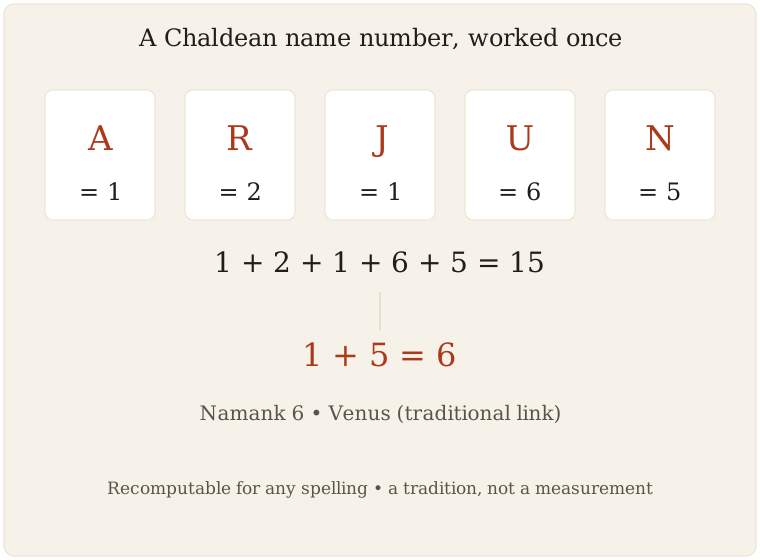
Astroly's worked example uses ARJUN. A is 1, R is 2, J is 1, U is 6 and N is 5. The total is 15. Reduce the digits: 1 + 5 = 6. The Namank is 6, traditionally linked to Venus, with themes of charm, care and harmony. The arithmetic is genuinely this simple, which is worth stating plainly: no app, consultant or paid reading is required to compute any name number. You can do every example in this article on paper in a minute.
Which spelling counts?
Here the practitioner sources already diverge, politely. Astro Baby Name says to use the spelling that will be written on documents, since Aarav and Arav give different numbers. Astroly and Mahadasha both steer the other way, toward the spelling the person actually uses day to day: Astroly says to type the name as it appears in your signature or professional life, and Mahadasha's calculator notes that the authoritative spelling is the one the person actually writes. For many people those are the same spelling, which hides the disagreement. When they differ, the tradition has no umpire; it is a hint that the system's answer depends on a choice the system itself cannot make for you.
Chaldean versus Pythagorean: same name, different number
The Western Pythagorean chart simply numbers the alphabet in sequence: A to I take 1 to 9, then the cycle repeats. The Chaldean chart assigns values by sound and skips 9. The two charts routinely produce different numbers for the same name, and both are in active use. Astroly states its method openly for exactly this reason. Mahadasha's calculator scores a name in both systems side by side. If two websites give you different name numbers, the likely explanation is not that one miscalculated; it is that they used different charts. Always ask which chart a reading used before comparing two readings.
The compound-number layer
Traditional Chaldean practice does not stop at the single digit. The chart's publishers describe numbers 10 to 52 as the most actively interpreted compound numbers, each carrying a symbolic story, with the root digit as the "core vibration". A total of 23, for instance, is read as the "Royal Star of the Lion" riding a 5. The compound layer is where readings get their flavour, and also where they become unfalsifiable: a compound meaning and a root meaning can be played against each other until something fits. We list the convention because it exists, and flag the flexibility because it matters.
Do you reduce 11 and 22 in a name total?
The same master-number fork from birth numbers reappears in name numbers, and the sources split the same way. The Chaldean chart site treats 11 and 22 as master numbers that are not reduced further. Other practitioners reduce every total to a single digit, since the graha mapping only covers 1 to 9. As with Bhagyank, a reading that reports 11/2 and one that reports 2 may be agreeing under different rules. The only defence is to state the convention before the interpretation, which this article does by following the reduce-to-one-digit convention and noting the fork.
The nine Namank themes, as tradition lists them
Astroly's public-image list runs: Namank 1 (Sun), leadership and authority, a name that stands out. Namank 2 (Moon), gentleness and diplomacy, a name people trust. Namank 3 (Jupiter), knowledge and respect, a name linked with guidance. Namank 4 (Rahu), originality and hard work, a name linked with unconventional or technical work. Namank 5 (Mercury), communication and business, a name that "travels well". Namank 6 (Venus), charm and creativity, linked with art, love and comfort. Namank 7 (Ketu), depth and expertise, suggesting research and a little mystery. Namank 8 (Saturn), seriousness and power, slow but lasting success. Namank 9 (Mars), courage and energy, leadership in a crisis. Astro Baby Name's parallel table swaps in slightly different themes: beginnings and initiative for 1, curiosity and communication for 5, ambition and endurance for 8. The two lists rhyme without matching, which is typical of the genre and worth noticing before treating any one list as definitive.
Hindi names and the transliteration problem
The Chaldean chart only reads English letters, so a Hindi name must first be transliterated, and Hindi sounds do not map one-to-one onto the Latin alphabet. प्रिया can be Priya or Priya with a doubled vowel elsewhere; a name ending in the soft tush sound can pick up or drop an H between documents, school records and passports. Mahadasha's calculator accepts names in Devanagari and eight other Indic scripts but transliterates them first and concedes the transliteration is a suggestion, not an answer, because the authoritative spelling is the one the person actually writes. This is not a footnote problem. For most Indian names the Namank depends on a romanisation choice that was often made casually by a parent, a school clerk or a passport office, years before anyone thought to count letters.
Namank beside Mulank and Bhagyank
The three numbers are read as a set. The Mulank is said to be your nature, the Bhagyank your life's direction, and the Namank your public face: Astroly describes it as how the world responds to you, how people see, remember and react to you. Its planet table matches the birth numbers exactly: 1 Sun, 2 Moon, 3 Jupiter, 4 Rahu, 5 Mercury, 6 Venus, 7 Ketu, 8 Saturn, 9 Mars. Tradition then compares the three: a Namank "friendly" to the Mulank and Bhagyank is read as supportive, a clashing one as friction. The comparison logic inherits every caveat of the numbers it compares, plus one of its own: the Namank can be recomputed for any spelling you like until it agrees with whatever you wanted it to say.
Name correction, stated carefully
Name correction means adjusting the spelling in use, adding or doubling a letter, so the total harmonises with the birth numbers. It is widely practised in India, especially for business names and public careers. The better sources are notably restrained about it. Astroly says plainly that no spelling change can guarantee results, advises never changing a legal name on official documents only for numerology, and notes that many people simply use an adjusted spelling socially. Contrast that with the louder end of the market, where a news-portal astro column quotes a numerologist saying a wrong name should be changed to improve fortune and that celebrities have succeeded by doing so. One of these is a tradition describing itself; the other is a service describing its product. If a reading ends in a paid name correction, the commercial reading of that moment deserves at least as much attention as the numerological one.
The Western extras and their own instability
Western-style calculators add more layers: the Expression number from the full birth name, a Soul Urge from its vowels and a Personality number from its consonants. Mahadasha's documentation exposes a quiet convention problem inside even these: whether Y counts as a vowel changes the Soul Urge and Personality results, so the calculator offers three Y modes. A system in which one letter's classification moves two of the three headline numbers is not measuring anything stable. Karmic-debt numbers (13, 14, 16, 19) appear in the same tooling, again as tradition. None of this is hidden by practitioners; it simply rarely reaches the marketing page.
Why a name reading feels personal
The Skeptic's Dictionary's numerology entry was written about precisely this product: the advertisement it dissects promises that from your name and birth date a numerologist can describe you "sight unseen", for nine dollars. The entry explains why it works psychologically. The descriptions are broad, so most people can find themselves in them; readers forget the misses and remember the hits; and being told you have unrealised strengths is flattering enough to feel like insight. It also points out the structural problem names add on top of birth dates: different languages have different alphabets, so the same person, transliterated two ways, has two different "true" numbers, and the system offers no way to say which is correct. Astro Baby Name's own advice to use the official spelling, and Astroly's to use the one you sign with, are practitioner answers to a hole in the method itself.
What testing has found
No one has run a controlled trial of name numbers specifically; there is nothing surprising in that, since even the tradition's defenders describe it as a reflective tool rather than a measurement. The closest direct evidence concerns the neighbouring claim. When Jeremy Genovese computed birth numbers for 806 Nobel laureates in 2017, their distribution matched chance exactly, across the board and across prize categories. If birth dates carry no detectable signal about the most accomplished lives we can measure, a claim that the letters of a name carry one needs stronger evidence than testimonials, and none has been published. Enjoy the chart as culture and wordplay; do not hand it decisions.
Guardrails for name numbers
Compute them yourself; the chart fits on an index card. Use one stated convention and say which. Treat every trait list as tradition. Never change legal documents, sign contracts, pick a baby's name under pressure, or pay a fee because a total came out "wrong". If a spelling change is purely social and costs nothing, it is as harmless as a lucky pen; the moment it costs money, documents or self-respect, the transaction has stopped being numerology.
Where this leaves a family choosing a name
The honest summary for anyone shortlisting baby names is short. If your family enjoys the tradition, compute the Namank of each shortlisted spelling with the Chaldean chart, compare it with the child's Mulank and Bhagyank if those matter to you, and let it be one voice in a warm conversation. Choose the name you will love saying for decades, on documents and across playgrounds, and let the number follow the name rather than the other way round. A name's real work is done by the people who answer to it and the people who use it kindly; no chart in this tradition has ever been shown to add to or subtract from that.
Sources consulted
- Chaldean letter values and compound-number meanings
- Astro Baby Name: how to find a Namank
- Astroly: name number calculator and name-correction caveats
- Mahadasha: Chaldean and Pythagorean name scoring documentation
- The Skeptic's Dictionary: numerology
- Genovese 2017: birth numbers of Nobel laureates match chance (PDF)


