Namkaran Muhurat: Timing, Names and Safety
A naming ceremony welcomes a child. Understand the traditions, keep birth and ceremony timings separate, and put mother and baby first.
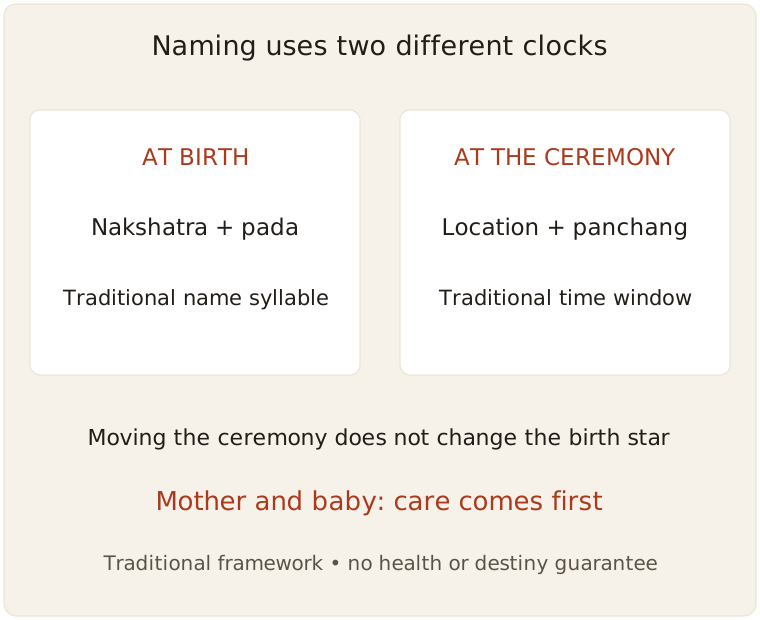
A welcome, not a deadline to fear
Namkaran, or namakarana, is the naming ceremony through which a family welcomes a child and announces a name. It is one of the samskaras described in Hindu ritual traditions, but its timing and form are not identical in every text or household. Some families hold a small ceremony soon after birth; others wait until the mother and baby are ready. A muhurat is a traditionally preferred window for the ceremony, not a medical deadline, a guarantee of a child's future, or a reason to rush recovery. The best practical plan begins with the needs of the people taking part.
This guide explains how traditional timing is selected, why sources differ, how a birth-nakshatra syllable differs from a ceremony date, and what to check before inviting anyone. It does not supply a universal calendar of dates. A real window depends on the intended location, the family's tradition, and the calendar calculations for that place. Nothing here requires a paid consultation, a product, or a particular expense.
The tenth, eleventh, and twelfth days: preserve the differences
The translated Manusmriti verse 2.30 on Wisdom Library names the tenth or twelfth day. Its accompanying commentary and comparative notes expose a wider discussion rather than one uncontested rule. The same page quotes Yajnavalkya for the eleventh day and other authorities for different times. These are historical textual positions, not instructions to rank families or children. Their variety is itself a warning against claiming that every Hindu household must observe exactly the same day.
ePandit's account of Muhurta Chintamani places the rite on the eleventh or twelfth day, allowing a later suitable day when needed. The Kanchi Kamakoti Peetham's Essence of Dharma Sindhu likewise discusses the eleventh or twelfth, while noting a view permitting the tenth. Do not silently translate the tenth into the eleventh to make the sources agree. Ask which convention your family actually follows, including whether the day of birth is counted as day one. Health and recovery still take precedence over any preferred count.
A birth-day count is not a tithi
Two different clocks appear in these discussions. The eleventh day after birth is a count of days. Ekadashi is the eleventh tithi of a lunar fortnight. They need not fall together. The Medhatithi commentary translated on Wisdom Library explicitly discusses counting from birth rather than treating the number as a lunar date, although the page's notes also record interpretive disagreement. A family can therefore say it follows the twelfth-day naming custom without meaning that the ceremony must occur on Dwadashi.
When discussing a booking, record the intended civil date and local time rather than only saying the twelfth day. For a birth close to midnight, a hospital date, an elapsed twenty-four-hour count, and a sunrise-based ritual convention can produce different expectations. That is not a reason to invent a rule. Establish the convention before counting, and ask the family or chosen officiant to confirm the date in plain language. Do not make guests infer it from a Sanskrit label.
What a location-specific muhurat checks
A panchang describes tithi, weekday, nakshatra, yoga, and karana, with transitions at particular times. A muhurat method applies additional rules for a particular activity. The PujaDeep explanation says its windows use the local sunrise-to-sunrise day and split intervals at relevant calendar transitions. This is why a list titled auspicious dates is not necessarily a list of all-day permissions. A morning interval can end when a tithi or another condition changes.
The ceremony city matters because local sunrise and civil time matter. A window printed for another city should not be copied just because both places use Indian Standard Time. For a family abroad, record the local time zone and whether daylight-saving time is relevant. If relatives join remotely, their joining time is a conversion from the ceremony's time, not a second astrological window. This article offers a selection process, not an unverified personal recommendation.
The preferred weekdays and lunar conditions
ePandit's account favours Monday, Wednesday, Thursday, and Friday, attributing the weekday rule to Dharma Sindhu. Its Muhurta Chintamani summary leaves aside rikta tithis, numbered 4, 9, and 14, and particular parva tithis. The PujaDeep summary of MC 5.11 also describes exclusions involving rikta and parva. These are traditional filters attached to a named source. They are not findings that a baby named on another weekday will suffer.
Do not combine every exclusion from every source into a supposedly definitive master list. The Kamakoti summary gives its own later-time restrictions, including tithis that another short guide may not list. It also distinguishes the main prescribed time from a later substitute time. A good explanation names the tradition, tells the reader which phase of the rule is being applied, and acknowledges what was not checked. More exclusions do not automatically mean a more accurate or more caring ceremony.
Nakshatra lists are useful only with their context
ePandit lists Mrigashira, Revati, Chitra, Anuradha, the three Uttaras, Rohini, Hasta, Ashwini, Pushya, Abhijit, Swati, Punarvasu, Shravana, Dhanishtha, and Shatabhisha in its naming account. PujaDeep describes classes of nakshatras, including mridu, dhruva, kshipra or laghu, and chara, rather than presenting the identical spelling list. Kamakoti's summary is similar in broad outline but not identical in presentation. Retain these differences instead of pretending every list is a direct quotation of one verse.
A guide should not make the reader memorise a list to avoid fear. The practical task is to confirm that the chosen interval meets the particular method being followed. If a calculator includes Abhijit or uses a different grouping convention, ask how that is handled. The label favourable belongs to the ritual system. It does not certify safety, immunity from illness, or a child's future temperament.
Morning preference and a flexible actual schedule
ePandit quotes a Dharma Sindhu rule avoiding the afternoon and night for naming. PujaDeep's commentary summary calls the forenoon best, midday middling, and leaves out the afternoon and night. These statements support a traditional preference for an earlier part of the day; they do not justify claiming that every newborn is calmest at the same hour. Feeding, sleep, recovery, medical appointments, and the baby's actual condition should determine what the family can manage.
Separate the short naming act from the social gathering. A family might keep the spoken blessing within a preferred interval and arrange food or remote greetings at another time. Tell guests which part is timed and which is flexible. Do not promise a minute-by-minute performance that requires waking a distressed baby or interrupting necessary care. If a delay makes the traditional interval impractical, use the family's accepted later option rather than creating a crisis.
Birth nakshatra and ceremony nakshatra are different questions
The birth-nakshatra syllable is drawn from the Moon's position at birth. The ceremony's nakshatra describes the Moon at the time selected for the rite. Moving the ceremony to a later date does not change the child's birth nakshatra. Confusing the two can lead a family to select a new name letter every time it considers a new date, even though it meant to follow a birth-based naming custom.
In the North Indian practice described by ePandit, each nakshatra has four padas with associated syllables. Its Ashwini example is chu, che, cho, la, written चू, चे, चो, ला. That is an example of one naming convention, not a requirement for every child. A personal calculation needs an accurate birth date, time, and place. If the recorded time is uncertain near a boundary, preserve that uncertainty rather than choosing a syllable with false confidence.
A ritual name and an everyday name can coexist
The Kamakoti account distinguishes devotional, month-related, nakshatra-related, and everyday names. It also records disagreement about whether the nakshatra form is required, noting a view that it is optional. ePandit describes families retaining a rashi name for ritual use and a different everyday name. The sources themselves therefore leave more room than a sales message insisting on one compulsory spelling might suggest.
Parents can consider meaning, pronunciation in their languages, spelling on documents, family associations, and whether they will enjoy using the name. These are practical editorial suggestions, not rules from a ritual text. Numerology is a separate system and need not be added as another test. A name does not need repeated paid corrections to make a child worthy of good care. If parents disagree, settle the name privately before a public announcement rather than using the ceremony to force a choice.
Keep the ceremony outline simple and clearly attributed
ePandit describes remembrance of Ganesha, parents holding the baby, speaking the name softly, and blessings. In some homes the name is written on rice. The Kamakoti account also describes announcing the everyday name and writing it on rice in a plate, within a fuller ritual sequence. These are descriptions, not a universal instruction manual. Your household may use another sequence, language, deity, or form of blessing.
Agree beforehand on who will speak, whether an officiant is wanted, what can be shortened, and whether any flame is involved. Keep loose grains, small ornaments, coins, and other ritual materials out of the baby's reach and mouth. A symbolic plate can remain on a separate table. There is no need to reproduce every object mentioned in a historical description. A short welcoming act can preserve its meaning without becoming an exhausting production.
Newborn care outranks the timetable
WHO's newborn-care guidance advises keeping mother and baby together, feeding on demand, washing hands before handling the baby, keeping the baby warm, and knowing where to seek care. It lists poor feeding, fast breathing, and high temperature as examples of danger signs. A naming ceremony must not become a reason to delay help. This article cannot assess an individual baby's symptoms or replace the care plan given by their clinician.
ePandit's own safety section says the doctor's advice comes first and that the muhurat can move. Plan a small gathering, allow a private feeding and rest space, and make it easy for the mother to step away. These arrangements are practical suggestions, not a diagnosis or a promise of infection prevention. Ask visitors to respect the parents' boundaries rather than treating access to the baby as an entitlement.
No honey or ceremonial feeding for the newborn
CDC says honey before twelve months can cause infant botulism and should not be added to a baby's food, water, formula, or pacifier. A tiny ceremonial quantity is still honey. Do not put honey in the newborn's mouth as part of naming. ePandit's naming guide likewise warns against putting unapproved substances in the baby's mouth and keeping rings and coins away from it.
The Kamakoti chapter contains descriptions of other rites and historical feeding practices in addition to naming. Their presence in a religious source does not make them current medical advice. Do not lift a neighbouring ritual's ingredient list into a newborn ceremony. Keep naming distinct from later feeding rites, follow current professional feeding guidance, and ask the baby's clinician about any uncertainty. Faith and affection do not require oral exposure to ritual substances.
Smoke, travel, and the right to postpone
ePandit advises keeping a baby away from havan smoke in an airy room. A practical plan can put the baby and mother in a separate comfortable space and use a brief blessing rather than bringing them beside a fire. Do not describe incense, herbs, or ritual smoke as harmless merely because they are traditional. If the home cannot accommodate a comfortable arrangement, simplify the event.
Travel is another choice rather than an obligation created by a chart. Ask the parents what is manageable, especially after discharge or a difficult recovery. A later home ceremony or a small remote gathering may be a better fit than a long trip. Postponement does not make the child's name unlucky or the parents negligent. No source consulted establishes that a missed window damages a child's health or destiny.
A practical planning sheet
Write down the family's tradition, whether it wants an early day-count ceremony or a later suitable day, the intended city, the acceptable date range, and any care-related limits. If asking someone to calculate a window, request its start and end in local civil time, the source or method used, and the relevant transitions. Then check the parents' agreement, the name spelling, the short ceremony outline, and the guest plan.
Keep birth details private. A public invitation normally needs the child's announced name, venue, and joining instructions, not a full birth record or chart. Confirm before sharing photographs or the baby's personal information. Set a modest budget only if spending is wanted, and distinguish optional decoration from anything claimed necessary. A useful plan is one the parents can change without guilt when the baby needs something else.
What this ceremony can reasonably offer
Namkaran can offer belonging, memory, prayer, and a shared commitment to care for a child. Those meanings do not depend on claiming that a selected minute has proven power over future achievement, illness, or happiness. The ritual sources consulted describe traditions; they do not supply controlled evidence for such predictions. A family can honour the tradition while being honest about this limit. Choose a clear name, a comfortable gathering, and a plan that protects recovery. The welcome is for the child, not the other way around.
Sources consulted
- Manusmriti 2.30: translation, commentary, and differing day counts
- Kanchi Kamakoti Peetham: Essence of Dharma Sindhu, naming section
- ePandit: naming timing, syllables, and safety
- PujaDeep: city-based windows and cited Muhurta Chintamani rules
- WHO: caring for a newborn
- CDC: no honey before twelve months


