Navamsa Chart Basics: D9 Calculation and Limits
A traceable D9 calculation, not a marriage verdict. Learn the mapping before interpreting the diagram.
Navamsa, usually labeled D9, is a derived chart made by dividing each zodiacal sign into nine parts. It is not another photograph of the sky, a second birth, or a secret marriage certificate. A planet keeps its natal astronomical position; an assignment rule maps that position to a sign in the divisional chart. Once that distinction is clear, D9 becomes a calculation that can be checked rather than an unexplained diagram that must be trusted. Its traditional interpretations are another layer, and they do not have scientific validation as predictions.
This introduction uses the common Parashara-style mapping, declares that choice, works through movable, fixed and dual signs, and explains boundaries, padas and vargottama. We consulted a displayed verse with translation as well as modern explanations. That is not a claim to have critically edited the entire classical text. Where sources offer different mappings or disagree in emphasis, the difference remains visible. The point is to learn exactly what a calculation says before asking what a practitioner believes it means.
What is divided, and what D9 records
The Navamsa encyclopedia entry defines navamsa as one ninth of a zodiacal sign. Thirty degrees divided by nine is three degrees twenty arcminutes. Each full zodiac therefore contains one hundred and eight such divisions. The D1 or rashi chart records the original sign placements; D9 records the sign assignments obtained from the chosen navamsa rule. Both charts should have clear labels. A D9 sign is not a correction that erases the D1 sign.
An arcminute is a unit of angle, not a minute on a clock. Three degrees twenty minutes of longitude is not a birth-time interval of three hours twenty minutes. The same notation can be confusing because both use minutes. For hand calculation, convert the angle to arcminutes: three degrees is one hundred and eighty arcminutes; another twenty gives two hundred. Each thirty-degree sign contains eighteen hundred arcminutes, which divides into nine equal two-hundred-arcminute sections.
The planet and the ascendant can each be mapped. This does not make the ascendant a physical planet or imply that all factors move at the same speed. The natal longitude supplies the input; the D9 method supplies the output label. Keep the source coordinate, the within-sign degree, the selected method and the resulting sign in separate fields. A lone final sign without its inputs is much harder to audit.
The rule we actually consulted
Siva.sh's display of Brihat Parashara Hora Shastra, chapter six, verse twelve gives Sanskrit and an English translation. The translation states that movable signs begin from themselves, fixed signs from the ninth from themselves, and dual signs from the fifth. We consulted that displayed verse, not an entire manuscript tradition. Modern explanations at Jyotishya and ePandit describe the same three-case rule and provide examples.
Counting from a sign is inclusive. The sign itself is first, not zero. Thus the ninth from Taurus is Capricorn, and the fifth from Gemini is Libra. Once the starting sign has been found, the nine navamsa sections receive successive zodiacal signs in forward order. Confusing an inclusive starting-sign count with a computer's zero-based index moves the answer. It is useful to keep ordinary section numbers one through nine and programming indices zero through eight explicitly separate.
Movable, fixed and dual: three starts, one declared method
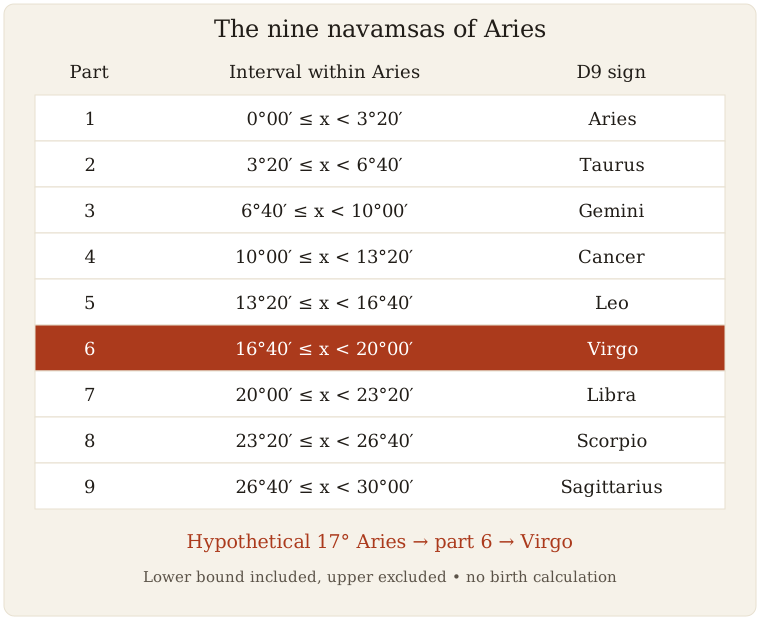
The movable signs are Aries, Cancer, Libra and Capricorn. Their first navamsa starts from the natal sign itself. Aries therefore maps its nine successive parts to Aries, Taurus, Gemini, Cancer, Leo, Virgo, Libra, Scorpio and Sagittarius. Libra starts from Libra instead. The rule does not say every movable sign starts from Aries. It says each starts from itself. That small phrase is the difference between a correct table and a memorized but misapplied shortcut.
The fixed signs are Taurus, Leo, Scorpio and Aquarius. Their starting signs are the ninth from each: Capricorn for Taurus, Aries for Leo, Cancer for Scorpio and Libra for Aquarius. The dual signs are Gemini, Virgo, Sagittarius and Pisces. Their starts are the fifth from each: Libra, Capricorn, Aries and Cancer respectively. All subsequent parts proceed forward in the common method used here. These named starts let you check a calculator's sign result without needing to interpret a life event.
The element shortcut is equivalent for this mapping: fire signs begin their navamsas from Aries, earth signs from Capricorn, air signs from Libra and water signs from Cancer. Jyotishya and ePandit give this formulation. It is a convenience, not a different calculation. Declare the mapping before using the shortcut, because the encyclopedia entry also lists Krishna Mishra and Somanatha approaches, including backward sequences for some groups. Different method names must not be silently combined into one universal table.
The nine exact angular intervals
Within a sign, the section boundaries are zero, three degrees twenty minutes, six degrees forty minutes, ten degrees, thirteen degrees twenty minutes, sixteen degrees forty minutes, twenty degrees, twenty-three degrees twenty minutes, twenty-six degrees forty minutes, and thirty degrees. There are ten boundary marks around nine intervals. Printing nine marks and treating them as nine complete parts would lose an edge. The diagram prints both endpoints of every interval and numbers all nine parts separately.
We use intervals that include the lower boundary and exclude the upper one. An exact three degrees twenty minutes begins part two; it does not remain in part one. Thirty degrees is the beginning of the next natal sign, not an extra endpoint assigned twice. This convention is also explained by Jyotishya's rounded-down part formula. Near a boundary, avoid deciding from a rounded display if the unrounded position can be obtained. A label rounded to the nearest minute can conceal which side the actual value lies on.
Worked example one: seventeen degrees Aries
Take a hypothetical point at seventeen degrees Aries. It is not a real person's birth position. Seventeen degrees equals one thousand and twenty arcminutes. Divide by two hundred: five complete parts have elapsed, with twenty arcminutes remaining. In ordinary counting this is part six. Aries is movable, so its sequence starts from Aries. Part six maps to Virgo. ePandit uses the same seventeen-degree Aries example, and the answer follows directly from the declared rule.
Our diagram highlights the interval sixteen degrees forty minutes to twenty degrees, the sixth section, and names Virgo below it. The point at seventeen degrees belongs inside that interval, not at its center by necessity. A schematic highlight does not claim an exact plotted planet. To keep the figure readable, a table separates the part number, exact interval and resulting sign. The caption supplies the interpretation of the highlighted part.
Worked examples two and three: Taurus and Gemini
Now take a hypothetical point at seventeen degrees Taurus. Its within-sign part is still six, because the same degree lies in the same angular interval. But Taurus is fixed, so the sequence starts from Capricorn. Counting Capricorn, Aquarius, Pisces, Aries, Taurus, Gemini gives Gemini for part six. A common mistake is to reuse Virgo from the Aries example simply because the degree is unchanged. The natal sign matters as well as the within-sign degree.
For a dual-sign example, use a hypothetical point at eleven degrees Gemini. Eleven degrees is six hundred and sixty arcminutes, giving three complete parts and a remainder of sixty. It is part four. Gemini starts from Libra, the fifth counted inclusively from Gemini. Libra, Scorpio, Sagittarius, Capricorn gives Capricorn for part four. These examples use simple classroom positions. No birth date, time or planetary identity has been invented to make them appear like an observed horoscope.
A second arithmetic check, with limits
The modern explanations give an equivalent way to obtain the sign in this common D9 mapping: multiply the full zodiacal longitude by nine, wrap it into a three-hundred-and-sixty-degree circle, and read the resulting sign. For seventeen degrees Aries, nine times seventeen is one hundred and fifty-three degrees, which lies in Virgo. Seventeen degrees Taurus is forty-seven degrees from Aries; nine times forty-seven is four hundred and twenty-three, wrapping to sixty-three, in Gemini.
Eleven degrees Gemini is seventy-one degrees from Aries. Nine times seventy-one is six hundred and thirty-nine; subtracting one full circle gives two hundred and seventy-nine, in Capricorn. This independent calculation agrees with the three-case method. It is useful as a check for the specified D9 rule. Do not assume that multiplying by any divisional number automatically reproduces every other varga's classical mapping. Our next article treats divisional charts more broadly; this introduction proves no such universal shortcut.
Nakshatra padas: equal angular size, different labels
The Hindu astrology source describes the common twenty-seven-nakshatra system, each nakshatra thirteen degrees twenty minutes and each of its four padas three degrees twenty minutes. The one hundred and eight padas therefore align with one hundred and eight navamsa-sized sections. Jyotishya explains the corresponding cyclic D9 sign assignments. A pada number alone is not enough to identify the D9 sign without knowing which nakshatra it belongs to.
Do not call a D9 sign a new physical constellation occupied by the planet. The division is derived from the natal longitude. Nor should a natal nakshatra label be moved from a D1 panel into a D9 panel without checking what the software means by its columns. A mathematical correspondence between sections is not permission to erase the difference between original coordinates and derived labels. The notation should help the reader trace that relationship, not hide it.
Vargottama: matching signs, not guaranteed outcomes
When a factor has the same sign in D1 and D9, the modern sources call it vargottama. In the common mapping, the relevant part is the first for a movable sign, the fifth for a fixed sign, and the ninth for a dual sign. That is a definition plus an arithmetic pattern. It does not mean the D1 and D9 degrees must be identical, or that every life topic becomes favorable.
The sources differ in interpretive emphasis. Jyotishya explicitly defines the term without drawing a meaning from it. ePandit reports a traditional favorable reading but says the factor decides nothing alone. The encyclopedia entry makes stronger statements and adds qualifications about unfavorable placements. We preserve the difference: the shared sign relationship can be checked, while the proposed benefits are traditional claims, not experimentally established outcomes. A beginner should not turn a label into a promise of wealth, marriage or moral worth.
Birth-time sensitivity is not a fixed stopwatch
ePandit gives roughly thirteen minutes as an average scale for an ascendant navamsa change and notes that signs rise at different rates and that less time can matter near a boundary. Jyotishya's example gives a different local rate for its particular demonstration. These are not contradictory universal clocks because neither should be used as a fixed duration for all places and moments. The actual ascendant's rate and distance from a boundary determine the relevant uncertainty.
Keep uncertainty in the original record. If a birth time is remembered approximately, do not repair it by selecting whichever D9 picture gives the most reassuring relationship description. Check the possible interval under declared settings and identify which factors remain stable. Even stability of a derived sign is not evidence of predictive validity. It simply means the stated input range did not cross that calculation's boundary. Precision and truth of a life claim remain different questions.
How to compare two D9 outputs
First compare original birth date, time and place, then zodiac reference and ayanamsa, then the navamsa method. For nodes, record the mean or true-node convention if relevant. Jyotishya discusses these as possible reasons programs differ. We do not reuse its numerical tolerances as universal guarantees. If the source longitude differs, recomputing the same mapping can still yield a different sign near a division boundary. Compare the input before blaming the final diagram.
Then compare signs, not paper positions. North and South Indian layouts arrange the same information differently. Label D1 and D9 clearly and preserve the ascendant of each. A changed D9 house origin is not a new natal longitude. A useful worksheet records factor, original sign and degree, section number, starting sign, D9 sign, method and uncertainty. This is our editorial checking sheet, not a claimed classical prediction sequence.
Traditional use, consent and the evidence boundary
ePandit describes D9's traditional association with partnership, dharma and planetary strength and insists it be read alongside D1 rather than alone. The encyclopedia lists further interpretive rules and other mappings. Those are descriptions of practice. None authorizes judging a partner's honesty, predicting divorce, or telling somebody that a diagram determines their worth. Relationships require consent, conversation and knowledge of the actual people, not a verdict from one divisional placement.
Berkeley's Understanding Science explains that careful tests of specific astrological expectations did not support their validity and that vague expectations can fit many results. The ability to reproduce a D9 mapping does not establish its psychological or predictive claims. Learn the calculation as part of cultural literacy if it interests you. Keep medical care, financial evidence and real relationship information separate from symbolic interpretation. The best beginner outcome is a traceable chart with honest limits, not a more elaborate reason to feel trapped.
Questions on this article
What does D9 divide?
Each thirty-degree sign into nine equal 3°20′ parts, assigned signs by a declared mapping. It is derived from natal longitude, not a second physical sky.
Where does the common sequence begin?
Movable signs from themselves, fixed from the ninth, dual from the fifth, counting inclusively. This article uses the common Parashara method.
What is vargottama?
The same sign in D1 and D9. The label is checkable; promised life benefits are traditional interpretations, not scientifically established outcomes.
Can D9 alone determine marriage?
No. Even the consulted practitioner source reads it with D1. No divisional placement establishes a partner’s worth or a relationship outcome.


