The ninth house: dharma, guru, fortune
A guide to the ninth house as the traditional symbol of direction, guidance and right action.
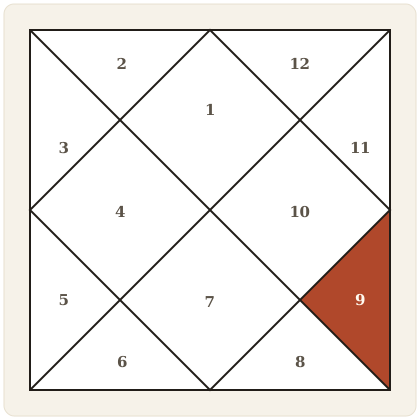
The ninth house of the chart is called Dharma Bhava, the "righteousness house" - and many treatises count it the single most auspicious house of the whole chart, because from here flows the stream of grace that is considered to make all the other houses work. Its subjects are: dharma - the right action a soul is here to perform - father, guru, higher learning and philosophy, long journeys and pilgrimage, religious practice, and bhagya, the fortune that arrives unearned through ancestral and karmic merit. Its body region is the hips and thighs. The ninth is a trikona, and the ninth lord is counted a natural benefic for every ascendant. This article explains what the ninth house covers, how it is read, and what the balanced meaning of "fortune" is - not a licence for fate, but a compass for direction.
Fortune and dharma: the house's two pillars
The two great names of the ninth house are fortune and dharma, and the formula joining them is the tradition's deepest lesson. "Bhagya" here does not mean a lottery - in the tradition fortune is that invisible help which sometimes arrives without accounting: the right advice at the right time, a door opening unasked, old goodness returning. And "dharma" does not mean ritual but right action - carrying out one's duty in one's circumstance. The relation of the two is that the tradition counts fortune as the fruit of dharma: a stream of ease has been seen joining the life of one who keeps doing right action. That is exactly why the treatises place this house so high - and exactly why no reading of this house can be a licence for lazy fate-belief.
The father theme: the traditions' open disagreement
A principal subject of the ninth house is the father, and here the tradition itself holds differing views - we present them all as they stand. The chief karaka for the father is the Sun. In Varahamihira's Brihat Jataka line, the Sun signifies the father for day births and Saturn for night births; and some fixed-karaka schemes name Saturn as Pitrkaraka, joining father, lineage and ancestors. So the answer to "who is the father's karaka" arrives only after choosing a tradition, and our method is the same as in the other articles: where the traditions split, we present all of them rather than impose one verdict. The limit of interpretation is the same sensitive rule as with the mother theme: these are tendency-indications, not a verdict on anyone's father's life or relationship. The bond with a father is built by lived conduct, and the address for his health is a doctor - not a chart.
The guru and guidance
The central subject of the ninth house is the guru - the guide who shows the road. The karaka planet is also Guru (Jupiter) itself, the significator of dharma, wisdom and the guru-principle. The tradition discusses from this house the fortune of finding a guru and receiving guidance. In modern life the shapes of "guru" have changed - teacher, mentor, senior adviser, sometimes a book or a moment - but the formula is the same: a person's direction is often made from a light given by someone else. This house's practical lesson: receiving guidance is also an art - asking, listening, and acting on advice. And keep the tradition's balance in mind too: honouring a guru and blind imitation are two different things - true guidance teaches you to think for yourself, never to stop thinking.
Higher learning and philosophy
The ninth house is the house of higher learning and philosophy. Keep the sequence in mind: foundational education from the fourth house, intelligence and creativity from the fifth, and higher knowledge - university study, research, law, philosophy, spiritual study - is seen from the ninth house. The tradition discusses ease in higher education and the fortune of deep study under a strong ninth. In modern reach this house joins everyone who keeps learning beyond degrees - researchers, students, policy makers, and every person who descends into the "why" of their field. This is tendency-thinking: the real road of higher education is built by entrance examinations, fees and practice; the ninth house only tells which way the thirst for learning tilts.
Long journeys and pilgrimage
Short journeys are seen from the third house; the long road, travel to far countries and pilgrimage belong to the ninth. The logic is elegant: the third house is the neighbourhood's, the ninth is the beyond-the-horizon's - the journey that changes the way one sees. In the tradition pilgrimage is counted not merely as travel but as an instrument of rising fortune - new places, new traditions and the sight of things larger than oneself pull a person beyond his limits. In modern form this subject extends to foreign travel, migration for higher education and cultural experiences. Here too the boundary is the same: decisions of travel are made by time, money and circumstance - the ninth house only tells how awake the inner traveller is.
Religious practice: a private road
Among the ninth house's subjects is religious practice too - worship, vows, pilgrimage-service, and that daily practice which joins someone to something larger than themselves. Our stance on this subject is one of restraint: the method of practice belongs to each family and each tradition, and this article's work is not to rank one method above another. In the tradition's view the ninth house only sees which way a person's leaning of faith tilts. In the modern context its most useful meaning comes out this way: human beings need meaning - in some form the experience of "I am part of something larger". Whether that experience arrives through worship, through service or through nature - the ninth house's lesson is to recognise that need, not to suppress it.
Trikona strength and the Dharma Karmadhipati yoga
The ninth house is a trikona - with the first and fifth, among the chart's most auspicious zones - which is why the ninth lord is counted functionally benefic for every ascendant, even when the planet is otherwise cruel by nature. From this comes a famous combination: when the lords of the ninth and tenth houses join - by conjunction, mutual aspect or exchange of signs - the Dharma Karmadhipati yoga forms, counted in the tradition among the strongest combinations. Its meaning is beautiful too: the union of dharma (the ninth) and karma (the tenth) - when right action and the field of work catch one direction. And then the same rule as in every yoga: a yoga is a capacity, not a guarantee; the tradition itself says a yoga ripens in its dasha, and the ripened fruit is picked only by effort.
Where the ninth lord sits
In traditional shorthand: the ninth lord in the ninth itself speaks of the fortune and dharma themes standing firm; in the tenth, of higher learning or dharma becoming the career field - the very direction of the Dharma Karmadhipati; in the fourth, of ancestral comfort and a fortune joined to home life; and in the third, of fortune-making through courage and writing. The lord's dignity - own sign, exaltation, a friend's sign - strengthens or weakens these leanings, and at the end the condition of the karaka Jupiter (and the Sun on the father theme) is weighed alongside. All of these are symbolic readings: conclusions about anyone's fortune, father or journeys come not from them but from the facts of a life.
Planets in the ninth house
In traditional shorthand: Jupiter in the ninth house is counted very favourable, with talk of learning, guidance and the dharma inclination. The Sun here speaks of a deep bond with the father and a life run by principles; Venus of interest in the philosophy of art and beautiful journeys; the Moon of love of pilgrimage and emotional faith; Mercury of analysis in philosophy and learning. Mars in the ninth is discussed as the courage to stand for principles; Saturn as learning that ripens late and either deep respect or deep questioning of tradition - either one of the two. Rahu speaks of a tilt toward unconventional philosophies or foreign learning, Ketu of spiritual intuition and old practice. All of these are tendency-indicators; the sign, the aspects and the lord's condition keep reshaping the final picture.
The question of time: when it activates
The ninth house's themes - opportunities of higher education, meeting a guide, long journeys, experiences like a rising of fortune - are seen coming forward when the mahadasha or antardasha of the ninth lord or of the karaka Jupiter runs. Jupiter's mahadasha lasts sixteen years and the Sun's six. The value of this discussion lies in understanding a leaning - not in fixing the date of an opportunity. Admission, travel or mentorship - the real time-setters of these are preparation, circumstance and people; the chart is a weather-indicator, not a timetable.
Common misconceptions
First: "a strong ninth house means fate will shine." Fortune in the tradition is the fruit of dharma - there is no evidence of fate shining without right action. Second: "a weak ninth house means an unlucky life." Never - the house, its lord and the karaka are tendency-indications, and effort is placed above fortune in the tradition. Third: "the ninth house is only about worship." This house also covers higher education, guidance, journeys and the father - religion is one subject, not the whole house. Fourth: "draw conclusions about the father from planetary positions." Never - a relationship is built by conduct, health is looked after by doctors, and the tradition itself holds differing views on the father's karaka.
The ninth house in our times
In modern life the ninth house's subjects are in the fastest change. Higher learning is no longer bound to campuses - online degrees, foreign universities, lifelong learning; experience-journeys in place of pilgrimage; mentors and coaches in place of the guru; and "the search for meaning" is this generation's most open question. Through all of it the tradition's lesson stays the same: direction comes from a compass, not from speed. The person who recognises their dharma - their right action - finds the meaning of the word fortune changed: then fortune is no longer the name of receiving something, but of becoming something. The modern essence of knowing the ninth house is this: recognise in which direction your "higher" lies - in which learning, which guidance, which journey - and keep taking a regular step that way.
A reading exercise: keep symbol and evidence apart
Take a hypothetical chart with Sagittarius in the ninth house, so the ninth lord is Jupiter. Suppose Jupiter sits in the ninth itself. The student first reads the framework: the house (the ninth, dharma and higher learning), the lord (Jupiter, in the ninth itself), the karaka (Jupiter again). The traditional reading: the learning and guidance theme standing firm. Now the second step - this is a tendency-statement, not proof of anyone's future or character. That person may be a professor; may work in a factory and teach the village children; the "guru-principle" may show the same in both, or not at all. The real information will come from their life. Record what matches, record what does not, and never invent an interpretation to force a match. This exercise keeps the study honest.
At a glance: the ninth house's subjects
| Aspect | Traditional subject |
|---|---|
| Names | Dharma Bhava, Bhagya Bhava |
| Main subjects | Dharma and right action, father, guru, higher learning, long journeys and pilgrimage, religious practice, fortune |
| Body region | Hips, thighs |
| Karakas | Jupiter (dharma, wisdom, the guru-principle); the Sun for the father - with Saturn for night births or in fixed-karaka schemes in some traditions |
| Classification | Trikona (1, 5, 9) - the most auspicious zone; the ninth lord is functionally benefic for every ascendant |
| Special combination | Dharma Karmadhipati yoga - when the ninth and tenth lords join |
| Related houses | Foundational education - the 4th; intelligence - the 5th; career - the 10th; short journeys - the 3rd |
An honest note
Astrology is a traditional system, not laboratory science. Take decisions about education, career, travel or family with qualified specialists and your own judgement; treat the chart as context, never the only basis. For any worry tied to a father or family, the first address is conversation and proper care. Sources actually consulted for this article: the ninth house's significations, Jupiter's karaka role, the traditions' disagreement on the father's karaka, the trikona classification and the Dharma Karmadhipati yoga from satyori.com/jyotish/articles/twelve-houses-overview/; planetary karaka confirmations from satyori.com/reference/grahas/; and the Vimshottari dasha years from panchangtime.com/methodology/vimshottari-dasha. Our aim is to explain the tradition in plain words, not to sell fear or make promises.
Questions on this article
What does the ninth house signify?
The tradition places dharma, father, guru, higher learning, long journeys and pilgrimage, religious practice and fortune here. These are symbolic meanings, not evidence about any person.
Which planet is the karaka for the father?
The traditions disagree: the chief karaka is the Sun; in Varahamihira's line the Sun for day births and Saturn for night births; some fixed-karaka schemes name Saturn as Pitrkaraka. This article presents all views and declares none final.
Does a strong ninth house guarantee fortune?
No. In the tradition fortune is counted as the fruit of dharma - right action - and effort is placed above fortune. The house, its lord and the karaka give tendency-indications, never a guarantee.
What is the Dharma Karmadhipati yoga?
When the lords of the ninth (dharma) and tenth (karma) houses join by conjunction, aspect or exchange, this famous combination forms - the union of right action and the field of work. It is a yoga of capacity; the tradition itself says it ripens in its dasha, never as a guarantee.


